
How Massachusetts' 15 kW Export Limit Affects Solar and Storage Design
Struggling with grid export limits for your factory's solar project? You want to maximize your investment, but utility rules feel like a roadblock, threatening your project's financial return and resilience goals.
The 15kW export limit in Massachusetts means your solar and battery system design must prioritize on-site energy consumption. You cannot send more than 15 kilowatts back to the grid at any time, so the system's size and controls must be carefully matched to your facility's actual electricity usage.
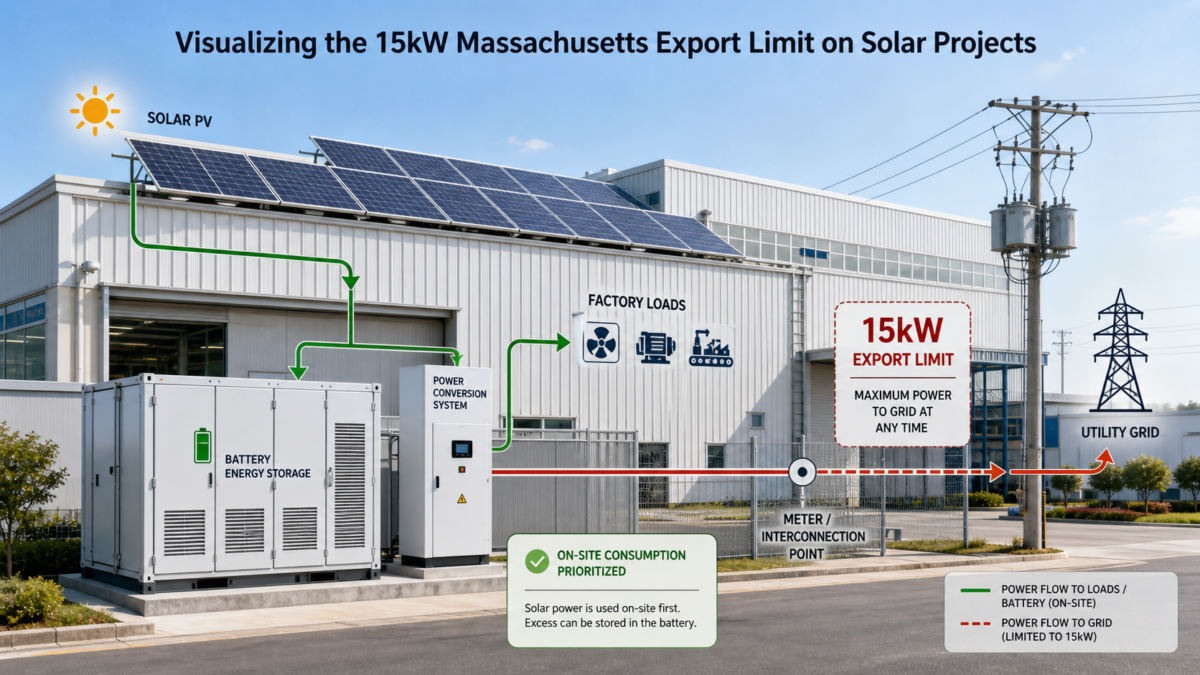 " alt="Engineers reviewing site data and energy storage project documents" title="Visualizing the 15kW Massachusetts Export Limit on Solar Projects" decoding="async" loading="lazy" />
This export limit is a common hurdle, not just in Massachusetts but in many places where utilities are protecting their local grid infrastructure. We’ve seen many projects get complicated because of this. But a constraint like this isn't an end point. It's a starting point. It forces us to think more critically about what we are really trying to achieve. Instead of just putting panels on a roof, we have to design a complete energy system. Let's break down what this really means for your factory.
What Buyers Often Misunderstand About Export Limits and Transformer Capacity
You think a big battery will solve your export limit problem and give you backup power. But you later discover your transformer can't handle the load, or the battery can't run your critical machines.
The biggest misunderstanding is that self-consumption, grid capacity relief, and outage resilience are the same thing. They are separate value streams. A system designed for one may not be able to deliver the others, especially if the site transformer is the real bottleneck, not the export limit.
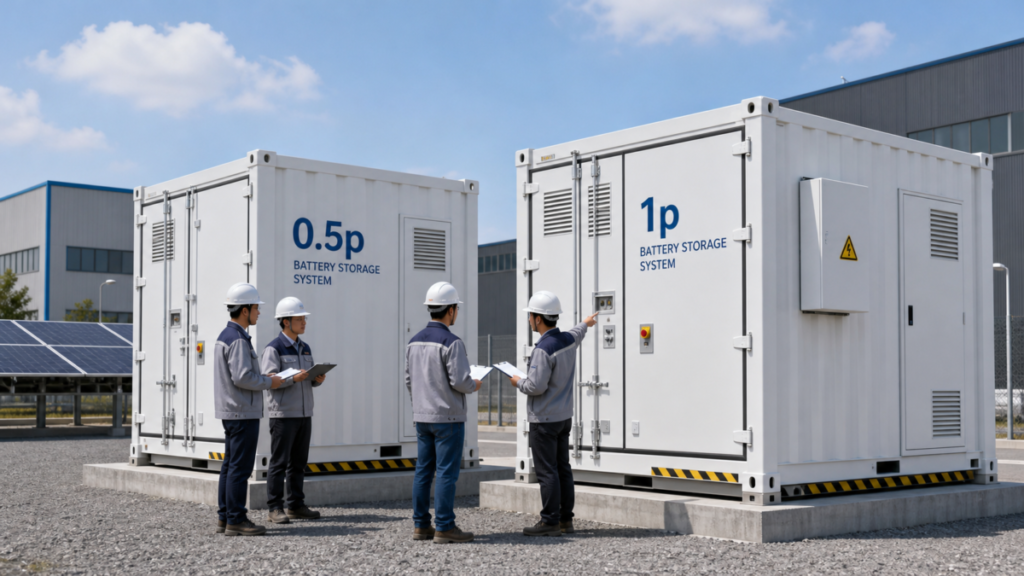
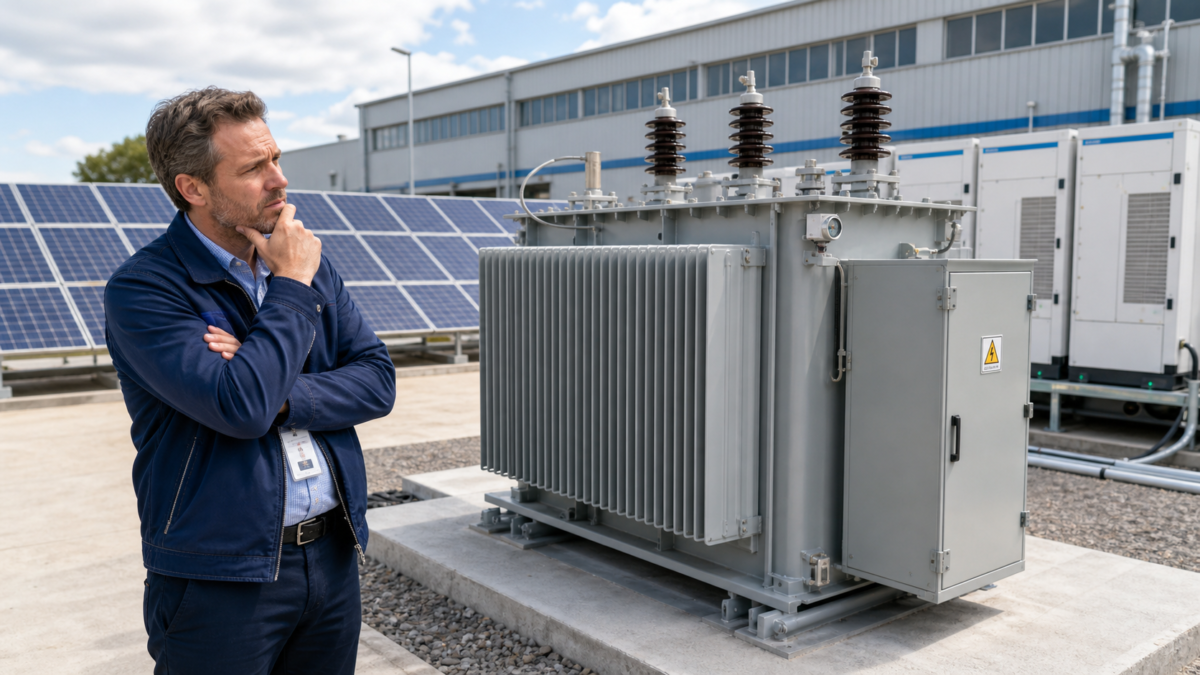 " alt="Representative commercial and industrial energy storage cabinet family" title="Understanding the Role of Transformers in Solar Export" decoding="async" loading="lazy" />
We see this all the time. A client focuses only on the utility export limit. They forget to check the capacity of their own transformer. The transformer is the gateway for all power entering and leaving your facility. If it's already close to its maximum rating, you have very little "headroom" to play with. This is a critical technical constraint that has to be addressed before any product is selected. It's a classic case of confusing different project goals. A system designed to absorb excess solar power for self-consumption is not automatically a backup power system. They require different engineering. We find it helpful to separate these ideas into a table to make it clear.
The Three Value Streams
| Value Stream | Common Expectation | Technical Reality |
|---|---|---|
| Self-Consumption | Store all unused solar power and use it later to reduce your bill. | This requires a battery and an Energy Management System (EMS) to manage charging and discharging based on your load profile. The battery size depends on solar overproduction, not your peak load. |
| Capacity Relief | Use the battery to avoid upgrading our transformer. | This requires the battery to discharge during peak facility load times. This function must be prioritized by the EMS, and the battery must be powerful enough to handle the peak. |
| Resilience (Backup) | The battery will run our whole factory during a grid outage. | This requires an "islanding" switch and a battery powerful enough to start your largest motors from a dead stop. This start-up load is often much higher than your normal running load. |
You cannot assume these are all included. Each one needs to be designed and verified. This is why we always start with the site's single-line diagram and a clear list of what the buyer actually needs to achieve.
Size the System Around Export Limits and Outage Consequences
You want a system that gives you energy independence during an outage. But sizing it based on your average usage could lead to a system that fails to start up when you need it most.
Sizing must account for the worst-case scenario: starting your critical equipment from a complete stop during an outage. This "restart load" can be many times higher than your normal operating load. An export limit only affects grid-tied operation; outage performance depends on inverter power and battery discharge capability.
 " alt="Engineers reviewing site data and energy storage project documents" title="Sizing a Battery System Around Export Limits and Load" decoding="async" loading="lazy" />
A motor's running load does not reveal the inverter power needed to restart it during an outage. A 40 kW pump, for example, can present a much larger momentary inrush. Record the actual restart sequence and startup current for each critical load, then size the inverter, transfer equipment and control logic around that evidence rather than the utility bill alone.
The Failure Mode Hidden at the Islanding Boundary
You've invested in a solar and battery system for resilience. The grid goes down, and you expect things to keep running, but instead, everything stays dark. The system failed to "island" correctly.
The hidden failure mode is often at the islanding boundary—the point where your facility disconnects from the grid. If this boundary isn't designed to handle the massive inrush current of your equipment starting up, the entire system can collapse before it even gets going.
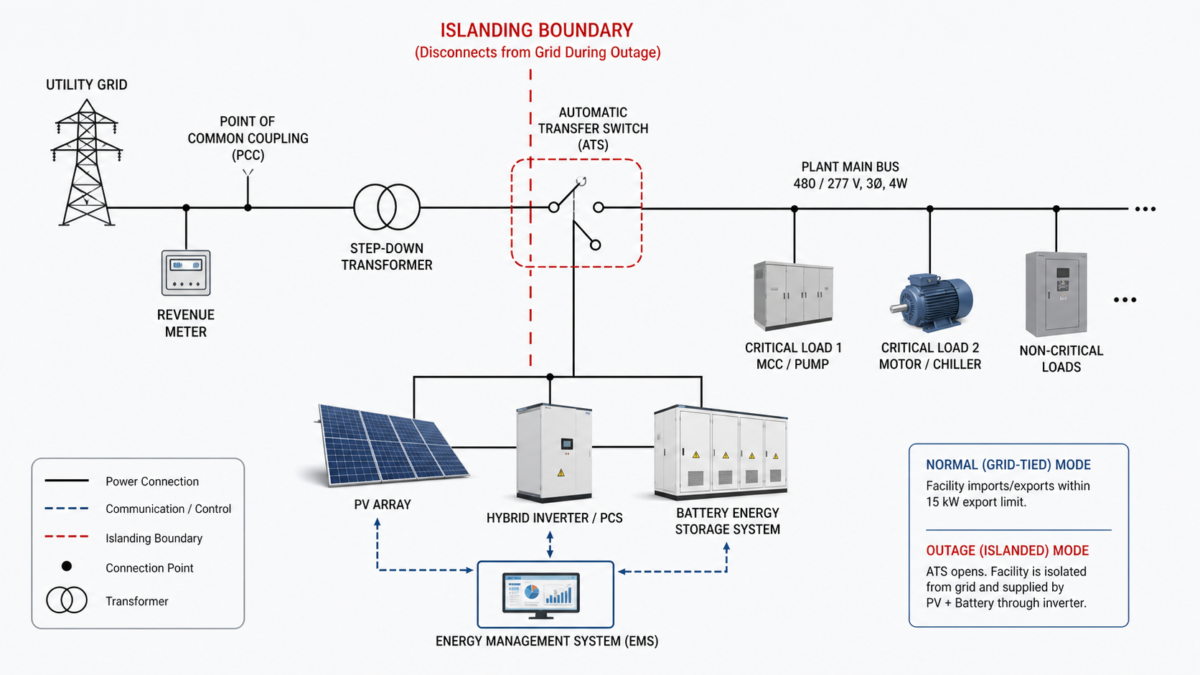 " alt="Engineers reviewing site data and energy storage project documents" title="Identifying the Critical Islanding Boundary in Microgrid Design" decoding="async" loading="lazy" />
When your site is grid-connected, the utility is a relatively stiff source. Once islanded, the battery inverter and transfer equipment must support the voltage, frequency and motor-starting duty. We therefore treat the islanding boundary as part of the system design, then document the constraints and simulate the transition and restart sequence before commissioning.
Questions to Resolve Before Signing the Contract
You're ready to sign a contract that promises huge savings and backup power. But are you sure the proposal is based on your site's reality, or is it based on optimistic assumptions?
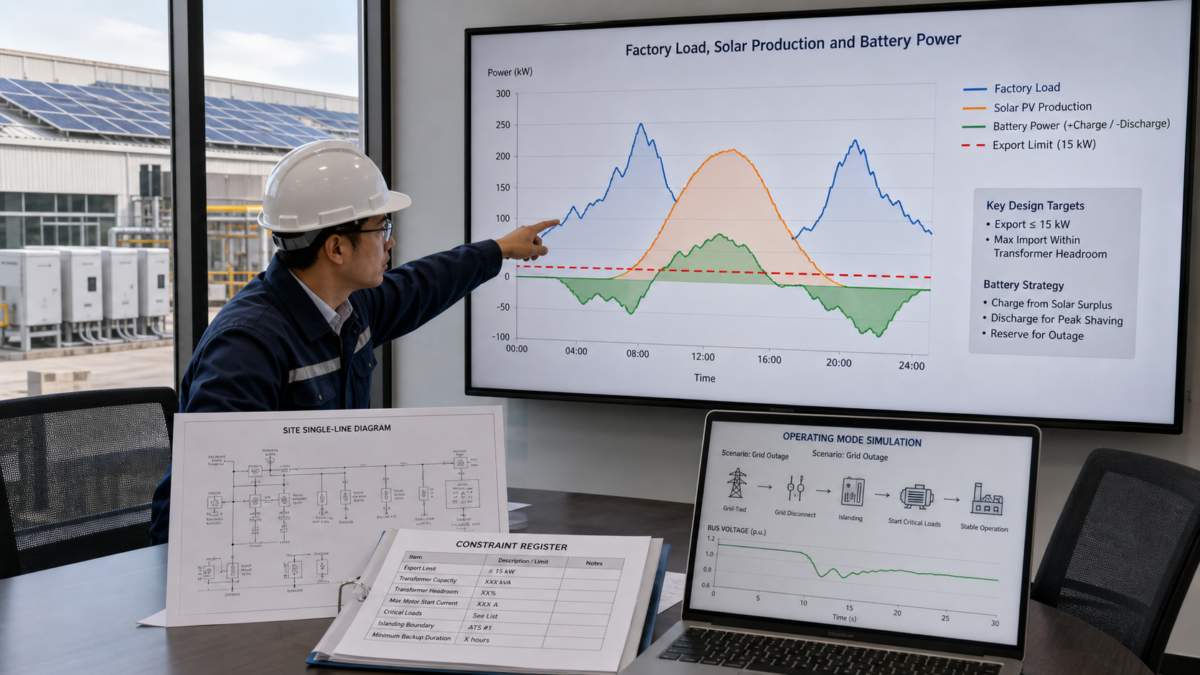
Before signing, you must ask for a site single-line diagram, a constraint register, and an operating-mode simulation. These documents prove the design is based on your specific loads, transformer capacity, and desired outage performance, not just a generic product recommendation.
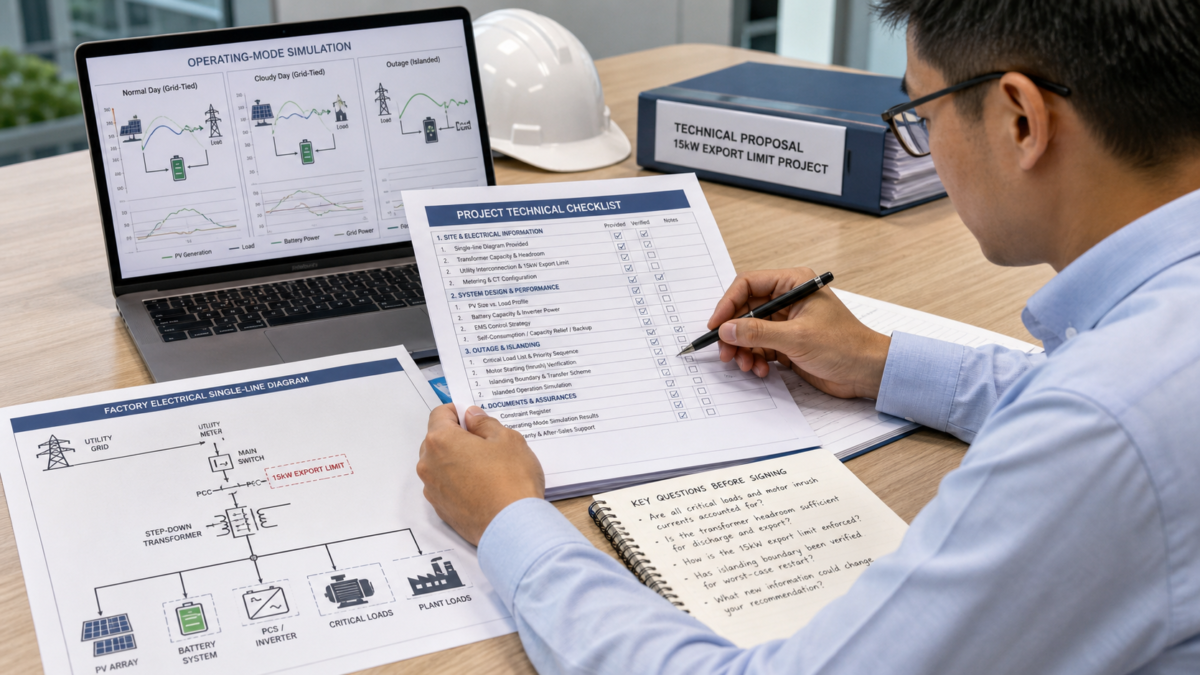 " alt="Engineers reviewing site data and energy storage project documents" title="Essential Technical Questions Before Committing to a Project" decoding="async" loading="lazy" />
We always tell potential clients to pause before signing anything. Don't start with a product. Start with the engineering. A good partner should be able to provide you with clear, site-specific documents. The single-line diagram is the map of your electrical system. The constraint register is the list of rules, including the 15kW export limit, transformer headroom, and maximum motor startup current. The operating-mode simulation is the test drive. It shows how the system will behave during a normal day, a cloudy day, and a grid outage. If a supplier can't give you these things, they may be selling you a product, not a solution. Ask them directly: "What new information could change your recommendation?" A solid technical team will have a clear answer. They might say, "If we discover another large motor we didn't know about, we would need to resize the inverter." This shows they are thinking about the real-world risks. This approach separates genuine technical partners from salespeople. It gives you a clear decision path and protects you from unrealistic expectations.
Conclusion
Export limits are a design starting point, not a barrier. Focus on your facility's real needs—transformer limits, critical loads, and outage operations—to build a system that delivers genuine value and resilience.
Leave a Reply