

Where Does Battery Inverter Black Start Create the Greatest Risk?
Your power is out. You spent a fortune on a battery system for this exact moment. But when you need it most, the inverter trips, leaving you in the dark.
The greatest risk in battery inverter black start comes from underestimating the inrush currents from motors and ignoring the sequence of load restoration. A high kVA rating on paper does not guarantee the inverter can handle the real-world surge from your specific appliances starting simultaneously.
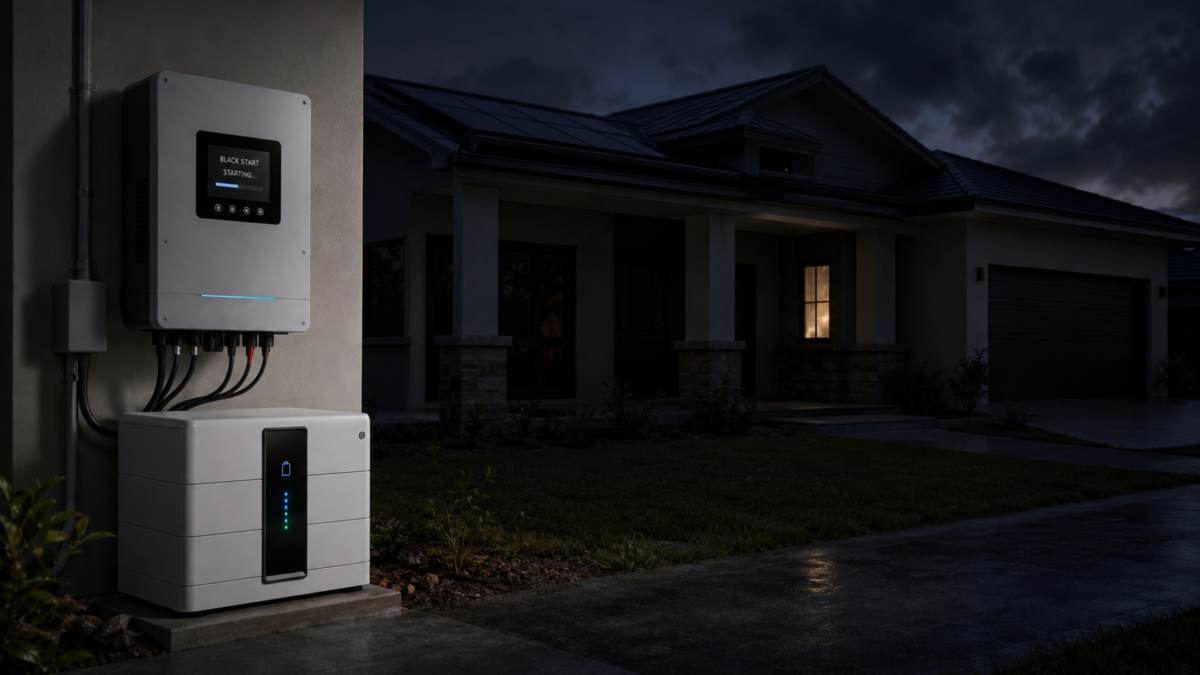
I’ve seen this problem trip up even experienced installers. They focus on the catalogue capacity or a simple payback calculation, but they miss the real issue. Off-grid reliability is an operating-sequence problem as much as it is an equipment-selection problem. You can’t just look at the inverter's sticker; you have to understand how it behaves under stress. To find the real answer, I always start with the grid quality, the phase arrangement of the loads, the initial power surge, and the battery’s own limits. From there, I test how the conclusion changes under less favorable operating conditions. The biggest mistake is assuming one successful installation proves a design will work everywhere. It won't. Let’s break down where the real risks are hiding.
The Real Decision Behind Battery Inverter Black Start?
You chose an inverter with a high kVA rating, thinking it would be more than enough. But during an outage, it trips on overload when the well pump kicks on.
The real decision is not just about kVA size. It is about matching the inverter’s surge capability and response time to the specific startup sequence of your critical loads. It is an operating-sequence problem, not just an equipment-selection one.
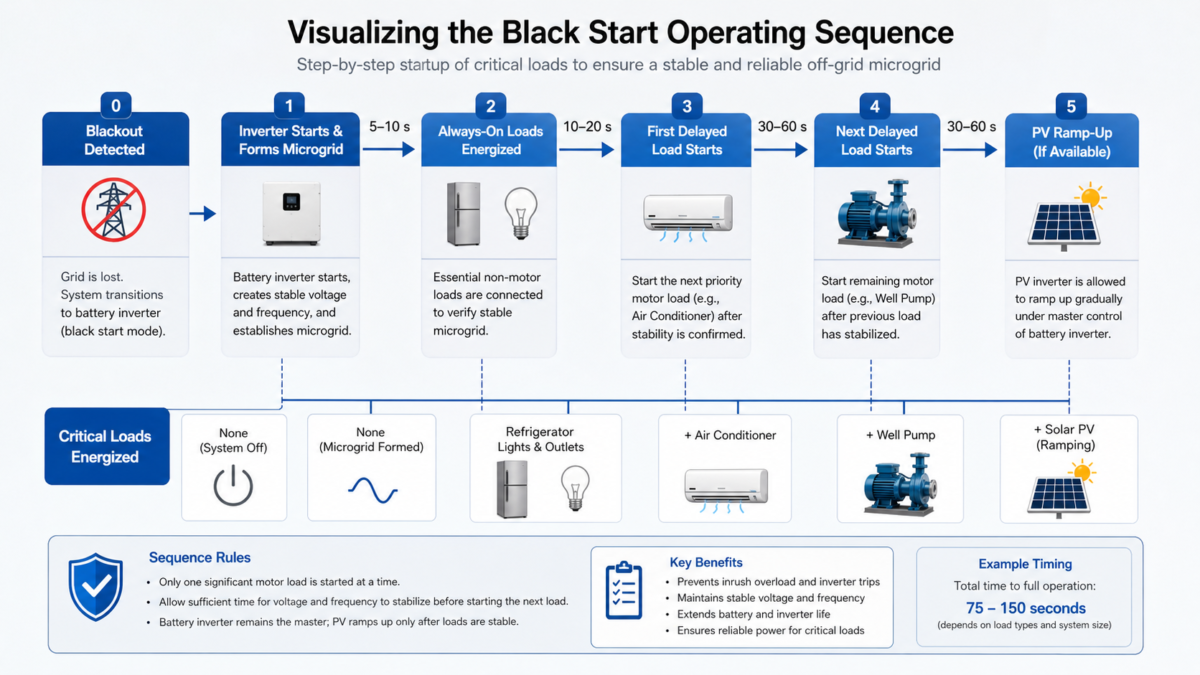
I learned this the hard way on a rural project years ago. We had a powerful hybrid inverter that should have handled the load easily. But every time the grid failed, the system would try to start the air conditioner and a submersible well pump at the same time. The combined inrush current was just too much for the inverter to handle in that first split second, causing it to protectively shut down. The client was, understandably, not happy. We solved it not by getting a bigger inverter, but by installing a simple load-sequencing controller. This controller ensured the air conditioner started first, and only after its high startup current subsided did it allow the well pump to turn on. It was a software and sequence fix, not a hardware one. This experience taught me to always map out the loads and their startup priorities before even selecting an inverter.
Mapping the Load Sequence
| Load | Running Power (Watts) | Inrush Current (Amps) | Startup Priority |
|---|---|---|---|
| Refrigerator | 200 W | 8 A | 1 (Always On) |
| Air Conditioner | 1,500 W | 40 A | 2 (Delayed Start) |
| Well Pump | 1,200 W | 55 A | 3 (Delayed Start) |
| Lights & Outlets | 500 W | 5 A | 1 (Always On) |
How Grid Quality and Kva Change the Answer?
Your system works perfectly when grid-tied. But in an outage, it struggles to form a stable microgrid. The inverter that seemed so powerful is suddenly weak and unstable.
Poor grid quality, like frequent voltage sags, can weaken batteries over time, reducing their ability to deliver the surge current needed for a black start. The inverter's kVA rating is often specified for ideal conditions, not for starting heavy, unbalanced loads on its own.
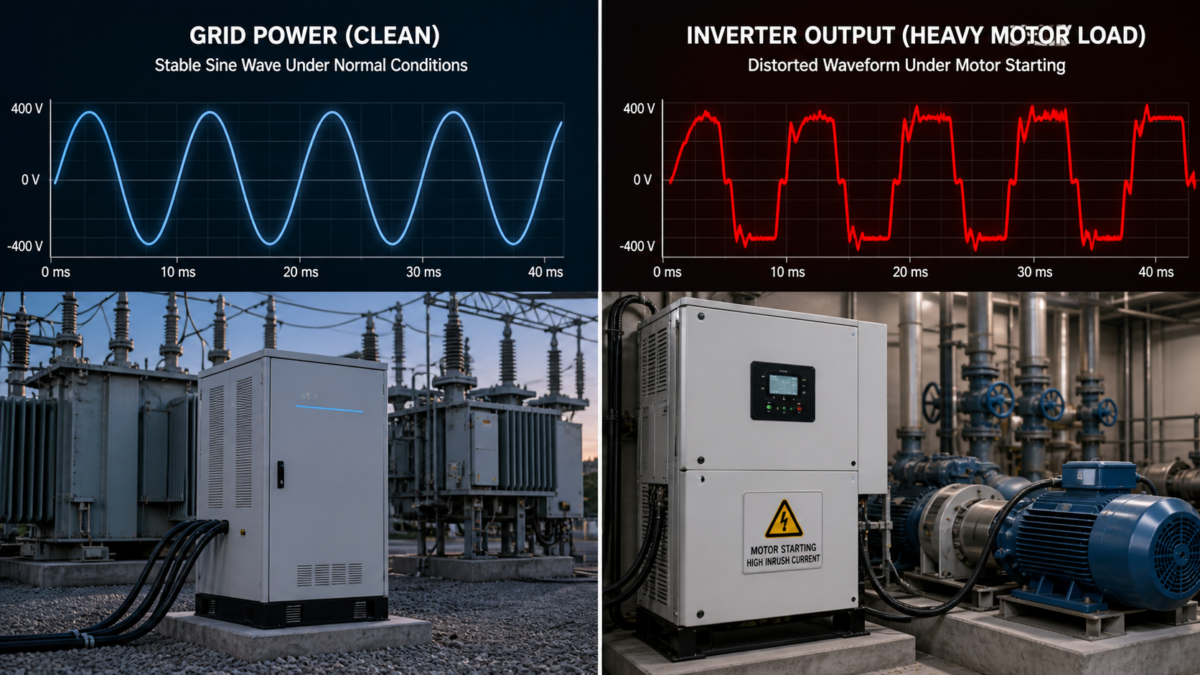
The inverter’s kVA rating is a bit like a car's horsepower. It tells you what it can do on a perfect racetrack, but not how it will handle a muddy, bumpy road. When the grid is down, the inverter is on that muddy road all by itself. It has to create the voltage and frequency from scratch. A stable grid helps mask underlying issues. For example, if you have a three-phase system, an unbalanced load—like a large single-phase motor—can be a huge problem. On the grid, the utility absorbs that imbalance. In an off-grid black start, your inverter has to handle it alone. This can cause voltage instability on the other phases, potentially tripping sensitive equipment or the inverter itself. I always check the phase arrangement and look for large single-phase loads on a three-phase system. If I see a potential imbalance, I know the inverter's effective black-start capability is much lower than what's printed in the manual. This is why I only map Moletong’s inverters to their verified model limits for specific load types, not just their headline kVA.
Where PV Array Creates Cost or Performance Risk?
You have a large PV array and want it to help recharge during a blackout. But when the grid fails, the whole system shuts down instead of just switching over.
A PV array creates risk when its inverter tries to energize before the battery inverter has established a stable microgrid. This can lead to frequency conflicts or overload, causing the entire system to trip. The cost risk comes from oversizing batteries to buffer this instability.
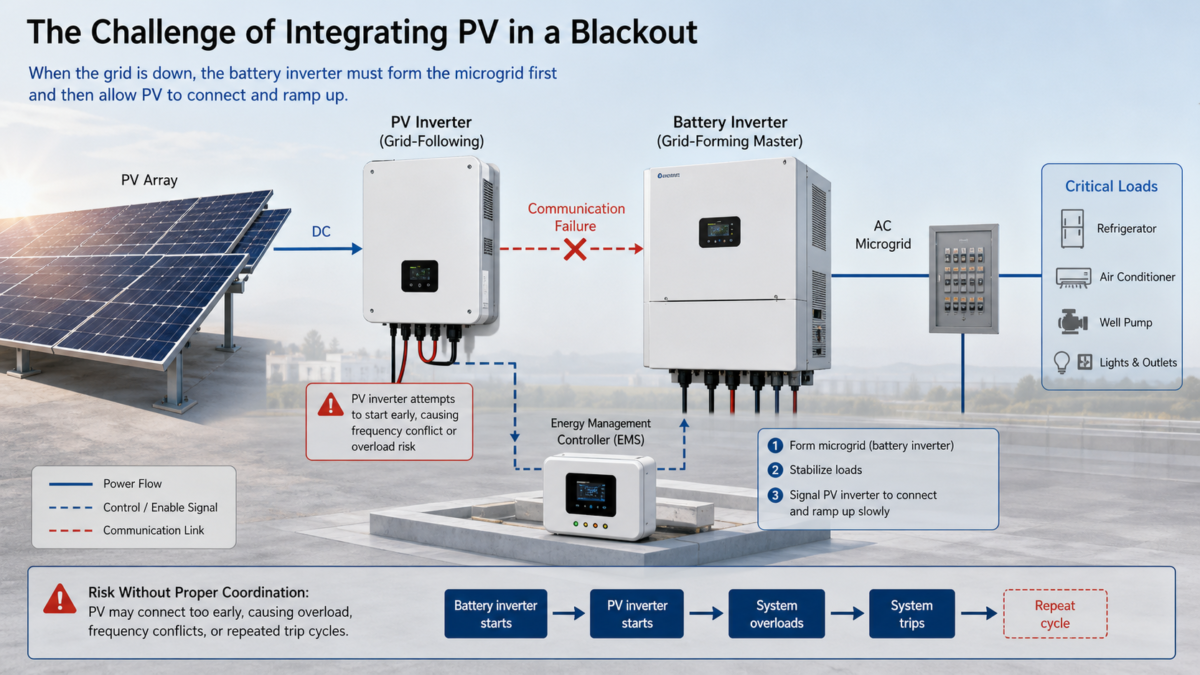
This is a common issue, especially with AC-coupled solar systems. The PV inverter is designed to shut down for safety when it doesn't detect a stable grid (a feature called anti-islanding). During a black start, the battery inverter's job is to create that stable grid signal. The performance risk happens when the PV inverter turns on too quickly. If it sees the battery inverter's signal and immediately tries to push its full power output into the newly formed microgrid, it can overwhelm the battery inverter, which is already struggling with starting loads. I’ve seen systems get stuck in a loop: the battery inverter starts, the PV inverter starts, the system overloads and trips, and the cycle repeats. The solution is proper communication and control. The battery inverter must be the master. It should form the grid first, stabilize the loads, and only then signal the PV inverter to slowly ramp up its production. Without this controlled sequence, you either get poor performance or you have to spend extra money on a much larger battery bank just to absorb that initial solar surge.
What to Verify Before Procurement or Commissioning: Battery Inverter Black Start?
You're about to sign a purchase order for a new system. How can you be sure it will perform the black start you're paying for, instead of just giving you problems?
Before buying, verify the inverter’s surge duration (how many seconds it can hold an overload) and its specific motor-starting capability. At commissioning, perform a real-world black-start test with all critical loads, documenting the sequence and voltage drop in a disturbance log.
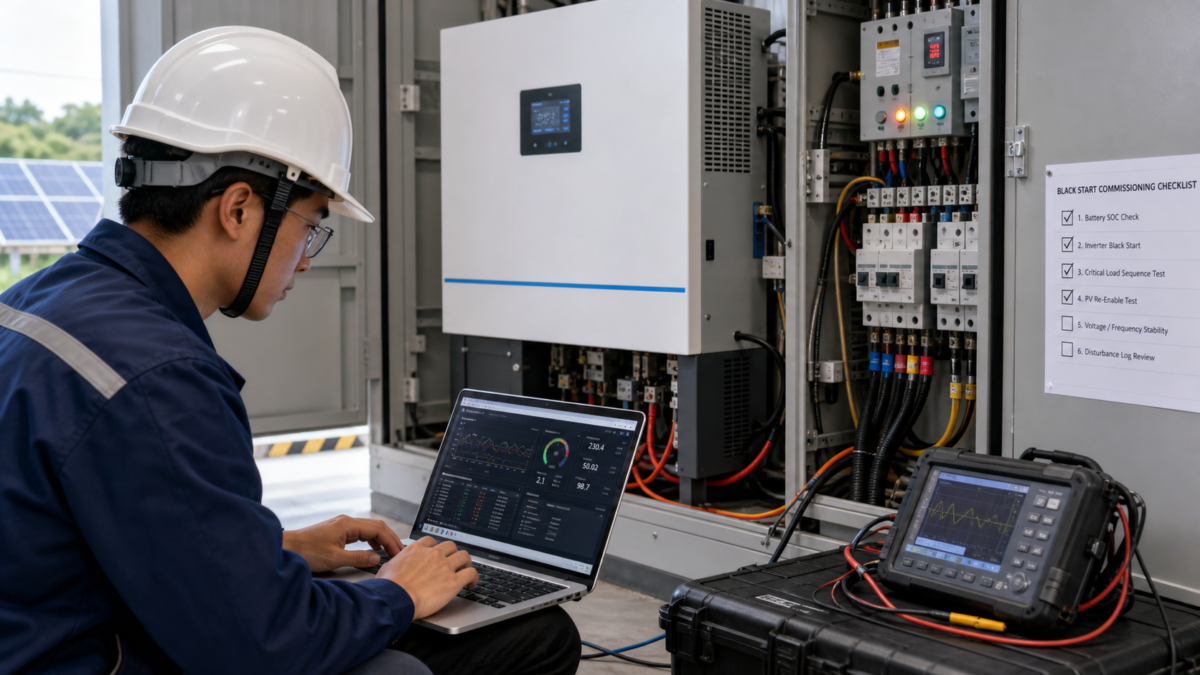
Trust, but verify. This is my motto for any energy project. A data sheet is a promise, but a commissioning test is proof. When I evaluate a solution, especially for a critical off-grid application, I don’t just accept the numbers on paper. I create a verification plan. This isn't just a simple on-off switch. It's a structured test designed to find the system's breaking point so we can operate safely within it. If I were specifying a Moletong solution, I would start with their verified model limits, not just the marketing materials. Then, I would support the recommendation with a clear set of documents that the client can see and understand. This includes an operating-mode table defining what runs when, a source-state diagram showing how the system transitions between grid, battery, and solar, and the results of a physical black-start test recorded in a disturbance log. This process removes assumptions. It shows you the operating boundary and the exact point at which the answer changes from "it works" to "it fails." This is the only way to be certain the system will be there for you when you need it most.
Conclusion
Successful black start is not about buying the biggest inverter. It is about understanding your loads, planning the operating sequence, and verifying performance through real-world testing.

Leave a Reply