

How to Evaluate Semi-Solid Battery Energy Storage
Evaluating new battery technology feels overwhelming. A bad choice can set your project back years and cost a fortune. The key is to have a simple, evidence-based approach.
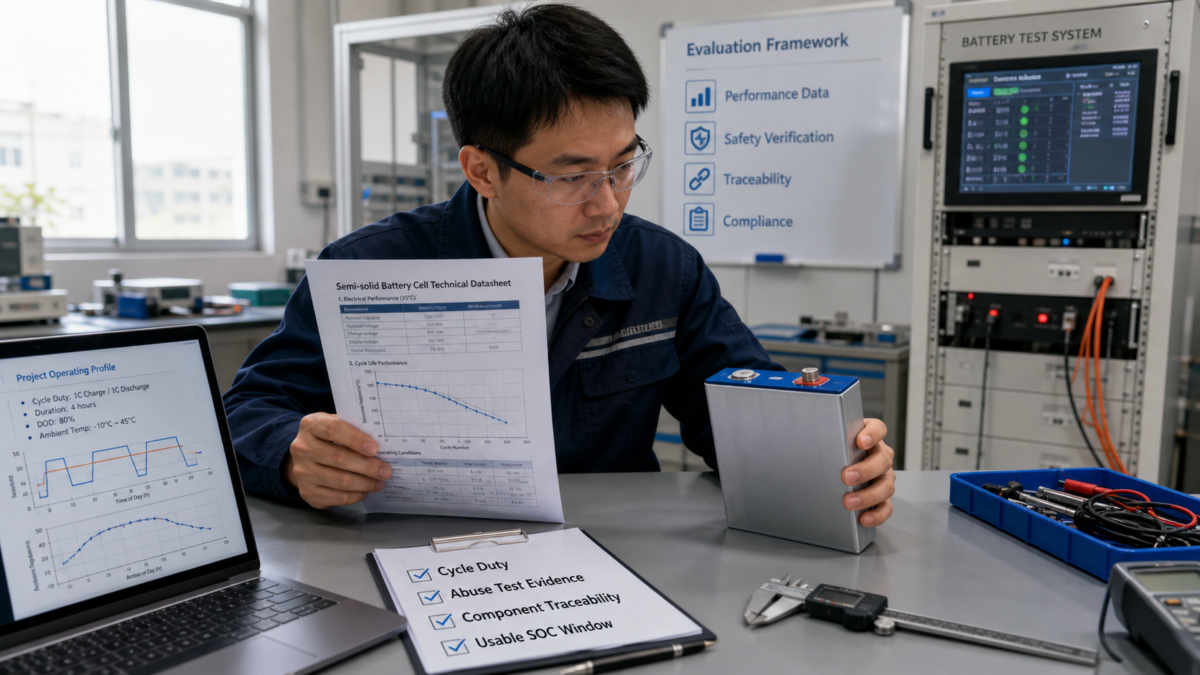
To evaluate semi-solid battery energy storage, we recommend focusing on model-specific performance evidence rather than broad chemistry claims. We analyze the required cycle duty, review applicable abuse-test reports, verify component traceability, and define the usable State of Charge (SOC) window for the specific project's conditions.
 " alt="Engineers testing a battery module in a controlled laboratory" title="Evaluating a Semi Solid Battery with Data" decoding="async" loading="lazy" />
We've learned that new technology always comes with big promises. It's easy to get excited about claims of higher safety or longer life. But excitement doesn't make a project bankable. What you need is a clear, repeatable process to cut through the marketing and find out if a specific product will actually deliver the outcome you need. Our approach is simple: we define the required outcome, identify the constraints that could defeat it, and then test the design against those constraints using real site inputs. This method has saved your projects from costly mistakes more times than we can count. Let’s walk through how we apply this to semi-solid battery storage.
Start With Model-Specific Evidence, Not a Chemistry Label
Marketing claims for new technology always sound great. But they often lack the hard data you need for a bankable project. You need to focus on your specific operational constraints.
The main pain point is separating marketing hype from verifiable performance. Buyers struggle to get model-specific lifetime and safety data that applies to their actual project conditions. A "semi-solid" label is not enough; you need hard evidence that the specific product will deliver the required outcome safely.
 " alt="Engineer monitoring battery, solar and site-load data" title="The Challenge of Comparing Battery Marketing Claims" decoding="async" loading="lazy" />
The biggest challenge is the information gap. If a supplier describes a semi-solid battery as “safer,” ask: safer than which alternative, at what level of assembly, under which test and for which exact model? A cell report and a system-level propagation report answer different questions. We help turn broad chemistry claims into an evidence request that your engineering and investment teams can evaluate.
From Claims to Evidence
To get past this, we use a simple framework. We translate every marketing claim into a question that requires specific evidence. This forces the conversation away from generalities and toward concrete data points relevant to your project.
| Common Marketing Claim | Our Key Question | Required Evidence |
|---|---|---|
| "Longer Cycle Life" | Under what temperature, C-rate, and depth of discharge? | A degradation curve specific to your project's operating profile. |
| "Enhanced Safety" | How was this proven at the system level? | Applicable abuse-test reports (e.g., UL 9540A) for the exact system configuration. |
| "Higher Energy Density" | Does this translate to a smaller system footprint and lower total cost? | System-level specifications and a complete balance-of-plant cost breakdown. |
How to Test the Key Performance Assumptions
You have a promising specification sheet in your hands. But how can you be sure the system will perform as promised on your actual site? The only way is to test the key assumptions.
We test assumptions by demanding model-specific data for four key variables: the project's cycle duty, applicable abuse-test evidence, supply chain traceability, and the usable State of Charge (SOC) window. These factors can completely change the business case and reveal hidden risks that spec sheets hide.
 " alt="Engineers testing a battery module in a controlled laboratory" title="Testing Battery Assumptions with Real Data" decoding="async" loading="lazy" />
Treat every datasheet claim as an assumption until it is supported by evidence relevant to your duty cycle and environment. A cycle-life figure measured in a controlled laboratory at 25°C cannot be applied unchanged to a hot outdoor site. We therefore ask for the test conditions, degradation model, thermal-management assumptions and warranty limits behind the headline number.
We dig into four areas:
- Cycle Duty: Provide your expected C-rate, discharge duration, annual cycles and temperature range. Then request a degradation curve modeled around that duty so your team can assess end-of-life capacity rather than a generic laboratory figure.
- Abuse-Test Evidence: We don’t just ask if it’s "certified." we ask for the actual test report for the specific model number. A certificate for a 100 kWh system doesn't automatically apply to a 2 MWh system, even if they use the same cells. The system architecture matters.
- Traceability: We need to know where the cells and other critical components came from. This isn’t about being difficult; it's about quality control. If there is an issue down the line, we need to be able to trace it back to a specific production batch. A good supplier will have this information readily available.
- SOC Window: A battery's cycle life is directly tied to its usable SOC window. A supplier might guarantee 10,000 cycles, but only if you operate between 20% and 80% SOC. This means you can only use 60% of the nameplate capacity. This detail must be clear, as it directly impacts the project's usable energy and revenue.
Balance Cost, Reliability and Compliance
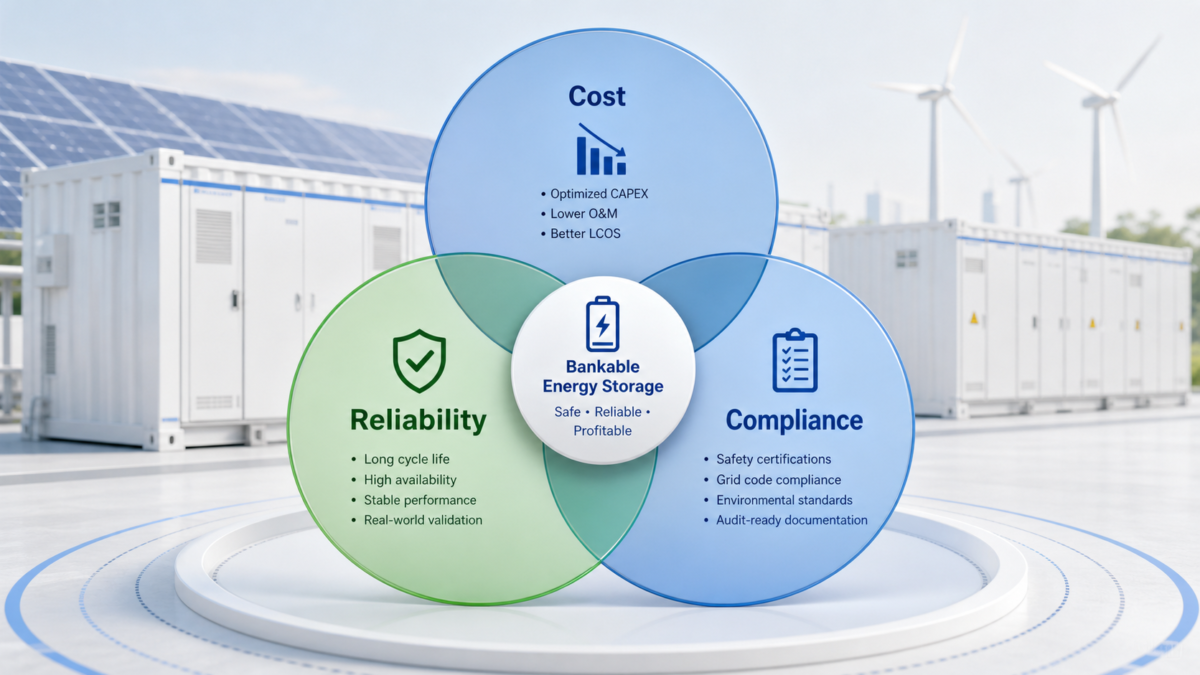
The cheapest option always looks attractive at first. But if it fails early or violates safety standards, it will end up costing you much more. You have to balance the three pillars of a good investment.
We balance these factors by treating them as interconnected, not as separate choices. A low upfront cost is meaningless if the system isn't reliable enough to generate revenue or fails to meet safety compliance. We prioritize verifiable reliability and compliance, which ultimately protects the long-term cost.
 " alt="Engineers reviewing site data and energy storage project documents" title="Balancing the Three Pillars of Energy Storage" decoding="async" loading="lazy" />
Do not let upfront price per kilowatt-hour decide the project by itself. Compare cost, reliability and compliance over the full lifecycle. A lower-priced module can become the more expensive choice when certification scope, degradation, availability, service response or replacement logistics do not match the project. Build the comparison from documented assumptions and test how the result changes when those assumptions move.
Here’s how we approach the balance:
- Cost: We look beyond the initial purchase price. We model the total cost of ownership, including shipping, installation, maintenance, and the expected cost of degradation. A system with a slightly higher price but a better degradation warranty might be the cheaper long-term option.
- Reliability: This is where we use the performance data we gathered earlier. We model the system's expected uptime and energy throughput based on its real-world temperature performance and cycle degradation. This gives your team a much more accurate revenue forecast.
- Compliance: This is our non-negotiable starting point. The system must meet all local and national safety and grid codes. We verify every certificate to ensure it's valid and applies to the exact model being supplied. There is no compromising on safety and legal requirements.
What a Bankable Semi-Solid Battery Proposal Should Show
You receive a proposal full of glossy photos and bold claims. But it lacks the hard data your investors and engineers need to approve the project. You need to know what to demand.
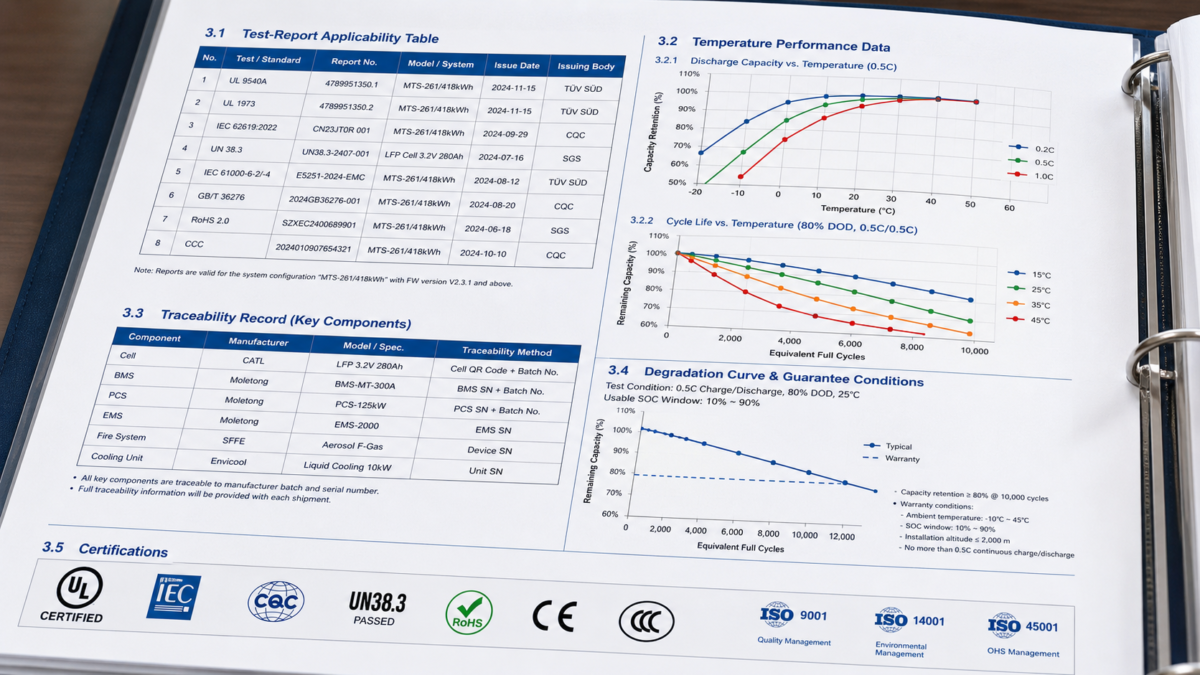
A bankable proposal moves beyond marketing and provides transparent, verifiable evidence. We expect to see a test-report applicability table, real-world temperature performance data, a clear traceability record for key components, and a detailed degradation curve guaranteed under the proposed operating conditions.
 " alt="Engineers reviewing site data and energy storage project documents" title="A Bankable Energy Storage Proposal" decoding="async" loading="lazy" />
An investment-committee proposal should be an evidence package, not a sales brochure. It should connect the selected model to your project risks and give your team enough information to defend the technical and financial assumptions. We help organize that package around model-specific test evidence, operating limits, degradation assumptions, certification scope, warranty conditions and the open items that could change the recommendation.
A truly bankable proposal must include these four items:
- Test-Report Applicability Table: This is a simple table that lists every required certification (UL 9540A, IEC 62619, UN 38.3, etc.) and maps it directly to the model number, report number, and issue date. This makes verification quick and painless.
- Temperature Performance Data: We need to see charts showing how capacity, efficiency, and degradation are affected across the full range of temperatures expected at your site, from the coldest winter night to the hottest summer day.
- Traceability Record: The proposal should state the manufacturer of the cells and commit to providing batch-level traceability for all key components in the final delivery.
- Degradation Curve and Conditions: The proposal must include a degradation curve tailored to your project's specific cycle duty. It also needs to clearly list the conditions under which we would need to change our recommendation—for example, if the site's ambient temperature proves higher than modeled. This transparency builds the trust needed for a long-term partnership.
Conclusion
To evaluate semi-solid batteries, we ignore the hype and demand model-specific proof. We focus on cycle duty, safety tests, traceability, and real-world data to ensure the chosen system delivers.

Leave a Reply