

Which Assumptions Matter Most When Evaluating Peak-Shaving Performance Guarantee?
A peak-shaving guarantee looks great on paper, but hidden assumptions can sink the project. What if the real savings never show up? You need to know which variables truly matter.
The most critical assumptions are future load growth, the system’s real-world efficiency map, battery degradation over time, and total CAPEX/OPEX. These variables can completely change the project's payback and must be tested against a transparent downside case, not just an optimistic base-case projection.

I've seen too many energy storage proposals that look precise but are built on shaky ground. They present a single, attractive payback number that feels certain. But certainty is a luxury we don't have. My approach is different. I believe a transparent downside case is far more useful than a precise-looking base-case payback. It’s about understanding the risks and building a solution that is robust enough to handle them. Let’s walk through the assumptions I focus on because they have the power to reverse an apparently obvious answer and turn a good investment into a bad one.
How do I start with the customer problem, not the product?
You are being sold a state-of-the-art battery system. But will it actually solve your high electricity bill problem? The key is to define your required financial outcome first.
To focus on the problem, first define the specific financial outcome you need, like a target reduction in demand charges. Then, identify the site-specific constraints, such as transformer limits or load patterns, that could prevent this outcome. This approach ensures the solution fits the problem.

My method for evaluating any peak-shaving project is simple. I start by defining what the buyer actually needs to achieve. Is it a 20% reduction in demand charges? Is it avoiding a costly transformer upgrade? This becomes our required outcome. Next, I identify the constraints that could defeat this outcome. This could be anything from unexpected load spikes to changes in utility tariffs. Finally, I test the proposed design using real, granular interval data from the site. I once worked on a project where the proposal was based on summer load data only. Once we audited the full year of data, we found the winter peaks were completely different, which changed the entire economic model. That’s why an interval-data audit is non-negotiable. This process keeps the focus on solving the customer’s problem, not just selling a box.
Key Steps to a Problem-First Approach
This table outlines the practical steps I take to ensure the proposed solution is grounded in reality.
| Step | Action | Why It Matters |
|---|---|---|
| 1. Define Outcome | Clearly state the financial or operational goal (e.g., “Reduce monthly demand charges by $5,000”). | This provides a clear, measurable target for success. Without it, you can’t evaluate the performance guarantee. |
| 2. Identify Constraints | List all potential barriers, such as physical space, grid interconnection limits, or future load growth. | Constraints define the boundaries of the solution and highlight potential points of failure for the guarantee. |
| 3. Audit Input Data | Collect and validate at least 12 months of 15-minute interval data from the site. | Ensures the model is based on actual operational patterns, not generic assumptions that can be misleading. |
How does load growth shape the performance guarantee design?
Your new peak-shaving system is working perfectly today. But your facility is expanding, and suddenly the system is too small to handle the new peaks, making the guarantee worthless.
Load growth directly impacts the required size and operational strategy of a peak-shaving system. A system designed for today's load may be undersized in two years, failing its performance guarantee. Projections of load growth must be a core input to determine the right system capacity.
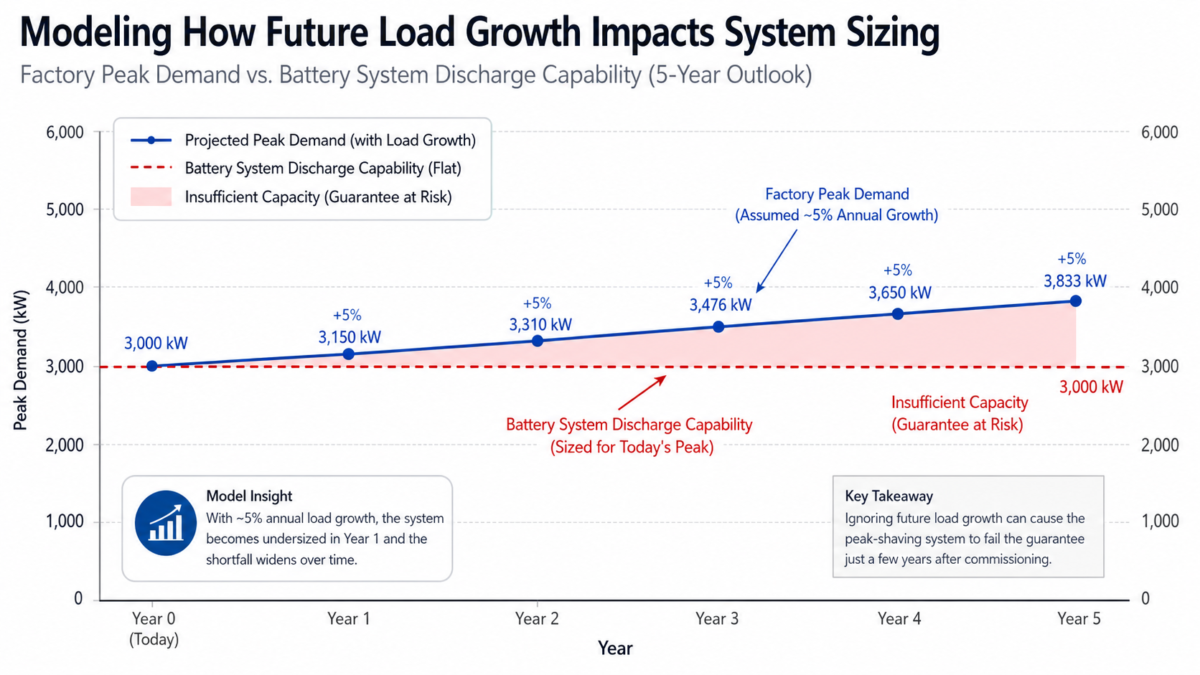
Load growth is one of the biggest deal-breakers I see. A performance guarantee is a promise over many years, but your factory’s electricity needs are not static. Even a modest 5% annual growth in peak demand can make a perfectly sized system undersized in just a few years. I remember a client, a plastics manufacturer, who installed a system based on their current operations. Eighteen months later, they added a new extrusion line. Their peak demand jumped 30%, completely overwhelming the battery. The savings they were guaranteed vanished overnight.
This is why the first conversation I have with a technical buyer is about their five-year business plan. Are you adding new machinery? Expanding your facility? Planning to run a second shift? These aren't just business questions; they are critical inputs for the system design. A performance guarantee that ignores potential load growth isn't a guarantee at all. It's a guess. I insist that any proposal includes a sensitivity analysis showing how the payback period changes with different load growth scenarios. This helps the buyer understand the real-world risk.
When do auxiliaries change the economics?
The battery system's efficiency looks great on the datasheet. But the cooling system and other internal power needs are eating into your savings. The numbers just don't add up.
Auxiliary systems, like the HVAC for a battery container, consume energy and reduce the net power available for peak shaving. This parasitic load can significantly erode savings, especially in harsh climates. A true economic model must subtract these auxiliary loads from the gross savings.
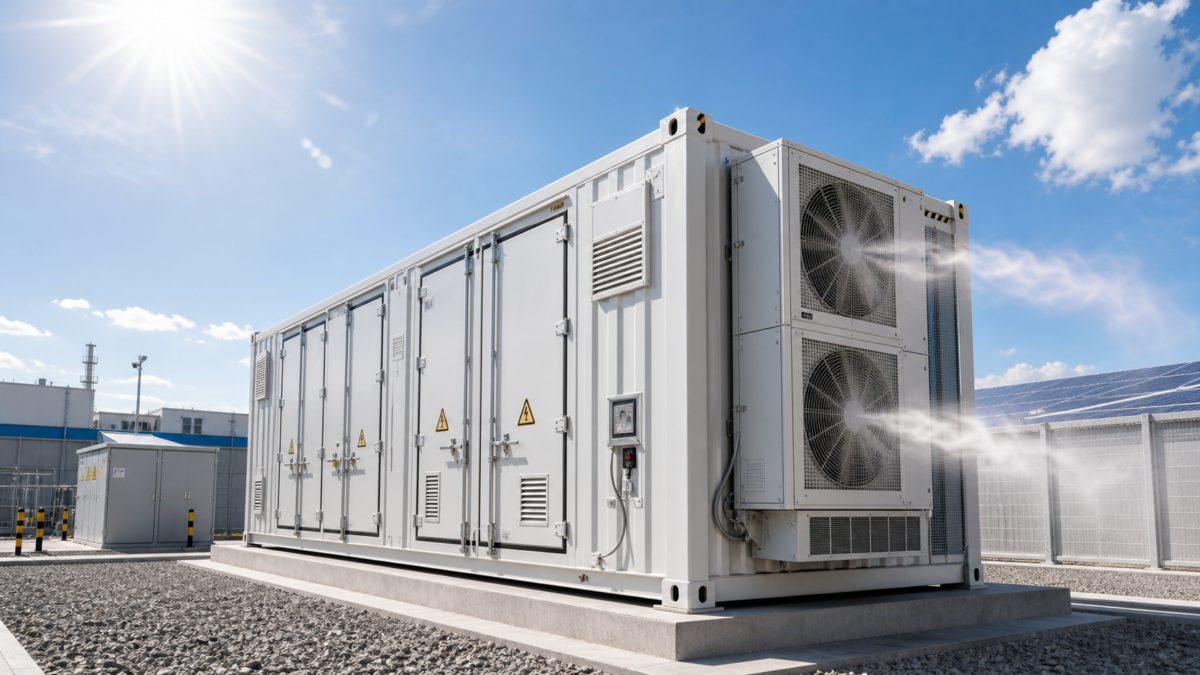
A battery system isn't just a block of cells. It's a complex machine with its own internal power needs, often called parasitic loads. The biggest consumer is usually the thermal management system, like the HVAC or liquid cooling pump. A datasheet might promise 95% round-trip efficiency, but that number often doesn't include the energy needed to keep the batteries at their optimal temperature. In a hot climate, a containerized system’s HVAC can run for many hours a day, consuming several kilowatts of power. This consumption directly reduces the net energy you can sell back or use for peak shaving.
This is why I always ask for a full efficiency map, not a single marketing number. The map shows how efficiency changes with temperature, the battery's state of charge, and how fast you charge or discharge it. It gives a much more honest picture. I also factor in degradation. Every year, the battery holds a little less energy. A guarantee that doesn't account for both auxiliary loads and degradation is presenting an overly optimistic case. When I use parameters from a Moletong system, for example, I use them as traceable inputs in my model. This transparency shows the buyer exactly how we got our numbers, building credibility.
How can I turn a performance guarantee into clear specifications?
You received a performance guarantee that sounds good but is vague. When performance doesn't meet expectations, there is no clear way to measure the failure or enforce the contract.
Convert a performance guarantee into clear specifications by creating an assumption register, a detailed cash-flow model, and an independent formula review process. Define the exact conditions, like load profiles and utility rates, under which the guarantee is valid and how performance will be measured.

A performance guarantee should be a tool for clarity, not a sales gimmick. To make it useful for a technical buyer, I turn it into a set of clear, testable specifications. This isn't just about the hardware; it's about the entire analytical package that supports the investment decision. My final deliverable always includes four key documents. First, an assumption register. This is a simple list of all the key variables—utility tariffs, load growth, system degradation, OPEX—and the values used in the model. Second, an audit of the site’s interval data, proving the inputs are clean and representative.
Third, an open-book cash-flow model, usually in a spreadsheet. The buyer and their team should be able to see every formula and change any input to test scenarios for themselves. A black-box model is a red flag. Fourth, I recommend an independent formula review, where a third party confirms the model’s logic is sound. Finally, I clearly state the conditions under which I would change my recommendation. For instance, if the utility announces a major change to its demand charge structure, the guarantee must be re-evaluated. This approach makes the guarantee practical, credible, and truly useful.
Conclusion
A practical peak-shaving guarantee tests key assumptions like load growth, real-world efficiency, and degradation to create a transparent downside case, which is far more valuable than a precise-looking payback.



Leave a Reply