

Battery Energy-as-a-Service in Vietnam: A Buyer's Guide
Deploying Battery Energy as a Service in a new country is complex. A simple copy-and-paste approach from another market is a recipe for failure, wasting time and money.
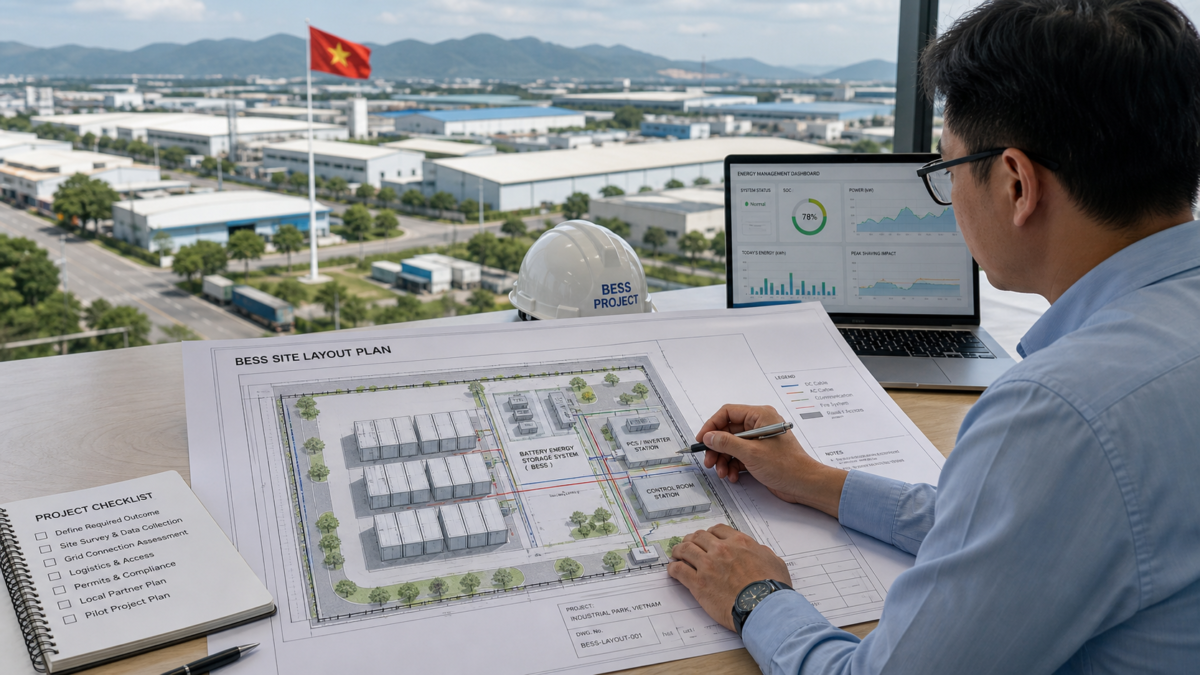
To succeed with Battery Energy as a Service in Vietnam, you must define your required outcome, not just the product. Identify local constraints like grid quality, logistics, and service travel time, then test your design against real site inputs. This builds a practical, country-specific solution.
 " alt="Indonesia project team reviewing a commercial energy storage site" title="Planning a Battery Energy as a Service Project in Vietnam" decoding="async" loading="lazy" />
We have seen too many projects stumble because the team tried to replicate a solution that worked perfectly well somewhere else. But what works in Germany or the US often fails in Southeast Asia. The variables on the ground are just too different. Our approach is simple: define what you need to achieve, find the one thing that can stop you, and build your plan around that reality. In Vietnam, that means focusing on the details that can reverse an apparently obvious answer. This way, you create a plan that is practical, credible, and truly useful. Let’s break down how to do that.
Start With the Customer Outcome, Not the Product
Many sales pitches begin with product specs. But this approach ignores your actual business needs, like cutting peak demand charges or guaranteeing backup power. Start with your required outcome.
Don't begin with battery chemistry or kilowatt-hours. First, define what you need the system to do. Do you need to lower your electricity bill by 20% or ensure four hours of uptime for critical machinery? This outcome is the foundation of your entire specification.
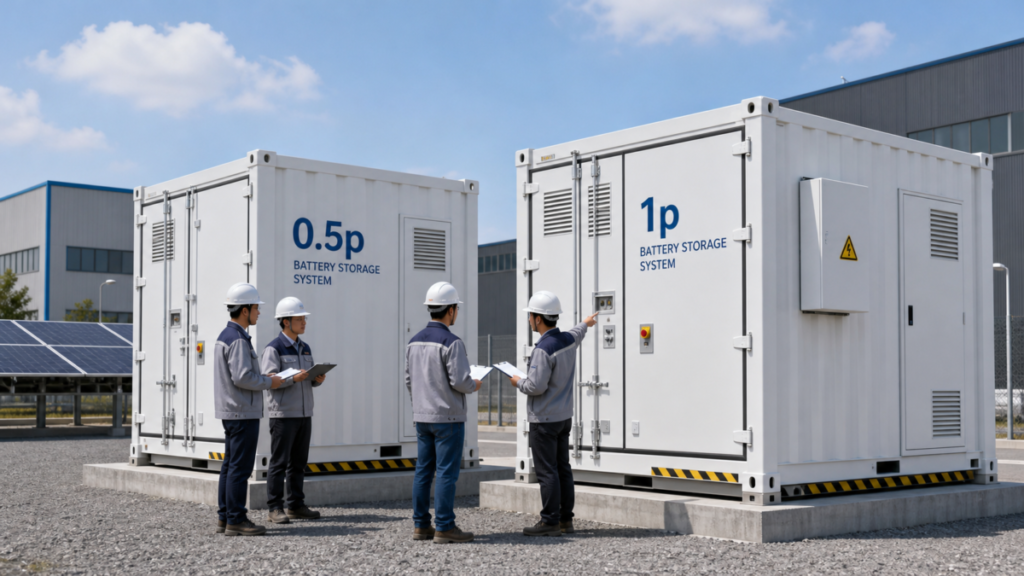
 " alt="Representative commercial and industrial energy storage cabinet family" title="Identifying the Core Customer Problem for BaaS" decoding="async" loading="lazy" />
When we work on a new project, the first conversation is never about hardware. It’s about the job the customer needs to get done. Are they trying to avoid costly grid upgrades by managing their peak demand? Or are they located in an area with an unstable grid and need reliable backup power to prevent production losses? These are two very different problems that might lead to very different technical solutions. A system designed for peak shaving needs a sophisticated Energy Management System (EMS) that can react to price signals. A backup power system prioritizes reliability and state-of-charge management. Focusing on the product first is like a doctor prescribing medicine before diagnosing the illness. You might get a powerful battery, but it might be completely wrong for your actual problem. That's why we always start by creating a simple table to clarify the goal.
From Vague Need to Clear Outcome
| Question | Product-First Approach (The Wrong Way) | Outcome-First Approach (The Right Way) |
|---|---|---|
| Starting Point | "We need a 261 kWh battery system." | "We need to reduce our peak demand charges, which cost us $5,000 last month." |
| Success Metric | The system is installed and commissioned. | Peak demand charges are reduced by at least 80% within three months. |
| Result | You own a battery. It may or may not solve your financial problem. | You have a solution that delivers a measurable return on investment. |
How Connectivity Shapes a Vietnam Energy-Service Design
You might assume stable internet is a given. But in many industrial areas, poor or intermittent connectivity can make your "smart" battery system completely ineffective. Design for real-world network conditions.
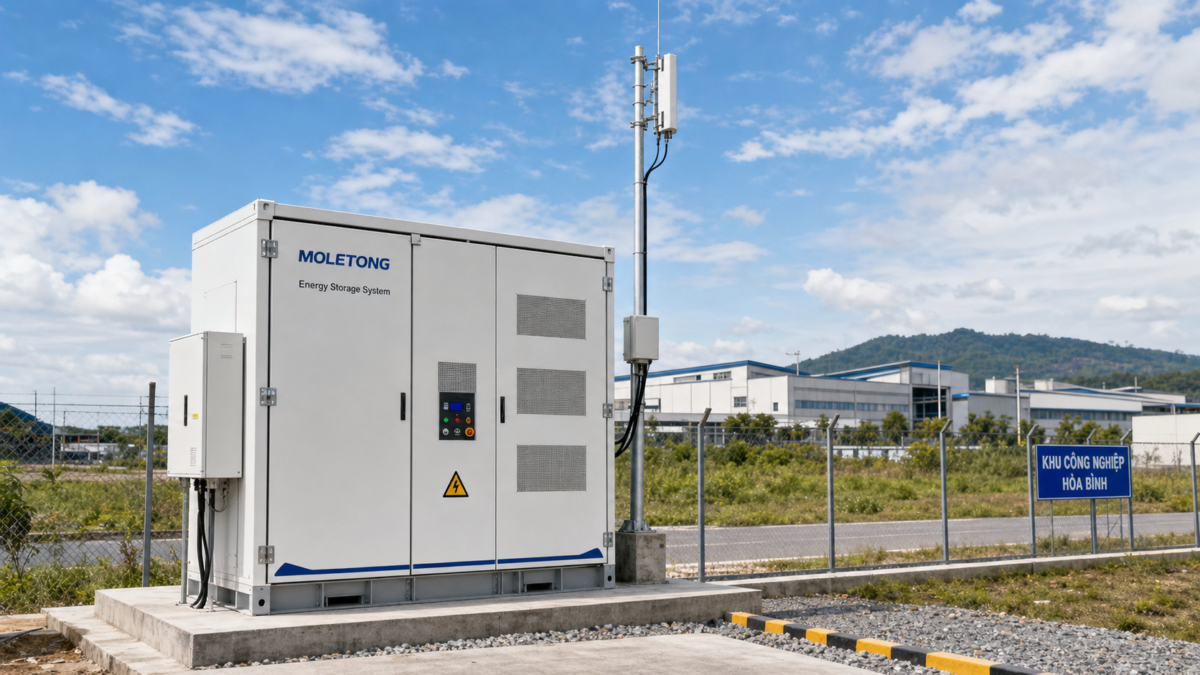
Connectivity is a core design constraint, not an IT issue to solve later. Unreliable connections can block remote monitoring, control, and vital software updates. Your design must include local control logic for outages and specify minimum network performance to meet your service level agreement.
 " alt="Indonesia project team reviewing a commercial energy storage site" title="Ensuring Reliable Connectivity for Remote Battery Management" decoding="async" loading="lazy" />
A phone showing a strong cellular signal does not prove that an industrial control connection will be stable at the equipment location. Test latency, packet loss and recovery at the exact installation point, then define the gateway, antenna, local control logic and data buffer needed when the network is unavailable. The service-level agreement should reflect the connectivity on which monitoring and optimization depend.
How the Local Tariff Changes the Economics
Your financial model for a battery project looks great on paper. But what happens if the utility changes its tariff structure? Sudden policy shifts can destroy your return on investment.
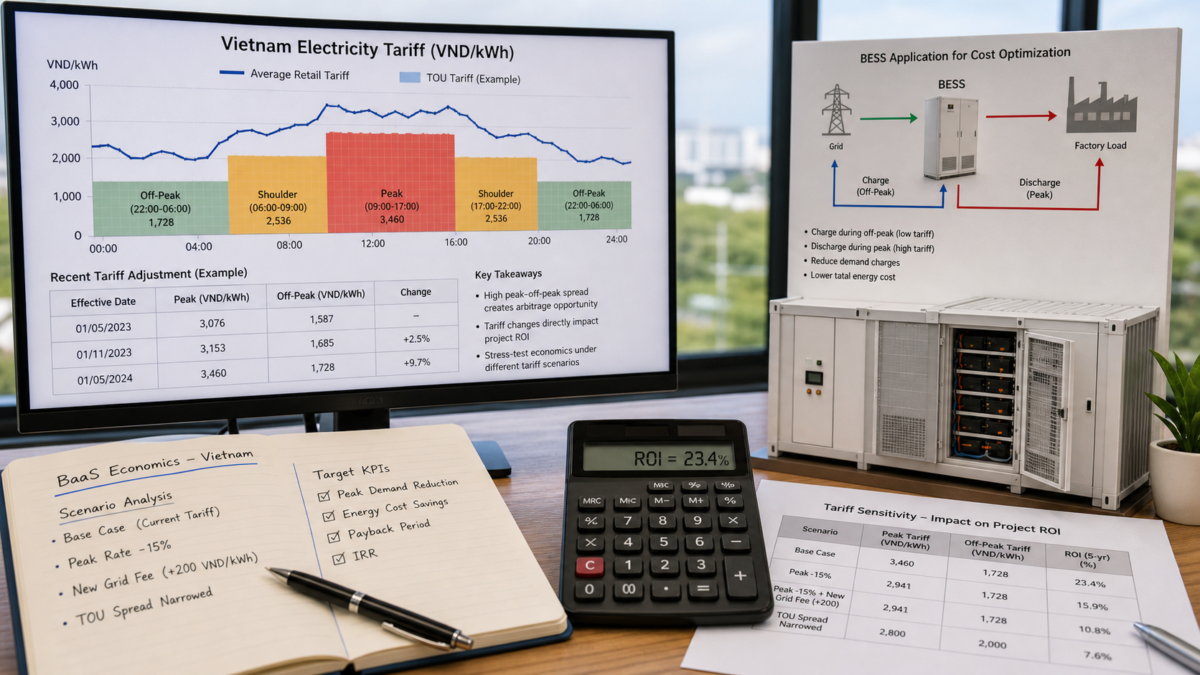
A project's profitability is tied directly to the local electricity tariff structure. Changes in peak pricing, demand charges, or new grid fees can turn a profitable project into a loss. Your financial model must use current Vietnamese tariffs and be stress-tested against potential changes.
 " alt="Technical and commercial teams reviewing an energy storage proposal" title="Analyzing Vietnam's Electricity Tariffs for BaaS Economics" decoding="async" loading="lazy" />
Peak-shaving and energy-arbitrage value depends on the applicable tariff, which can change over the project term. Use a model that can update peak and off-peak prices, fees and operating assumptions, then run sensitivity cases before agreeing the commercial structure. We also recommend confirming the current tariff and interconnection rules with the relevant Vietnamese authority or utility for the specific site.
Turn the Service Model Into Clear Project Specifications
Translating your business needs into a technical document is difficult. Vague specifications lead to confusing proposals from vendors and, ultimately, to project failure. Use a structured checklist.
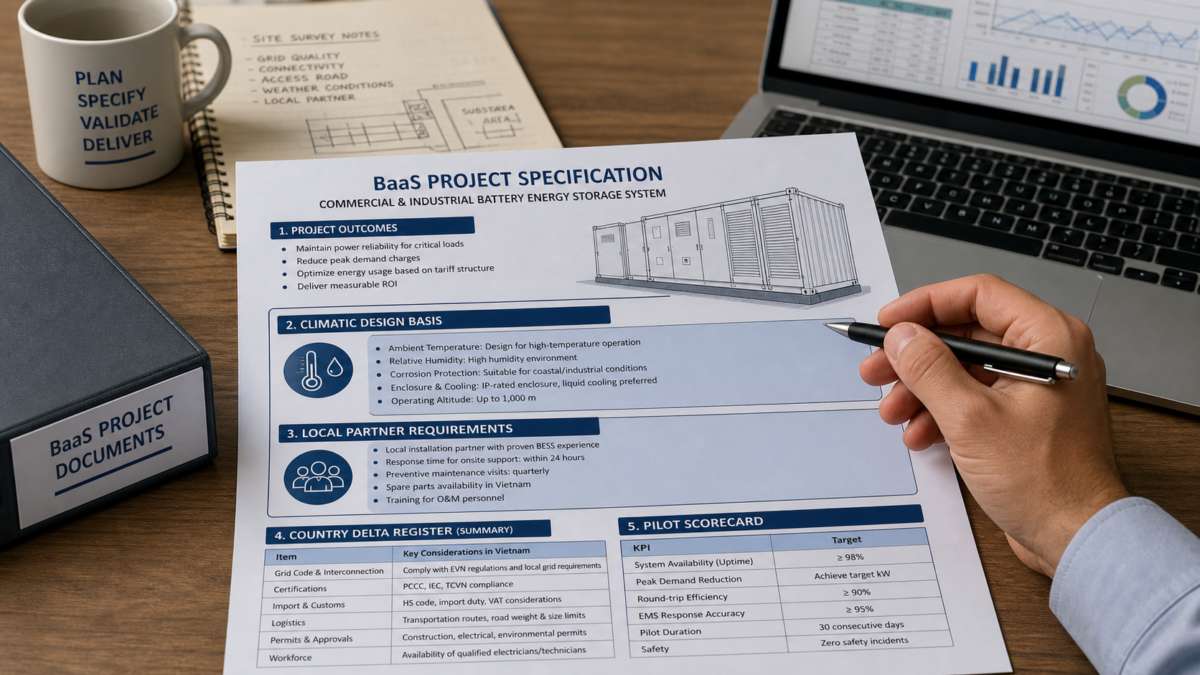
Convert your required outcomes into a clear specification document. This must include a country delta register, climatic design basis, a local partner plan, and a pilot scorecard. This ensures suppliers quote for exactly what you need and gives you a clear basis for judging success.
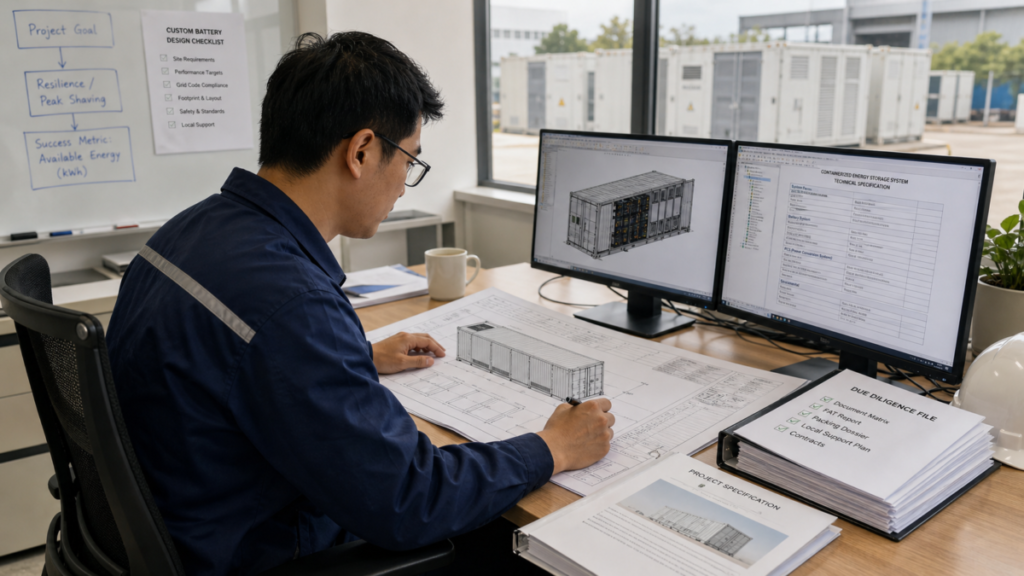
 " alt="Engineers reviewing site data and energy storage project documents" title="Creating a Clear Specification for a BaaS Project" decoding="async" loading="lazy" />
A bill of materials is not a specification. For a project in Vietnam, you can't just copy the specs from a European project. We insist on creating four key documents to bridge the gap between the idea and the reality on the ground.
First, the country delta register. This lists everything that's different in Vietnam: grid codes, import duties, required certifications, road weight limits for logistics, and even the availability of qualified electricians.
Second, the climatic design basis. Vietnam is hot and humid. This climate will kill a battery system that wasn't designed for it. Your spec must define the ambient temperature and humidity the system must operate in. This is where products like Moletong's liquid-cooled containerized systems become a necessity, not a luxury.
Third, the local partner plan. Who will install the system? Who will perform maintenance? How quickly can they respond to a fault? Your service promise is only as good as your local team.
Finally, the pilot scorecard. Before a full rollout, you need to test a single site. The scorecard defines what success looks like with clear KPIs: "Achieve 98% uptime," or "Reduce peak demand by X kilowatts for 30 consecutive days." These documents turn a vague idea into a buildable, measurable project.
Conclusion
Success in Vietnam BaaS isn't about copying a solution. It's about defining your outcome, understanding local constraints like connectivity and tariffs, and building a specification that addresses them directly.
Leave a Reply