

What Large Battery Projects Teach Us About Wind-Farm Storage
Your wind farm's output is unpredictable, causing grid instability and costing you money. You think adding a battery is a simple fix, but hidden complexities can derail your project's success.
Elon Musk's battery farm success matters because it proved large-scale energy storage is viable. For your project to be a triumph, you must go beyond the headlines and model site-specific constraints like black start capability, service dispatch priority, and State of Charge conflicts to deliver on your required outcome.
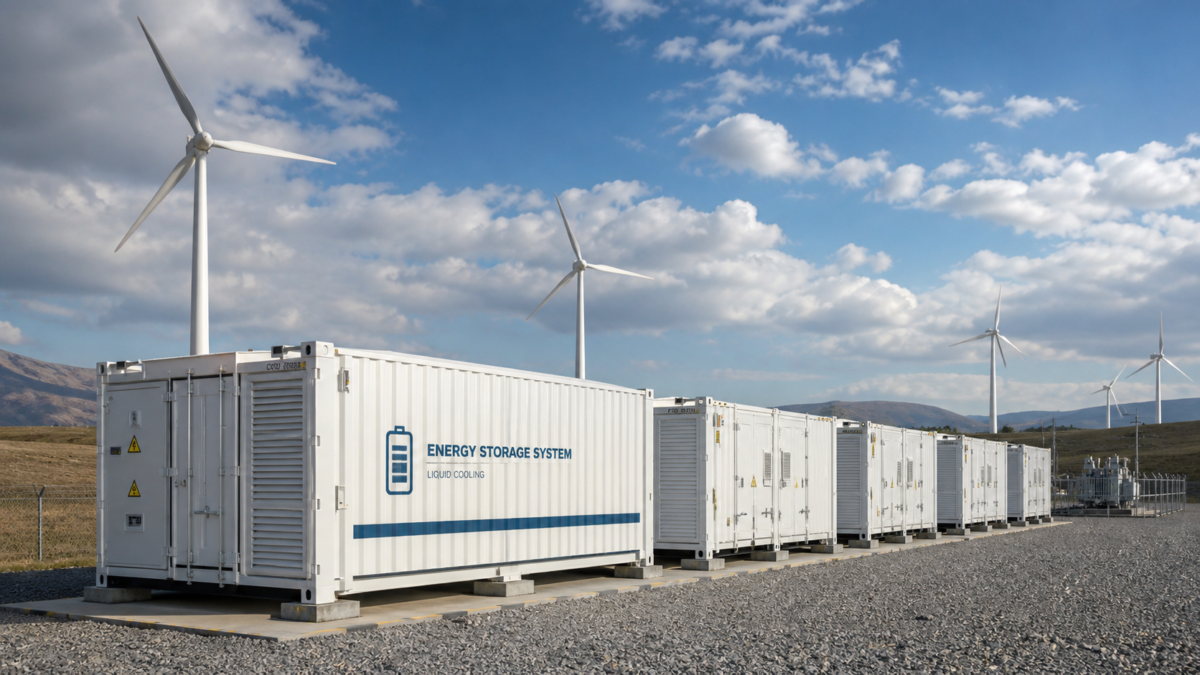 " alt="Representative wind farm with utility-scale battery storage" title="Connecting Large-Scale BESS with Wind Farms" decoding="async" loading="lazy" />
The headlines about massive battery farms are exciting. They show what's possible. But as an engineer, we know that what makes a project a real triumph isn't its size, but how well it solves a specific problem in a specific place. The lessons from these big projects are valuable, but they don't give you a blueprint. Our approach has always been simple: define what the buyer needs to achieve, find the hidden constraint that could defeat that goal, and then test the design against real-world inputs. This is how you move from a good idea to a dependable asset. Let's break down what that means for wind farm battery smoothing.
The Operational Reality Behind Wind-Farm Battery Smoothing
You assume a battery simply charges and discharges to smooth out wind power. But when you stack multiple services, their competing demands can cripple performance and undermine your business case.
The operational reality is that a battery cannot do everything at once. Wind smoothing, frequency response, and energy arbitrage create State of Charge (SOC) conflicts. You must establish a clear dispatch hierarchy to prioritize services, ensuring the most critical operational and commercial outcomes are always met.
 " alt="Representative wind farm with utility-scale battery storage" title="Visualizing the Dispatch Logic for Smoothing" decoding="async" loading="lazy" />
When we start a project, our first step is to forget the hardware for a moment and focus on the required outcome. Is the main goal to meet a strict grid code for power ramp rates? Or is it to maximize revenue by selling ancillary services? The answer changes everything. Multi-service value is credible only when you model the conflicts. For instance, the battery can't be held at a high state of charge, ready to absorb a sudden surge in wind, while also being held at a low state of charge, ready to inject power for frequency support. We always map out a service-priority table to make the control logic clear. This isn't just a technical exercise; it's the foundation of the financial model. With a clear hierarchy, a system like Moletong's Energy Management System (EMS) can make autonomous decisions that protect the primary goal. Without it, you're just hoping for the best.
| Priority | Service | Required SOC Window | Purpose |
|---|---|---|---|
| 1 | Grid Compliance (Ramp Rate Control) | 20% - 80% | Avoid penalties; maintain connection agreement. |
| 2 | Black Start Reserve | Maintain > 30% | Site restoration after grid loss (if required). |
| 3 | Frequency Regulation | 40% - 60% | Generate ancillary service revenue. |
| 4 | Energy Arbitrage | 0% - 100% (Opportunistic) | Buy low, sell high based on market price. |
Why Black Start Changes the Design
You've designed a perfect battery system for smoothing. But when a widespread blackout hits, your entire wind farm is useless without a grid signal to restart it.
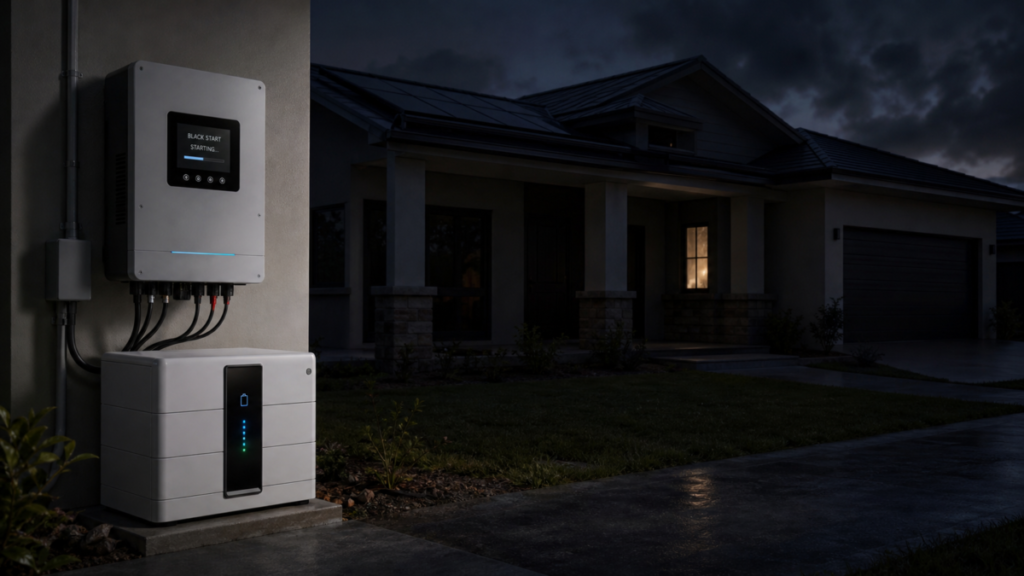
Black start capability changes the design because the battery must transform from a grid-following asset into a grid-forming one. This demands a more advanced Power Conversion System (PCS) and control logic capable of creating a stable, independent microgrid to re-energize the wind turbines and local network.
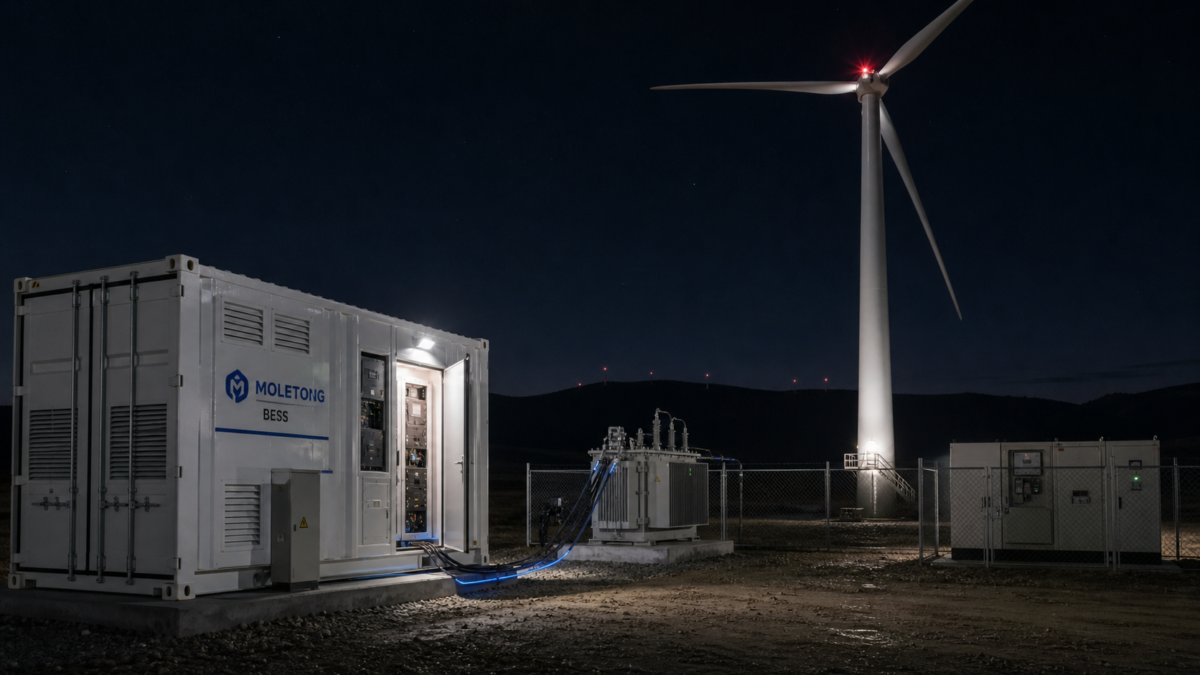 " alt="Representative wind farm with utility-scale battery storage" title="BESS Enabling Wind Farm Black Start" decoding="async" loading="lazy" />
One of the first questions we ask is, "What happens when the grid is gone?" If the answer is, "We need to be able to restart the wind farm on our own," then we are talking about a completely different project. A standard battery system is "grid-following." It needs to see a stable voltage and frequency from the grid to operate. But for a black start, the battery has to create that voltage and frequency itself. This is called "grid-forming" capability. It requires a more robust PCS that can handle the massive inrush currents from starting large transformers and motors. It also means you have to reserve a significant portion of your battery's energy just for this purpose. This energy is then unavailable for smoothing or selling to the grid, which impacts your revenue models. This single requirement can completely reverse the decision on system sizing and technology choice, proving that understanding the true constraints is more important than just picking the biggest battery.
Balance Performance, Safety and Serviceability
You are focused on maximizing power output and revenue. But pushing the system to its limits can create safety risks and lead to costly downtime when maintenance is needed.
Balancing these requires designing them in from the start. Performance is dictated by the PCS and EMS. Safety is handled by the BMS, thermal management like liquid cooling, and fire suppression. Serviceability depends on a modular design and physical access, which prevents minor faults from becoming major outages.
 " alt="Representative utility-scale battery energy storage site" title="Serviceability in a Modern BESS Design" decoding="async" loading="lazy" />
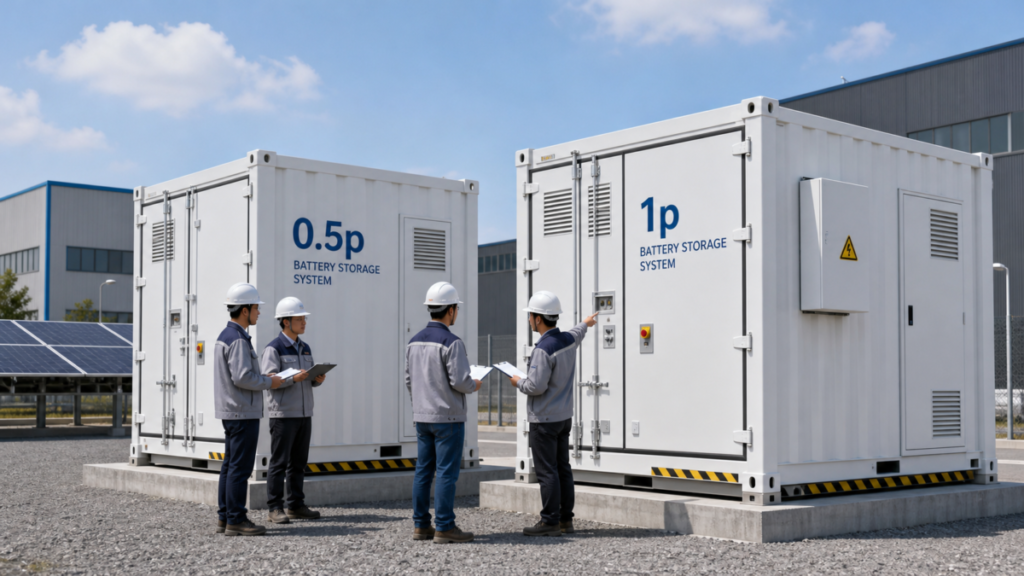
Performance, safety and serviceability must be designed together. Higher sustained power increases the thermal-management duty, while tight container spacing can make maintenance slower and less safe. We review heat rejection, access clearances, lifting routes, replaceable-unit strategy and isolation procedures alongside the power requirement so day-one performance does not create a lifecycle problem.
What to Confirm at Design Review and Handover
The project is nearing completion and everything looks good on paper. But if you don't verify the control logic and restoration plans now, you risk discovering a critical flaw during an actual grid event.
At design review, you must confirm the finalized dispatch hierarchy, the specific SOC reservations for each service, and the results of dynamic simulation studies. At handover, insist on witnessing a full restoration test and reviewing a 24-hour dispatch trace using real-world data.
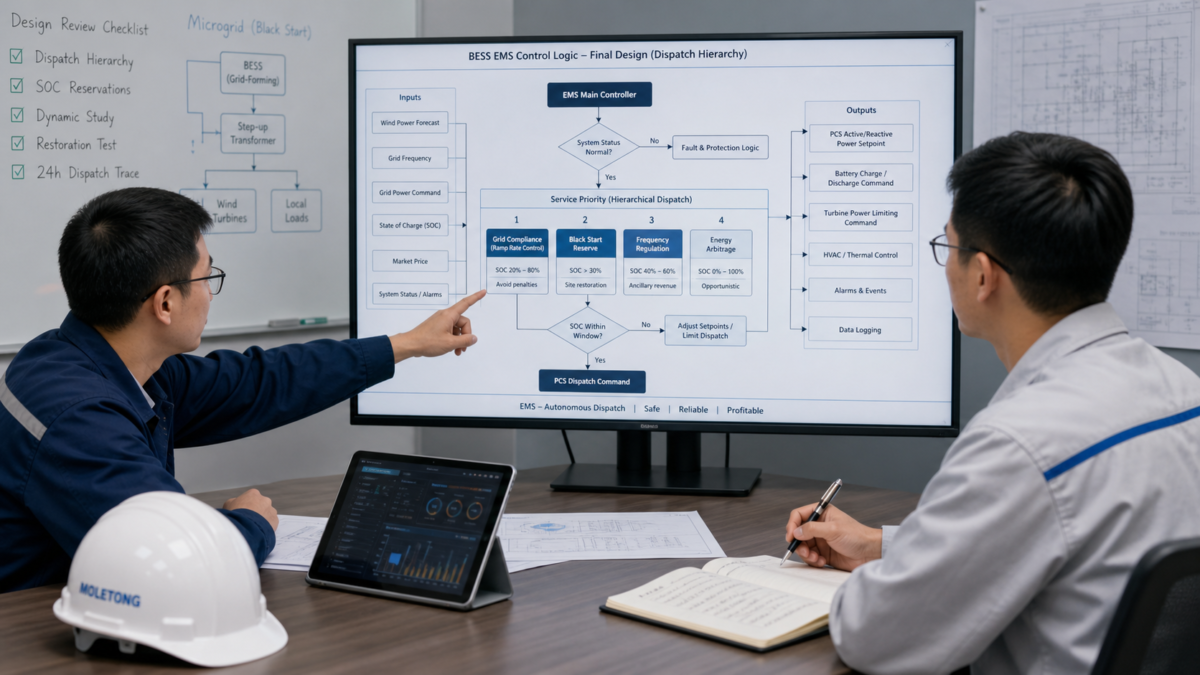 " alt="Engineers reviewing site data and energy storage project documents" title="Confirming Control Logic at Design Handover" decoding="async" loading="lazy" />
Our approach at this critical stage is to demand proof. We don’t want to hear what the system is supposed to do; we want to see it. We would require four key deliverables before signing off. First, the final service-priority table, hard-coded into the EMS. Second, a dynamic-study summary report showing the BESS and wind turbines operating together stably during simulated grid faults. Third, a 24-hour dispatch trace using a real renewable profile. This simple simulation often reveals SOC conflicts that weren't obvious before. And fourth, a detailed restoration test procedure, which we would then execute on-site during commissioning. Finally, we ask the supplier one simple question: "Under what conditions would your recommendations change?" A good partner will be able to define the system's operational boundaries clearly. This process ensures that what the buyer paid for is exactly what was delivered, creating a practical, credible, and useful asset.
Conclusion
The success of major battery farms is inspiring. But for your project, triumph depends on modeling real-world constraints like dispatch priority, SOC conflicts, and black start before you ever break ground.

Leave a Reply