

What Does Without Indonesia’s Nickel, Evs Have No Future in America… Mean for Project Design?
Headlines about resource scarcity can feel distant. But they highlight a key issue for anyone buying energy storage. What happens when the deal looks too good to be true?
That headline means project design must focus more on risk than on equipment. No-upfront storage deals transfer capital costs, but they do not automatically transfer performance, regulatory, or counterparty risk. Your project's success depends on managing these risks from the start.
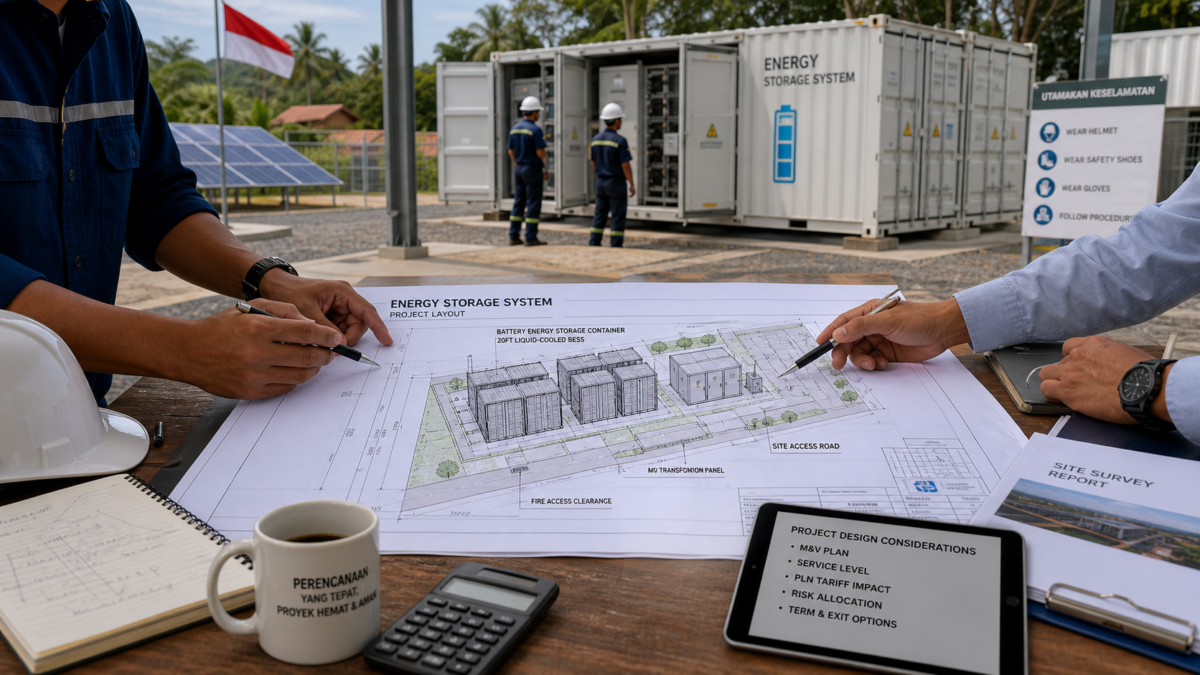
When I see a big headline about the global supply chain, my first thought isn't about the raw materials. I think about what it means for the contracts we sign and the projects we build right here. A supply crunch in one part of the world can make new business models, like "no upfront battery storage," seem very attractive elsewhere. But these models bring their own set of challenges that are easy to overlook. The practical lesson I've learned is that the product is the last thing you should discuss. I would never begin with a product recommendation. I would begin with the details of the service, the performance guarantees, and what happens when things go wrong. This approach helps separate a real technical limit from just a bad assumption or an unrealistic hope. It gives you a clear path to making a good decision.
What Buyers Often Misunderstand About Indonesia No Upfront Battery Storage?
You need battery storage but the initial cost is too high. A "no upfront" or "energy-as-a-service" model looks like the perfect solution. But what hidden risks are you accepting?
Buyers often believe that a no-upfront model transfers all risk to the provider. In reality, it only transfers the initial capital expense. The buyer often retains significant performance, regulatory, and counterparty risks that can eliminate any projected savings if not managed in the contract.

The most common misunderstanding I see is the difference between transferring a cost and transferring a risk. Yes, you avoid a large upfront payment. That is a clear benefit. But the provider's goal is to make a return on their asset. Their success depends on the system performing in your facility, under local regulations, and connected to the local utility. If the system underperforms, do you still have to pay a minimum fee? If a new permit is required, who is responsible for the cost and the delay? If the provider goes out of business, what happens to the equipment on your property? These are not cost problems; they are risk problems. The only way to manage them is to define every responsibility clearly before you sign anything. I always recommend starting with a responsibility matrix. It forces a conversation about the details that are often hidden in the fine print.
Sample Bilingual Responsibility Matrix
A clear matrix shows who does what. It removes confusion and protects both parties.
| Task / Tugas | Responsibility / Tanggung Jawab | Notes / Catatan |
|---|---|---|
| Site Eligibility & Survey / Survei & Kelayakan Lokasi | Shared / Bersama | Buyer provides access and site data. Seller confirms technical feasibility. |
| Permit Application (Izin Mendirikan Bangunan – IMB) / Pengajuan Izin | Buyer / Pembeli | Seller provides technical documents, but Buyer is the applicant. |
| Grid Interconnection (Penyambungan Jaringan PLN) / Sambungan Jaringan | Seller / Penjual | Seller manages the technical application with the utility (PLN). |
| Monthly M&V Reporting / Laporan M&V Bulanan | Seller / Penjual | Report must show savings calculation against agreed baseline. |
| Routine Maintenance / Perawatan Rutin | Seller / Penjual | Defined schedule and response time should be in the contract. |
Sizing Around M&v and Service Response?
Your provider proposed a 200 kWh system. They say it will save you money. But how do you know if that size is correct, or just what they wanted to sell?
Correct sizing is not based on a product datasheet. It must be calculated from your Measurement and Verification (M&V) plan and the provider’s guaranteed service response time. The system must be large enough to hit savings targets even with planned and unplanned downtime.
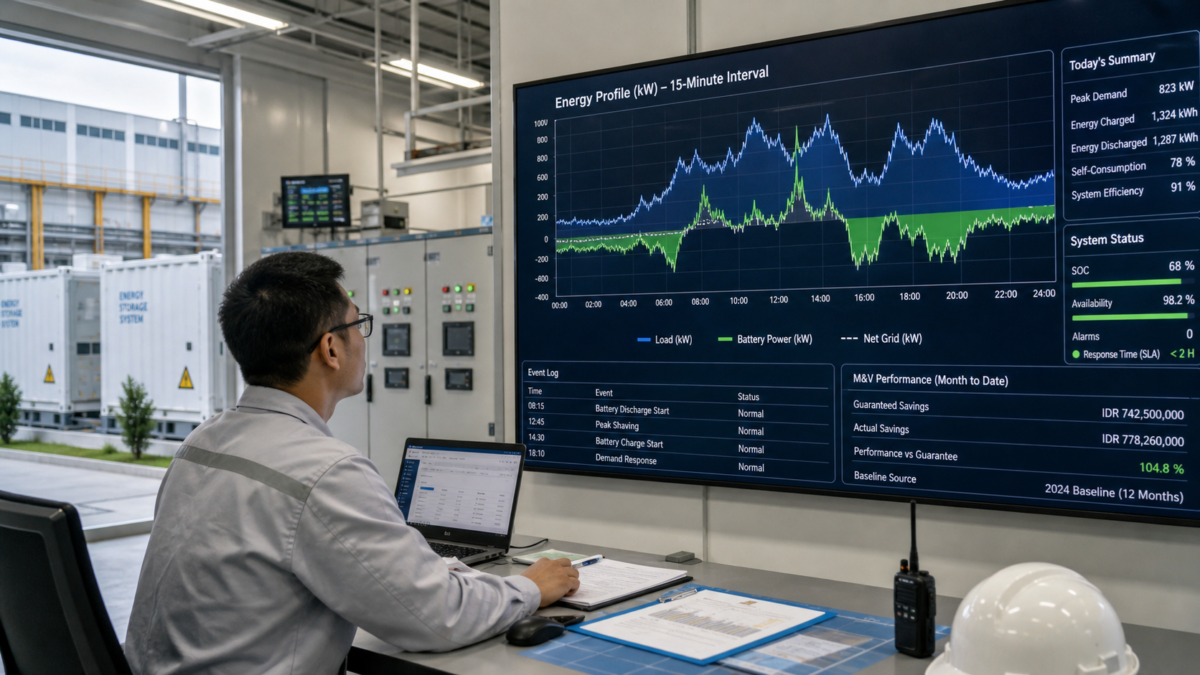
I once worked on a project where the client was offered a battery system that seemed perfectly sized to shave their main afternoon peak. On paper, it looked great. The provider’s simulation showed consistent savings. But we asked two simple questions. First, what is the guaranteed uptime and service response time? The answer was 95% uptime and a 72-hour response for critical failures. Second, how does the M&V plan account for that 5% downtime? There was no answer. The system was sized so tightly that a single three-day outage during a high-tariff week would wipe out an entire month's savings. The M&V plan didn't account for reality. A properly sized system needs a buffer. It must be able to meet its monthly or annual savings target as defined in the M&V plan, not just its daily function in a perfect scenario. You must size around the service level agreement (SLA) to ensure the financial performance you were promised can actually be delivered.
The Failure Mode Hidden in PLN Bills?
Your battery provider's dashboard shows you saved thousands last month. But your official bill from PLN is almost unchanged. Where is the disconnect between the screen and your bank account?
The hidden failure mode is when the battery’s control software and the savings model do not account for all the charge categories on a PLN bill. Optimizing for just one variable, like peak kilowatt (kW) demand, can negatively impact others, like power factor penalties.

A PLN bill is more complex than a simple rate per kilowatt-hour. In my experience with industrial clients in Indonesia, the biggest surprises come from demand charges (biaya beban), reactive power charges (biaya kelebihan kVARh), and various taxes and fees. A simple battery system might be programmed to discharge quickly to lower your single highest 15-minute demand peak. This looks good on a simple graph. But that rapid discharge could worsen your power factor, triggering a high kVARh penalty that eats up all the savings from the demand charge reduction. The system won the battle but lost the war. A successful project requires a savings model built from a full year of your itemized PLN bills, not just your smart meter data. You must ensure the provider’s M&V report compares their performance against every relevant line item on the actual utility bill, not just the variables that make their system look good.
Key Indonesia No Upfront Battery Storage Questions Before Signing the Contract?
You have a proposal in hand for a no-upfront battery system. The numbers look good and you are ready to move forward. What final checks should you make before you commit?
Before signing, you must ask for the specific termination terms, a sample M&V report, the exact tariff source for the savings calculation, and clear site eligibility rules. Getting these details in writing protects you from vague promises and ensures everyone agrees on what success looks like.

A contract is the final step, but the questions should start long before. I always tell my clients to treat the negotiation process as the first test of what it will be like to work with the provider. If they can't give you clear, simple answers now, they won't be able to later when there is a problem. Based on what I've seen in the market, I would not proceed without written answers to these specific questions:
- Termination: What are the exact financial and logistical terms if I need to terminate the contract early? What conditions allow you, the provider, to terminate?
- M&V Methodology: Can I see a sample of the exact monthly report I will receive? How is the baseline energy usage calculated and can it be adjusted?
- Tariff Source: Which specific PLN tariff schedule and date is this financial proposal based on? What happens if PLN changes that tariff structure next year?
- Performance Guarantees: What happens if the system fails to deliver the projected savings in a given month? Is there a penalty for the provider or just a lower fee for me?
- Permits and Regulations: Who is financially and administratively responsible if a new permit or certification is required by the government during the contract term?
These questions give you a clear decision path and help you separate a real partner from a simple sales pitch.
Conclusion
No-upfront storage deals are about risk management, not just equipment. Focus on the contract, M&V, and termination terms to ensure the promised savings become a reality for your business.

Leave a Reply