

How Should Buyers Respond to Scada/ems Engineer to SCADA Engineer?
Are you watching two SCADA engineers talk, hoping for the best? It feels like progress, but a simple "yes, it connects" can hide huge risks for your project.
You should treat BESS EMS SCADA and Modbus cybersecurity as a design and operating decision, not a catalogue comparison. True integration success happens when ownership and failure behavior are clear and tested, long before a simple Modbus connection is established. This protects your project's value.

I see this all the time. A buyer gets two engineers in a room, one from the BESS EMS supplier and one from their own SCADA team. They talk Modbus registers and IP addresses. The buyer hears "yes, they can communicate" and breathes a sigh of relief. But this is often where the real problems begin. A connection is not the same as a reliable, safe, and commercially effective integration. The most important questions are not about if they can connect, but how they behave when things go wrong. To get the answers you need, you have to dig much deeper than a simple handshake between two systems. You have to make the downside visible from the very beginning.
When Buyers Respond to Scada/ems Engineer to SCADA Engineer Becomes a Business Case?
Tired of technical talks that don't address your business risks? You need to turn the conversation from features to failure modes to see the real financial impact.
This conversation becomes a business case when you explicitly define ownership and test failure behaviors. You must make the potential downside visible, especially where reliability, safety, or commercial value could change. This shifts the focus from a simple connection to a robust operational design.
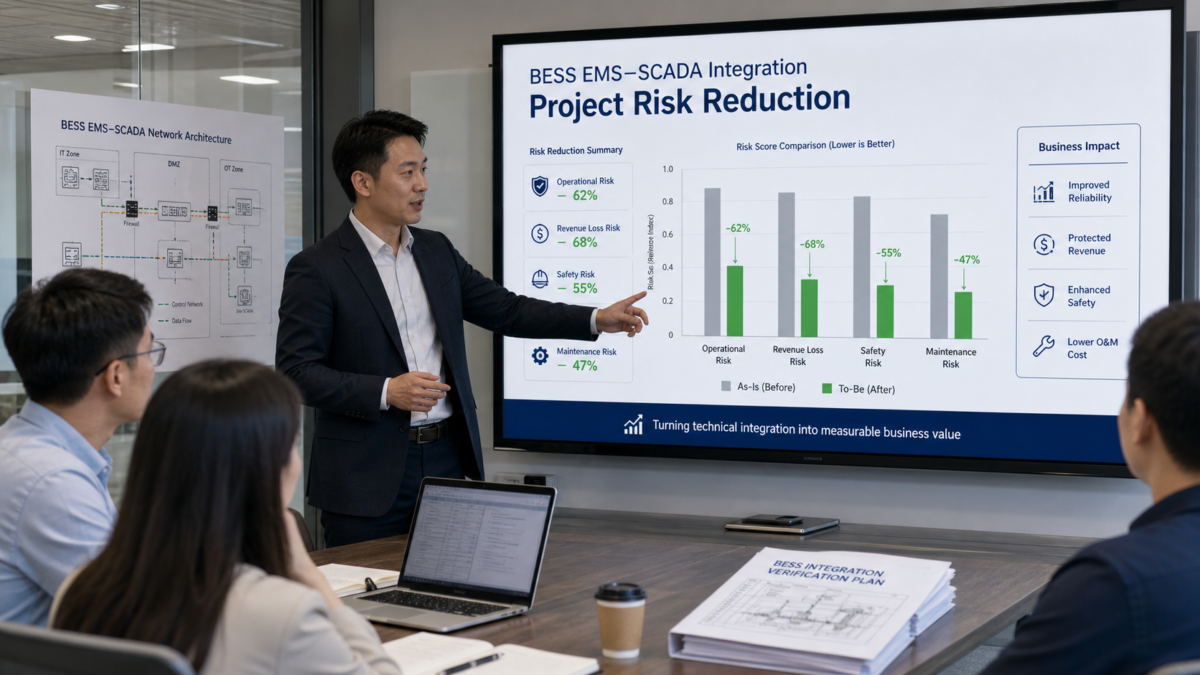
I once worked on a project where the team celebrated a successful Modbus connection between the BESS and the site SCADA. Two weeks after commissioning, a brief network flicker caused the BESS to lock into its last state: charging at full power. Nobody defined the failure behavior. The system didn't know whether to stop, go to a safe idle, or do something else. The result was a huge energy bill and a loss of market revenue until an engineer could manually reset it. This is why I treat integration as a core design decision. We need to ask questions about who owns what, especially when it breaks. Who owns the firmware updates? Who is responsible if the time sync fails? Making these failure behaviors and ownership lines explicit turns a technical chat into a real business case that protects your investment.
From Catalogue Comparison to Design Decision
Moving from a simple check-the-box approach to a design-focused one is critical. It changes the questions you ask and the evidence you demand.
| Topic | Catalogue Comparison Approach (High Risk) | Design Decision Approach (Low Risk) |
|---|---|---|
| Communication | Does it have Modbus TCP? | What is the exact fail-safe behavior on communication loss? Who owns the network switch configuration? |
| Alarms | Can we see the alarms? | What is the alarm rationalization philosophy? How are nuisance alarms prevented from hiding critical ones? |
| Firmware | What is the current version? | Who owns firmware updates? What is the verification process before deploying on-site? |
| Cybersecurity | Is it password-protected? | What are the network zones? How is traffic between zones controlled? What is the patch management plan? |
Which BESS EMS SCADA Modbus Cybersecurity Inputs Deserve the Most Scrutiny?
Worried that you're focusing on the wrong technical details? Your BESS performance depends on getting a few key inputs right, and they are not always the obvious ones.
The inputs that deserve the most scrutiny are time synchronization, the alarm philosophy, network zone definitions, and firmware ownership. These fundamentals directly impact reliability, safety, and your ability to diagnose problems. A failure in any of these areas can undermine the entire system's performance and security.
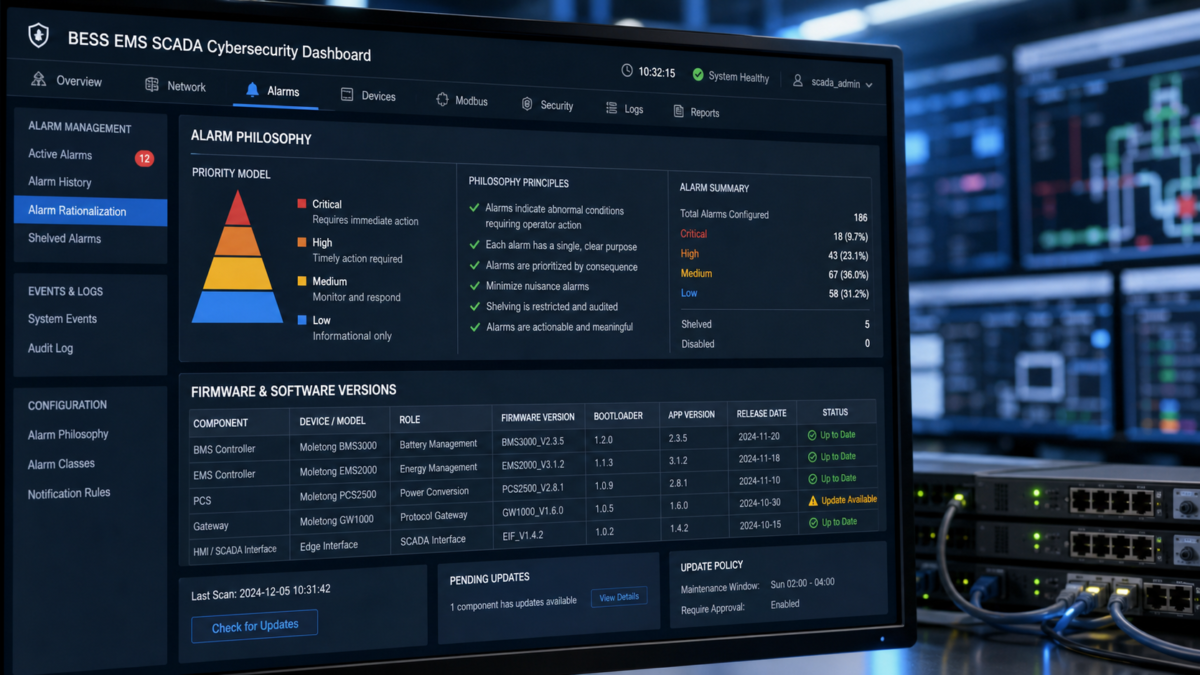
I learned the importance of time sync the hard way. A client's BESS kept tripping offline, and we couldn't figure out why. The logs from the EMS, the PCS, and the site SCADA were all out of sync by a few seconds. This small difference made it impossible to build a clear sequence of events. We wasted days trying to piece together the puzzle. It turned out to be a simple misconfiguration in the network time protocol (NTP) server. That's why I am now obsessed with these core inputs. It's not just about a list of features. It's about how the system behaves as a whole. Your alarm philosophy determines if your operators see one critical warning or are buried in a hundred useless messages. Network zones are your first line of defense against cyber threats. And clear firmware ownership means you know who is responsible for crucial updates and patches. These are the details that matter.
How to Stress-Test BESS EMS SCADA Modbus Cybersecurity Performance?
How can you be sure your new BESS will perform under pressure? A simple "on" switch test is not enough. You need to simulate real-world problems before they happen.
You stress-test performance by actively creating failure scenarios. This includes using packet captures to verify data, running cause-and-effect tests by unplugging cables or blocking ports, and performing a full alarm rationalization to check the system's response. The goal is to see how it behaves, not just if it works.

On one project, we were preparing to commission a large-scale BESS from Moletong. Before we went live, my team insisted on a series of stress tests. We told the client we were going to "try to break it." We used Wireshark, a packet capture tool, to see exactly what data was flowing over the Modbus connection. We found that under heavy load, some data packets were being dropped, which the supplier’s spec sheet said was impossible. Then, we physically unplugged the network cable between the EMS and the site SCADA. We wanted to see what the BESS would do. Would it stop? Would it hold its last command? It’s a simple cause-and-effect test. By making the system fail in a controlled way, we found three critical vulnerabilities that would have caused major operational headaches. This is what stress-testing is all about: finding the breaking points in a safe environment, not during a real-world revenue event.
A Buyer-Focused BESS EMS SCADA Modbus Cybersecurity Verification Plan?
How do you turn all this advice into a concrete plan? You need a list of documents and tests to demand from your supplier before you sign off.
A buyer-focused verification plan should demand specific, tangible evidence. This includes a final Modbus point list, packet captures from stress tests, cause-and-effect test results, an alarm rationalization report, a detailed network diagram, and a table of operating assumptions. This is the minimum detail needed for an RFQ.

If I were buying a Moletong BESS today, I would make my verification plan part of the contract. I would ask for a register of the exact BMS, EMS, PCS, and cloud interface models and firmware versions being delivered. This prevents last-minute substitutions. I would then demand a network diagram showing all the network zones, firewalls, and data paths. My plan would require the supplier to perform specific cause-and-effect tests in my presence, like a communication failure test. I'd want to see the alarm rationalization document that explains why each alarm exists and what the operator should do. Finally, I would want a simple table of assumptions. For example, an assumption might be "The site NTP server will be available with 99.99% uptime." Having this documentation doesn't just prove the system works; it creates a clear baseline for the system's entire operating life. This level of detail is the only way I would trust the conclusion that the system is ready for use.
Conclusion
Treat BESS integration as a design decision. Demand proof of how it fails. This clarity on ownership and behavior is the only way to protect your project's value.



Leave a Reply