

LiFePO4 Charging Low Temperature: A Practical Design and Procurement Guide?
Charging lithium iron phosphate batteries in the cold seems simple. But overlooking the details can permanently damage your investment, creating serious safety risks. Let's look at this as a design decision.
A buyer should see low-temperature charging as a system-level design choice, not just a battery feature. I believe you must trust model-specific test data, not just general chemistry claims, to ensure long-term reliability and safety for your project.
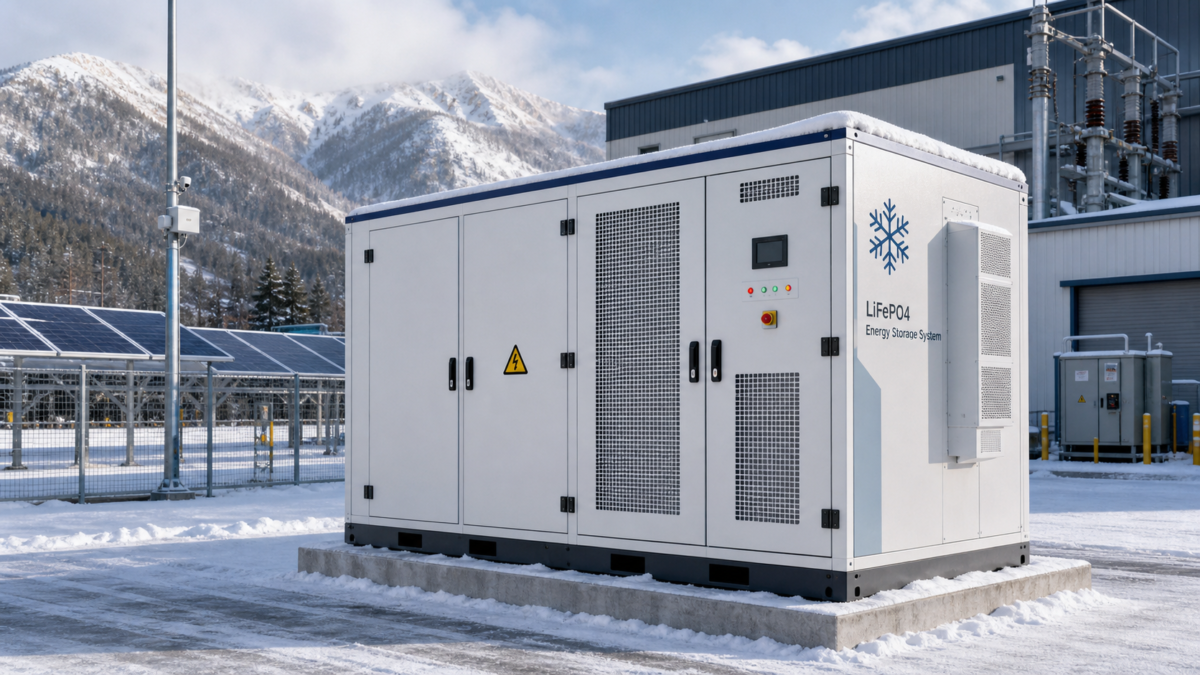
When I started working with energy storage, I saw many projects treat batteries like simple appliances. You pick one from a catalogue, install it, and expect it to work. But I learned the hard way that a battery system is a complex chemical plant. Its performance depends entirely on its operating conditions. Low temperature is one of the most punishing conditions you can throw at it. The difference between a successful project and a costly failure often comes down to how well you planned for the cold. This guide is based on what I would demand to see before putting my name on a low-temperature battery project. Let's dive into the details you need to get this right.
Why Is LiFePO4 Charging Low Temperature Harder Than It Looks?
Your datasheet might promise low-temperature charging capability. But inside the cell, a destructive process called lithium plating can silently kill your battery's capacity and create a serious fire hazard.
It is harder because charging below 0°C (32°F) can cause metallic lithium to build up, or plate, on the anode. This is an irreversible process that permanently reduces capacity and increases the risk of an internal short circuit.
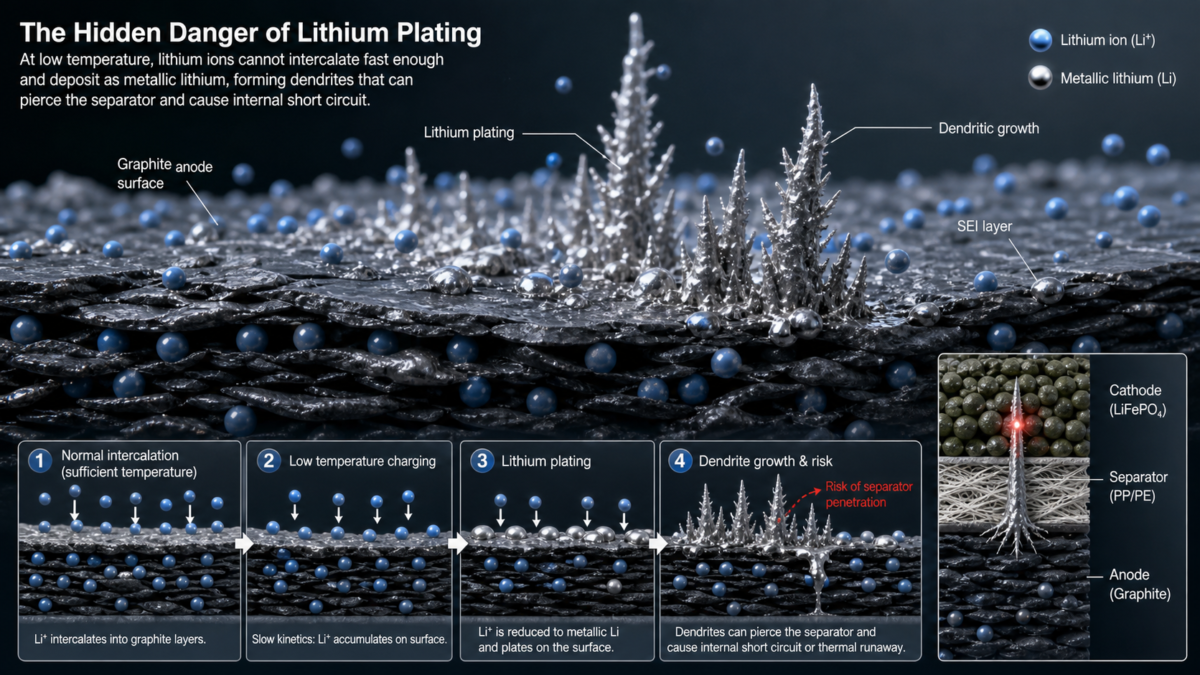
I view any claim about chemistry as a starting point, not a guarantee. The term "LiFePO4" describes a family of chemistries, not a single recipe. A manufacturer can change the electrolyte, the additives, the anode material, and the separator to improve cold-weather performance. But these changes involve trade-offs, perhaps affecting cycle life at high temperatures or the total cost. The central problem is that when a lithium ion tries to enter the graphite anode in the cold, it moves too slowly. It’s like trying to get through a crowded doorway. If the ions can't get in fast enough, they just pile up on the surface as metallic lithium. This is lithium plating. It takes capacity away forever. Even worse, this metallic lithium can grow into sharp, needle-like structures called dendrites. If a dendrite grows long enough to puncture the separator and touch the cathode, it causes an internal short circuit. That can lead to a fire.
Catalogue Claims vs. Engineering Reality
I always compare the marketing claims to the physical realities of the application. The two are often very different. Here is a table showing what I mean.
| Factor | Typical Catalogue Assumption | My Engineering Concern |
|---|---|---|
| Dwell Time | The battery will only be cold for a short time. | How many hours or days will the battery actually sit below 5°C before a charge is attempted? |
| Cycle Duty | Light cycling or charging from a high state of charge. | Will the system need to charge from a low state of charge at a high rate in freezing weather? |
| Cell Chemistry | “Low-Temperature LFP” is a universal solution. | What specific additives were used, and what is the third-party test data for this exact cell model? |
| Temperature History | The battery is new and operates in a lab. | How does aging and a history of temperature swings affect the risk of lithium plating over 10 years? |
When I see a description like "Moletong LFP" or "semi-solid state," I treat it as information about a specific company's model. I do not treat it as a universal claim about all chemistries with that name. The specific evidence for that model is the only thing that matters.
The Site Data Needed to Evaluate LiFePO4 Charging Low Temperature?
You need to pick a battery system for a site with cold winters. Using the average yearly temperature to make your decision is a recipe for disaster. The extreme low temperatures are what matter.
You need detailed, historical temperature data for the specific installation site. This must include the absolute minimum ambient temperature, how long cold periods last, and when charging power from solar or the grid is available.
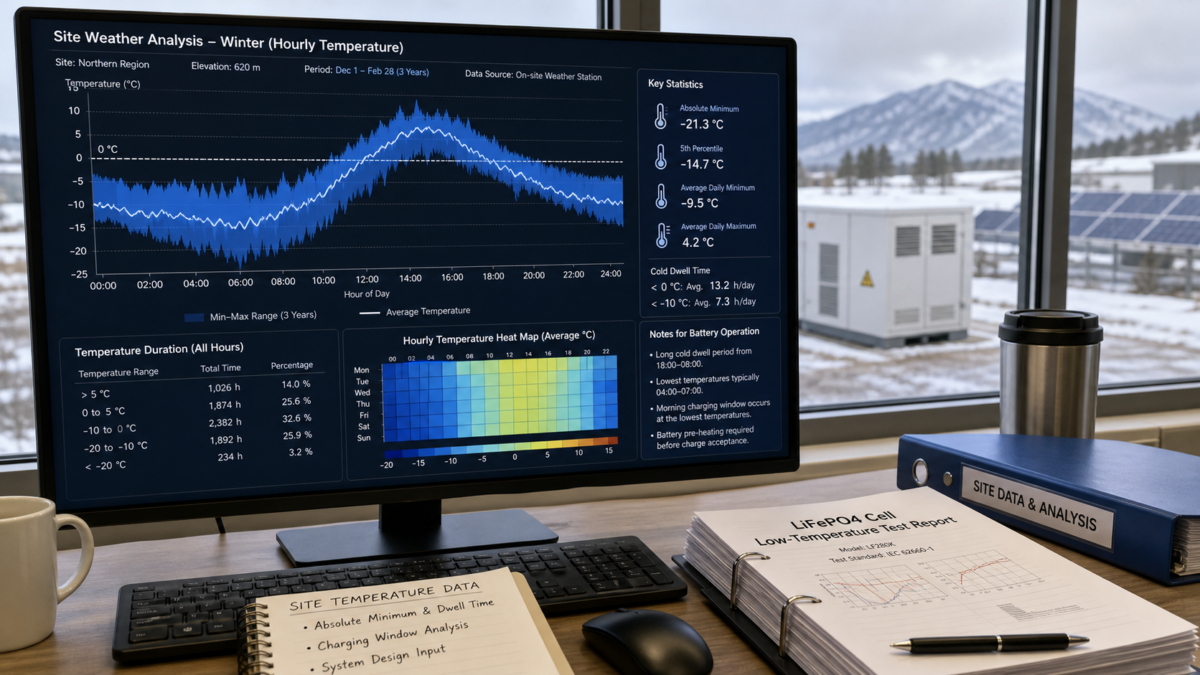
The first thing I ask for in a project is the site's temperature history, preferably as hourly data for the last few years. A simple "average low" for winter is useless to me. I need to know the worst-case scenario. How cold does it get, and for how long does it stay that cold? We call this "dwell time." A battery sitting at -10°C for eight hours is a completely different design problem than one that only dips below freezing for an hour before sunrise. I also need to understand the charging profile. For example, if it's an off-grid solar site, the system will need to accept a charge in the morning when temperatures are often at their lowest. The battery system must be able to safely heat itself before it starts accepting that charge current. This heating process uses energy from the battery itself, so you have to account for that loss in your overall energy budget. Without this granular site data, any system design is just a guess.
Which LiFePO4 Charging Low Temperature Assumptions Distort the Result?
We all use assumptions to simplify complex problems. But in battery system design, making the wrong assumptions can lead to commercial loss, equipment failure, and serious safety incidents.
The most dangerous assumption is that a battery's "low-temp chemistry" marketing name guarantees performance in your specific application. Also, assuming lab conditions match the field or that a BMS can prevent all damage are critical errors.
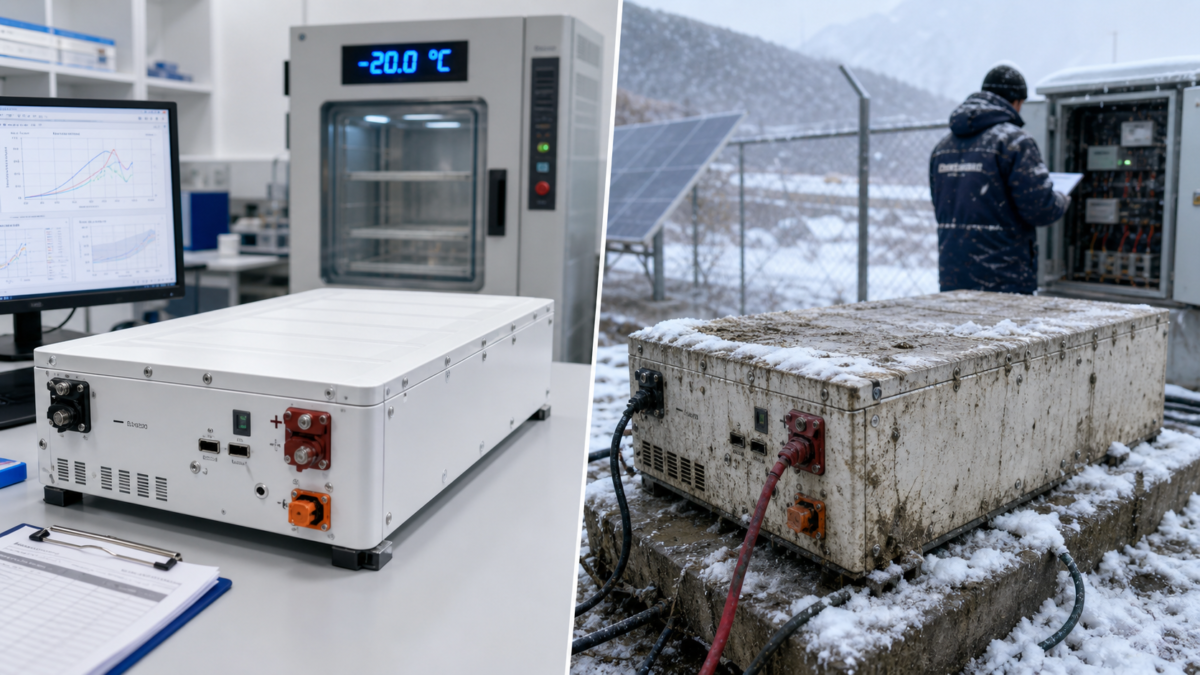
I have seen several assumptions consistently lead to poor outcomes. The first is believing that the Battery Management System (BMS) is a magic shield. A good BMS will have a low-temperature charging cutoff. It will prevent you from charging when it's too cold. But its sensors are measuring temperature in a few specific spots. Is the coldest cell in the pack right next to a sensor? Probably not. The BMS can reduce risk, but it cannot eliminate it, and it certainly cannot reverse damage that has already occurred from a previous mistake. Another bad assumption is that the performance shown in a test report from a lab will be what you get in the field. A lab test might be done on a new cell, at a constant temperature, with a specific charging rate. Your site has fluctuating temperatures, an aging battery, and variable charging from solar or the grid. That is why I demand to see the exact conditions of any test report. I want to know if they are even remotely similar to the conditions my project will face. The nameplate is not a substitute for evidence.
A Practical LiFePO4 Charging Low Temperature Selection Checklist?
You are ready to write a Request for Quotation (RFQ) for your project. A vague request will only get you a generic and potentially risky product. You need to be specific to protect your investment.
My practical checklist demands model-specific evidence. I would ask for third-party test reports applicable to your temperature range, cell traceability records, degradation curves under similar conditions, and a clear statement of the supplier's assumptions.
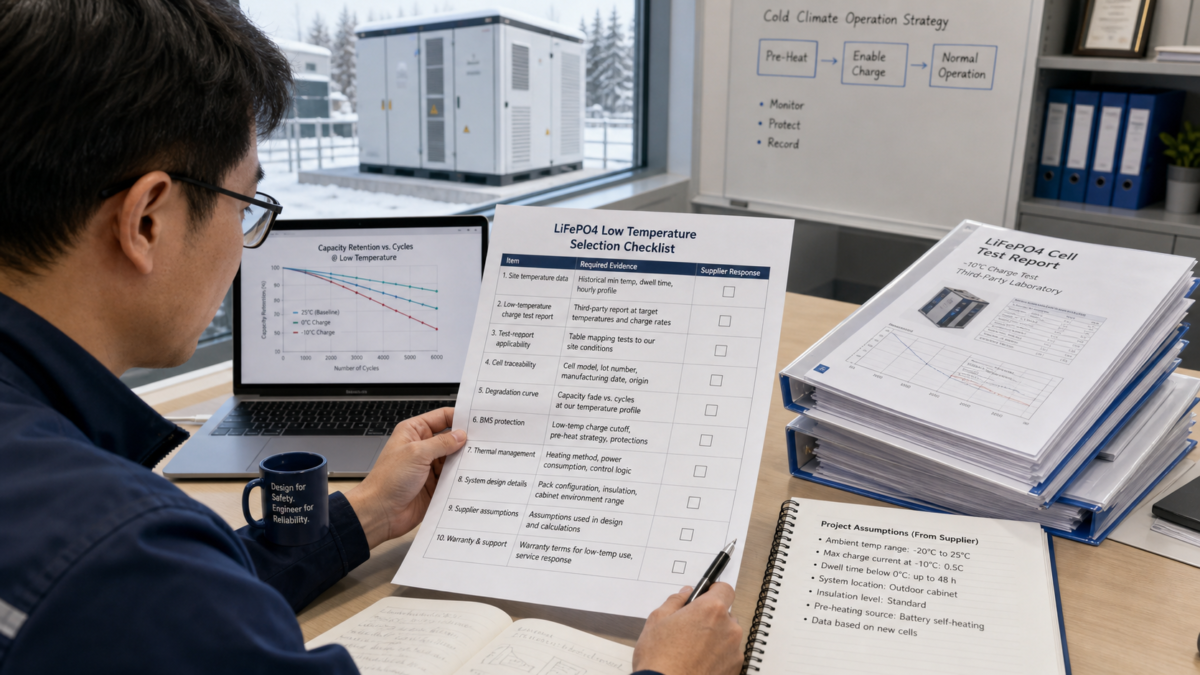
This is the level of detail I would require before I trusted a conclusion or used it in a formal RFQ. I would not just ask for a "low-temperature battery." I would treat it as a design and operating decision. Here are the exact items I would put in my specification. First, I would provide the supplier with my detailed site temperature data and my expected operating profile. Then, I would ask them to provide a solution and support it with specific documentation. I need to see a test-report applicability table that shows which tests they have done that are relevant to my site's conditions. I would ask for the traceability record for the cells to prove their origin and manufacturing consistency. I would also demand a degradation curve showing the expected capacity loss over time based on my site's temperature and cycling duty. Finally, and this is very important, I would require the supplier to give me a short, clear table of the assumptions they made in their calculations. Making the downside condition visible is key, especially where reliability and safety are on the line.
Conclusion
I treat low-temperature charging as a design and procurement task. To ensure safety, reliability, and value, you must demand model-specific evidence from your supplier for your unique site conditions.

Leave a Reply