

What Can Go Wrong with LiFePO4 Home Battery Wall Rack?
You've seen the sleek home battery racks online and think it's a simple upgrade. But hidden issues can turn your smart investment into a frustrating and costly problem.
Form factor and coupling architecture are the biggest risks. A wall rack that doesn't fit your space, can't be serviced easily, or is wired inefficiently for your solar setup can cause major headaches. Mismatched goals, like expecting huge savings from a system built only for backup, also lead to disappointment.
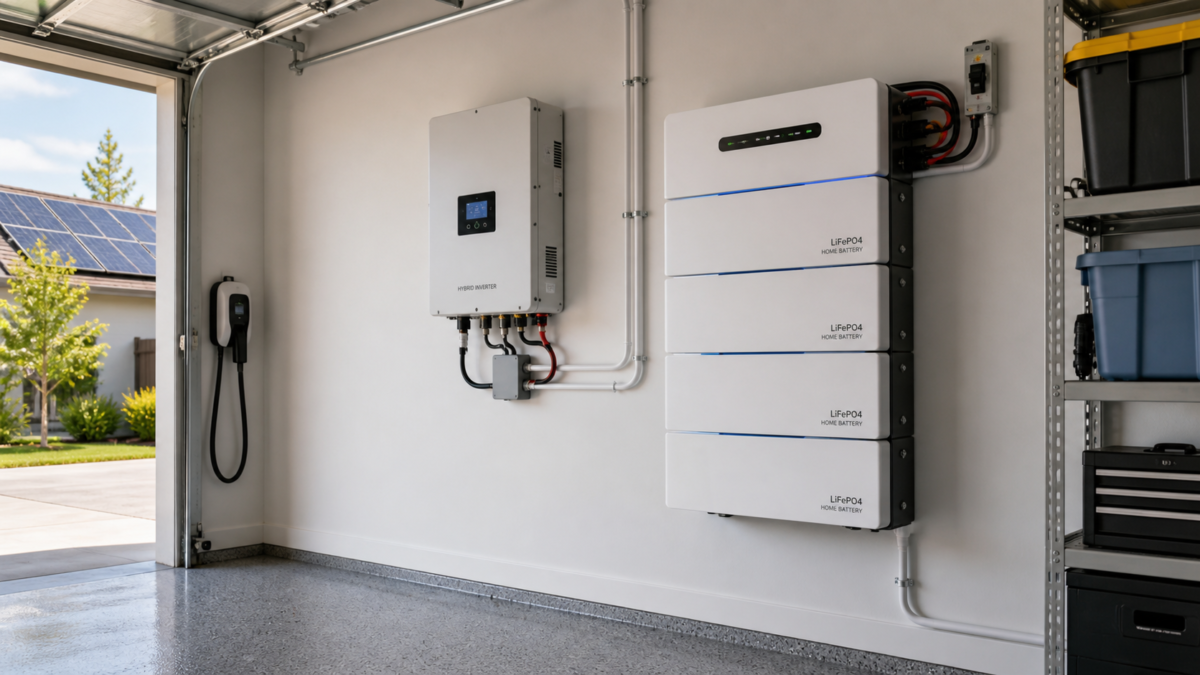
This isn't just about picking a product from a catalog. It's about making sure the hardware is the right fit for your home, your electrical system, and what you actually want to achieve. I've seen too many projects get complicated because of simple planning mistakes that were missed at the beginning. We need to dig deeper than just the battery's capacity or price tag. Let's look at the details that really matter and make sure you get it right the first time.
Why Is LiFePO4 Home Battery Wall Rack Harder Than It Looks?
The product photos show a clean, simple box on the wall, looking like a piece of modern art. But the reality involves checking wall strength, leaving enough clearance for cooling and service, and routing thick, heavy cables. Getting these physical and electrical details wrong is where projects fail.
It's harder because the physical form factor dictates everything else. A wall-mounted battery needs a strong, suitable wall with enough open space around it for air to circulate and for a technician to work. The system's coupling architecture—AC or DC—also completely changes the installation process and cost.
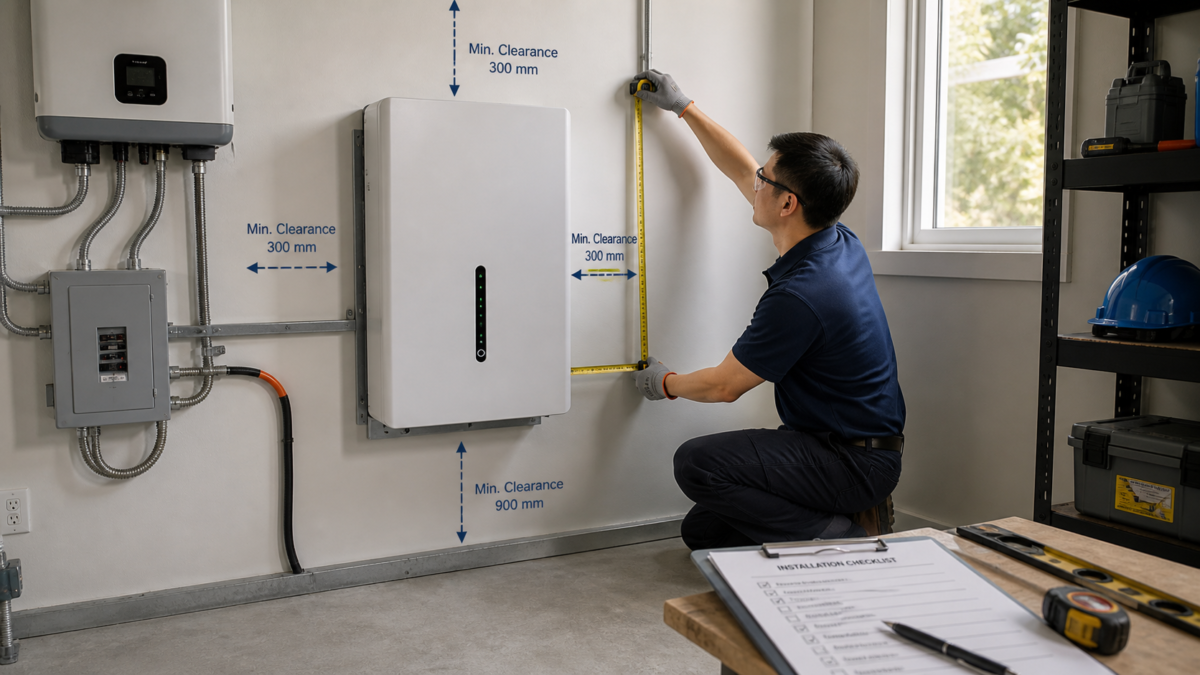
Let's break this down into the two parts that I see cause the most confusion: the physical fit and the electrical connection.
Form Factor vs. Reality
The first thing I check on a site visit is the wall itself. A fully loaded battery rack can weigh hundreds of pounds. You can't just hang it on any old drywall. It needs to be anchored securely to studs or a solid masonry wall. I once had a client who wanted a battery in a specific spot, but the wall was just an interior partition. We had to explain that without proper structural support, it was a non-starter. You also need to think about clearance. These units generate some heat and need airflow. The manual will specify a minimum distance on all sides. If you install it in a tight closet, it could overheat and shut down right when you need it most. And don't forget service access. A technician needs to be able to open the cover and get to the terminals.
The AC vs. DC Coupling Puzzle
The second big piece is how the battery connects to your home and your solar panels. This is called "coupling architecture." AC-coupled systems are generally easier to add to an existing solar installation. DC-coupled systems are often more efficient if you're installing the solar and battery at the same time. Neither one is universally "better"; they are just different tools for different jobs. The choice impacts efficiency, total cost, and how easily you can expand the system later.
| Factor | AC-Coupled System | DC-Coupled System |
|---|---|---|
| Best For | Adding a battery to an existing solar setup. | New solar and battery installations done together. |
| Efficiency | Slightly lower (more power conversions). | Generally higher (fewer power conversions). |
| Installation | Simpler wiring, connects to the main panel. | More complex, requires a compatible hybrid inverter. |
| Expansion | Easier to add more batteries from different brands. | Can be harder to expand unless planned for. |
What Site Data Is Needed to Evaluate a LiFePO4 Home Battery Wall Rack?
You know you need a battery, but you're not sure which numbers and measurements to collect first. Guessing on your energy needs or your home's voltage can lead to buying an undersized system that won't work, or an oversized one that wastes money. A few key data points will fix this.
To properly evaluate a system, you need four key pieces of site data: physical service access and clearance dimensions, your home's electrical service voltage, your actual daily usable energy requirement in kilowatt-hours (kWh), and the battery enclosure's environmental exposure (like temperature and humidity).
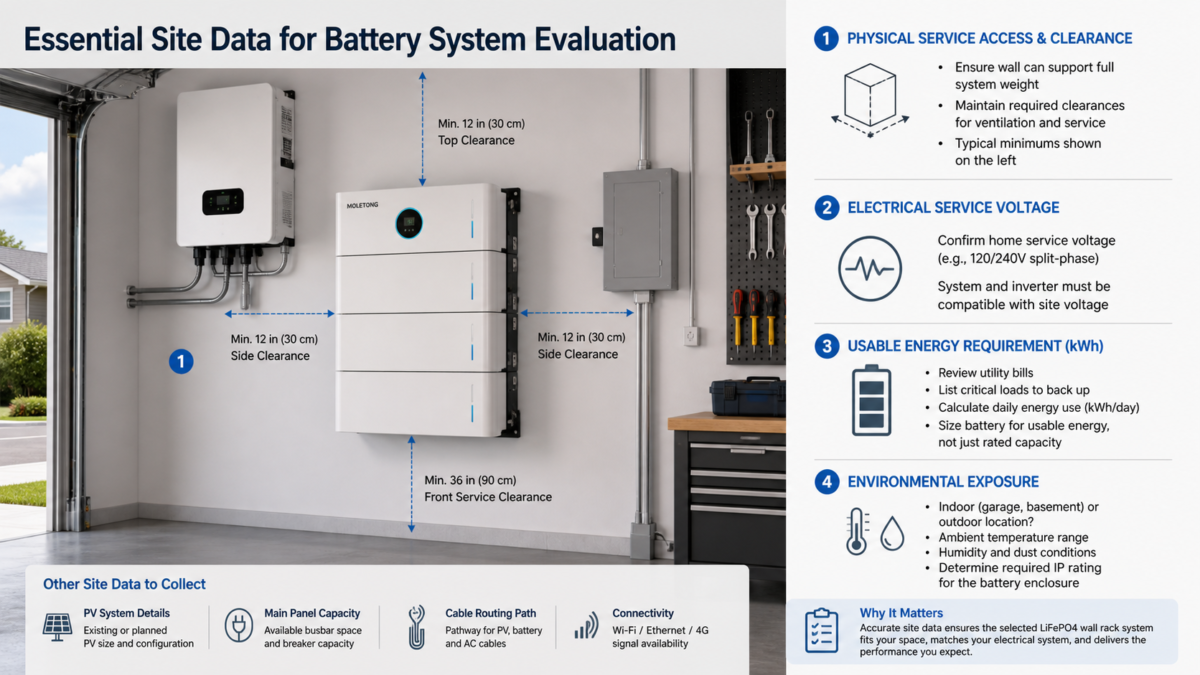
Before I even look at product spec sheets, I get this information from the client. It’s the foundation for a good recommendation. First, I need to know the physical space. I ask for photos and measurements of the proposed location, making sure there is enough room for the unit itself plus the required maintenance clearance—usually about three feet in front. Second is the site voltage. In the U.S., most homes use a 120/240V split-phase system, and the equipment must be compatible with that. Using a product designed for a different grid is a recipe for disaster. Third, we need to calculate the real-world usable energy needed. This isn't just a guess. We look at utility bills and list the specific "critical loads" you want to back up, like the refrigerator and some lights. We then calculate how much energy they use over 24 hours to size the battery correctly. Finally, I ask about the environment. Is the battery going in a climate-controlled garage or a dusty, damp basement? This determines the required IP rating for the enclosure to protect it from dust and moisture.
Which LiFePO4 Home Battery Wall Rack Assumptions Distort the Result?
Marketing materials often promise incredible savings and seamless, whole-home backup from a single product. But these perfect-world promises rely on assumptions that might not match your home, your utility rates, or your actual goals. Believing them can lead to disappointment.
The most distorting assumption is that a single battery system can perfectly achieve every goal—savings, resilience, and grid relief—at the same time. Other bad assumptions include expecting the battery's rated power continuously, ignoring the full installation cost, and believing future expansion will be simple.
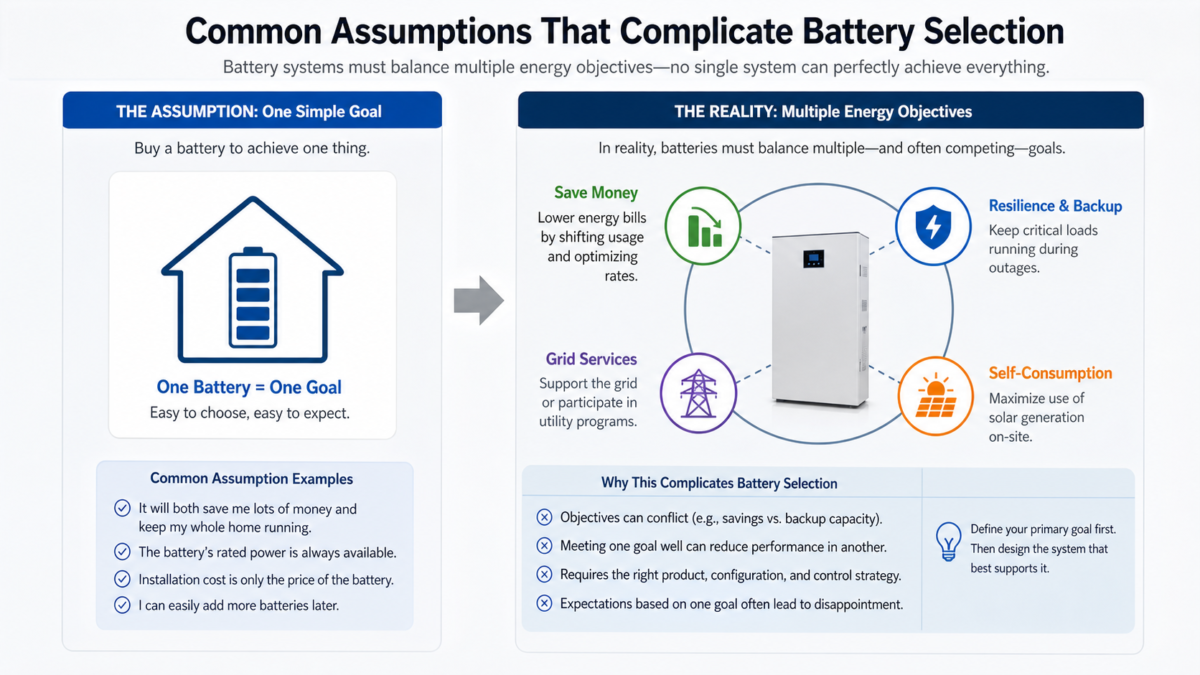
The first thing I do is clarify what the buyer really wants the battery to do. The goals are not interchangeable. A system designed for financial savings works by storing cheap nighttime or solar energy and using it during expensive peak hours. This requires a specific control strategy. A system designed for resilience, or backup power, needs enough capacity and power output to run your critical loads during a grid outage. These are often two different configurations. Trying to do both can be a compromise that does neither one well. Another bad assumption is that expansion is easy. Adding another battery pack a few years later isn't always plug-and-play. You might find that the model is discontinued, or that your inverter can't handle the extra capacity. I always advise clients that if they think they will need more storage in the future, it's far better to design the initial system with that in mind. I would never let a single glowing review or a neighbor's perfect install become a universal promise for a different home with different goals.
What Is a Practical LiFePO4 Home Battery Wall Rack Selection Checklist?
With so many different products and technical details, how can you make a final, confident choice? You don't want to get overwhelmed and miss a critical detail that leads to buying the wrong system for your needs. The solution is to use a simple, practical checklist.
First, clearly define your primary goal (e.g., backup for specific appliances). Next, confirm the physical fit, checking wall strength and service clearances. Then, compare the usable energy and power output of different models against your needs. Finally, review the total project cost, including all installation labor.
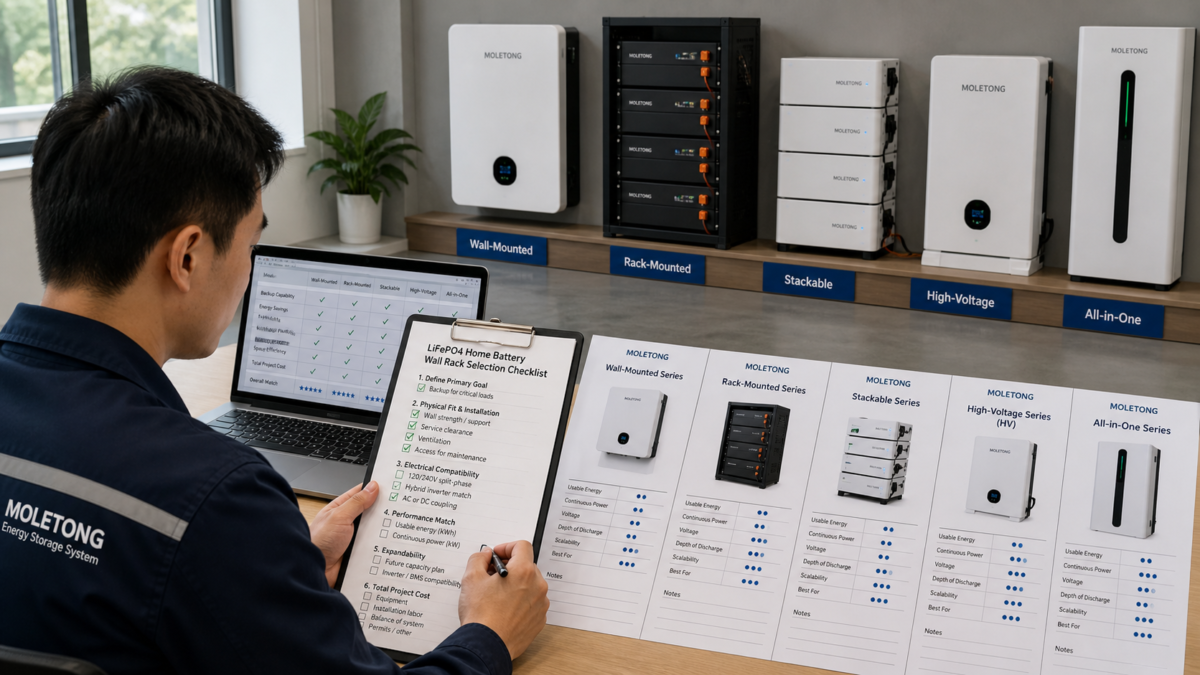
This process turns a complex decision into a series of simple steps. It’s exactly how I walk my clients through it. The goal is to match the right product form factor to the job. For example, within our Moletong product family, we have different designs for different situations. A sleek wall-mounted unit is great for a finished garage where looks matter and you need to save floor space. But a rack-mounted system might be better for a basement utility room where you have more space and might want to add more batteries later. A stackable system is even easier to expand. Each has its place. The key is to avoid picking the form factor first and then trying to make it fit. Instead, you let the site and the goal guide you to the right product.
| Moletong Form Factor | Best For | Key Site Consideration |
|---|---|---|
| Wall-Mounted | Finished spaces, saving floor space. | Requires strong wall support and service clearance. |
| Rack-Mounted | Utility rooms, server closets. | Needs adequate floor space and good ventilation. |
| Stackable | Easy expansion, scalability. | Requires a solid, level foundation for the stack. |
| High-Voltage | Higher efficiency and power output. | Must be paired with a compatible HV hybrid inverter. |
| Integrated | All-in-one simplicity. | A single unit contains the battery and inverter. |
Conclusion
Choosing the right battery rack is not about the box. It’s about matching your real goals to your specific site, and then selecting the right form factor to prevent future problems.
Leave a Reply