

Where Does Electrolyzer Create the Greatest Risk?
You're planning a green hydrogen project, but the numbers don't feel right. The promises of high capacity seem disconnected from the operational challenges you know are coming.
The greatest risks in an electrolyzer project are not in the core stack technology itself. They are found in the system interfaces: the water supply, the variable power input, the hydrogen compression and storage, and the committed offtake. These external factors can quickly make a project unbankable or inoperable.
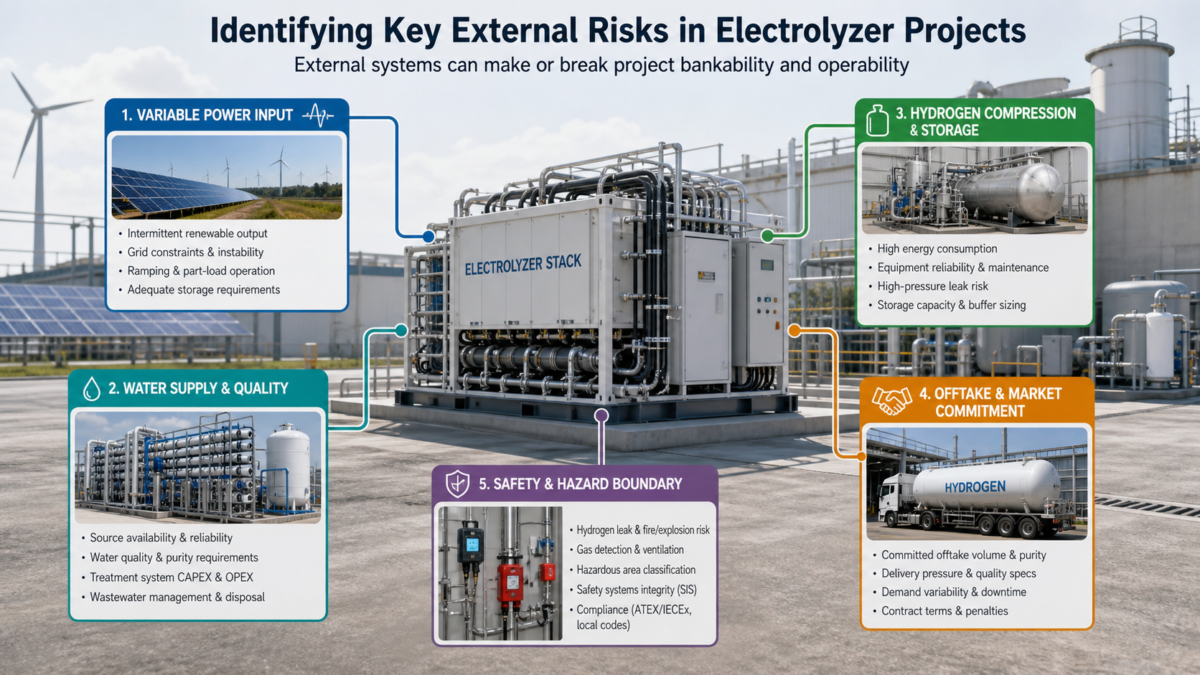
The nameplate capacity of an electrolyzer tells you what it can do under ideal lab conditions. The site conditions, balance of plant, and offtake agreements determine what it will do in the real world. My approach has always been simple: define the buyer's required outcome, find the constraint that can defeat it, and then test the whole design with real site inputs. Announced capacity is not the same as committed offtake, operability, or bankability. Let's look at why focusing on water, compression, offtake, and the safety boundary can reverse an apparently obvious answer and lead to a successful project.
The Operational Reality Behind Electrolyzer?
You see a 100 MW electrolyzer advertised with impressive output figures. But intermittent renewables and real-world demand can slash its actual production, making the investment questionable.
The operational reality is that an electrolyzer's output is governed by its weakest link. This includes variable renewable power, downtime for maintenance, and inconsistent demand from offtakers. Announced capacity rarely equals actual, bankable hydrogen production without a robust, fully simulated system design.
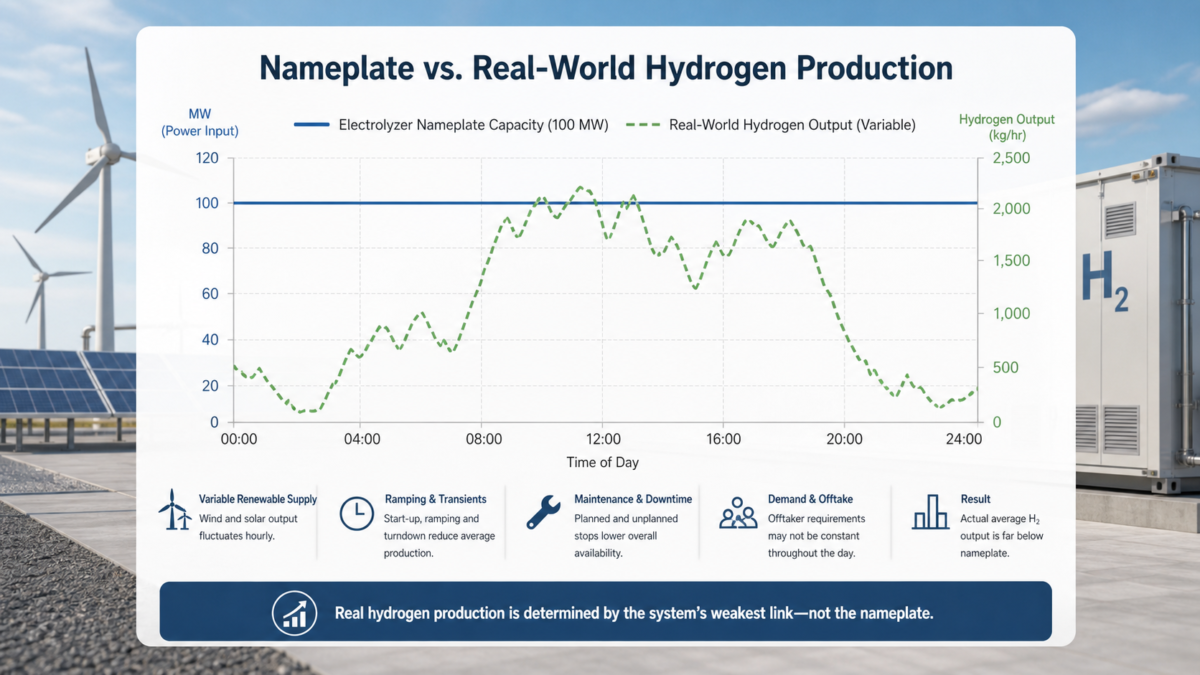
I always start with the offtake agreement, not the electrolyzer spec sheet. A buyer needs a certain volume of hydrogen, at a specific purity and pressure, on a reliable schedule. That is the required outcome. The electrolyzer is just one tool to get there. The problem is that its power source, usually wind or solar, is not reliable. This mismatch between variable supply and steady demand is the central challenge. This is where an hourly simulation becomes non-negotiable. I would model an entire year of site-specific weather data against the electrolyzer’s ability to ramp up and down. This reveals the true capacity factor, not a theoretical one. It also shows how much battery storage is needed to smooth out the power and maximize production hours. For example, Moletong's focus on integrated wind, PV, electrolyzer, and storage systems is a direct response to this operational reality. It acknowledges that these components cannot be designed in isolation.
From Nameplate to Reality
The gap between the brochure and the bankable reality can be significant. A quick look at the key parameters shows where the risks hide.
| Parameter | Nameplate Specification | Operational Reality |
|---|---|---|
| Capacity | 100 MW | Limited by real-time renewable power availability and grid constraints. |
| H2 Output | ~2,000 kg/hr | Average output is much lower due to variable input and ramp-up/down times. |
| Uptime | >98% (Stack) | Overall system uptime is lower due to maintenance on compressors, purifiers, and power systems. |
| Power Source | DC Power | Requires complex AC/DC rectifiers and is subject to grid harmonics and instability. |
Ultimately, an interface map is critical. It forces a practical discussion about every connection: electrical, water, gas, and data. Without it, you are just buying a machine. With it, you are building a production facility.
Why Water Changes the Design?
Electrolyzers need water, which seems simple. But water quality, quantity, and the cost of treating it can become a major project constraint, halting progress before it even begins.
Water quality directly impacts electrolyzer performance and lifespan. Impurities foul membranes and electrodes, demanding extensive, costly purification systems. The availability and cost of sourcing and treating large volumes of water can become a primary constraint, fundamentally altering project feasibility and design.
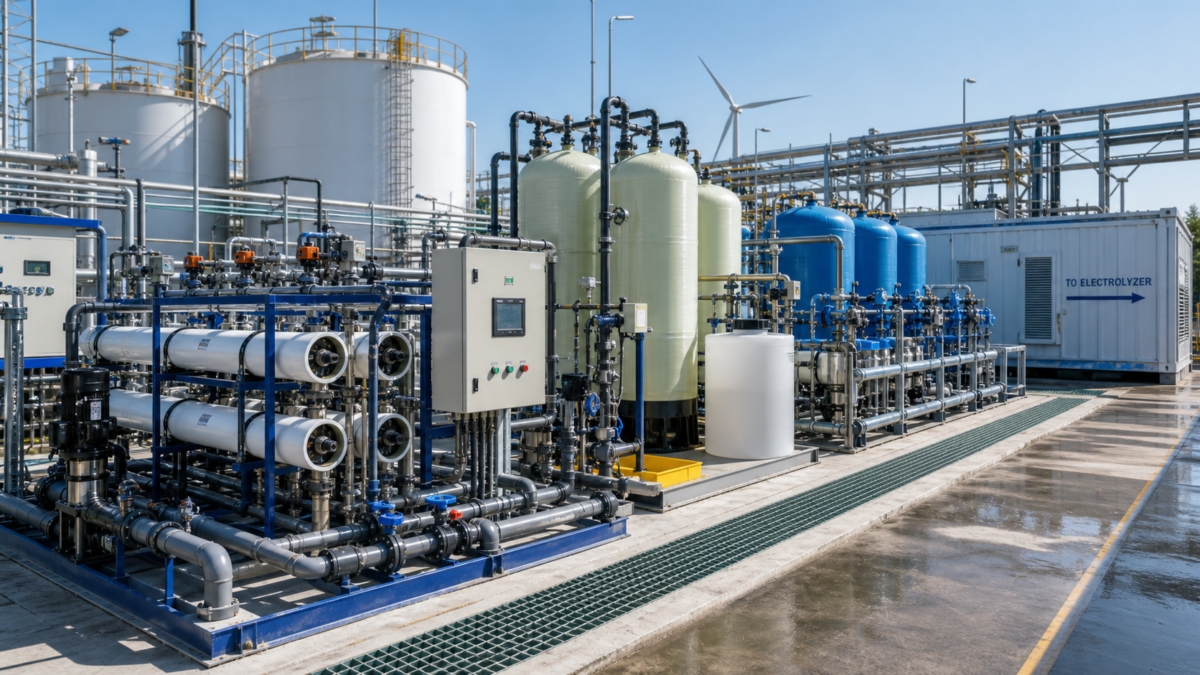
I once reviewed a project where the electrolyzer was perfectly sized for the renewable power source. The economics looked solid. The problem was the water. The only local source was brackish groundwater with high mineral content. The project team had budgeted for a simple filter system, but the electrolyzer OEM required ultrapure, deionized water. The cost of the multi-stage reverse osmosis and deionization plant needed to meet that specification was so high that it completely destroyed the project's financial model. This is not an unusual story. You need about nine liters of water to make one kilogram of hydrogen. But that's nine liters of pure water at the electrolyzer inlet. To get that, you might need to process 12 or 15 liters of raw water, depending on the efficiency of your treatment system. This water treatment facility is a significant part of the Balance of Plant (BOP). It has its own footprint, its own power consumption, and its own maintenance schedule. Ignoring it in the early design stages is a recipe for failure. A detailed mass-and-energy balance is essential. It must account for the raw water input, the pure water output, the wastewater stream, and the energy needed to run the entire purification process.
Balancing Performance, Safety, and Serviceability in Electrolyzer?
Everyone wants maximum hydrogen output from the smallest possible footprint. But pushing performance can compromise safety and make routine maintenance nearly impossible, leading to costly downtime.
The key is integrating these three elements from day one. High-pressure operation improves downstream efficiency but increases risks from hydrogen leaks. Compact designs save space but can make servicing components difficult and dangerous. A successful design considers the entire lifecycle, not just peak performance metrics.
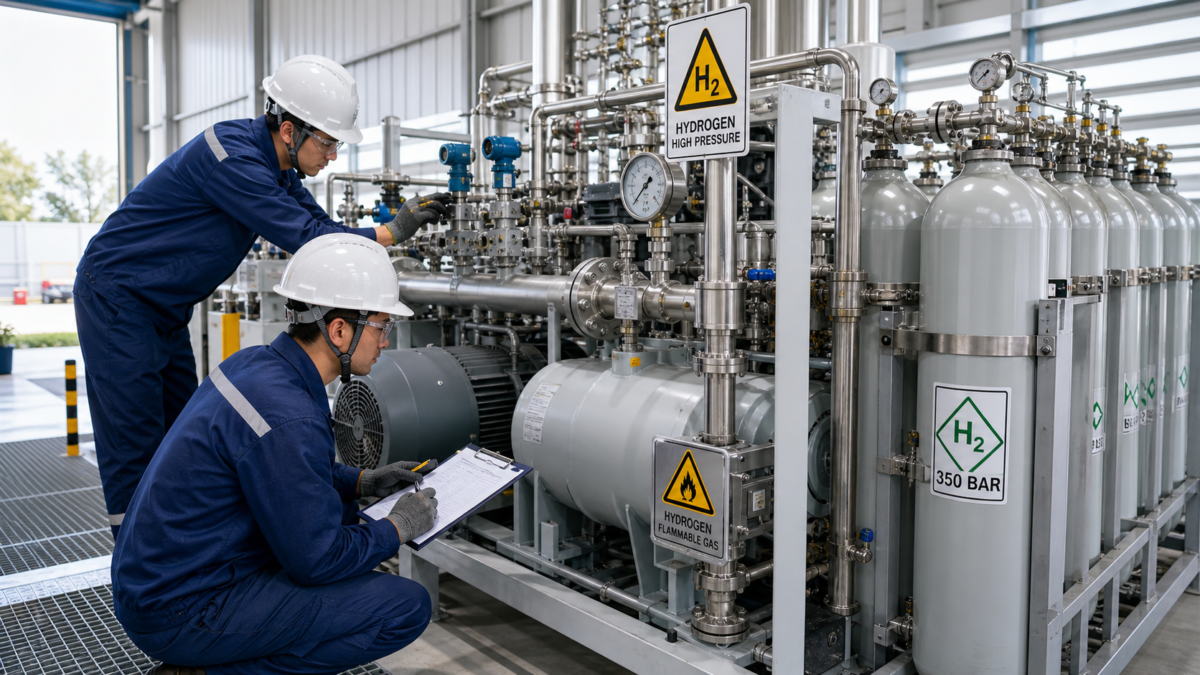
My focus immediately goes to the safety boundary and the hydrogen compression. An electrolyzer producing hydrogen at 30 bar is one thing. But if the offtaker needs it at 350 bar for a refueling station, you have a major energy and safety island in between. The compressors needed for this are power-hungry and a significant maintenance item. More importantly, this is where the highest risk of a hydrogen leak exists. The design must include robust ventilation, gas detection, and defined hazard zones (ATEX/IECEx). I always ask to see the P&ID (Piping and Instrumentation Diagram) and the HAZOP (Hazard and Operability) study. These documents tell the real story of how safety is managed. Then there's serviceability. I've seen beautifully compact, containerized systems that look great in a sales presentation. But when a pump seal fails, you find out it takes two days and a special crane to access it because it's buried behind a wall of pipes. A good design provides clear access for routine checks and component replacement. This is where experience with integrating complex systems, like Moletong’s work in containerized energy storage, provides practical insight. The design must be built for the technicians who will keep it running for 20 years, not just for the team that commissions it.
What to Confirm for Electrolyzer at Design Review and Handover?
The final design review seems complete, and all the boxes are checked. But have you tested the design against the messy reality of your specific site and offtake contract?
Confirm the system's response to real-world inputs, not just ideal specifications. You must verify the mass-and-energy balance, the interface map between all subsystems, and the offtake assumptions. Demand to see pilot data and clear documentation on the conditions that would change the recommendations.
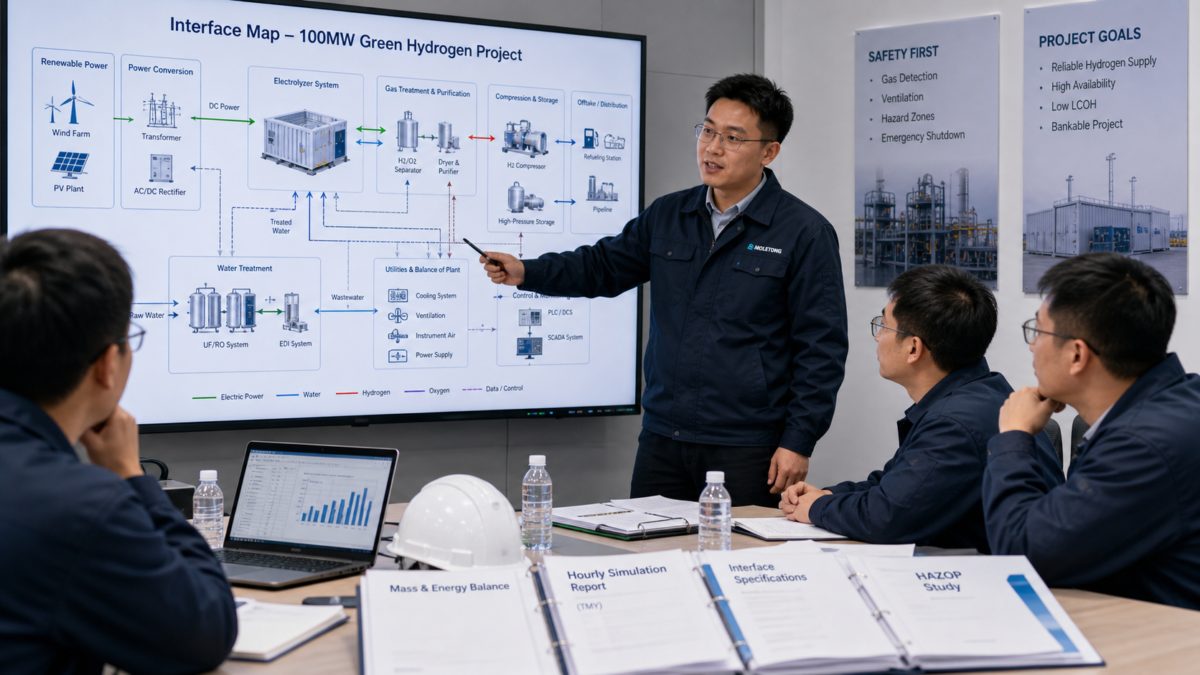
Before I would ever sign off on a handover, I need a specific set of documents that prove the design is grounded in reality. This isn't about distrusting the supplier; it's about professional diligence to ensure the project is bankable and operable. First, I want the full mass-and-energy balance. It must show all inputs (power, raw water) and all outputs (hydrogen, oxygen, waste heat, wastewater) under various operating loads. Second, I need the complete hourly simulation for a typical meteorological year at the site. This demonstrates how the integrated system—renewables, storage, and electrolyzer—actually performs over time. Third, I require a detailed interface map. This document should define the exact specifications at every connection point: voltage and frequency stability from the grid, water pressure and purity from the treatment plant, and hydrogen pressure and flow rate to the compressor. Fourth, the offtake assumptions must be explicit. Is the demand constant or variable? What happens if the offtaker shuts down for a week? Finally, I always ask under what conditions the supplier would change their recommendation. This reveals their confidence in the design and highlights the remaining risks.
Conclusion
The biggest electrolyzer risks are not in the core technology. They are in the system integration. Focus on water, power variability, offtake, and safety to ensure a bankable project.
Leave a Reply