

How Much Additional Are You Paying to Have Whole House Backup Power?
Choosing whole-house backup power feels complex, and the price tags can be confusing. You see battery capacity numbers but don't know what they mean for your home during an outage.
The additional cost for whole-house backup is driven by your home's measured energy use and the choices you make during an outage, not just the battery's price. Runtime is a direct result of which appliances you keep running, turning it into a controllable expense, not a fixed number.

I've seen many people get hung up on the kilowatt-hour (kWh) rating of a battery, thinking it's a simple guarantee of runtime. But that single number doesn't tell the whole story. The real answer to how much you're paying for peace of mind comes from a much more personal place: your own habits and your home's specific electrical loads. The good news is that we can move this decision from guesswork to a clear, calculated plan.
This article is my attempt to walk you through the exact process I use to determine battery runtime. My goal is to show you that the final result isn't a universal promise. It's an outcome based on transparent reasoning. I want to help you see when a certain conclusion applies to your project and, just as importantly, when it does not.
How Can You Reframe Battery Backup Runtime as a Measurable Decision?
Thinking about battery runtime can feel like a complete guess. A simple kWh rating on a spec sheet can be very misleading and lead you to buy a system that's too small or too big.
You can reframe runtime by shifting focus from battery capacity alone to your home's real energy budget. It becomes a measurable decision based on which specific circuits you back up, their measured power draw, and how you plan to use electricity during an outage.
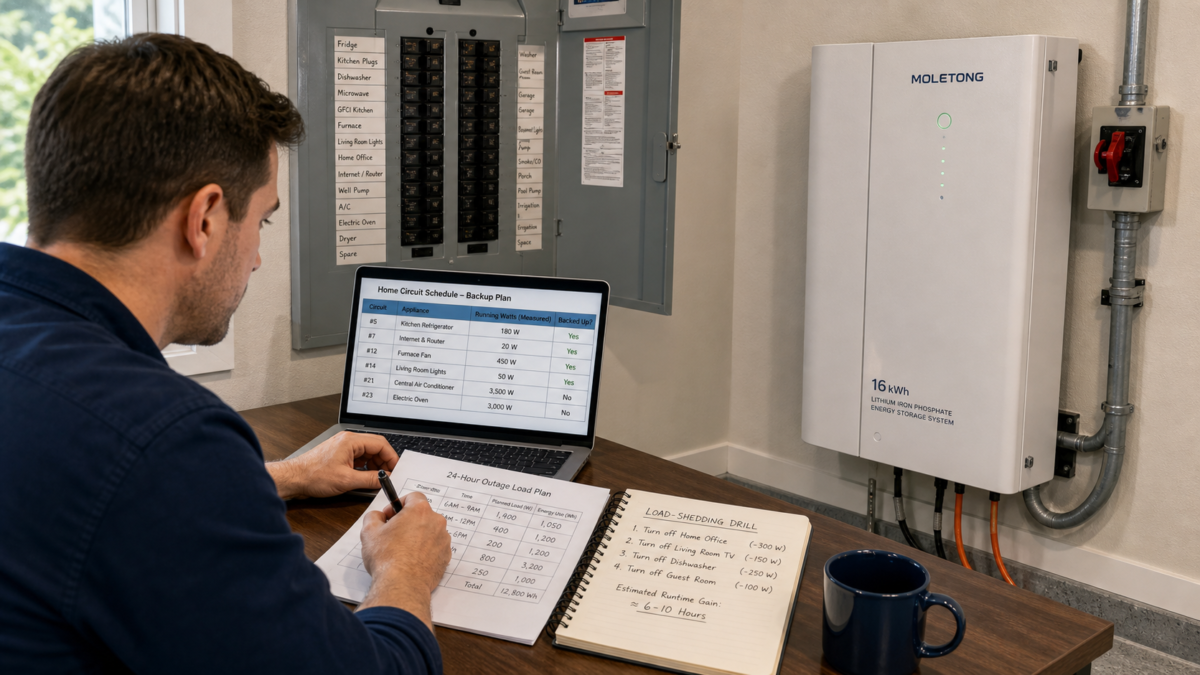
The key is to stop thinking of runtime as a feature you buy and start seeing it as an outcome you create. A battery's capacity, measured in kWh, is like the size of a gas tank. But the miles you can drive—your runtime—depends entirely on how heavily you press the accelerator. Your home's electrical load is that accelerator. For example, my Moletong 16 kWh residential battery holds a fixed amount of energy. But the runtime it provides can vary from just a few hours to more than a day. The difference comes down to a simple list: a circuit schedule.
Your Backup Choices Determine Your Load
Before anything else, we must decide what needs to stay on. Below is a simplified example of how this decision directly changes your total load, and therefore, your runtime.
| Circuit | Appliance | Running Watts (Measured) | Backed Up? |
|---|---|---|---|
| #5 | Kitchen Refrigerator | 180 W | Yes |
| #7 | Internet & Router | 20 W | Yes |
| #12 | Furnace Fan | 450 W | Yes |
| #14 | Living Room Lights | 50 W | Yes |
| #21 | Central Air Conditioner | 3,500 W | No |
| #23 | Electric Oven | 3,000 W | No |
By choosing not to back up the central air conditioner and electric oven, the homeowner immediately reduces their continuous load from thousands of watts to just a few hundred. This single choice dramatically extends the runtime of the 16 kWh battery. It's not magic; it's a measurable decision.
What Data Do You Need to Evaluate Battery Backup Runtime Without Guesswork?
You know you need data for an accurate estimate, but it's hard to know what to collect. Without real numbers, you risk under-sizing your system or over-paying for capacity you don't need.
To remove the guesswork from runtime evaluation, you need four key pieces of information: a detailed circuit inventory, the measured running watts for essential appliances, your area's typical outage duration, and the desired State of Charge (SOC) reserve for safety.
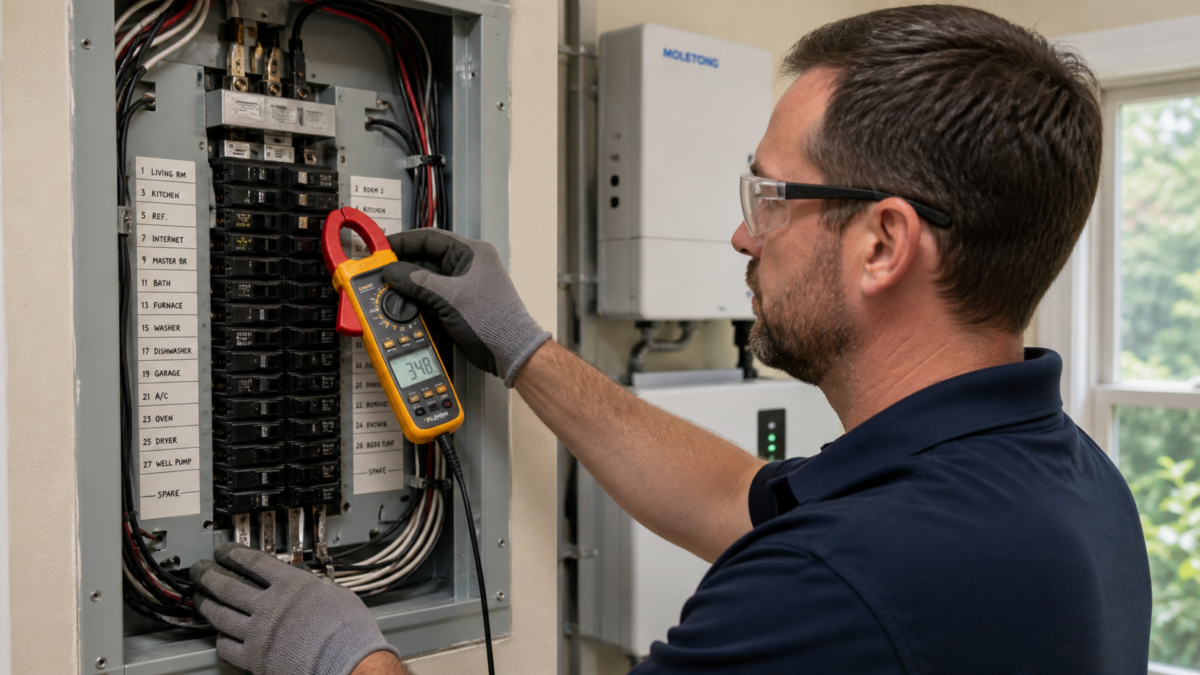
When I work on a project, I don't rely on assumptions. I insist on gathering hard data because it's the only way to build a reliable backup plan. First, we create a load inventory by going through your circuit breaker panel and identifying what every single breaker controls. This tells us what we have to work with. Second, and this is critical, we measure the actual running watts of your key appliances. The sticker on your refrigerator doesn't tell you how much power it uses on average; a power meter does. A modern fridge might only pull 150-200 watts, but it cycles on and off, so we need to understand its real-world consumption. Third, we have to be realistic about outage duration. Are you preparing for a 4-hour brownout or a 48-hour storm recovery? The target matters. Finally, I always plan for a reserve State of Charge (SOC). I never advise running a battery down to 0%. Keeping a 20% reserve protects the battery's health and gives you a safety buffer. For a 16 kWh battery, this means our planning is based on a usable capacity of 12.8 kWh, not the full 16.
How Does Motor Surge Change the Risk Profile?
Many people are caught off guard by the hidden power demand of large motors. This sudden surge can easily overload your system and trip the inverter, leaving you in the dark exactly when you need power most.
Motor surge, also called inrush current, is a brief but massive power spike when an appliance like a well pump or A/C unit starts. It changes the risk profile by demanding high peak power (kW) from the inverter, which is a separate consideration from the battery's energy capacity (kWh).
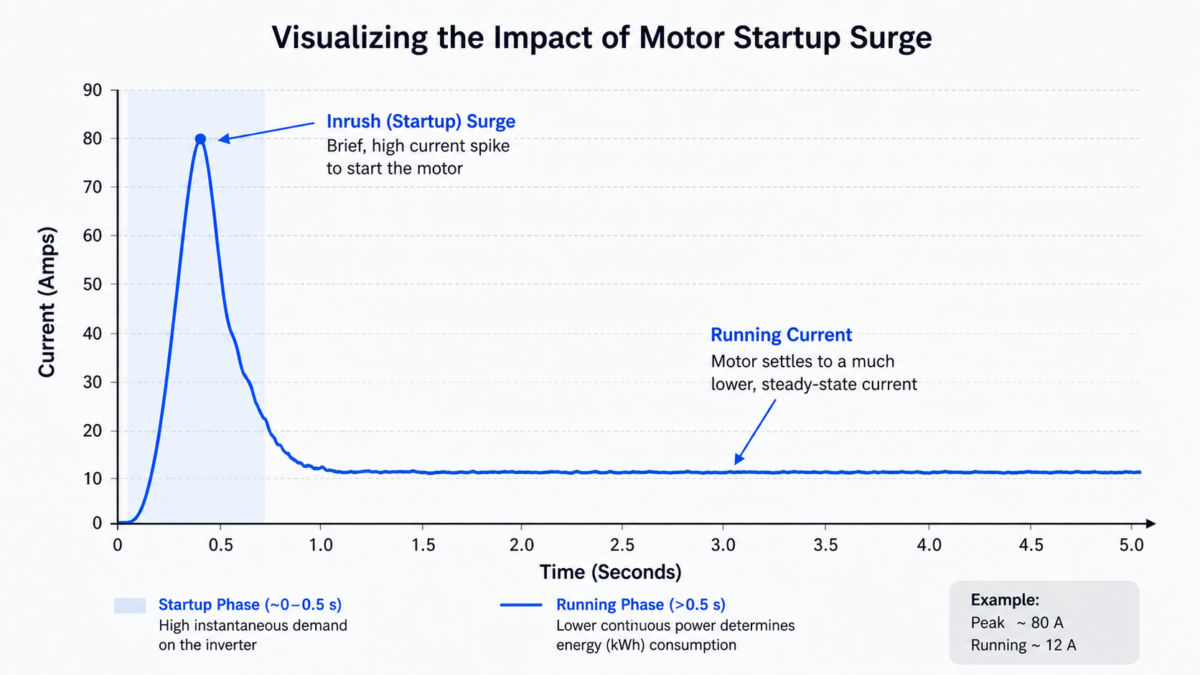
This is one of the most misunderstood aspects of battery backup. Your battery provides energy (kWh), but your inverter delivers power (kW). They are two different things. A large motor, like the compressor in a central air conditioner or a well pump, can have a running load of 2,000 watts but require a surge of 6,000 watts or more for less than a second to get started. If your inverter isn't rated to handle that peak demand, it will shut down to protect itself. This creates a significant risk. Your battery might be 90% full, but if the inverter can't handle the startup surge of your A/C, you won't be able to run it. This is a major reason why true "whole-house backup" is often more expensive and complex than a "critical loads" system. Sizing an inverter to handle the surge from a 4-ton A/C unit significantly increases cost. It forces a tough decision: pay a lot more for an inverter that can handle the surge, or change the plan to exclude that appliance from the backup system. It’s a risk you manage with either money or a conscious choice.
What Are the Final Checks Before Approving Battery Backup Runtime?
You've done the math and have a plan on paper, but are you truly prepared? A theoretical plan can easily fail in a real outage if it hasn't been tested against reality.
Before finalizing your system, run two critical checks. First, map out a realistic 24-hour outage timeline to see how your energy needs change. Second, conduct a hands-on "load-shedding drill" to practice turning off non-essential circuits to extend your runtime.
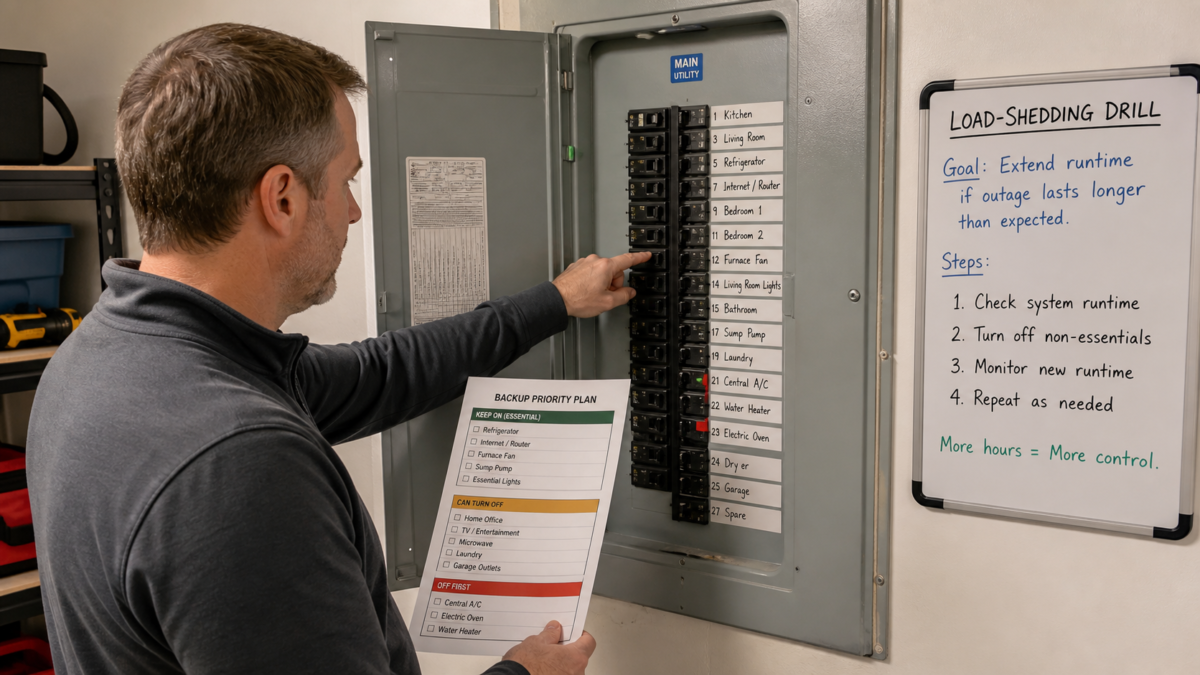
This is where the plan becomes real. First, I have clients walk through a hypothetical 24-hour outage. We map it out. In the morning, you might use 1,500 watts for 30 minutes to make coffee and toast. During the day, your load might drop to just 200 watts for the fridge and internet. In the evening, it might climb to 800 watts for cooking and lights. This exercise proves that your energy consumption is dynamic, not a flat number, which helps refine the runtime estimate. The second check is what I call the load-shedding drill. We go to the breaker panel together. I'll say, "Okay, the power is out. With your current usage, the system estimates 12 hours of runtime. But the utility says it could be 24 hours. Let's make a change." We then physically turn off the breaker for the home office. The system updates: now we have 18 hours. We turn off the circuit for the living room TV. Now we have 22 hours. This simple practice turns an abstract concept into a tangible skill. It gives you control and shows that runtime isn't just a number—it's a resource you can actively manage.
Conclusion
The true cost of whole-house backup power is a function of your measured loads and your operating choices, not just a battery's kWh rating. Make a plan with real data.

Leave a Reply