

What Can Go Wrong with Battery Customs?
Worried about your custom battery order? Hidden costs and shipping delays can turn a good deal into a total disaster.
Things go wrong when buyers focus only on the ex-works price. Problems arise from unclear warranties, missing certificates, weak support plans, and a mismatch between the battery and its real-world application. Prioritizing landed lifecycle risk is key to avoiding these issues.

I have seen many battery customs projects run into trouble. The practical lesson I always take away is that the landed lifecycle risk matters much more than the lowest ex-works price. It's a simple idea, but it changes everything. If you start by chasing the lowest sticker price, you often end up with a system that doesn't fit your needs or fails early. My approach is different. I would not begin with a product recommendation at all. I would start by talking about the warranty, the escalation process for problems, the destination rules, and the necessary certificates. Most importantly, I want to understand the outcome the buyer actually needs. This changes the conversation entirely and helps everyone involved.
This approach makes it much easier to separate a genuine technical constraint from a poor assumption or an unrealistic expectation. You quickly find out if a limitation is based on physics or just a supplier's unwillingness to provide proper support. It puts the focus on what's real and what's required for the project to succeed long-term. In the end, this focus on the complete picture gives the buyer a clear decision path. It helps you make a smart choice without turning one public experience into a misleading marketing claim for or against a supplier. It's about a repeatable, documented process.
Defining Success for Battery Customs?
Think you found the perfect battery supplier? A low price means nothing if the system fails to meet your actual operational needs.
Success isn't the lowest price; it's getting the right outcome. This means the battery performs as needed for its entire lifecycle, backed by a clear warranty, specific destination rules, and a solid escalation process for any issues that arise.

When I talk about success in a battery project, I'm talking about achieving a specific, measurable result for the business. This goes far beyond just getting a container of batteries delivered to the port. The real goal is a reliable energy asset that performs a specific job—like peak shaving or providing backup power—for a contracted number of years. It's a shift from thinking about a one-time purchase to investing in a long-term capability. To do this right, we have to define success with clear metrics that cover the entire lifecycle of the system. This means looking at the total cost of ownership, not just the initial purchase price.
From Price to Performance
The initial focus is almost always on the ex-works price. But this is a narrow view. A truly successful project is defined by its long-term performance and reliability. I guide clients to evaluate proposals based on a much broader set of criteria that reflect the total value and risk.
Key Success Metrics
Here’s a table showing how I reframe the definition of success away from simple cost-cutting toward a more holistic, risk-aware perspective.
| Traditional Metric (Price-Focused) | Lifecycle Metric (Outcome-Focused) |
|---|---|
| Lowest Ex-Works Price | Lowest Total Landed Lifecycle Cost |
| Basic Product Specs | Verified Performance in Target Application |
| Standard Warranty Included | Warranty Terms Aligned with Use Case |
| Supplier Promises | Documented Local Support Plan |
What Evidence Is Needed to Evaluate Battery Customs?
Are the supplier's claims actually believable? Without real proof, you're just buying promises, not a reliable energy system for your business.
You need hard evidence. Go beyond the marketing materials and request model-level documents, project contracts from previous jobs, a signed Factory Acceptance Test (FAT) report, the full packing dossier, and a detailed local support plan.

Claims are easy to make, but a professional supplier should be able to back them up with documentation. When I evaluate a potential partner for a battery project, I treat it like an investigation. My goal is to verify everything. If a company claims to have a certain manufacturing capacity, I want to see the proof. If they claim their product meets a specific standard, I need to see the certificate, and I need to check that it’s valid for the specific model and destination country. This process of due diligence isn't about being difficult; it's about managing risk. I would start by building a complete due-diligence file. This file becomes the foundation for my recommendation. It’s not based on feelings or a good sales pitch. It’s based on a collection of documents that tell the real story of the product and the company behind it.
This document matrix should include everything from corporate registrations to specific project contracts. I want to see the signed Factory Acceptance Test (FAT) for the actual equipment being purchased. I also ask for the packing dossier to understand how the equipment will be protected during transit. Finally, I need to see a local support plan. This is critical. It tells me what happens if something goes wrong after installation. I explain to the client the limits of the comparison based on the documents we have. I also state what new information could change my recommendation. This creates a transparent and defensible decision-making process.
The Trade-Off Between Warranty and Application?
Does your warranty actually cover you? Many warranties contain fine print and exclusion clauses that make them useless if your application is too demanding.
A strong warranty is tied directly to the application. The trade-off is clear: a lower price might come with a limited warranty that doesn't cover your specific use case. A realistic warranty aligns with genuine technical constraints.

The warranty is one of the most important parts of any battery supply agreement, but it's also one of the most misunderstood. People often just look at the number of years and assume they are covered. But the reality is much more complex. The warranty is a contract that is only valid under specific operating conditions. If you operate the battery outside of those conditions—the defined "application"—the warranty can be void. This is where the trade-off becomes very real. A supplier offering a very low price might be doing so because their warranty has very strict limitations. They are betting that your application will fall outside those limits, absolving them of responsibility.
My job is to get this discussion out in the open from the very beginning. I work with the buyer to clearly define the intended application in technical terms: charge/discharge rates, daily cycles, operating temperature, and more. Then, we present this application profile to the potential suppliers and ask them to provide a warranty that explicitly covers it. This simple step makes it easy to separate a genuine technical constraint from a poor assumption. If a supplier says, "Our battery cannot support that C-rate," that's a technical fact we can work with. But if they say, "Our standard warranty doesn't cover that," it opens a negotiation about what it would take to get the right coverage. It forces an honest conversation about risk and responsibility.
How to Compare Battery Customs Proposals on Equal Terms?
Juggling multiple quotes for a custom battery? Comparing them based on price alone is a recipe for expensive mistakes down the line.
To compare proposals equally, you must look past the ex-works price. Create a comparison matrix to evaluate the total landed lifecycle risk. This includes warranty terms, escalation paths, destination rules, valid certificates, and verified manufacturer claims for each proposal.
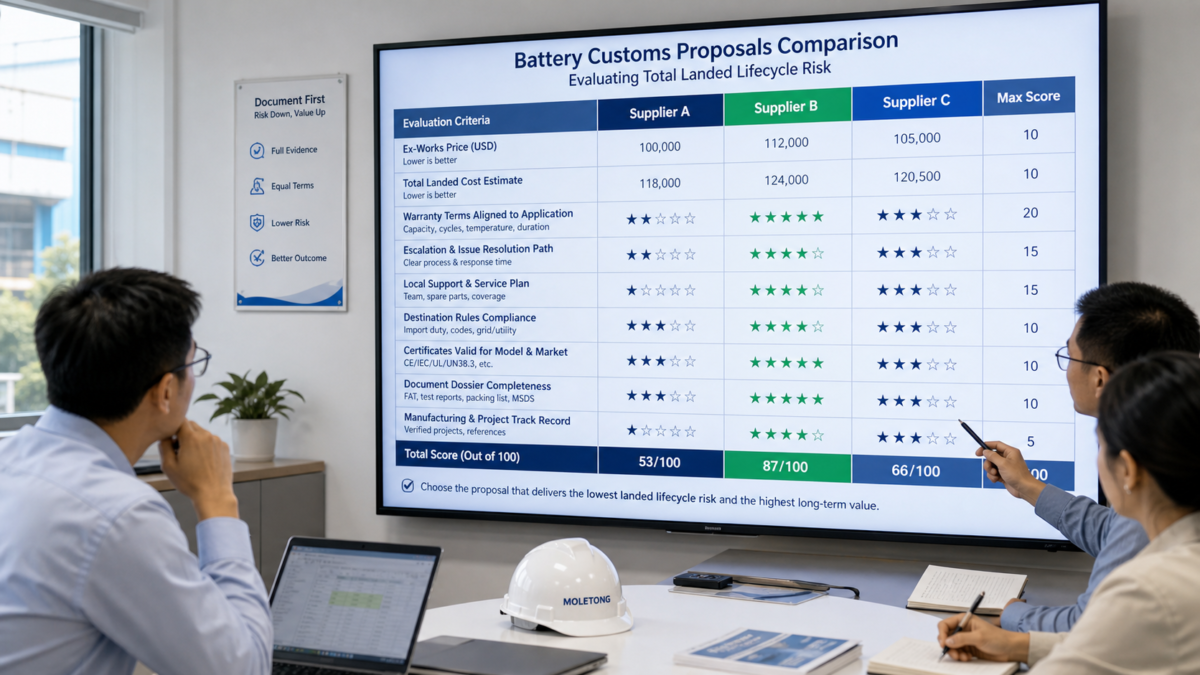
When you have several proposals on your desk, the natural tendency is to look at the bottom-line price and pick the lowest one. I strongly advise against this. It's a classic mistake that focuses on a single data point while ignoring dozens of other factors that determine the true cost and risk of the project. To make a smart decision, you have to compare the proposals on truly equal terms. This means creating a structured framework that accounts for all the elements that contribute to the landed lifecycle risk. I use a simple document matrix or spreadsheet to do this. It allows me to line up the proposals side-by-side and score them on the factors that really matter for long-term success.
This method transforms the decision from a simple price comparison into a comprehensive risk assessment. It makes the trade-offs visible. For example, Supplier A might be 10% cheaper but offers no local support and has a restrictive warranty. Supplier B costs more upfront, but they provide a full document dossier, a warranty tailored to the application, and a contracted local partner for service. The matrix makes it obvious that Supplier B, despite the higher initial price, represents a much lower overall risk. This structured approach provides a clear, data-driven path to a decision. It protects the buyer from being swayed by a low price that hides significant downstream costs and problems.
Conclusion
Focus on landed lifecycle risk, not just the initial price. A thorough due-diligence process based on hard evidence leads to a reliable outcome.

Leave a Reply