

What Should Buyers Verify About Lfp Battery Energy Storage Safety?
Relying on a "safe chemistry" label is a gamble. This vague assurance often masks real-world risks. I will show you how to move beyond labels and verify safety with evidence.
To truly verify LFP battery safety, buyers must review model-specific abuse-test reports, cell temperature history, operating C-rate data, and supply chain traceability records. Nameplate chemistry alone is not sufficient evidence for a safe and reliable energy storage investment.
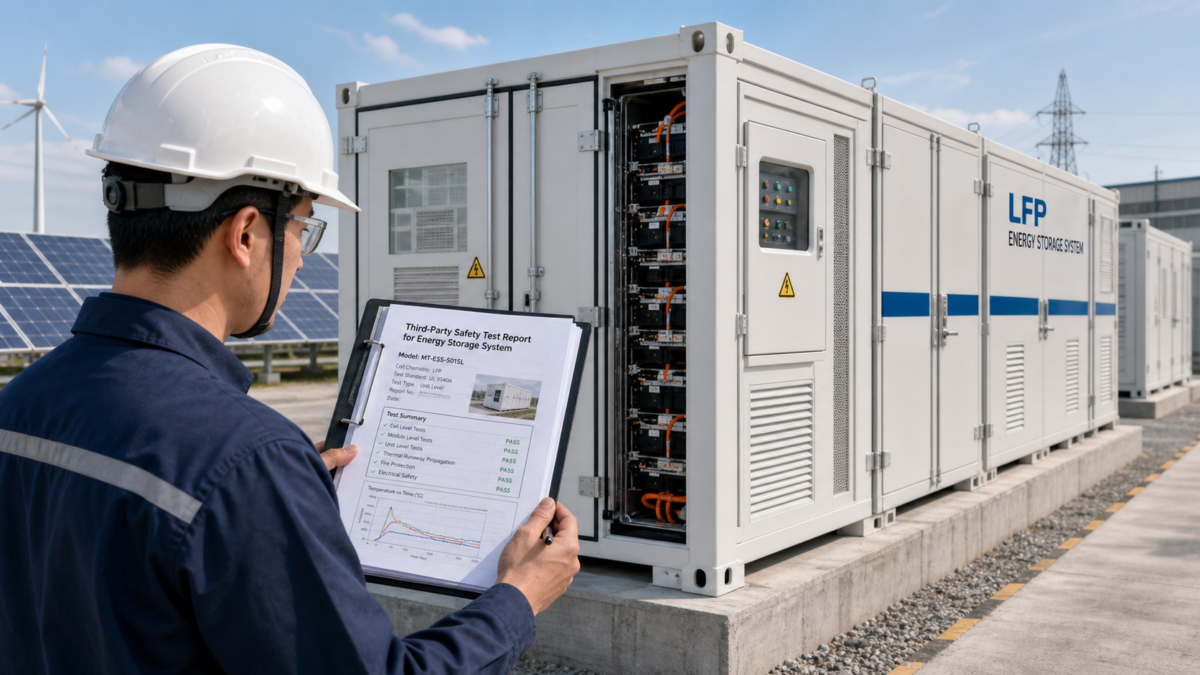
I have seen too many buyers make decisions based on a three-letter acronym: LFP. They are told it's the "safe" choice, and the conversation often stops there. This is a mistake. Safety is not a feature you can select from a dropdown menu. It is the result of a specific design, manufacturing process, and a deep understanding of how a system will behave in your exact environment. In this post, I will walk you through the practical steps and specific data points I use to evaluate the safety of any LFP battery system, so you can make a decision based on evidence, not assumptions. This process will empower you to ask the right questions and demand the right proof.
How can we reframe LFP battery energy storage safety as a measurable decision?
Safety often feels like a vague, unquantifiable concept. You might be tempted to rely on brand reputation or chemistry labels alone. This approach is nothing more than guesswork.
You reframe safety by focusing on measurable data. Compare model-specific abuse-test results, degradation curves under various temperatures, and documented operating limits. This process turns an abstract risk into a calculated business decision you can stand behind.
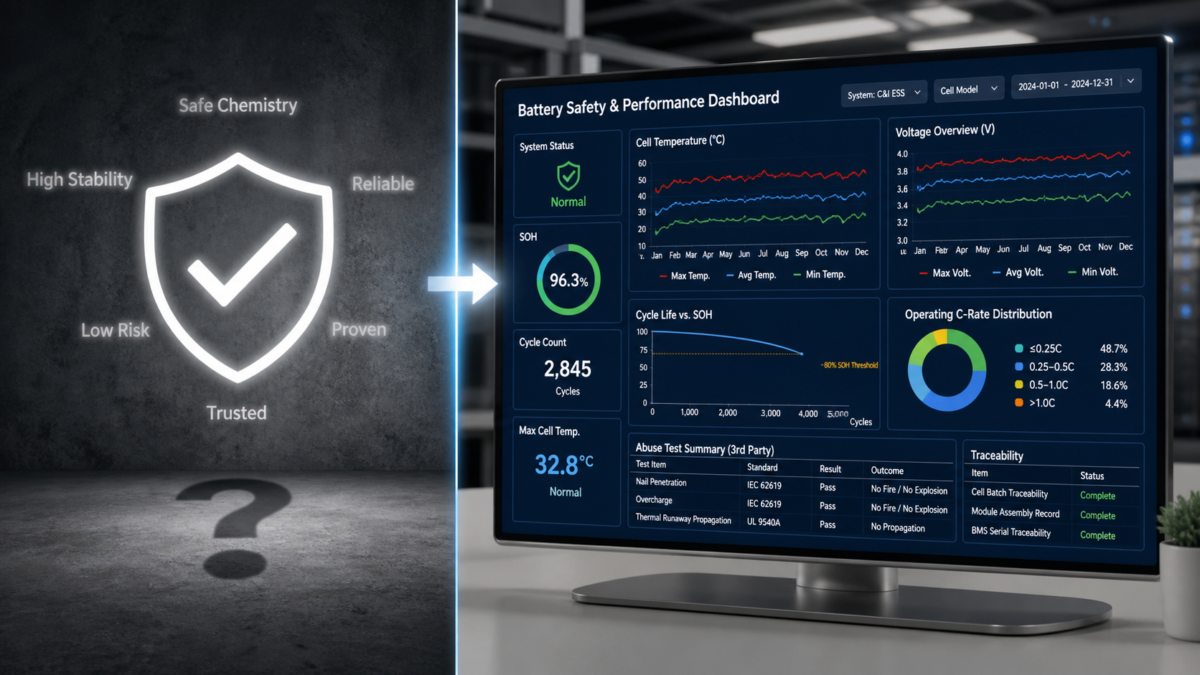
My position is simple: the nameplate chemistry is not a substitute for model-specific lifetime and safety evidence. "LFP" is a broad category, not a uniform product. Two LFP batteries from different manufacturers can have wildly different safety profiles based on their specific cell design, electrolyte, and BMS controls. I once evaluated two systems for a project in a hot climate. The first supplier gave me a glossy brochure that said "Safe LFP Chemistry." The second gave me a full UL 9540A test report and cycle life data at 45°C. The decision was obvious. Before I even compare products, I look at the assumptions behind their safety claims. I built a simple table to organize my thoughts.
| Assumption to Check | Why It Matters | What to Ask For |
|---|---|---|
| Operating Temperature | High temps accelerate degradation and increase risk. | Degradation curves at your site’s average and peak temperatures. |
| C-Rate | Aggressive charging/discharging creates thermal stress. | Cycle life data at the C-rate your application requires. |
| Abuse Tolerance | A datasheet doesn’t show what happens when things go wrong. | Third-party reports for nail penetration, overcharge, and thermal runaway. |
I always test a conservative operating case. Instead of using the manufacturer's most attractive numbers, I model the system's performance based on my site's real-world, and sometimes harsh, conditions. This gives me a much more realistic picture of the long-term safety and financial return.
What data is needed to evaluate LFP battery energy storage safety without guesswork?
Datasheets always showcase perfect lab conditions. But your project site is not a lab. Relying only on marketing materials leaves you guessing about real-world performance and safety.
You need third-party abuse-test reports for the specific model, cell-level temperature history logs, and cycle life data at different C-rates and temperatures. This evidence shows how the battery performs under stress, not just in an ideal environment.
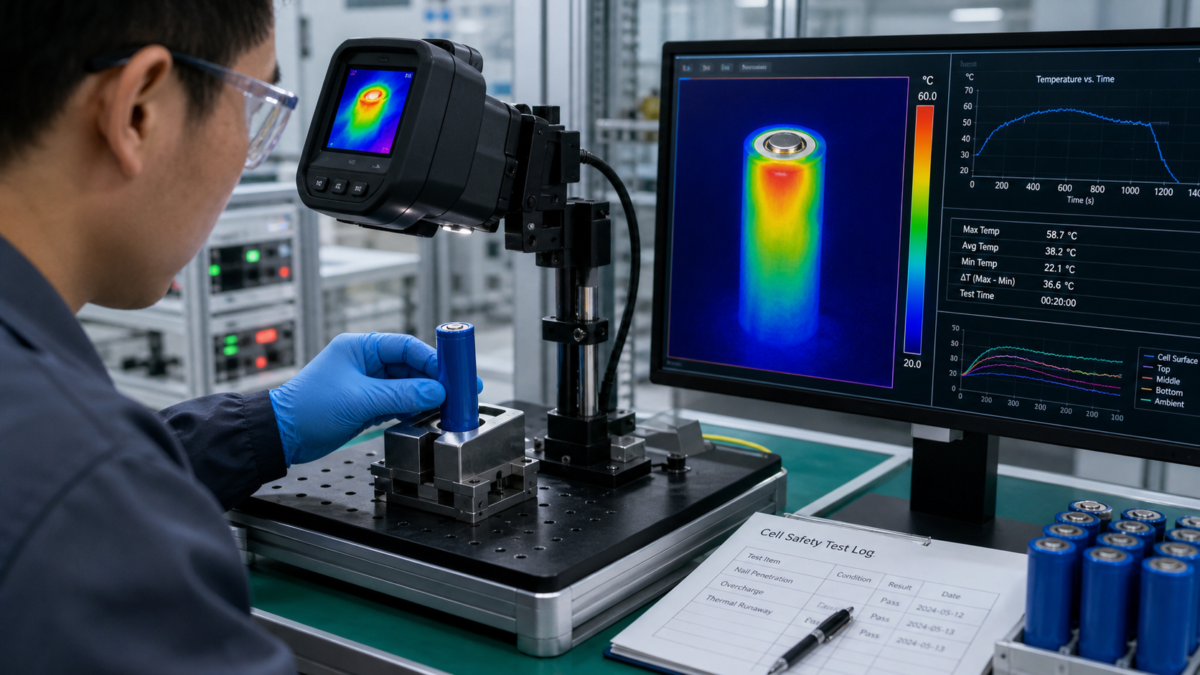
To get beyond guesswork, I demand a specific set of documents. First are the abuse-test reports. I look for certifications like IEC 62619 and, crucially, system-level tests like UL 9540A that evaluate thermal runaway propagation. These reports tell me what happens when a cell fails. Does the fire spread to the rest of the module or container? I need to know the answer. Next, I dive into the cell's history. I want to see temperature data and C-rate profiles from long-term testing. This tells me how the battery has been treated and how it's likely to degrade. A battery consistently operated at high temperatures or aggressive C-rates will have a shorter, less reliable life.
When a manufacturer like Moletong provides information on their specific LFP or semi-solid state technology, I treat it as company-published data for that model only. It is not a universal claim about the entire chemistry category. I ask them for the same evidence: show me the test reports and operational data for the exact system I am considering buying. This data-first approach removes the marketing spin and focuses the conversation on verifiable facts.
How does traceability change the risk profile?
You might approve a system based on a golden sample that passed every test. But how do you know the unit you receive is built with the exact same cells? This uncertainty is a massive, often invisible, risk.
Full traceability from cell manufacturing to final assembly transforms the risk profile. It provides auditable proof that the battery you buy matches the one that was tested and certified. This eliminates the risk of unverified components compromising system safety.
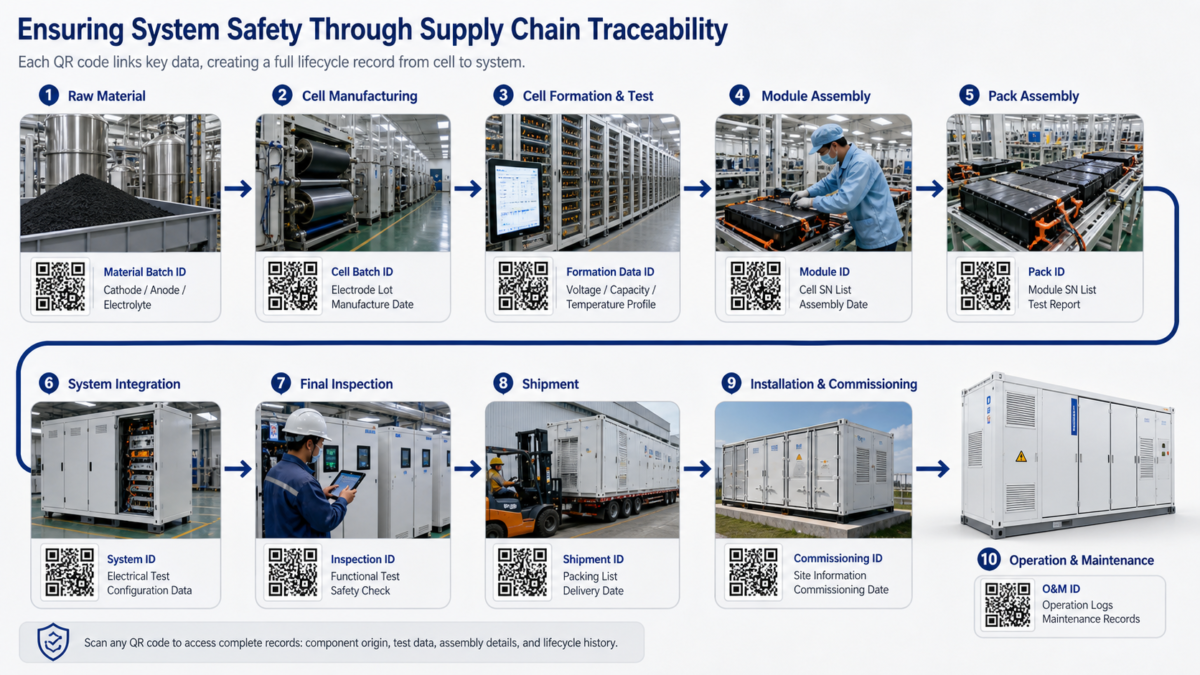
Traceability sounds complicated, but it is a fundamental part of risk management. A proper traceability record links the serial number of your energy storage system directly back to the specific batch of cells inside it. It should include the cell manufacturing date, the raw material lots used for the anode and cathode, and the results of quality control checks at each stage. This creates an unbroken chain of evidence. I worked on a project where a supplier, under cost pressure, switched to a cheaper cell provider halfway through our order. The new cells had a slightly different chemical composition and did not perform as well in high temperatures.
We only found out after two units showed accelerated degradation. The project suffered significant delays and financial losses. Had we demanded a complete traceability record for each unit delivered, we would have immediately seen the component change. It would have triggered a mandatory re-verification process, protecting us from the failure. Traceability is not just about paperwork; it is about guaranteeing that the safety and performance you paid for are what you actually receive. It changes the risk from a blind guess into a manageable, documented process.
What are the final checks before approving LFP battery energy storage safety?
You have collected all the data and reviewed the reports. Now what? It is easy to get overwhelmed by the technical details and miss the most important question: does this evidence apply to my project?
Create a concise decision checklist for your final review. Use a simple table to compare the test report's conditions against your site's reality. Review the temperature data and degradation curve, and verify the traceability record. This ensures your decision is a perfect fit.
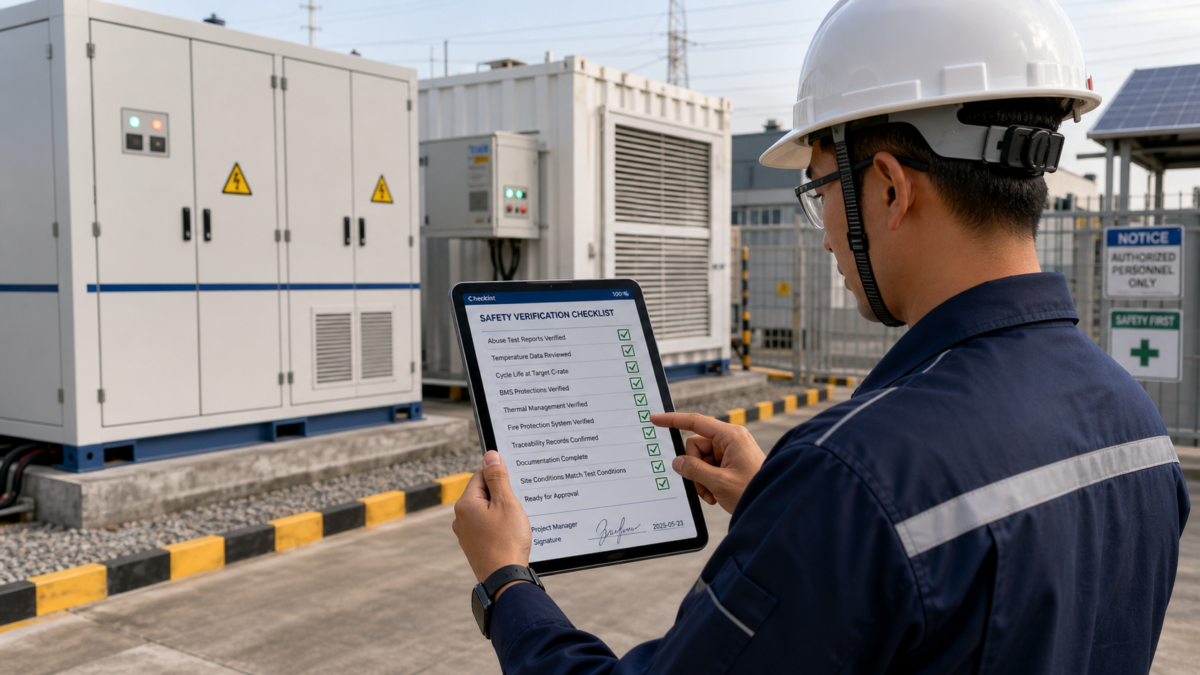
Before I give final approval, I consolidate everything into a simple applicability table. This is my last sanity check to make sure I haven't overlooked a critical mismatch between the test environment and my actual installation site. It prevents me from copying a conclusion that may not fit my specific needs. For example, a system might have great test results from a lab in a cool climate, but those results mean very little for my project in a desert. The table helps me spot these gaps instantly.
Here is a simplified version of what I use:
| Parameter | Test Report Condition | My Project’s Condition | Is There a Gap? |
|---|---|---|---|
| Ambient Temperature | Tested at 25°C | Average 35°C, Peak 45°C | Yes, significant. Request high-temp data. |
| Operating C-Rate | Tested at 0.5C | Requires frequent 1C peaks. | Yes. Need 1C cycle life and safety data. |
| Cell Manufacturer | CATL Model X | Supplier confirms CATL Model X. | No. Verified via traceability record. |
This final, structured check moves the decision away from a feeling and into a fact-based approval. I review the degradation curve one last time, confirm the traceability record is complete, and then I can sign off with confidence. This simple checklist allows me to repeat the same rigorous evaluation every single time.
Conclusion
Verifying LFP safety requires model-specific data, not chemistry labels. Use a structured, evidence-based process to make a measurable, site-specific decision and eliminate dangerous guesswork from your investment.
My Role
About me
Brand Name: Moletong
Slogan: Carbon Neutrality, Tracking the Future
Website: www.moletong.com
Company Overview
Established in 2011 and headquartered in Dongguan, Guangdong, we are an integrated new-energy equipment enterprise specializing in energy storage systems, complete electrical equipment, photovoltaic solutions, charging infrastructure, and hydrogen-energy solution integration.
We integrate R&D, manufacturing, sales, system configuration, and technical service to support utility-scale, commercial and industrial, and residential energy applications. Our solutions are designed around practical customer needs such as peak shaving and valley filling, electricity-cost optimization, transformer-capacity support, emergency backup, renewable-energy integration, intelligent energy management, and photovoltaic-storage-charging coordination.
Our Core Business
1. Energy Storage Systems & Equipment
We develop lithium iron phosphate energy-storage products for utility-scale, commercial and industrial, residential, and integrated charging applications. Our documented portfolio includes liquid-cooled containerized energy-storage systems, commercial and industrial storage cabinets, residential battery systems, storage-and-charging systems, BMS, PCS, and EMS functions.
2. Complete Electrical Equipment
We provide complete high- and low-voltage electrical products, including gas-insulated ring-main units, high-voltage switchgear, low-voltage withdrawable and fixed switchgear, power-distribution cabinets, meter boxes, box-type substations, charging-station substations, and busbar-trunking systems.
3. Photovoltaic & Integrated Energy Solutions
We provide photovoltaic supporting equipment and system solutions, including 35 kV step-up substation equipment, photovoltaic combiner cabinets, adjustable mounting structures, photovoltaic-storage integration, and equipment support for grid connection, power transmission, and microgrid applications.
4. Charging & Hydrogen-Energy Solution Integration
We provide AC and DC charging solutions, storage-and-charging systems, and photovoltaic-storage-charging integration for industrial parks, commercial parking facilities, transport hubs, and locations with limited grid or transformer capacity. We also develop hydrogen-energy integration concepts involving renewable hydrogen production, hydrogen storage, refueling, and hydrogen-electric coupling. Specific hydrogen products, certifications, production capacity, and completed projects must be confirmed separately.
Product Applications & Technology Focus
Primary Service Industries:
Our principal customer sectors include Industrial and Commercial Energy Users, Renewable-Energy Developers, Power and Electrical Engineering, EV Charging Infrastructure, Commercial and Public Facilities, and Residential Energy Storage.
Product Categories We Serve:
- Utility-Scale Containerized Energy-Storage Systems
- Commercial and Industrial Energy-Storage Cabinets
- Residential Energy-Storage Batteries and Inverters
- Integrated Storage-and-Charging Systems
- High- and Low-Voltage Switchgear
- Box-Type Substations and Charging-Station Substations
- Busbar-Trunking and Power-Distribution Products
- Photovoltaic Step-Up and Combiner Equipment
Technology Expertise:
Our documented technical focus includes:
Lithium Iron Phosphate Cells, BMS, PCS, EMS, Liquid Cooling, Natural Cooling, Modular System Integration, Remote Monitoring, Load Tracking, Anti-Reverse-Flow Control, Transformer-Capacity Protection, and Intelligent Operation and Maintenance.
Production Capacity & Equipment
Energy Storage Production & R&D Platform
Our supplied corporate materials identify one production base in Dongguan and a Dongguan engineering R&D center. We support product development, equipment manufacturing, system configuration, and technical service for residential, commercial and industrial, and large-scale energy-storage applications.
- Product Platform Highlights: 5,015 kWh liquid-cooled containerized storage systems, 627 kWh and 261 kWh commercial and industrial storage cabinets, 16 kWh residential battery systems, and 261 kWh and 627 kWh integrated storage-and-charging systems.
Electrical Equipment Platform
We provide product design and manufacturing support for complete electrical assemblies used in industrial facilities, commercial buildings, substations, photovoltaic projects, charging stations, and public infrastructure.
- Equipment Highlights: High-Voltage Ring-Main Units, High-Voltage Metal-Clad Switchgear, Low-Voltage Withdrawable Switchgear, AC Low-Voltage Switchgear, Distribution Cabinets, Box-Type Substations, Prefabricated Charging-Station Substations, and Busbar-Trunking Systems.
Energy Storage & Electrical System Capabilities
General Capabilities:
- Application and electricity-use requirement analysis
- Energy-storage system selection and capacity configuration
- Equipment design and manufacturing
- BMS, PCS, and EMS system integration
- Peak shaving, valley filling, and time-of-use energy scheduling
- Load tracking and anti-reverse-flow control
- Transformer-capacity protection and demand management
- Photovoltaic-storage and storage-charging integration
- Remote installation, commissioning, and trial-operation support
- Operator training, warranty service, and technical after-sales support as contracted
Our Core Specialties:
- ✔️ Liquid-Cooled Large-Capacity energy-storage systems
- ✔️ Commercial & Industrial peak-valley and backup-power solutions
- ✔️ Integrated Photovoltaic-Storage-Charging applications
- ✔️ Complete Electrical Distribution equipment and system coordination
Quality Control & Certifications
We apply quality, environmental, and occupational health and safety management requirements to the design, manufacture, and sales of our documented product scope.
Quality Management Scope:
The supplied qualification materials show ISO management-system certificates and patent certificates held by Moletong. The product manuals separately define model-specific electrical parameters, monitoring functions, protection requirements, cooling methods, fire-protection configurations, operating environments, and technical-service conditions.
Testing & Protection Focus:
- Cell voltage, current, temperature, and operating-status monitoring
- Overcharge, over-discharge, overtemperature, and abnormal-condition protection
- Liquid-cooling or natural-cooling verification according to product model
- Fire-protection configuration according to product type
- Enclosure protection, corrosion resistance, and operating-environment requirements
- BMS, PCS, EMS, and communication-function verification where applicable
Certifications & Compliance:
- ISO 9001 Quality Management System
- ISO 14001 Environmental Management System
- ISO 45001 Occupational Health and Safety Management System
- Invention Patent and Utility Model Patent Certificates
- Selected product models list IEC 62619, UN 38.3, RoHS, EN 61000 series requirements, GB/T 36276, CCC, and relevant IEC/GB electrical standards
Certification scope varies by product model, configuration, destination market, and certificate validity period. Model-specific certificates must be confirmed before any formal compliance claim.
Target Markets & Partnership Models
Who We Serve:
- Industrial Facility Owners: Plant managers, energy managers, facility managers, and procurement teams at factories or industrial parks seeking peak-valley electricity-cost optimization, demand management, transformer-capacity support, or emergency backup power
- Renewable-Energy Developers: Project developers, engineering managers, and procurement teams for photovoltaic or wind projects requiring energy storage, step-up equipment, electrical distribution, or renewable-energy integration
- EPC & Electrical Contractors: Project managers, technical managers, and equipment-purchasing teams at qualified engineering companies requiring packaged energy-storage or electrical equipment with technical coordination
- Charging-Station Developers & Operators: Investment, construction, and operations teams working on sites with limited grid access, insufficient transformer capacity, high peak demand, or photovoltaic-storage-charging requirements
- Energy Service Companies & System Integrators: Solution designers and project-development teams building commercial and industrial energy-management, microgrid, or distributed-energy projects
- Residential Storage Distributors & Installers: Importers, distributors, wholesalers, and qualified installers requiring lithium iron phosphate batteries, off-grid or hybrid inverters, and residential storage configurations
- Commercial & Public-Facility Owners: Property, engineering, and facility-management teams for commercial buildings, schools, hospitals, hotels, parking facilities, and transport locations requiring reliable power distribution, charging, or backup-energy solutions
Target Geographies:
Our home market is China, supported by regional sales coverage for South, East, Central, and Southwest China. The supplied 2026 catalogue also identifies an overseas office in Indonesia, supporting practical market development in Southeast Asia. Other overseas markets are served only after confirming model-specific certification, grid requirements, shipping conditions, and local installation standards.
Types of Cooperation:
- Equipment Supply: Standard or configured energy-storage and electrical products
- System Configuration: Product selection and capacity configuration based on the customer's application
- System Integration: BMS, PCS, EMS, photovoltaic, charging, and electrical-system coordination
- Project Technical Cooperation: Technical coordination with renewable-energy developers, EPC contractors, and qualified local engineering companies
- Integrated Energy Solutions: Photovoltaic-storage, storage-charging, and photovoltaic-storage-charging applications
- Technical Service: Training, remote installation and commissioning support, warranty, and after-sales service as agreed in the commercial contract
Our Core Competitive Advantages
⭐ Integrated New-Energy Product Portfolio
By combining energy-storage systems, complete electrical equipment, photovoltaic supporting products, charging applications, and intelligent energy-management functions, we can configure solutions around the customer's complete power-use scenario.
⭐ Coverage from Residential to Utility Scale
Our documented energy-storage range extends from 16 kWh residential systems to 261 kWh and 627 kWh commercial and industrial systems and a 5,015 kWh containerized system.
⭐ Application-Oriented System Design
Our solutions address identifiable operating needs, including peak-valley arbitrage, demand management, transformer-capacity constraints, backup power, renewable-energy consumption, and charging-station power support.
⭐ Integrated Control & Safety Architecture
Our storage products combine lithium iron phosphate cells with BMS, PCS, EMS, model-specific thermal management, multi-level protection, intelligent monitoring, and remote operation and maintenance functions.
⭐ Regional Sales & Technical Service Support
With a Dongguan headquarters and engineering center, regional sales coverage in China, and an overseas office identified in Indonesia, we support equipment selection, technical coordination, training, remote commissioning assistance, and contracted after-sales service.

Leave a Reply