

Why Does Best Ways to Reduce Obsolescence Matter in Real Projects?
Your BESS lifecycle guarantee looks great on paper, but what happens when critical parts become obsolete? This risk can silently derail your project's performance and finances years from now.
Reducing BESS spare parts obsolescence matters because it directly impacts your long-term operational costs, revenue, and system safety. You need a data-driven model based on alarms, temperature, and maintenance events, not just a product label, to manage lifecycle guarantees and ensure parts availability.
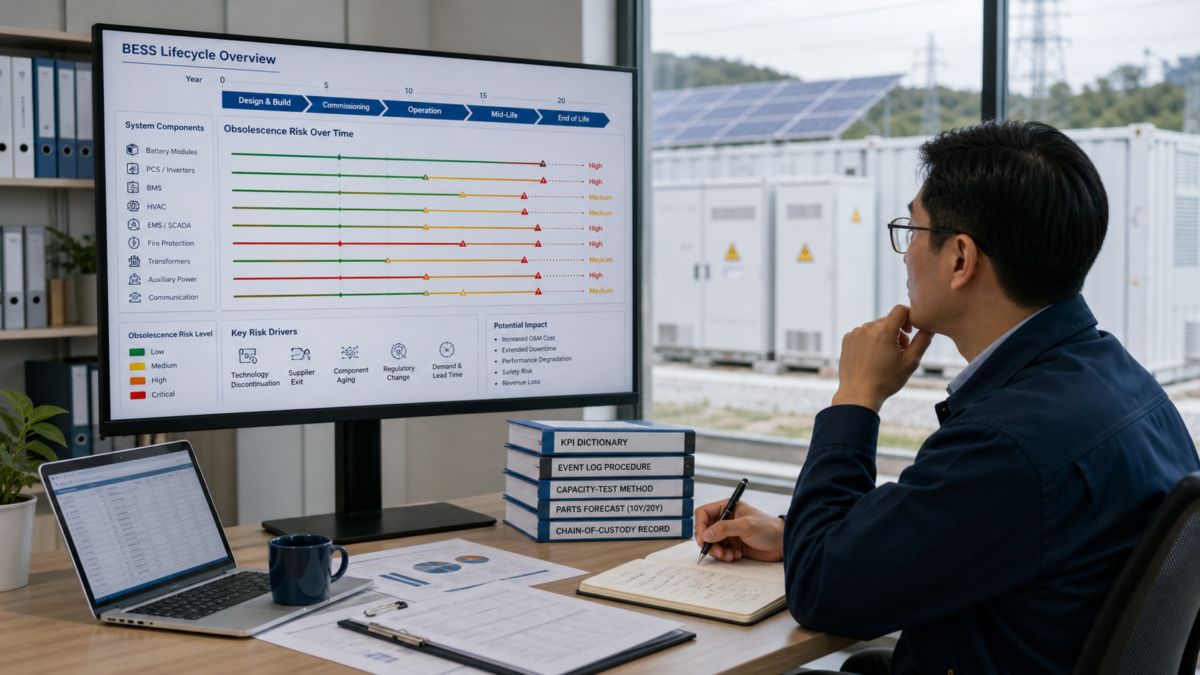
If I were advising you on this topic, I would start with that one question from the title. Too often, we see attractive proposals with long-term guarantees that fall apart under real-world pressure. The key isn't the promise itself, but the practical framework that supports it. A vague commitment to a 20-year design life is meaningless without the tools to measure, verify, and enforce it. The rest of this article will walk you through how to build that framework, turning a supplier's promise into a project reality that you can count on.
The Operational Reality Behind Best Ways to Reduce Obsolescence Matter in Real Projects?
A lifecycle guarantee is a great marketing tool. But without a clear measurement method, data owner, and dispute process, it can become an empty promise when you need it most.
The operational reality is that every guarantee needs a concrete framework. This means defining a KPI dictionary, an event log, a capacity-test method, and a parts forecast. This structure turns a vague promise into a manageable, data-driven process for your real project.

Every lifecycle promise needs to be backed by a clear and agreed-upon process. I once consulted on a project where the BESS failed its capacity test in year seven. The supplier argued it was due to operator error, while the owner blamed component degradation. The guarantee was useless because they had never defined who owned the operational data, how to measure degradation accurately, or what to do in a dispute. It turned into a long and expensive legal battle. To avoid this, you need to establish a solid foundation from day one. I insist on a simple framework for every project I'm involved with. It covers the essential pillars needed to make any guarantee work in the real world.
| Component | What It Is | Why It Matters |
|---|---|---|
| Measurement Method | The specific, agreed-upon procedure for testing system capacity and performance. | Removes ambiguity and ensures both parties are testing the same thing in the same way. |
| Data Owner | The party responsible for collecting, storing, and providing access to operational data (like event logs and KPI records). | Establishes a single source of truth and prevents data from being lost or manipulated. |
| Dispute Process | A predefined set of steps to follow if the system fails to meet its guaranteed performance. | Avoids costly legal fights by creating a clear path to resolution, like third-party verification. |
Why Alarms Changes the Design?
You probably think of alarms as simple notifications for when something goes wrong. But what if they were the key to predicting failure and obsolescence before they even happen?
Alarms change the design because they are predictive data points, not just reactive alerts. By linking specific alarm types to component stress, temperature, and efficiency, you can build a decision model that anticipates failures and informs your spare parts strategy long before a part becomes obsolete.

Relying on a product's spec sheet is not enough. A spec sheet tells you how a component performs in a lab, not how it will survive in your specific project environment. I prefer to build a decision model using real-world data. Think about it this way: an alarm for "inverter over-temperature" shouldn't just trigger a fan. It should be an event that gets logged against that specific inverter's asset record. If that alarm triggers frequently, your model can flag that component as being under high stress. This data helps you forecast when that model of inverter is likely to fail or need service. You can then proactively order spare parts or plan for a replacement before the original manufacturer stops making them. This is the difference between being reactive and being proactive. At Moletong, we believe in using real service records and clearly documented examples to build these models. We never invent asset outcomes because real data is the only thing you can rely on to manage long-term risk.
Balancing Performance, Safety, and Serviceability in BESS Spare Parts Obsolescence?
Everyone wants to get the maximum performance from their BESS asset. But pushing the system to its absolute limits can accelerate wear, create serious safety risks, and make service nearly impossible.
Balancing these three factors requires testing the most inconvenient operating conditions during the design phase. This proactive stress-testing identifies weak points, ensures safety margins are respected, and confirms that critical components can be serviced efficiently, preventing an attractive proposal from becoming an operational nightmare.

The most important test I always recommend is for the most inconvenient operating condition. This is where an attractive proposal often becomes difficult to deliver. I remember a project we reviewed in a region with high humidity and frequent grid fluctuations. The supplier's proposal looked fantastic based on standard operating conditions. However, we insisted on testing a scenario that combined high ambient humidity with a simulated, unstable grid signal. The system's power conversion system (PCS) immediately began to overheat, and its communication bus failed. The standard design had not accounted for the combined stress. This test revealed that the PCS would have degraded far faster than projected, and its replacement parts would have been needed years ahead of schedule. By finding this out before signing the contract, the buyer was able to demand a more robust PCS and a specific spare parts plan for it. Testing the worst-case scenario isn't about being negative; it's about being realistic and protecting your investment from predictable failures.
What to Confirm for BESS Spare Parts Obsolescence at Design Review and Handover?
The project is almost finished, and everyone is ready to celebrate. But if you don't ask the right questions at this final stage, you could be stuck with an unserviceable asset.
At design review and handover, you must confirm the KPI dictionary, event log procedures, the capacity-test method, the long-term parts forecast, and the chain-of-custody record for critical components. These documents are the foundation for managing obsolescence and holding your supplier accountable.

This is your last, best chance to ensure the long-term health of your BESS. Before you approve the final design and accept the handover, you need to treat it like a final inspection. I have a list of exact questions that I advise every buyer to ask. Getting clear, documented answers to these questions is non-negotiable. It's the only way to transform a paper guarantee into a practical, long-term asset management plan. Don't be afraid to hold up the final payment until you are completely satisfied with the answers and the documentation provided. This is your leverage to ensure you get what you paid for—a reliable and serviceable system for its entire lifespan.
Here are the exact questions you should be asking:
- KPI Dictionary: "Can you show me the final, approved KPI dictionary? Who has the authority to change it, and what is the process for doing so?"
- Event Log: "What is the standard operating procedure for downloading, storing, and analyzing the system's event log? Who is responsible for this?"
- Capacity-Test Method: "Where is the step-by-step capacity-test method documented? Does it specify all required equipment, environmental conditions, and pass/fail criteria?"
- Parts Forecast: "Please provide the 10-year and 20-year spare parts forecast. Which of these parts are proprietary, and what is your plan if a third-party supplier goes out of business?"
- Chain-of-Custody Record: "I need to see the complete chain-of-custody record for the battery modules, inverters, and transformers. This must trace the components from the original factory to our site."
Conclusion
Managing BESS obsolescence isn't about a product label; it's about a clear, data-driven process. Ask the right questions early to protect your investment for its entire lifecycle.



Leave a Reply