

When Does BESS SCADA Point List Make Business Sense?
Struggling with BESS SCADA integration costs? A simple connection seems fine, but hidden failures can cripple your project. The right point list is your insurance against this operational risk.
A BESS SCADA point list makes business sense when it goes beyond basic connectivity to explicitly define ownership, failure modes, and operational boundaries. This is achieved through detailed protocol maps, alarm philosophy, and network diagrams, preventing costly integration failures and ensuring system reliability from day one.

I've seen too many projects where the technical teams celebrate a successful "ping" or the first Modbus data read, only to have the system fail under real-world conditions. My view is that integration only succeeds when ownership and failure behavior are spelled out, not just when the cable is plugged in. The real question isn't whether the data can connect, but what happens when it doesn't, or when it provides a value that makes no sense.
Thinking about this from the start saves a massive amount of time, money, and finger-pointing down the line. We need to test our assumptions under less-than-perfect conditions to see where the design breaks. This detailed thinking is what separates a fragile integration from a truly resilient and profitable energy asset. Let's look at what buyers often get wrong.
What Buyers Often Misunderstand About BESS SCADA Point List?
You think a successful Modbus connection means your BESS integration is complete and reliable. But when an alarm doesn't show up, who fixes it? The blame game begins.
Buyers often misunderstand that a BESS SCADA point list is not just about data transfer. Its real value is in creating a contractually binding document that defines who is responsible for each piece of data, how failures are handled, and the exact performance of the integration.
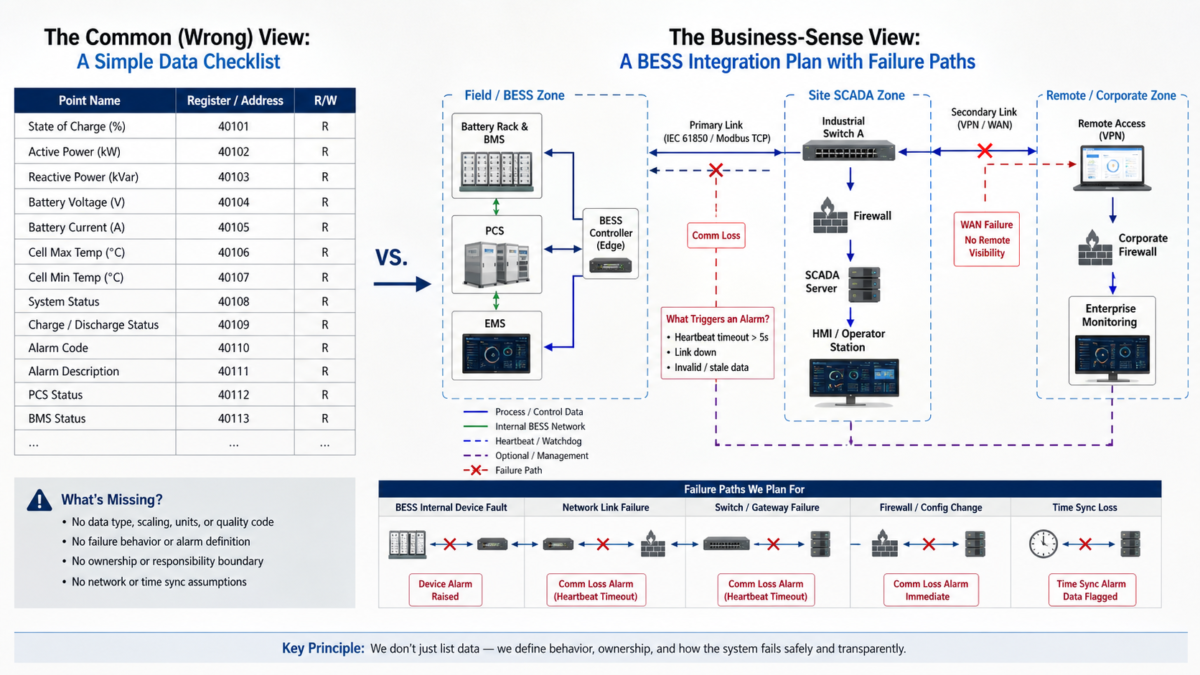
The biggest mistake I see is treating the point list like a product catalogue. Buyers scroll through a list of available data points and pick the ones that look important, like State of Charge or Active Power. This approach completely misses the point. A point list isn't a menu; it's a behavioral contract between the BESS and the control system. I remember a project where the BESS vendor and SCADA integrator spent weeks arguing over a single faulty data point because the point list just said "SoC %". It didn't specify the data type, scaling, or what a "null" value meant. That simple omission cost them thousands in delays. A successful installation at one site is not proof that the same generic list will work at another, especially with different firmware or network conditions. The point list must define the behavior, not just the name of the data.
| Aspect | The Common (Wrong) View | The Business-Sense View |
|---|---|---|
| Data Point | “Modbus register 40101 is available” | “Register 40101 is a 16-bit unsigned integer, scaled by 0.1, representing SoC. A value of 65535 indicates an error.” |
| Failure Mode | “The SCADA system will alarm if the BESS is offline.” | “If the communication heartbeat is lost for >30s, the SCADA system will generate a ‘Comm Fail’ alarm and the BESS will enter a safe state.” |
| Responsibility | “Vendor provides the points.” | “The BESS vendor is responsible for data integrity to the network switch. The integrator is responsible from the switch to the HMI.” |
Sizing Around Protocol/register Map and Alarm Philosophy?
You need to define your system's communication, but a generic protocol map seems sufficient. Then, a critical alarm floods your system with nuisance alerts or, worse, doesn't trigger at all.
Sizing your point list means starting with the protocol/register map and a clear alarm philosophy. This ensures every point has a purpose, defining not just what data is exchanged, but how it behaves, when it alarms, and who needs to react, preventing operational chaos.
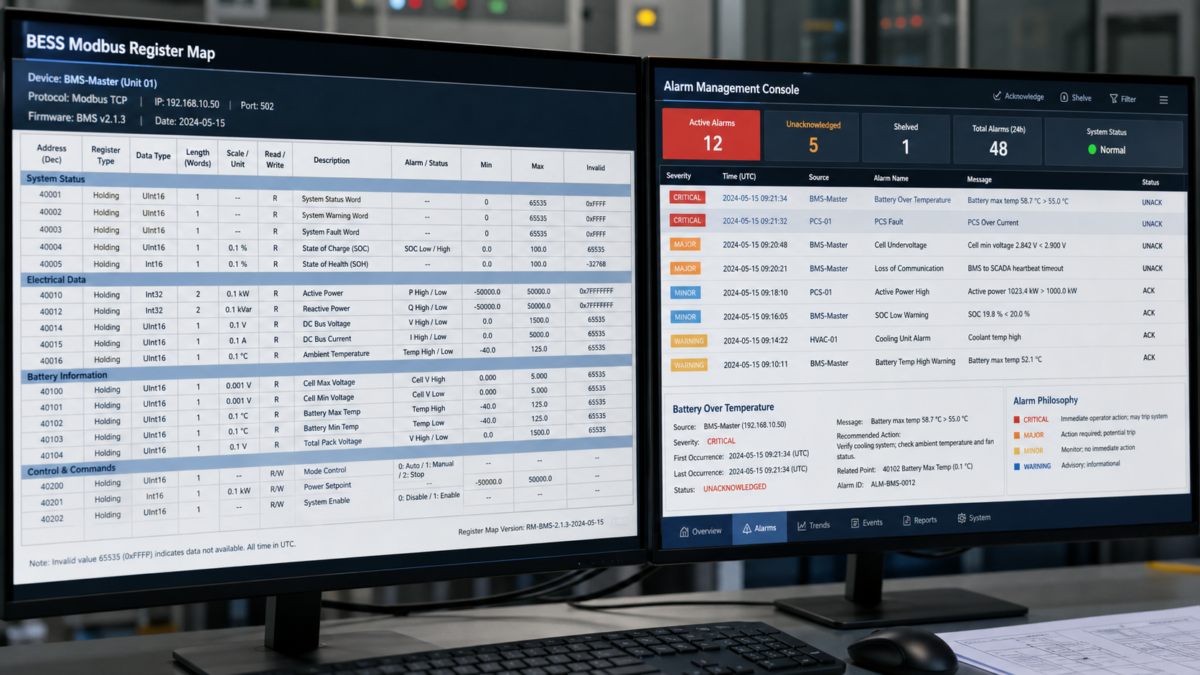
When I evaluate an integration, I don't start with the catalogue of features. I start with the fundamentals: the protocol/register map, time synchronization, the historian requirements, and remote access needs. This is where the details live. For any specific solution, like one from Moletong, I would insist on verifying the exact BMS, EMS, and PCS interfaces against a register map that is locked to a specific model and firmware version. Marketing documents are not good enough.
An alarm philosophy is crucial. It’s more than a list of potential faults. It is a rationalization process that defines the severity, priority, and required operator action for every single alarm. Does this alarm require an immediate shutdown, or is it just a warning? Can it be suppressed during maintenance? On one project, we discovered the BESS timestamped events in UTC while the SCADA historian used local time. For months, their performance data was skewed, making it impossible to diagnose intermittent faults until we did a full packet capture and found the time sync discrepancy. These are the details that make or break the business case.
The Failure Mode Hidden in Network Zones?
Your BESS network seems robust with firewalls and separate zones for control and data. But a simple switch failure isolates your entire asset from the control room, and you don't even know it.
The hidden failure mode in network zones is a loss of communication that isn't properly alarmed. A robust point list must include "heartbeat" or "watchdog" signals for every network segment, so you are immediately alerted to a silent connection loss, not just a device fault.
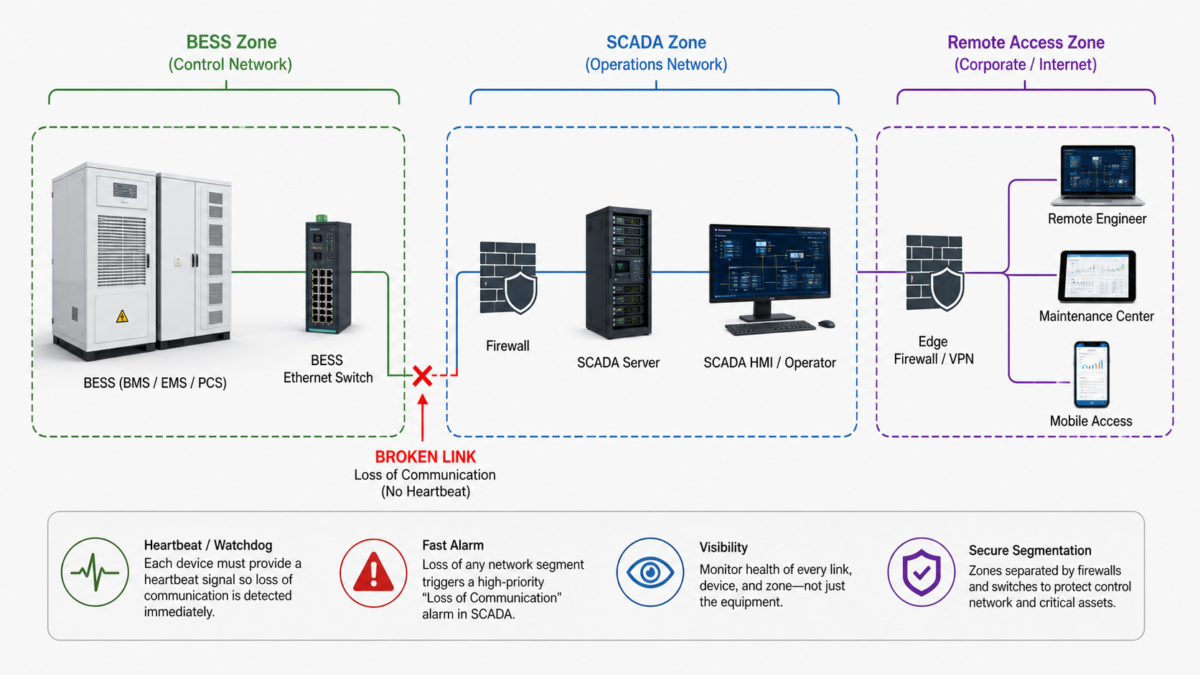
A modern BESS installation is not a single network. It has multiple zones. There is the internal BESS network connecting the batteries and power electronics. Then there is the site-level SCADA network for the operator. Often, there's a third zone for remote access over a corporate WAN or the internet. The biggest hidden risk is a failure of the link between these zones. A firewall rule change, a faulty gateway, or a disconnected cable can leave you completely blind to the asset's status. The BESS might be operating perfectly, or it might be in a critical fault state, but you would have no idea because the communication link is dead.
This is why a point list must include points that monitor the health of the network itself. I insist on having a "heartbeat" or a communications watchdog timer from every key component. For example, a simple register that increments every second. If the SCADA system doesn't see that value change for five seconds, it generates a high-priority "Loss of Communication" alarm. We always run a 'pull the plug' test during commissioning. We physically disconnect the network cable between the BESS and the SCADA system. The key question is: what alarm appears on the screen, and how fast? If the answer is 'nothing happens', the integration design is a failure.
Key BESS SCADA Point List Questions Before Signing the Contract?
You're ready to sign the contract, and the BESS SCADA point list looks comprehensive. But you haven't asked who owns the data, how it will be tested, or what happens when firmware is updated.
Before signing, ask: Who owns data validation? How will each point be factory and site tested? What is the process for managing firmware updates that change the register map? Who provides the network diagram and alarm philosophy? These questions ensure clarity and prevent future disputes.

The time to get clarity is before you sign anything. A detailed point list attached to the contract is your best tool for avoiding future pain. I never sign off on an integration plan until the following questions have clear, written answers that are initialed by both the equipment vendor and the system integrator. It has saved me from countless headaches and change orders. These questions force everyone to move from vague promises to concrete commitments. They establish the operating boundary and the point at which the answer changes from "it should work" to "it is contractually guaranteed to work this way."
Who provides the definitive, firmware-specific register map?
You need a guarantee that the point list corresponds to the exact firmware version being delivered. A generic marketing document is a recipe for disaster.
What is the exact testing procedure for every point?
The contract must specify how each point will be tested, both at the factory (FAT) and on-site (SAT). This should include cause-and-effect tests. For example, to test a high-temperature alarm, the sensor must be safely simulated to trigger the alarm through the entire chain to the operator screen.
Who is responsible for data quality?
If the SCADA system reads garbage data, who investigates first? This should be clearly defined. Is it the BESS vendor's responsibility to prove the data is correct at their network port, or the integrator's job to prove they are reading it correctly?
How are firmware and software updates managed?
A BESS firmware update can completely break the integration if the register map changes without notice. There must be a contractual process for managing these changes, including re-testing the integration.
Conclusion
A detailed point list isn't a cost; it's an investment in operational certainty. It transforms integration from a technical handshake into a reliable, well-defined business relationship.



Leave a Reply