

Available Fault Current Much Higher Than Rating. Crazy?
Your new switchgear study is in. The available fault current is way higher than the equipment rating you wanted to buy. This feels wrong, and very unsafe.
No, it is not crazy if the selection is based on a verified short circuit study and specific, reliable operating scenarios. Protective device coordination can clear a fault before the peak current is reached, making a lower-rated, series-rated system perfectly safe and compliant under those defined conditions.
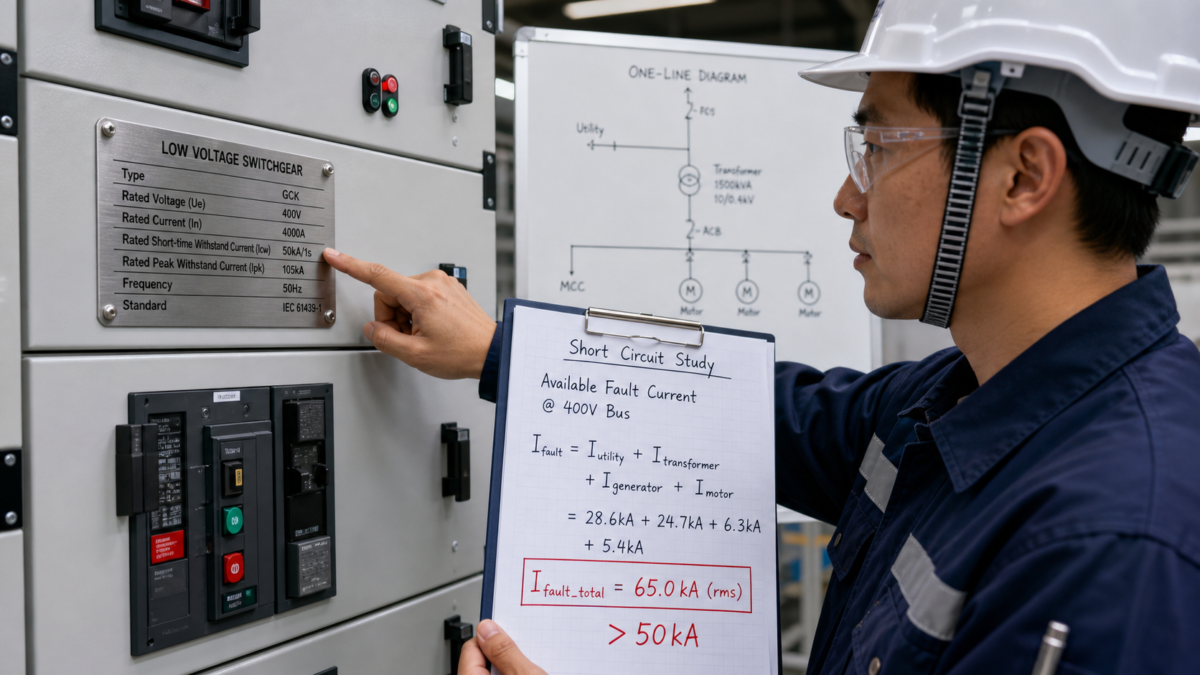
I've seen this scenario play out many times. An engineer presents a study that seems to defy basic logic. The calculated maximum fault current is, for example, 65kA, but they are recommending 50kA-rated switchgear. It immediately raises red flags for the buyer. Is the engineer cutting corners? Are they putting my facility and my people at risk just to save a few dollars? My experience shows that while skepticism is healthy, dismissing the study outright is a mistake. The most convincing recommendations are backed by layers of proof. These proofs show exactly which site conditions make the recommendation strong, and which would make it weak. We need to dig into those details, not just look at the final number.
When Available Fault Current Much Higher Than Rating. Crazy Becomes a Business Case?
Your facility needs new switchgear. The initial quote for equipment rated for the maximum possible fault current is sky-high. You wonder if there's a more affordable, yet safe, option.
This becomes a business case when you can prove, through a detailed study, that specific operating conditions or upstream protective devices limit the actual fault energy the switchgear will ever experience. This allows for a lower, less expensive rating without sacrificing safety or compliance.
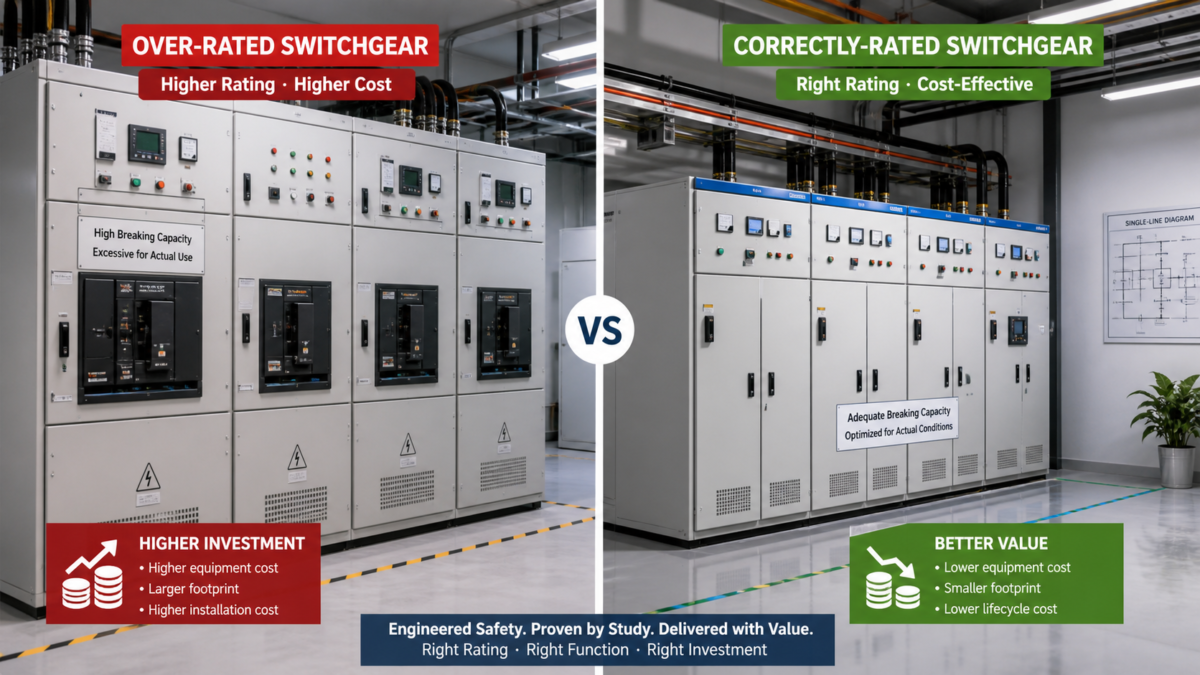
When I get involved in a project, I first want to know what the buyer hopes to achieve. Savings, resilience, capacity relief, and compliance are not the same thing. One buyer might want the absolute lowest cost that meets the minimum safety code. Another might need to ensure their data center never goes down, making ultimate resilience the top priority, with cost being a secondary concern. The 'crazy' recommendation of using lower-rated gear only makes sense if it aligns with the buyer's primary goal, which is often cost savings. But this must be done safely. The business case rests on whether the operating scenarios that justify the lower rating are stable and guaranteed. For instance, if the lower rating depends on a current-limiting fuse upstream, we have to ask: what happens if someone replaces that fuse with a standard one during maintenance? The business case falls apart if it's not robust against human error and future system changes.
Comparing Goals and Scenarios
The decision must trace back to the project's core goals. A simple table can help clarify these trade-offs.
| Primary Goal | Typical Scenario | Justification for Lower Rating | Potential Risk |
|---|---|---|---|
| Cost Savings | New commercial building with a stable utility source. | A fast-acting upstream breaker limits the peak fault current. | Future utility upgrades could increase available fault current. |
| Resilience | Hospital or data center with multiple backup generators. | Very weak. Parallel generator operation can increase fault levels. | Equipment failure during a power outage is unacceptable. |
| Capacity Relief | An expanding factory adding large motor loads. | Possible, but motor contribution must be modeled carefully. | Underestimating motor contribution can lead to catastrophic failure. |
| Compliance | Meeting the minimum requirements of the electrical code. | Strong, if the study and equipment are fully documented. | An inspector may question the system without clear documentation. |
Each path has different equipment requirements. I would not let a single positive example from one project become a universal promise for all others.
Which Switchgear Short Circuit Rating Study Inputs Deserve the Most Scrutiny?
You receive a short circuit study, but it's just a stack of papers with a final number. You're not sure which inputs are assumptions and which are hard facts.
Focus your scrutiny on three key inputs: the utility's available fault current data, the impedance values of all transformers, and the contribution from large motors. These inputs have the largest impact on the final calculated fault levels and are most often subject to change or estimation.
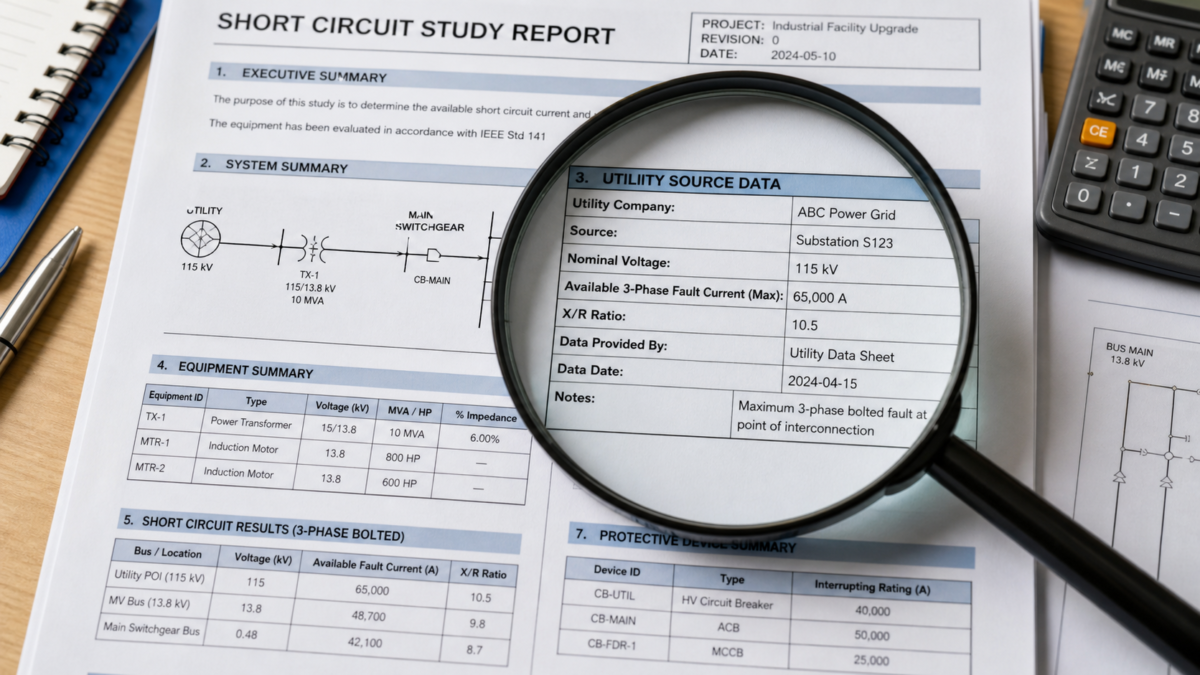
When I review a study, I go straight to the source data. The final fault current number is the result of a calculation, and that calculation is only as good as its inputs. The utility fault level is the biggest variable. I always ask for the official data sheet from the utility company. Sometimes, they provide a maximum value that is much higher than the typical day-to-day value. We also need to know their plans for the next 5-10 years. Are they upgrading a substation nearby? That could significantly increase the fault current available at the site. Next, I check the transformer impedance. A lower impedance means a higher fault current. I verify the value on the transformer's nameplate, not just in the study's library. Finally, motors. During a fault, running motors act like temporary generators, feeding current into the short circuit. I check that all significant motors have been included and that their contribution is calculated correctly. Getting these three inputs right is the foundation of a reliable study.
How to Stress-Test Switchgear Short Circuit Rating Study Performance?
The study looks good on paper, showing your chosen switchgear is safe for one specific scenario. But what about other situations? How do you know it will hold up?
Stress-test the study by modeling realistic "worst-case" operating scenarios. This includes running backup generators in parallel with the utility, simulating future utility upgrades, and calculating the fault level with all large motors starting simultaneously. This reveals the system's true breaking point.
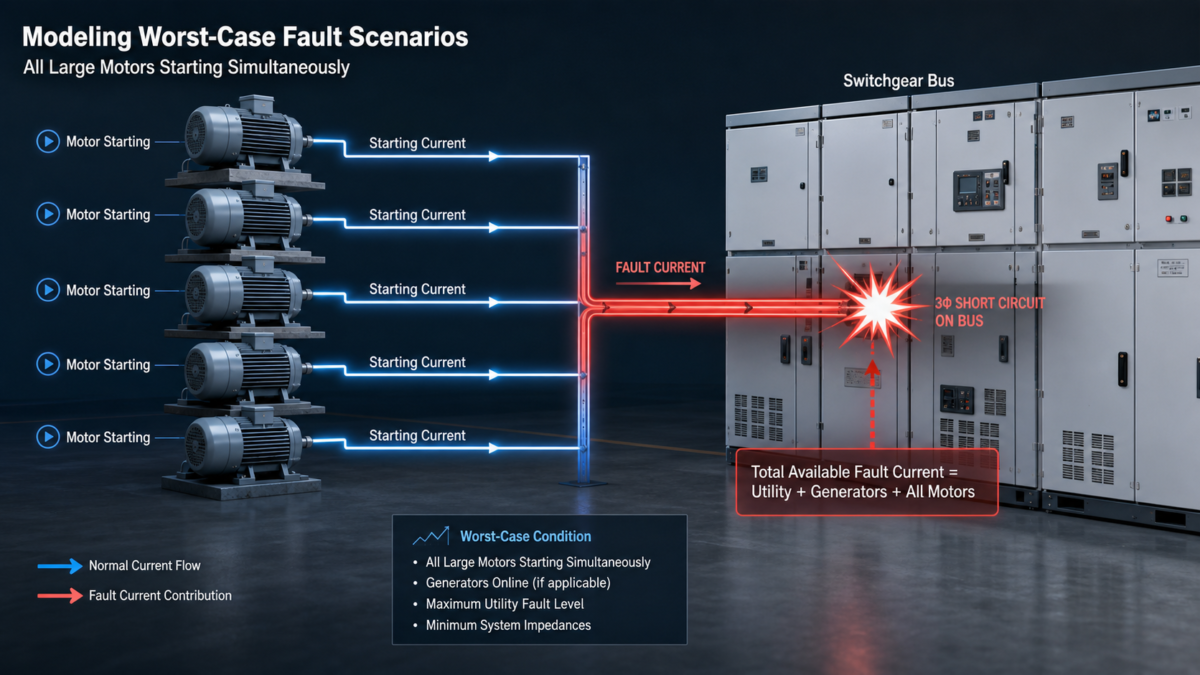
A single positive study result doesn't give me much comfort. I need to see how the system behaves under pressure. I always create what I call a "realistic downside case." For example, the main study might assume the utility is the only source. But what if the facility has a backup generator that can be paralleled with the grid for load testing? For that brief period, the available fault current will be the sum of both sources, which could be much higher. I insist on modeling this scenario. Another stress test involves future growth. Let's say the client plans to add a new production line with large motors in three years. We should model that future state today to see if the switchgear we're buying will still be adequate. This isn't about creating impossible scenarios; it's about anticipating likely operational changes. By comparing the results of these stress tests to the equipment ratings, we can make a much more informed decision and avoid a dangerous situation down the road.
A Buyer-Focused Switchgear Short Circuit Rating Study Verification Plan?
You've approved the study and purchased the equipment. How do you confirm that what you designed is what you actually received and that it's all set up correctly?
The buyer must have a verification plan that traces the paper study to the physical hardware. This plan requires demanding and reviewing five key documents: the final approved single-line diagram, the complete fault and coordination study, the final relay setting files, the factory acceptance test (FAT) records, and a post-installation thermal scan.
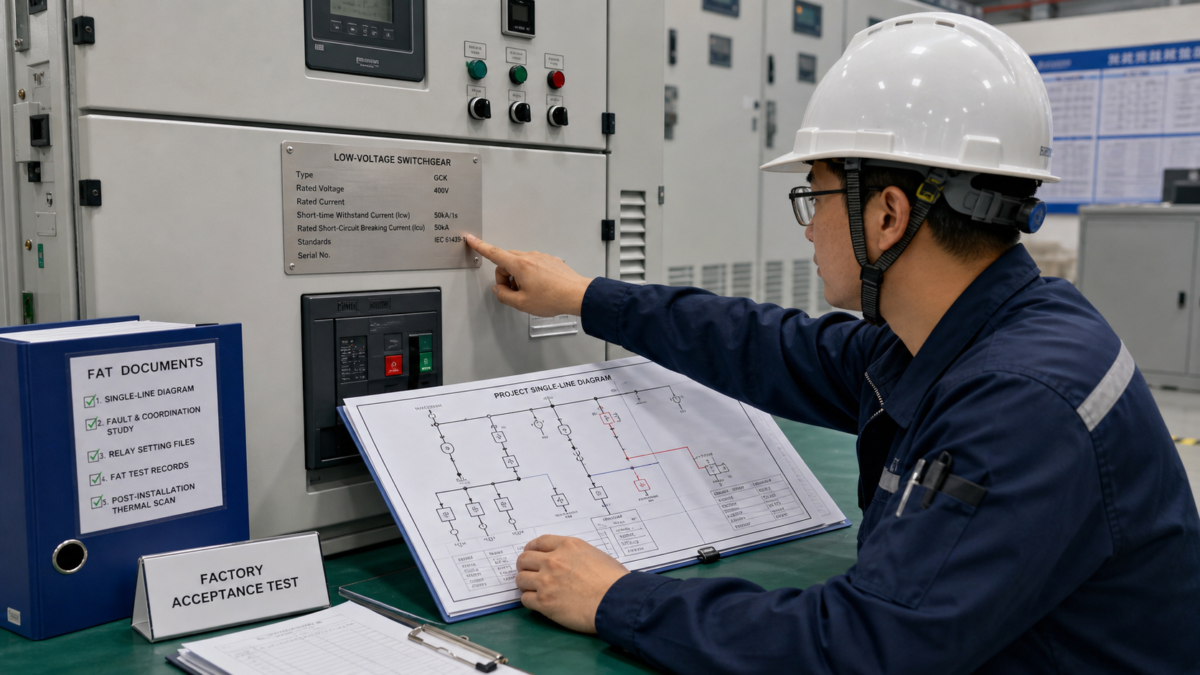
I always tell my clients that the study is just the beginning. The real proof is in the execution. A buyer's verification plan is a simple, step-by-step process to connect the dots. First, I lay the approved single-line diagram next to the fault study. I check every breaker, every cable, and every transformer to make sure they match. Second, I look at the protective relay settings. The coordination study determines how these relays should be programmed. I need to see the final setting file that will be loaded into the actual relays. Third, during the factory acceptance test (FAT), I physically check the nameplates. If we are supplying Moletong GCK low-voltage switchgear, its short-circuit rating must be clearly stated on the equipment and match the project-specific rating from the study. Fourth, I review the FAT record to ensure all tests were passed. Finally, after installation and energization, a thermal scan of the equipment under load is crucial. It can reveal potential problems like loose connections that could lead to failure. This complete chain of evidence is the only way to be certain that the engineered safety has been delivered.
Conclusion
Switchgear selection must trace back to verified study values and specific operating scenarios. A lower rating can be a smart business case, but only with a robust verification plan.
My Role
About me
Brand Name: Moletong
Slogan: Carbon Neutrality, Tracking the Future
Website: www.moletong.com
Company Overview
Established in 2011 and headquartered in Dongguan, Guangdong, we are an integrated new-energy equipment enterprise specializing in energy storage systems, complete electrical equipment, photovoltaic solutions, charging infrastructure, and hydrogen-energy solution integration.
We integrate R&D, manufacturing, sales, system configuration, and technical service to support utility-scale, commercial and industrial, and residential energy applications. Our solutions are designed around practical customer needs such as peak shaving and valley filling, electricity-cost optimization, transformer-capacity support, emergency backup, renewable-energy integration, intelligent energy management, and photovoltaic-storage-charging coordination.
Our Core Business
1. Energy Storage Systems & Equipment
We develop lithium iron phosphate energy-storage products for utility-scale, commercial and industrial, residential, and integrated charging applications. Our documented portfolio includes liquid-cooled containerized energy-storage systems, commercial and industrial storage cabinets, residential battery systems, storage-and-charging systems, BMS, PCS, and EMS functions.
2. Complete Electrical Equipment
We provide complete high- and low-voltage electrical products, including gas-insulated ring-main units, high-voltage switchgear, low-voltage withdrawable and fixed switchgear, power-distribution cabinets, meter boxes, box-type substations, charging-station substations, and busbar-trunking systems.
3. Photovoltaic & Integrated Energy Solutions
We provide photovoltaic supporting equipment and system solutions, including 35 kV step-up substation equipment, photovoltaic combiner cabinets, adjustable mounting structures, photovoltaic-storage integration, and equipment support for grid connection, power transmission, and microgrid applications.
4. Charging & Hydrogen-Energy Solution Integration
We provide AC and DC charging solutions, storage-and-charging systems, and photovoltaic-storage-charging integration for industrial parks, commercial parking facilities, transport hubs, and locations with limited grid or transformer capacity. We also develop hydrogen-energy integration concepts involving renewable hydrogen production, hydrogen storage, refueling, and hydrogen-electric coupling. Specific hydrogen products, certifications, production capacity, and completed projects must be confirmed separately.
Product Applications & Technology Focus
Primary Service Industries:
Our principal customer sectors include Industrial and Commercial Energy Users, Renewable-Energy Developers, Power and Electrical Engineering, EV Charging Infrastructure, Commercial and Public Facilities, and Residential Energy Storage.
Product Categories We Serve:
- Utility-Scale Containerized Energy-Storage Systems
- Commercial and Industrial Energy-Storage Cabinets
- Residential Energy-Storage Batteries and Inverters
- Integrated Storage-and-Charging Systems
- High- and Low-Voltage Switchgear
- Box-Type Substations and Charging-Station Substations
- Busbar-Trunking and Power-Distribution Products
- Photovoltaic Step-Up and Combiner Equipment
Technology Expertise:
Our documented technical focus includes:
Lithium Iron Phosphate Cells, BMS, PCS, EMS, Liquid Cooling, Natural Cooling, Modular System Integration, Remote Monitoring, Load Tracking, Anti-Reverse-Flow Control, Transformer-Capacity Protection, and Intelligent Operation and Maintenance.
Production Capacity & Equipment
Energy Storage Production & R&D Platform
Our supplied corporate materials identify one production base in Dongguan and a Dongguan engineering R&D center. We support product development, equipment manufacturing, system configuration, and technical service for residential, commercial and industrial, and large-scale energy-storage applications.
- Product Platform Highlights: 5,015 kWh liquid-cooled containerized storage systems, 627 kWh and 261 kWh commercial and industrial storage cabinets, 16 kWh residential battery systems, and 261 kWh and 627 kWh integrated storage-and-charging systems.
Electrical Equipment Platform
We provide product design and manufacturing support for complete electrical assemblies used in industrial facilities, commercial buildings, substations, photovoltaic projects, charging stations, and public infrastructure.
- Equipment Highlights: High-Voltage Ring-Main Units, High-Voltage Metal-Clad Switchgear, Low-Voltage Withdrawable Switchgear, AC Low-Voltage Switchgear, Distribution Cabinets, Box-Type Substations, Prefabricated Charging-Station Substations, and Busbar-Trunking Systems.
Energy Storage & Electrical System Capabilities
General Capabilities:
- Application and electricity-use requirement analysis
- Energy-storage system selection and capacity configuration
- Equipment design and manufacturing
- BMS, PCS, and EMS system integration
- Peak shaving, valley filling, and time-of-use energy scheduling
- Load tracking and anti-reverse-flow control
- Transformer-capacity protection and demand management
- Photovoltaic-storage and storage-charging integration
- Remote installation, commissioning, and trial-operation support
- Operator training, warranty service, and technical after-sales support as contracted
Our Core Specialties:
- ✔️ Liquid-Cooled Large-Capacity energy-storage systems
- ✔️ Commercial & Industrial peak-valley and backup-power solutions
- ✔️ Integrated Photovoltaic-Storage-Charging applications
- ✔️ Complete Electrical Distribution equipment and system coordination
Quality Control & Certifications
We apply quality, environmental, and occupational health and safety management requirements to the design, manufacture, and sales of our documented product scope.
Quality Management Scope:
The supplied qualification materials show ISO management-system certificates and patent certificates held by Moletong. The product manuals separately define model-specific electrical parameters, monitoring functions, protection requirements, cooling methods, fire-protection configurations, operating environments, and technical-service conditions.
Testing & Protection Focus:
- Cell voltage, current, temperature, and operating-status monitoring
- Overcharge, over-discharge, overtemperature, and abnormal-condition protection
- Liquid-cooling or natural-cooling verification according to product model
- Fire-protection configuration according to product type
- Enclosure protection, corrosion resistance, and operating-environment requirements
- BMS, PCS, EMS, and communication-function verification where applicable
Certifications & Compliance:
- ISO 9001 Quality Management System
- ISO 14001 Environmental Management System
- ISO 45001 Occupational Health and Safety Management System
- Invention Patent and Utility Model Patent Certificates
- Selected product models list IEC 62619, UN 38.3, RoHS, EN 61000 series requirements, GB/T 36276, CCC, and relevant IEC/GB electrical standards
Certification scope varies by product model, configuration, destination market, and certificate validity period. Model-specific certificates must be confirmed before any formal compliance claim.
Target Markets & Partnership Models
Who We Serve:
- Industrial Facility Owners: Plant managers, energy managers, facility managers, and procurement teams at factories or industrial parks seeking peak-valley electricity-cost optimization, demand management, transformer-capacity support, or emergency backup power
- Renewable-Energy Developers: Project developers, engineering managers, and procurement teams for photovoltaic or wind projects requiring energy storage, step-up equipment, electrical distribution, or renewable-energy integration
- EPC & Electrical Contractors: Project managers, technical managers, and equipment-purchasing teams at qualified engineering companies requiring packaged energy-storage or electrical equipment with technical coordination
- Charging-Station Developers & Operators: Investment, construction, and operations teams working on sites with limited grid access, insufficient transformer capacity, high peak demand, or photovoltaic-storage-charging requirements
- Energy Service Companies & System Integrators: Solution designers and project-development teams building commercial and industrial energy-management, microgrid, or distributed-energy projects
- Residential Storage Distributors & Installers: Importers, distributors, wholesalers, and qualified installers requiring lithium iron phosphate batteries, off-grid or hybrid inverters, and residential storage configurations
- Commercial & Public-Facility Owners: Property, engineering, and facility-management teams for commercial buildings, schools, hospitals, hotels, parking facilities, and transport locations requiring reliable power distribution, charging, or backup-energy solutions
Target Geographies:
Our home market is China, supported by regional sales coverage for South, East, Central, and Southwest China. The supplied 2026 catalogue also identifies an overseas office in Indonesia, supporting practical market development in Southeast Asia. Other overseas markets are served only after confirming model-specific certification, grid requirements, shipping conditions, and local installation standards.
Types of Cooperation:
- Equipment Supply: Standard or configured energy-storage and electrical products
- System Configuration: Product selection and capacity configuration based on the customer's application
- System Integration: BMS, PCS, EMS, photovoltaic, charging, and electrical-system coordination
- Project Technical Cooperation: Technical coordination with renewable-energy developers, EPC contractors, and qualified local engineering companies
- Integrated Energy Solutions: Photovoltaic-storage, storage-charging, and photovoltaic-storage-charging applications
- Technical Service: Training, remote installation and commissioning support, warranty, and after-sales service as agreed in the commercial contract
Our Core Competitive Advantages
⭐ Integrated New-Energy Product Portfolio
By combining energy-storage systems, complete electrical equipment, photovoltaic supporting products, charging applications, and intelligent energy-management functions, we can configure solutions around the customer's complete power-use scenario.
⭐ Coverage from Residential to Utility Scale
Our documented energy-storage range extends from 16 kWh residential systems to 261 kWh and 627 kWh commercial and industrial systems and a 5,015 kWh containerized system.
⭐ Application-Oriented System Design
Our solutions address identifiable operating needs, including peak-valley arbitrage, demand management, transformer-capacity constraints, backup power, renewable-energy consumption, and charging-station power support.
⭐ Integrated Control & Safety Architecture
Our storage products combine lithium iron phosphate cells with BMS, PCS, EMS, model-specific thermal management, multi-level protection, intelligent monitoring, and remote operation and maintenance functions.
⭐ Regional Sales & Technical Service Support
With a Dongguan headquarters and engineering center, regional sales coverage in China, and an overseas office identified in Indonesia, we support equipment selection, technical coordination, training, remote commissioning assistance, and contracted after-sales service.

Leave a Reply