

Should You Charge on Solar with Import/export Limits?
Import/export limits can make charging a solar battery feel like a puzzle. You want to store free energy, but grid rules get in the way. What should you do?
Yes, you can and often should charge on solar even with grid limits. The key is to define your primary goal. For maximizing self-consumption, it’s a clear win. For providing grid support or resilience, you need detailed site-specific data to ensure the system performs as expected.
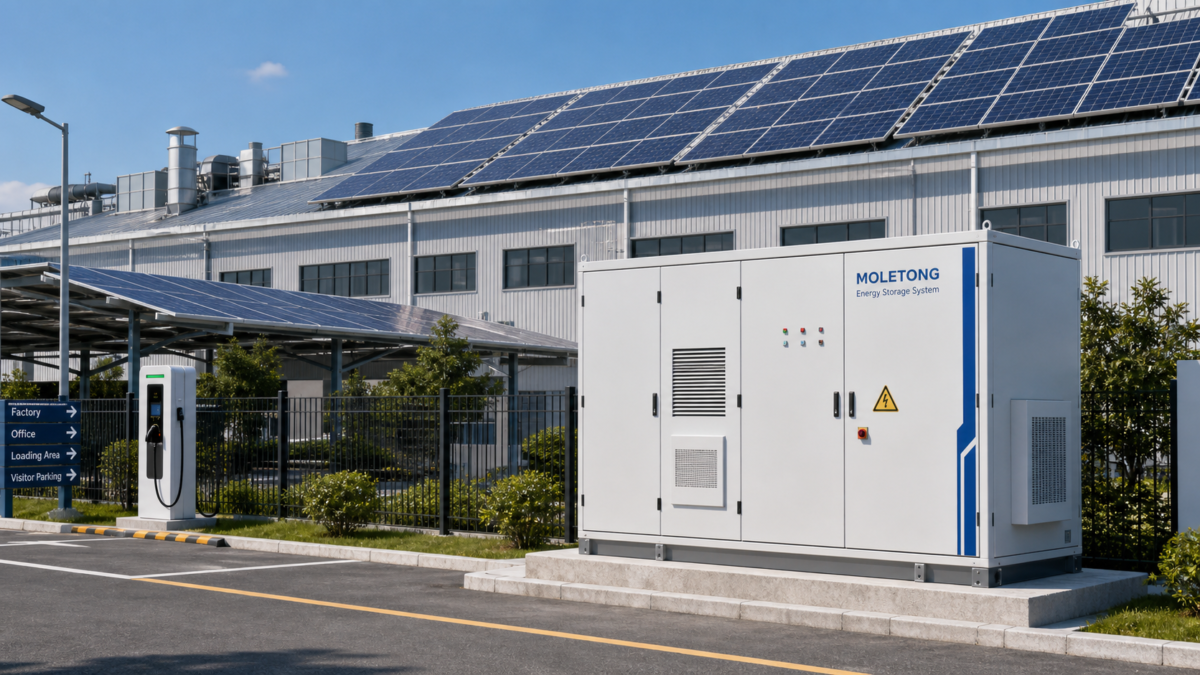
I’ve reviewed many battery storage scenarios that looked perfect on paper. The sales proposal showed amazing savings. But when we dug into the details of the site, we found the promises couldn't be met. The numbers only worked under ideal conditions that never happen in the real world. A single good example of a project often gets turned into a universal promise, and that’s a dangerous way to make an investment. We need to look at the site first, not the brochure. This guide will walk you through how I approach these projects to separate the hype from the reality.
Why You Charge on Solar with Import/export Limits Is Harder Than It Looks?
You have solar panels and an export limit, so you add a battery. Problem solved, right? But then you might find the battery isn't charging or discharging when you expect.
It's harder than it looks because you are trying to make one piece of equipment achieve several different goals that can conflict. Maximizing daily savings, providing backup power, helping your transformer, and following grid rules are four different jobs, and they don’t always work together.
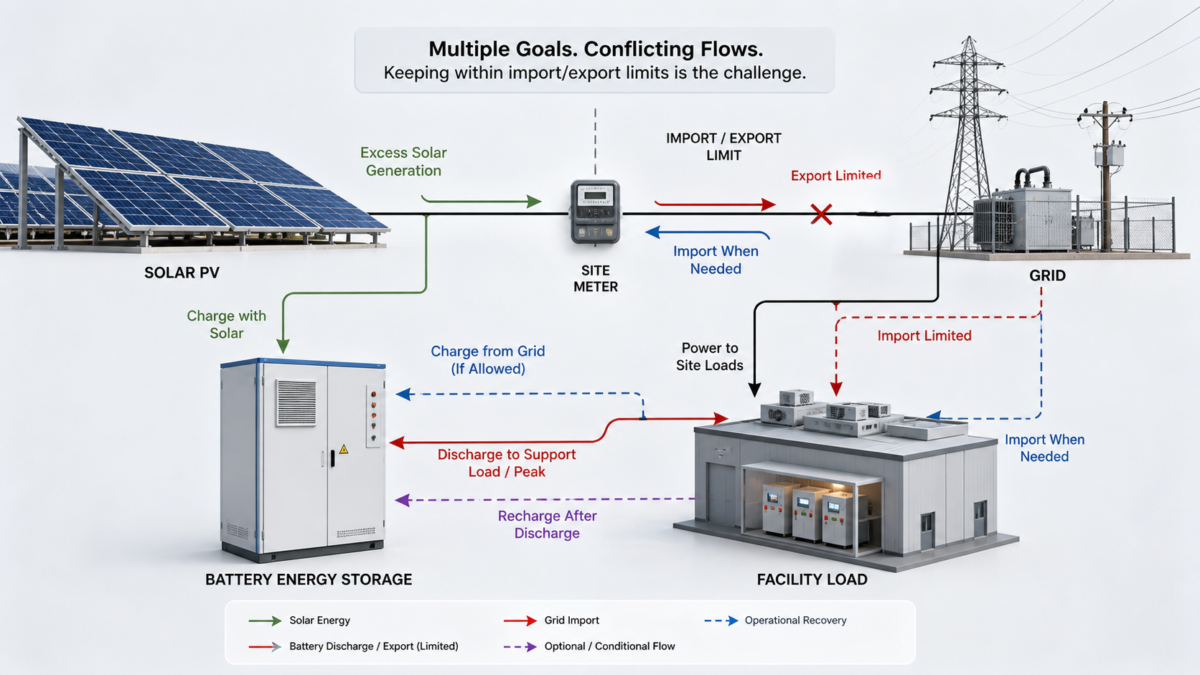
In my experience, the biggest mistake is trying to get credit for multiple benefits without checking if they are compatible. This is called double-counting value streams. For example, if you want your battery to provide backup power (resilience), you need to keep it mostly charged. But if you want to save money on your electricity bill (self-consumption), you need to cycle it every day. You can't do both at the same time with the same stored energy. I always start by clarifying what the buyer expects the battery to do. Is the main goal savings, resilience, capacity relief, or just compliance? They are not the same.
How Different Goals Create Conflict
I created a simple table to show my clients how these goals can pull the system in different directions.
| Primary Goal | How It Works | Potential Conflict |
|---|---|---|
| Self-Consumption (Savings) | Store excess solar during the day and use it at night to lower grid purchases. | This daily cycling can leave the battery with a low state of charge, reducing its effectiveness for emergency backup power. |
| Capacity Relief | Discharge the battery to support the site transformer during peak load times. | Your site’s peak load might not happen when you have stored solar energy, forcing you to charge from the grid at a less optimal time. |
| Resilience (Backup) | Keep the battery state of charge high in case of a grid outage. | A full battery cannot absorb new solar energy, which might then be curtailed due to export limits, wasting potential generation. |
| Compliance | Use the battery to absorb any solar generation that would exceed the export limit. | The battery’s charge and discharge speed must be fast enough to react to sudden changes in solar output and site load. |
The Site Data Needed to Evaluate Battery Storage Solar Export Limit?
You want to make a smart decision, but your analysis is based on generic data. This can lead to buying a system that is too big or too small for your needs.
To properly evaluate a battery, you need real data from your site. This includes 15-minute interval load data for a full year, your solar PV system’s actual or expected generation profile, and the maximum capacity (headroom) of your transformer.
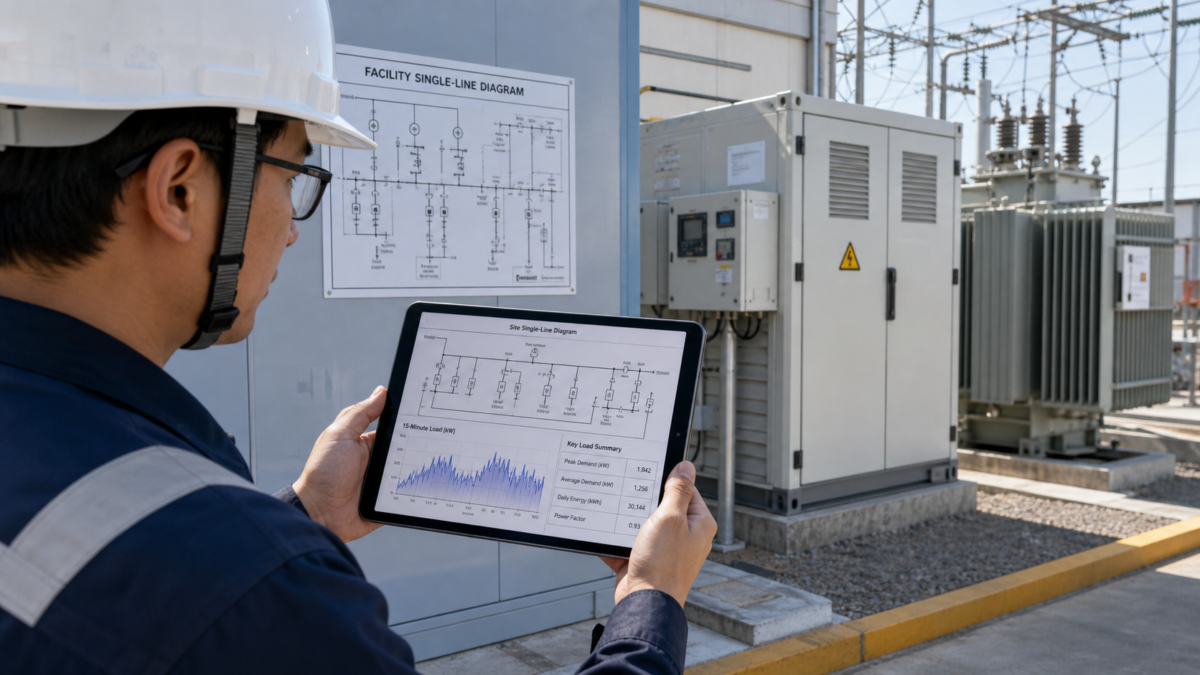
After clarifying the goal, my next step is always to collect the site data. Without it, any proposal is just a guess. I once worked on a project where the client’s load data looked very predictable. But we found out they had a huge motor that started up twice a day for 30 minutes. This huge spike in power use was not visible in their monthly bills. It completely changed the size and type of battery system they needed. This is why a simple bill analysis is not enough. You have to look at the fine details.
The most convincing analysis I can build for a client uses four key documents: a site single-line diagram, a constraint register, an operating-mode simulation, and a restart-load record. A single-line diagram is the electrical map of the facility. A constraint register is just a simple list of all the limits, like the export limit or transformer capacity. The simulation shows how the battery would have performed over the last year using the real data. For resilience, the restart-load record lists the critical equipment that must turn on after an outage, which tells us how powerful the battery needs to be.
Which Battery Storage Solar Export Limit Assumptions Distort the Result?
Your financial model shows a five-year payback. But you worry the assumptions are too optimistic and the real-world results won't match. You are right to be skeptical.
The most common assumptions that distort results are using perfect weather data, assuming your facility's load never changes, and ignoring battery degradation over time. Assuming the system can react instantly to prevent export is another major flaw; control systems have delays.
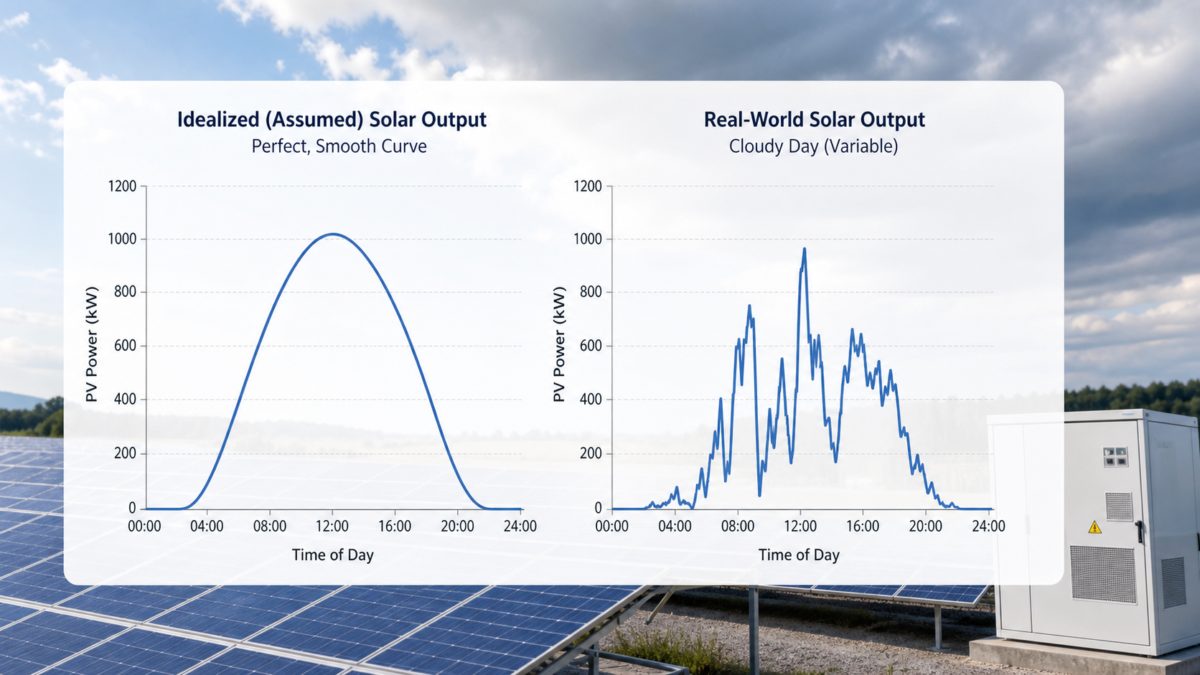
I always tell my clients to ask for the downside case. What does the performance look like during a week of cloudy weather in the winter? What if the facility adds a new production line next year and its energy use changes? A good analysis should not be based on a single, perfect year. It should be tested against realistic, and even pessimistic, scenarios. A single positive example should never become a universal promise.
Another big issue is assuming perfect control. The idea is that the moment your solar generates one watt more than you are using or allowed to export, the battery will absorb it. In reality, the site meter has to measure the export, send a signal to the energy management system (EMS), and the EMS then tells the battery to start charging. This takes time. A well-integrated system like Moletong's, which combines the storage, EMS, and electrical switchgear, can make this process faster and more reliable. However, even the best equipment cannot overcome a design based on flawed assumptions. That’s why we run simulations to see how the system will actually behave with these small delays included.
A Practical Battery Storage Solar Export Limit Selection Checklist?
You understand the complexities and are ready to move forward. But you need a clear, step-by-step process to avoid making a costly mistake during the selection process.
Start by clarifying the primary goal with all stakeholders. Next, gather detailed site data. Then, model at least two scenarios: a typical case and a realistic downside case. Finally, have a qualified engineer review the integrated system design before you buy.
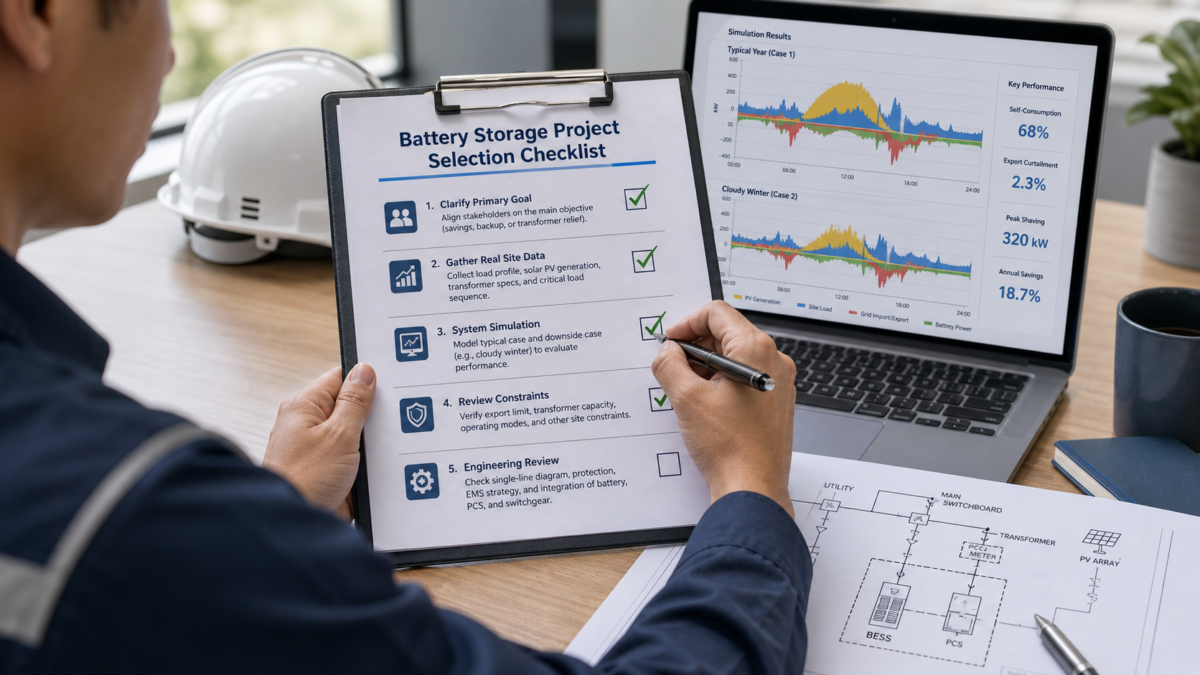
To make this process easier, I've developed a simple checklist that I walk through with every client. It keeps us focused on what really matters and makes sure we don't let a sales pitch override sound engineering. The goal is to understand which site conditions make the recommendation stronger or weaker. For example, a facility with very high energy use during sunny hours might not need a large battery, because most of the solar is consumed on-site anyway. In contrast, a facility that operates mainly at night could get huge benefits from storing all its daytime solar.
Here are the steps I follow:
- Clarify the Primary Goal: Is it savings, backup power, or transformer relief? We write this down and agree on it. This becomes the guide for all future decisions.
- Gather the Real Site Data: We collect the facility load profile, the solar PV generation profile, transformer specifications, and the critical load sequence for backup.
- Compare Scenarios with a Simulation: We use the data to simulate how the proposed battery system would operate. We always run a "typical year" and a "cloudy winter" or other downside case to see the full range of likely outcomes.
- Review the Full Engineering Plan: We look at the single-line diagram, the list of constraints, and the planned operating modes. If a provider like Moletong is supplying the battery, EMS, and switchgear as an integrated package, we confirm it is engineered for the specific site conditions.
Conclusion
Do not double-count different battery benefits. The first step is to clarify your primary goal, then use real site data to see if the project makes sense for you.
Leave a Reply