

Why Does Solar PV Plant Kpis: What Actually Tells You Your… Matter in Real Projects?
Your solar plant has many KPIs, but do you know which ones actually predict profit? Ignoring the right metrics can lead to underperformance and lost revenue, turning a great investment sour.
Solar PV plant KPIs, especially the Performance Ratio (PR), matter because they directly measure if your plant is generating the energy—and revenue—it was designed for. They provide a clear, standardized way to compare the promised output against the actual, real-world energy delivered to the grid.
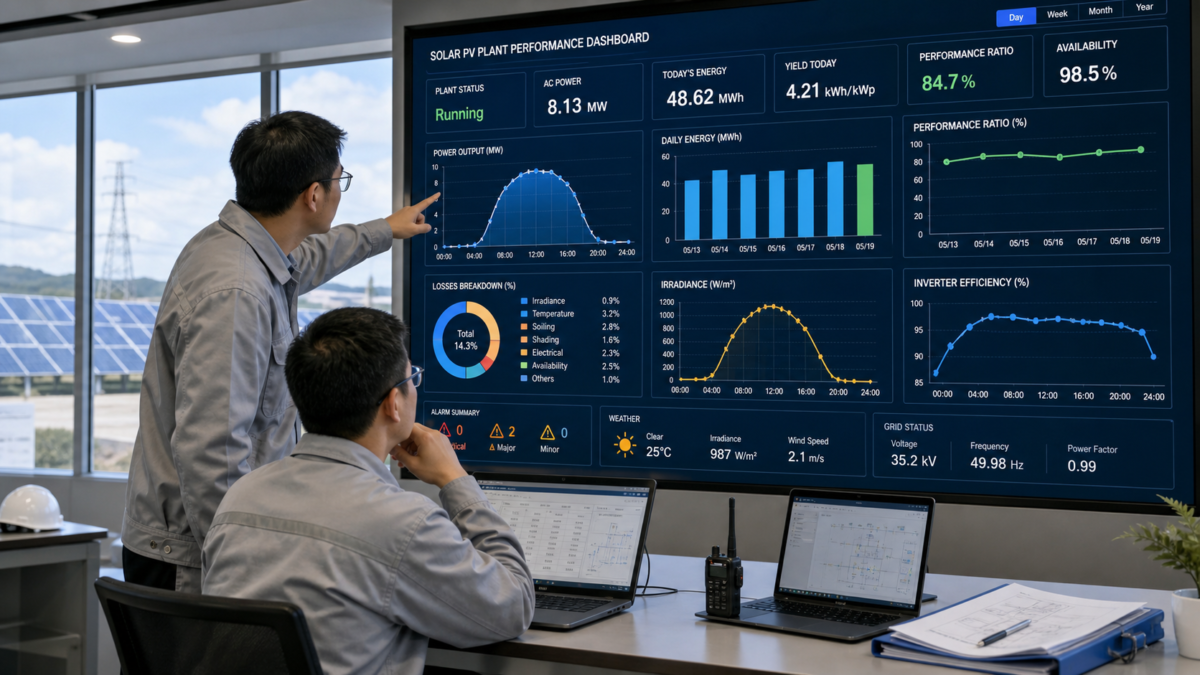
I’ve seen too many projects fall short of their financial models because the team focused on the wrong numbers. The performance ratio is a great starting point, but it's what's behind that number that really counts. It's about translating a percentage on a report into predictable cash flow. To do that, we need to dig into the assumptions that build that KPI and understand where they can go wrong in the real world. Let's look at the gap between a design on paper and a producing asset.
The Buyer Pain Point Behind Solar PV Plant Kpis?
You were sold on a specific performance ratio, but now the plant isn't hitting its numbers. The shortfall is costing you money every day, and nobody can give you a straight answer.
The biggest pain point is the disconnect between the simulated performance and the actual energy your plant sells. This gap comes from overlooked site-specific issues like grid limits, higher-than-expected soiling, and component mismatches that eat away at your returns without being obvious on a standard report.
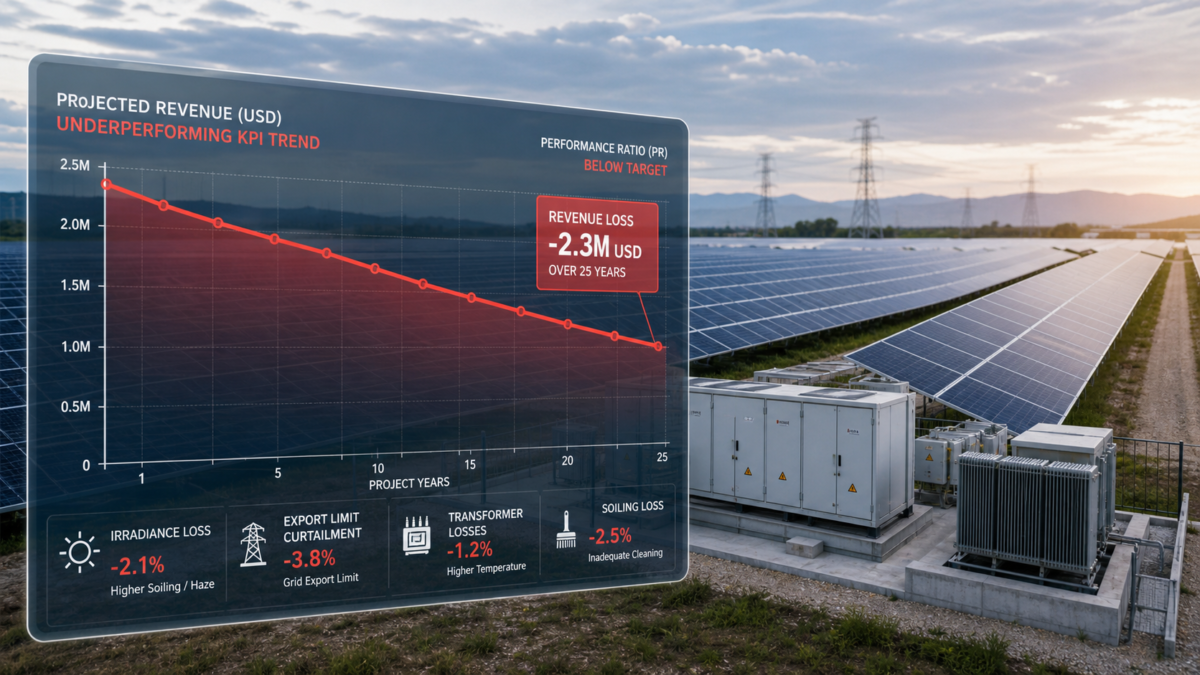
My approach has always been simple: an optimized PV design is just a theory until the real-world constraints are solved. The pain comes when a project is built based on a perfect simulation that doesn't account for the messy reality of the site and the grid. For instance, an EPC might show you a fantastic performance ratio based on industry-standard weather data, but your specific location might have morning fog that wasn't in the model. Or the design might be able to produce 10 MW, but the grid operator only lets you export 8 MW during peak hours. These are not small details; they are the exact things that can reverse a project's profitability.
From Simulation to Reality
The gap between a spreadsheet and a functioning power plant is where financial risks hide. An investor or owner feels the pain when the kilowatt-hours delivered don't match the pro-forma model they signed off on. The problem isn't usually one big failure, but a series of small, unverified assumptions that add up.
| KPI Component | The Promise (On Paper) | The Pain Point (In Reality) |
|---|---|---|
| Irradiance | Based on clean, standardized satellite data. | The actual site has more dust, local shading, or haze. |
| Layout | Optimized for maximum module count. | A strict grid export limit forces curtailment, wasting energy. |
| Transformer | Rated to handle the plant’s peak power. | It overheats or trips under sustained real-world loads. |
| O&M Plan | A low-cost plan with basic panel cleaning. | Cleaning is ineffective or infrequent, causing significant soiling loss. |
The Financial Impact of Small Misses
A 2% drop in performance ratio might not sound like much, but over 25 years, it can represent hundreds of thousands of dollars in lost revenue. This is the core pain point: the slow, silent drain on your investment caused by assumptions that were never properly challenged before construction began.
How to Test the Key PV Plant Performance Ratio O&M Assumptions?
You see an O&M proposal promising a high performance ratio for a low price. How can you be sure those promises are based on reality and not just optimistic guesswork?
You test O&M assumptions by replacing generic data with real-world site inputs. Demand a simulation that uses local irradiance measurements, the actual grid export limit, and the specific transformer's operating characteristics. This forces the model to reflect the physical reality of your project.
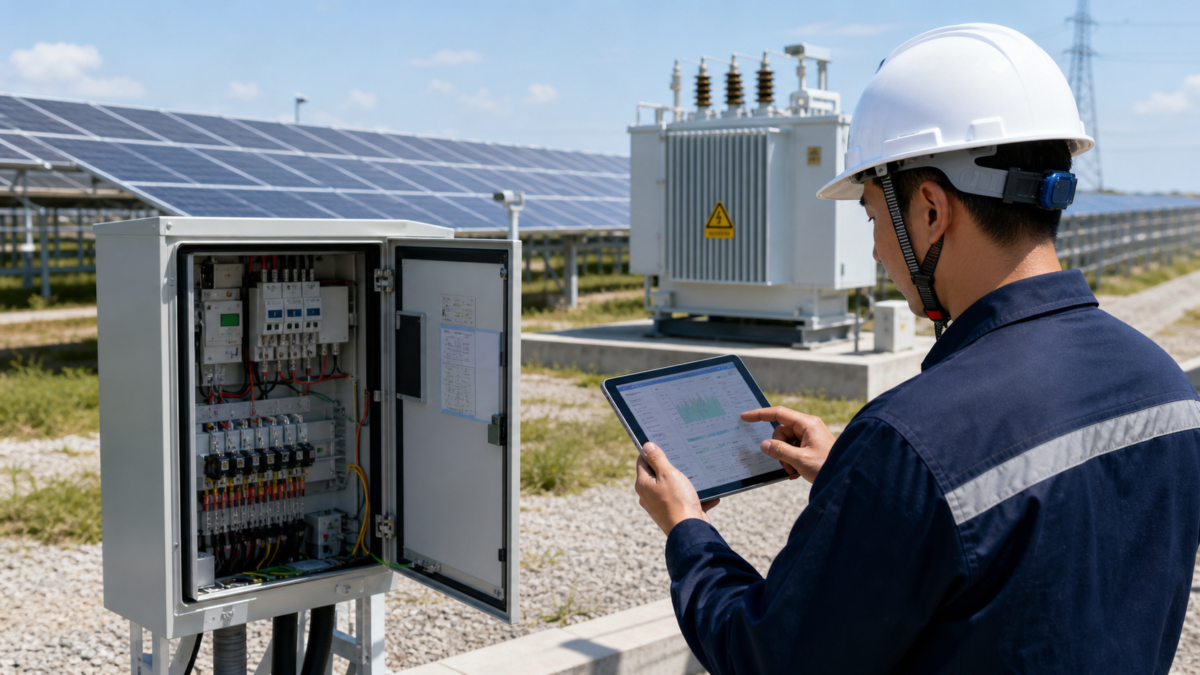
My method is to define the required outcome first—what performance ratio do you need to be profitable? Next, I identify the biggest constraints that could prevent that outcome, like grid stability or maintenance access. Finally, I insist on testing the design against those specific constraints. I've found that four variables can completely change the answer: irradiance, layout, export limit, and the transformer. For example, I would use company-published case studies from an experienced EPC like Zhongwei to see what's achievable in a similar environment. I'd also look at the specs for the actual electrical products being used, such as Moletong's substation equipment, to ensure they can handle the load without inventing performance gains. You have to ground every assumption in physical evidence from the site or the equipment datasheets. This is how you move from a theoretical design to a bankable asset.
Balancing Cost, Reliability, and Compliance in PV Plant Performance Ratio O&M?
You need an O&M plan that fits your budget. But going too cheap can risk equipment failure, void warranties, and lead to costly compliance issues with the grid operator.
The right balance is found by prioritizing reliability and compliance over the absolute lowest cost. A good O&M plan justifies its price by showing how it maintains critical hardware like transformers and inverters to ensure long-term, compliant energy delivery, which protects revenue.
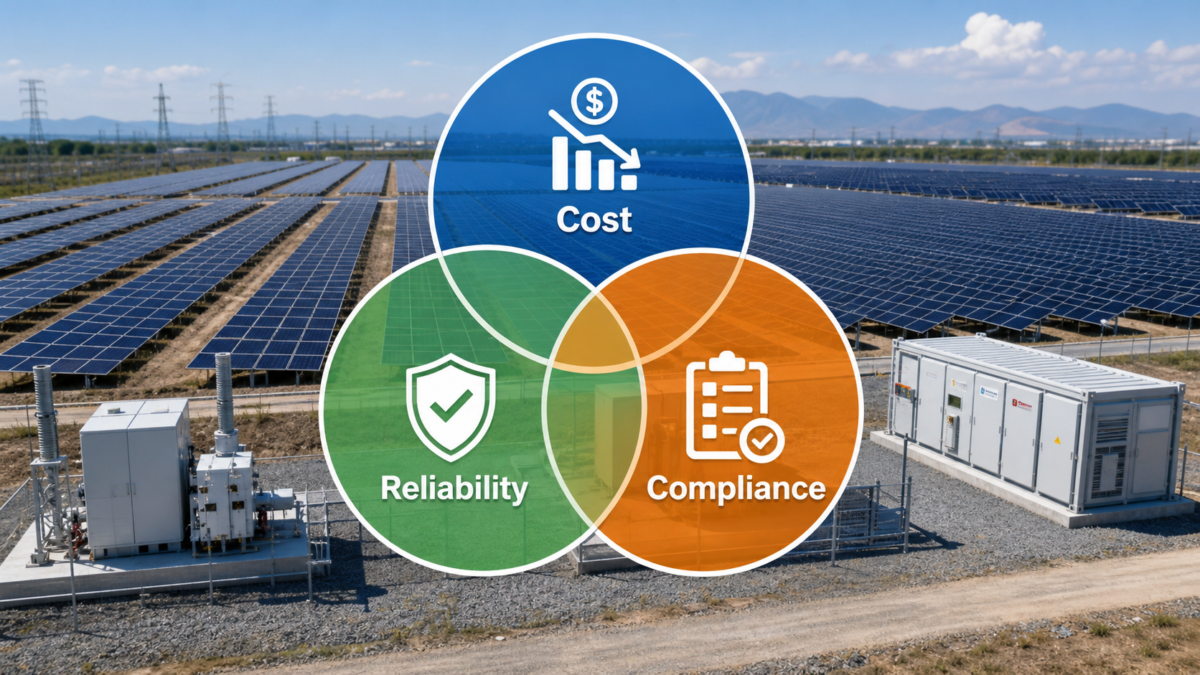
It's a classic balancing act. I've seen owners choose the cheapest O&M provider only to face major repair bills a few years later because routine maintenance on key electrical systems was skipped. A PV plant is more than just panels; it includes complex equipment like transformers and switchgear that require expert attention. For instance, using robust equipment from a manufacturer like Moletong is a great start, but that equipment still needs to be maintained according to specifications to ensure a 25-year lifespan. Furthermore, compliance is not optional. Your grid connection agreement has strict rules. If your plant can't meet them because of poor maintenance, the utility can order you to disconnect, meaning zero revenue. A slightly more expensive O&M contract that includes regular transformer oil testing and detailed grid compliance checks isn't a cost—it's insurance for your primary revenue stream.
What a Bankable PV Plant Performance Ratio O&M Proposal Should Show?
You're looking at an O&M proposal filled with technical jargon and big promises. How can you tell if it's a solid, bankable plan or just a generic sales document?
A bankable O&M proposal provides proof, not just promises. It should include a performance baseline calculated from your site's specific data, an interconnection register detailing grid requirements, and sample test sheets. Crucially, it must also state the conditions that would require changing its recommendations.
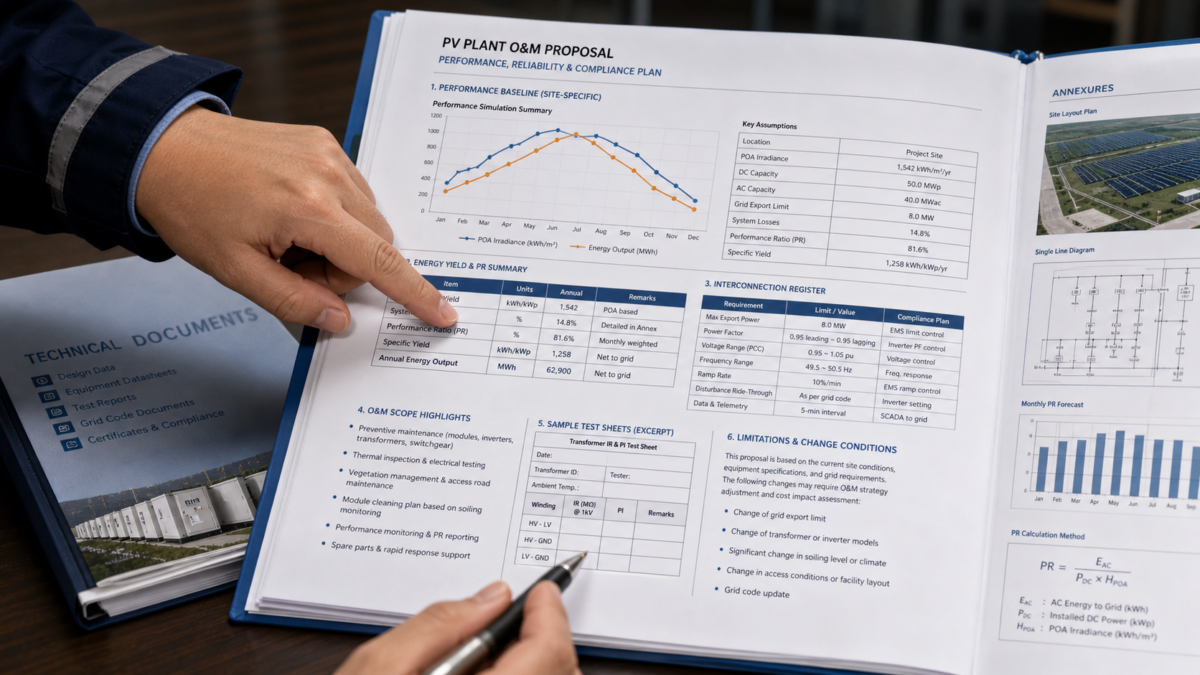
When I review a proposal, I look for a pack of evidence. I want to see that the provider has done their homework on my specific project. This means they've used a site survey pack to gather local data, not just public information. Their simulation inputs should be transparent. I expect to see an interconnection register that lists every requirement from the grid operator and a plan to meet them. I also want to see the actual test sheets they will use to commission and verify performance. Most importantly, a credible proposal will include a section on limitations. For example, it might say, "Our recommendation is based on the current export limit of 8 MW. If this changes, the O&M strategy will need to be revised." This shows they are thinking practically and builds trust. It proves the plan is a living document tied to reality, which is exactly what a technical buyer needs to see.
Conclusion
A practical, evidence-based approach to PV plant KPIs and O&M is non-negotiable. It protects your investment and ensures you get the reliable energy production you were promised.
My Role
About me
Brand Name: Moletong
Slogan: Carbon Neutrality, Tracking the Future
Website: www.moletong.com
Company Overview
Established in 2011 and headquartered in Dongguan, Guangdong, we are an integrated new-energy equipment enterprise specializing in energy storage systems, complete electrical equipment, photovoltaic solutions, charging infrastructure, and hydrogen-energy solution integration.
We integrate R&D, manufacturing, sales, system configuration, and technical service to support utility-scale, commercial and industrial, and residential energy applications. Our solutions are designed around practical customer needs such as peak shaving and valley filling, electricity-cost optimization, transformer-capacity support, emergency backup, renewable-energy integration, intelligent energy management, and photovoltaic-storage-charging coordination.
Our Core Business
1. Energy Storage Systems & Equipment
We develop lithium iron phosphate energy-storage products for utility-scale, commercial and industrial, residential, and integrated charging applications. Our documented portfolio includes liquid-cooled containerized energy-storage systems, commercial and industrial storage cabinets, residential battery systems, storage-and-charging systems, BMS, PCS, and EMS functions.
2. Complete Electrical Equipment
We provide complete high- and low-voltage electrical products, including gas-insulated ring-main units, high-voltage switchgear, low-voltage withdrawable and fixed switchgear, power-distribution cabinets, meter boxes, box-type substations, charging-station substations, and busbar-trunking systems.
3. Photovoltaic & Integrated Energy Solutions
We provide photovoltaic supporting equipment and system solutions, including 35 kV step-up substation equipment, photovoltaic combiner cabinets, adjustable mounting structures, photovoltaic-storage integration, and equipment support for grid connection, power transmission, and microgrid applications.
4. Charging & Hydrogen-Energy Solution Integration
We provide AC and DC charging solutions, storage-and-charging systems, and photovoltaic-storage-charging integration for industrial parks, commercial parking facilities, transport hubs, and locations with limited grid or transformer capacity. We also develop hydrogen-energy integration concepts involving renewable hydrogen production, hydrogen storage, refueling, and hydrogen-electric coupling. Specific hydrogen products, certifications, production capacity, and completed projects must be confirmed separately.
Product Applications & Technology Focus
Primary Service Industries:
Our principal customer sectors include Industrial and Commercial Energy Users, Renewable-Energy Developers, Power and Electrical Engineering, EV Charging Infrastructure, Commercial and Public Facilities, and Residential Energy Storage.
Product Categories We Serve:
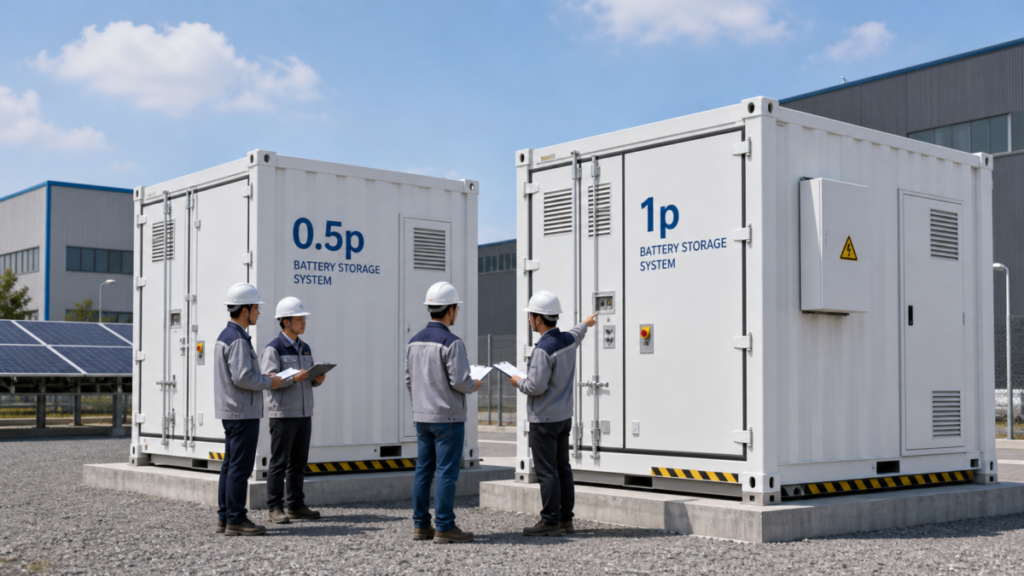
- Utility-Scale Containerized Energy-Storage Systems
- Commercial and Industrial Energy-Storage Cabinets
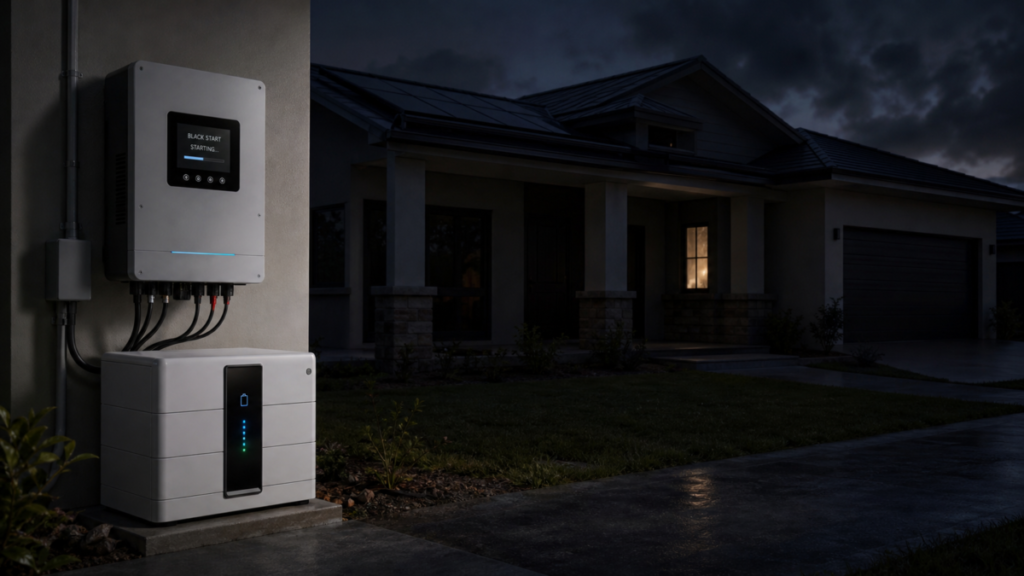
- Residential Energy-Storage Batteries and Inverters
- Integrated Storage-and-Charging Systems
- High- and Low-Voltage Switchgear
- Box-Type Substations and Charging-Station Substations
- Busbar-Trunking and Power-Distribution Products
- Photovoltaic Step-Up and Combiner Equipment
Technology Expertise:
Our documented technical focus includes:
Lithium Iron Phosphate Cells, BMS, PCS, EMS, Liquid Cooling, Natural Cooling, Modular System Integration, Remote Monitoring, Load Tracking, Anti-Reverse-Flow Control, Transformer-Capacity Protection, and Intelligent Operation and Maintenance.
Production Capacity & Equipment
Energy Storage Production & R&D Platform
Our supplied corporate materials identify one production base in Dongguan and a Dongguan engineering R&D center. We support product development, equipment manufacturing, system configuration, and technical service for residential, commercial and industrial, and large-scale energy-storage applications.
- Product Platform Highlights: 5,015 kWh liquid-cooled containerized storage systems, 627 kWh and 261 kWh commercial and industrial storage cabinets, 16 kWh residential battery systems, and 261 kWh and 627 kWh integrated storage-and-charging systems.
Electrical Equipment Platform
We provide product design and manufacturing support for complete electrical assemblies used in industrial facilities, commercial buildings, substations, photovoltaic projects, charging stations, and public infrastructure.
- Equipment Highlights: High-Voltage Ring-Main Units, High-Voltage Metal-Clad Switchgear, Low-Voltage Withdrawable Switchgear, AC Low-Voltage Switchgear, Distribution Cabinets, Box-Type Substations, Prefabricated Charging-Station Substations, and Busbar-Trunking Systems.
Energy Storage & Electrical System Capabilities
General Capabilities:
- Application and electricity-use requirement analysis
- Energy-storage system selection and capacity configuration
- Equipment design and manufacturing
- BMS, PCS, and EMS system integration
- Peak shaving, valley filling, and time-of-use energy scheduling
- Load tracking and anti-reverse-flow control
- Transformer-capacity protection and demand management
- Photovoltaic-storage and storage-charging integration
- Remote installation, commissioning, and trial-operation support
- Operator training, warranty service, and technical after-sales support as contracted
Our Core Specialties:
- ✔️ Liquid-Cooled Large-Capacity energy-storage systems
- ✔️ Commercial & Industrial peak-valley and backup-power solutions
- ✔️ Integrated Photovoltaic-Storage-Charging applications
- ✔️ Complete Electrical Distribution equipment and system coordination
Quality Control & Certifications
We apply quality, environmental, and occupational health and safety management requirements to the design, manufacture, and sales of our documented product scope.
Quality Management Scope:
The supplied qualification materials show ISO management-system certificates and patent certificates held by Moletong. The product manuals separately define model-specific electrical parameters, monitoring functions, protection requirements, cooling methods, fire-protection configurations, operating environments, and technical-service conditions.
Testing & Protection Focus:
- Cell voltage, current, temperature, and operating-status monitoring
- Overcharge, over-discharge, overtemperature, and abnormal-condition protection
- Liquid-cooling or natural-cooling verification according to product model
- Fire-protection configuration according to product type
- Enclosure protection, corrosion resistance, and operating-environment requirements
- BMS, PCS, EMS, and communication-function verification where applicable
Certifications & Compliance:
- ISO 9001 Quality Management System
- ISO 14001 Environmental Management System
- ISO 45001 Occupational Health and Safety Management System
- Invention Patent and Utility Model Patent Certificates
- Selected product models list IEC 62619, UN 38.3, RoHS, EN 61000 series requirements, GB/T 36276, CCC, and relevant IEC/GB electrical standards
Certification scope varies by product model, configuration, destination market, and certificate validity period. Model-specific certificates must be confirmed before any formal compliance claim.
Target Markets & Partnership Models
Who We Serve:
- Industrial Facility Owners: Plant managers, energy managers, facility managers, and procurement teams at factories or industrial parks seeking peak-valley electricity-cost optimization, demand management, transformer-capacity support, or emergency backup power
- Renewable-Energy Developers: Project developers, engineering managers, and procurement teams for photovoltaic or wind projects requiring energy storage, step-up equipment, electrical distribution, or renewable-energy integration
- EPC & Electrical Contractors: Project managers, technical managers, and equipment-purchasing teams at qualified engineering companies requiring packaged energy-storage or electrical equipment with technical coordination
- Charging-Station Developers & Operators: Investment, construction, and operations teams working on sites with limited grid access, insufficient transformer capacity, high peak demand, or photovoltaic-storage-charging requirements
- Energy Service Companies & System Integrators: Solution designers and project-development teams building commercial and industrial energy-management, microgrid, or distributed-energy projects
- Residential Storage Distributors & Installers: Importers, distributors, wholesalers, and qualified installers requiring lithium iron phosphate batteries, off-grid or hybrid inverters, and residential storage configurations
- Commercial & Public-Facility Owners: Property, engineering, and facility-management teams for commercial buildings, schools, hospitals, hotels, parking facilities, and transport locations requiring reliable power distribution, charging, or backup-energy solutions
Target Geographies:
Our home market is China, supported by regional sales coverage for South, East, Central, and Southwest China. The supplied 2026 catalogue also identifies an overseas office in Indonesia, supporting practical market development in Southeast Asia. Other overseas markets are served only after confirming model-specific certification, grid requirements, shipping conditions, and local installation standards.
Types of Cooperation:
- Equipment Supply: Standard or configured energy-storage and electrical products
- System Configuration: Product selection and capacity configuration based on the customer's application
- System Integration: BMS, PCS, EMS, photovoltaic, charging, and electrical-system coordination
- Project Technical Cooperation: Technical coordination with renewable-energy developers, EPC contractors, and qualified local engineering companies
- Integrated Energy Solutions: Photovoltaic-storage, storage-charging, and photovoltaic-storage-charging applications
- Technical Service: Training, remote installation and commissioning support, warranty, and after-sales service as agreed in the commercial contract
Our Core Competitive Advantages
⭐ Integrated New-Energy Product Portfolio
By combining energy-storage systems, complete electrical equipment, photovoltaic supporting products, charging applications, and intelligent energy-management functions, we can configure solutions around the customer's complete power-use scenario.
⭐ Coverage from Residential to Utility Scale
Our documented energy-storage range extends from 16 kWh residential systems to 261 kWh and 627 kWh commercial and industrial systems and a 5,015 kWh containerized system.
⭐ Application-Oriented System Design
Our solutions address identifiable operating needs, including peak-valley arbitrage, demand management, transformer-capacity constraints, backup power, renewable-energy consumption, and charging-station power support.
⭐ Integrated Control & Safety Architecture
Our storage products combine lithium iron phosphate cells with BMS, PCS, EMS, model-specific thermal management, multi-level protection, intelligent monitoring, and remote operation and maintenance functions.
⭐ Regional Sales & Technical Service Support
With a Dongguan headquarters and engineering center, regional sales coverage in China, and an overseas office identified in Indonesia, we support equipment selection, technical coordination, training, remote commissioning assistance, and contracted after-sales service.
Leave a Reply