

How Should DC Coupled Solar Battery Be Specified for Real Operating Conditions?
Choosing a solar battery based on capacity alone is a huge mistake. This simple error can lead to costly installation problems. Let’s specify your battery for real-world conditions.
Specify a DC-coupled solar battery by first defining its physical form factor and coupling architecture. These two factors directly influence installation costs, service access, future expansion options, and overall operational risk. Consider wall/floor limits, enclosure exposure, and peak power needs before selecting a specific model.
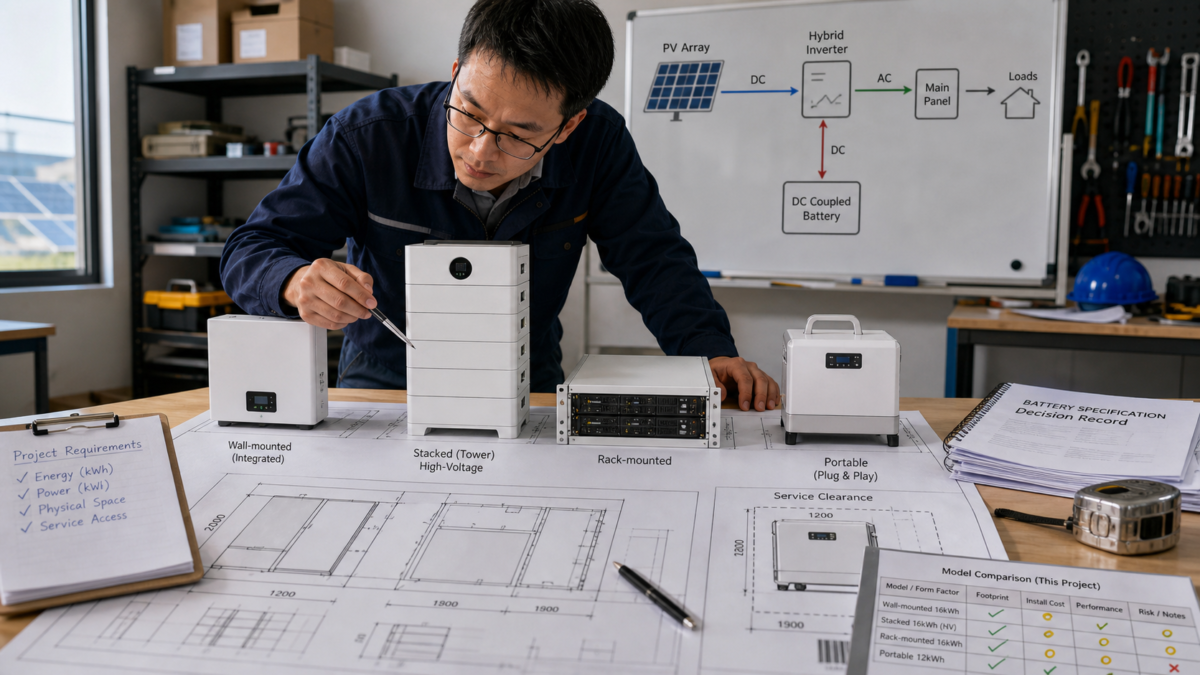
It's easy to get lost in datasheets full of numbers. But I’ve learned that the real engineering work starts when we translate those numbers into a physical installation. The most common mistake I see is someone judging a battery just by its kilowatt-hour (kWh) rating. That one number tells you almost nothing about the installation, service, or expansion risk. My rule is simple: form factor and coupling architecture are what really matter. Let's break down how to turn a general need for a battery into a specific engineering requirement that works in the real world.
From DC Coupled Solar Battery to an Engineering Requirement?
You know you need a battery, but how big? The wrong choice can waste money or fail to meet your needs. Let's turn your "what" into a technical "how."
Translate your need into an engineering requirement by documenting four key variables: required energy storage (kWh), peak power output (kW), physical installation space (dimensions and weight limits), and required service clearances. This forms the basis for comparing different DC-coupled solar battery models and form factors.
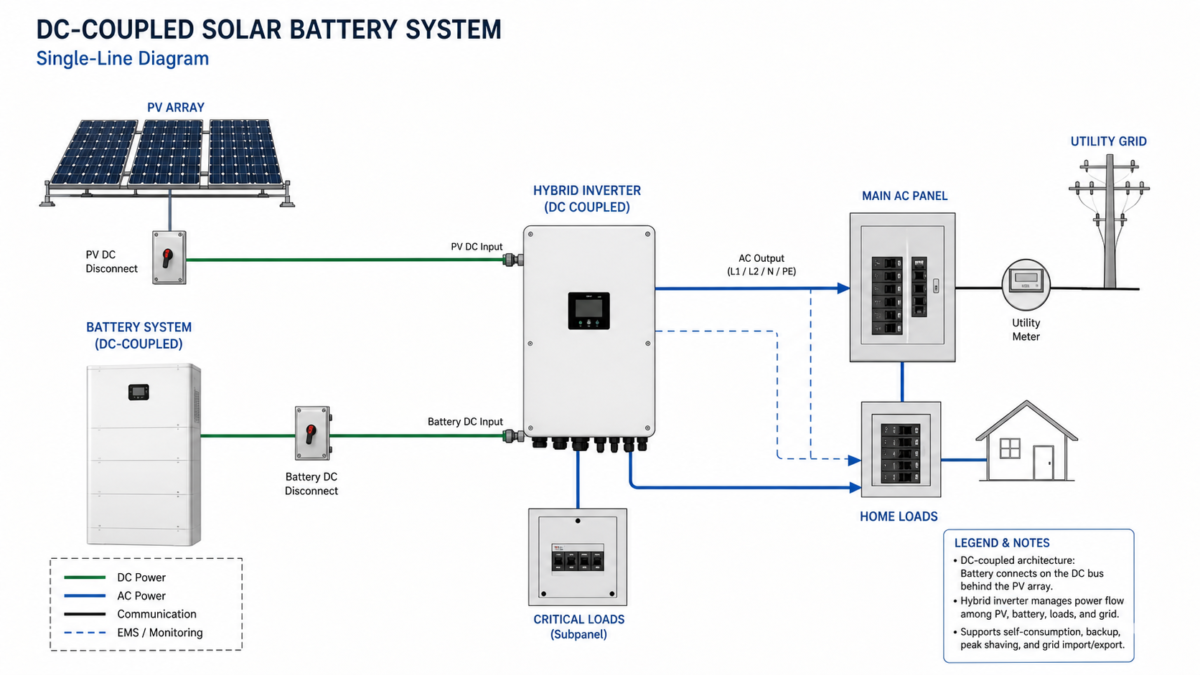
When a client tells me they want a "solar battery," my first job is to help them define what that actually means for their project. We can't just pick a model from a catalog. We have to create a clear engineering requirement first. This process moves the decision from a vague idea to a concrete specification. I focus on four main areas to build this requirement.
Key Specification Variables
First, we define the energy and power needs. This is more than just a single kWh number. We look at how much energy is needed to last through an outage and how much peak power is needed to start large appliances like an air conditioner. Second, we measure the physical space. I need exact width, depth, and height, but I also check for any obstructions. Third, we have to think about service access. A battery needs space around it for cooling and for a technician to work on it safely. Finally, we look at the logistics of getting the battery into place. Can we get it through the door? Up the stairs? These practical questions are part of the engineering requirement.
| Variable | Description | Example Question |
|---|---|---|
| Energy (kWh) | The total amount of energy the battery can store. This determines how long it can power your home. | How many hours of backup power do you need for essential loads? |
| Power (kW) | The maximum rate of electricity the battery can deliver. This determines how many appliances can run at once. | What is the combined power draw of your largest appliances? |
| Physical Space | The physical footprint and volume of the battery, including dimensions and weight. | Where will the battery be installed, and what are the exact dimensions of that space? |
| Service Access | The clearance required around the unit for ventilation, maintenance, and potential replacement. | Is there at least 3 feet of clear space in front of the proposed location? |
Only after we have documented these four points can we begin to compare actual products.
The Role of Wall/floor Limits in the Final Design?
Found the perfect battery? But what if it's too heavy for your wall or too big for the room? Let's check the physical limits before you buy.
Wall and floor load limits are critical constraints that dictate the battery's form factor. Wall-mounted units are limited by structural capacity, while floor-stacked systems are limited by floor space and point loading. Always verify these limits with a structural engineer to avoid installation failure and ensure safety.
I always tell my clients that gravity is a key part of any battery specification. It sounds simple, but overlooking the weight and dimensions of a battery is a frequent and costly error. The "best" battery on paper is useless if you can’t install it safely. The physical structure of the installation site often makes the decision for us, narrowing our options down to a specific form factor. For example, a sleek, wall-mounted battery looks great, but many interior walls aren't built to hold several hundred pounds. I always insist on checking the wall framing and consulting a structural engineer if there is any doubt.
If a wall can't support the weight, we have to look at floor-standing options. This is where products like Moletong's stackable or rack-mounted batteries come in. A stackable system like a high-voltage tower battery puts the weight directly on the floor slab, which can usually handle it. However, this form factor takes up valuable floor space. We have to make sure it won’t block a walkway or violate local fire codes for clearance. For larger systems, we might use a rack, but that requires even more floor space and height. The decision between wall, stack, or rack isn't about which is better in general; it’s about which is right for the specific floor and wall we have to work with.
Why One DC Coupled Solar Battery Outcome Does Not Prove the Rule?
Your neighbor's solar battery works perfectly for them. So it must be right for you, too, right? This assumption can be a costly mistake.
One successful outcome doesn't prove a rule because every project has unique constraints. Factors like available space, structural limits, local electrical codes, and future expansion plans vary widely. A solution that is perfect for one home may be impractical or unsafe for another with different conditions.
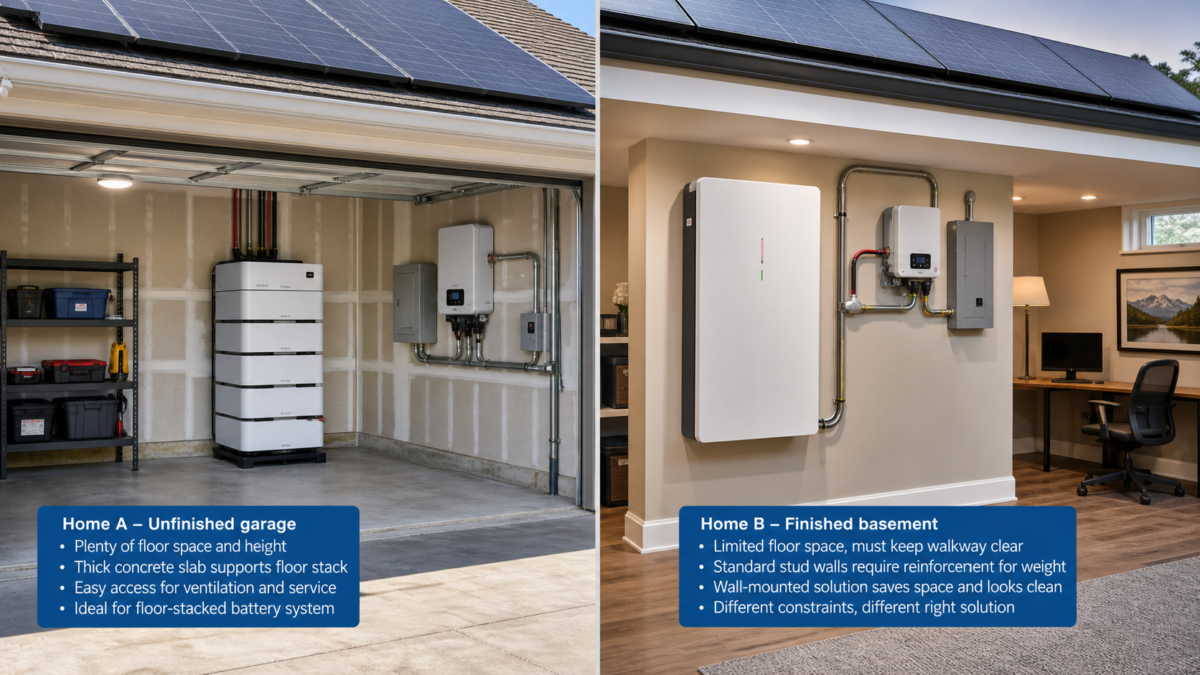
I often have to explain to customers why we can't just copy a system that worked for someone else. A recommendation from a friend or neighbor is a good starting point, but it's not a substitute for a proper engineering review. I recently worked on two projects that seemed identical on paper. Both were for 16 kWh DC-coupled systems. The first home had a large, unfinished garage with a thick concrete floor and plenty of open wall space. For this project, a floor-stacked Moletong battery system was the perfect fit. It was easy to install, had great ventilation, and left plenty of room for future expansion. The installation was straightforward and cost-effective.
The very next week, I visited the second home. The customer wanted the same 16 kWh system but wanted it installed in a finished basement that also served as a home office. The floor space was limited, and a floor-stacked system would have been a major obstruction. The walls were standard drywall over wood studs. After a structural check, we found a section of wall that could be reinforced to support a wall-mounted unit. We chose an integrated, wall-mounted product instead. It had a smaller footprint and a cleaner look that fit the finished space. Both customers got a 16 kWh battery, but the "right" solution was completely different for each. This shows why we must analyze every project on its own.
How to Document the DC Coupled Solar Battery Decision?
You've made a great choice, but can you prove it? Without clear documentation, your reasoning can get lost, causing issues during service or upgrades.
Document your decision using four key items: a dimensioned layout showing the equipment and clearances, a single-line electrical diagram, photos of the installation space highlighting constraints, and a table comparing the chosen model against alternatives based on your project's specific requirements (cost, performance, risk).
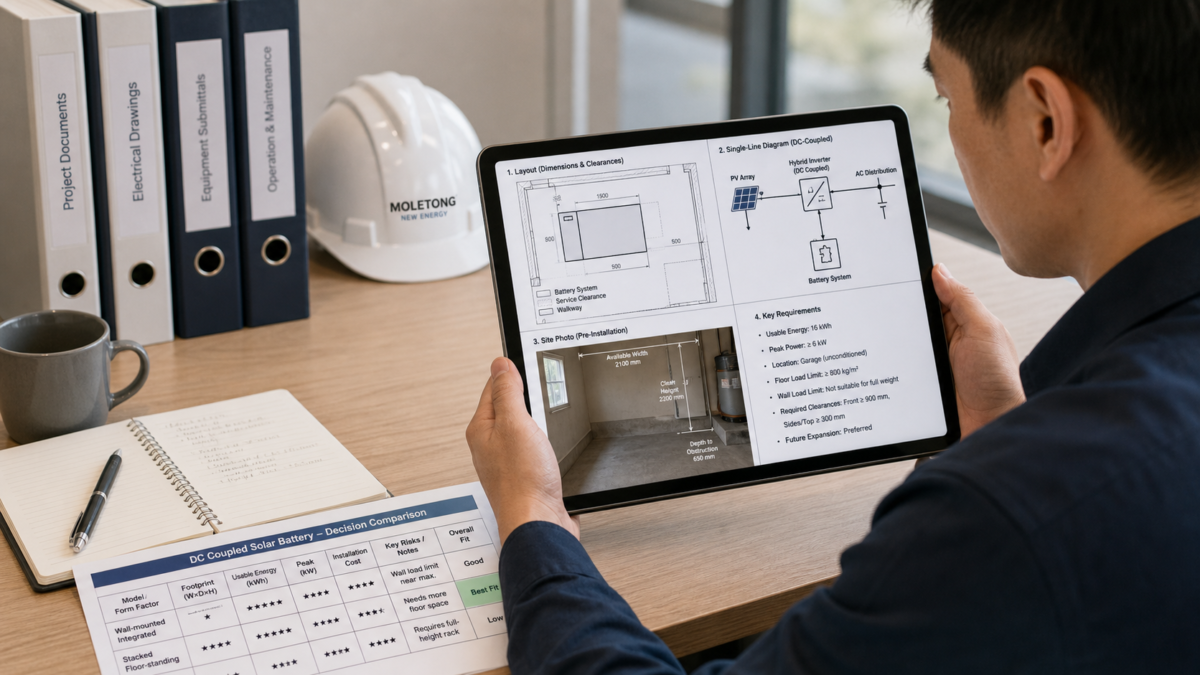
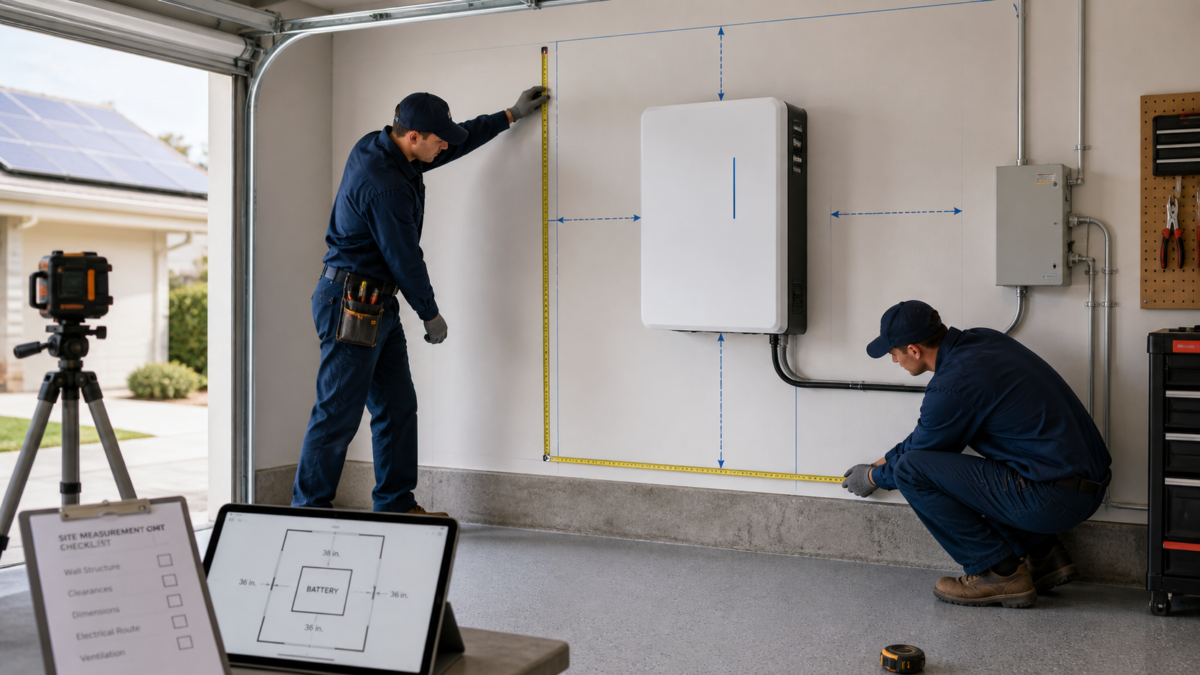
After all the analysis, making the final decision is just one step. The last, and most important, step is to document why that decision was made. This protects both me and my client. It creates a transparent record that can be used for maintenance, service, and future upgrades. I always create a simple project folder with four key documents. First is a dimensioned layout. This is a simple sketch or drawing showing the battery's location, its dimensions, and the required service clearances around it. It proves that we thought about access for future service.
Second is the single-line electrical diagram. This shows how the DC-coupled battery connects to the solar inverter and the rest of the electrical system. It’s essential for any future electrical work. Third, I take photos of the actual installation space before work begins. I make sure to capture any challenges, like nearby plumbing, an uneven floor, or a tight corner. These photos provide context for why we chose a specific form factor. Finally, I create a simple decision table. This table lists the models we considered and compares them on the key criteria for this project: form factor, physical footprint, installation cost, and any specific risks we identified. This documentation turns our choice from an opinion into a well-reasoned engineering decision.
Conclusion
Specifying a DC-coupled battery is about matching the form factor to real-world limits. This transparent, engineering-led approach reduces risk and ensures your system performs as expected for years to come.
Leave a Reply