

How Should Buyers Evaluate BESS Project Registration EPC?
Struggling to choose the right BESS EPC partner? You are worried an attractive proposal will become difficult to deliver, leaving you with a system that fails when you need it most.
To evaluate a BESS project EPC, you should use a decision model based on lifecycle support. Focus on the Service Level Agreement (SLA), service territory, partner training, and system compatibility. This is much more reliable than relying on a product label or a single user's review.

Choosing an EPC partner for a Battery Energy Storage System (BESS) project feels like a big decision, because it is. I have seen too many buyers focus only on the initial hardware cost or the brand name on the battery. They get a great price on paper, but the real test comes six months later during the first unexpected outage. The practical issue is that the success of your project depends on lifecycle support, not just hardware availability. If I were advising you today, I would tell you to start with one question: how will this partner support me when things go wrong? Let’s turn that principle into a clear decision model you can use.
Should You Start with the Customer Problem, Not the Product?
Your BESS project is failing before it starts. You are comparing datasheets and prices, but this product-first approach misses the most critical part: your specific operational needs and challenges.
You should always start with the customer's problem. By defining your exact operational needs—like peak shaving, backup power, or grid services—you can design a solution that truly fits. A product-first approach often leads to a system that is either over-specified and expensive or under-powered and unreliable.

When I work with a new client, I don’t begin by showing them our Moletong product catalog. Instead, I ask them to describe their worst-case scenario. What happens when the grid goes down? What does a peak demand charge do to their monthly budget? The answers to these questions define the problem we need to solve. Only then can we talk about products. An EPC that pushes a specific BESS model before they understand your pain points is selling you a box, not a solution. The best partners build their proposals around your exact operational models, competencies, and how you will collect evidence of success. They own the escalation process because they helped define the problem from day one. I've found a problem-first approach builds a much stronger foundation for a successful long-term project.
From Vague Needs to a Specific Solution
Let's compare these two approaches. The difference is in the details that get uncovered. A problem-first discussion forces everyone to think about the real-world application, not just the technical specifications on a piece of paper.
| Evaluation Area | Product-First Approach (The Wrong Way) | Problem-First Approach (The Right Way) |
|---|---|---|
| Starting Point | “I need a 500 kWh BESS.” | “I need to reduce my peak demand charges by 30%.” |
| Key Metric | Cost per kWh ($/kWh) | Return on Investment (ROI) based on savings |
| Technical Focus | Battery chemistry, C-rate, efficiency | Load profile, charge/discharge strategy, grid interaction |
| Outcome Risk | The system might not solve the actual financial or operational issue. | The system is designed specifically to meet a business objective. |
How Does an SLA Shape the BESS Project Registration EPC Design?
You signed the contract. But what happens when the system underperforms? Without a clear Service Level Agreement (SLA), you are left hoping your EPC partner will respond when you need them.
An SLA contractually defines performance, uptime, and support response times. It forces the EPC to design a more robust and reliable system because they are financially accountable for its performance. A strong SLA directly shapes the design by requiring redundancy, high-quality components, and proactive monitoring.

I always tell buyers to look at the SLA section of a proposal first. This document is more important than the hardware datasheet. Why? Because it turns a promise of support into a contractual obligation. An EPC willing to commit to a 99% uptime guarantee with a four-hour response time for critical failures has to design the system differently. They will build in redundancy. They will use components with a proven track record. They will insist on robust remote monitoring capabilities. I remember a project in a remote area where the client was focused on the lowest initial cost. I explained that without an SLA, a simple inverter fault could mean days of downtime waiting for a technician. By adding an SLA, the design changed to include a redundant inverter and a local parts cache. The upfront cost was slightly higher, but it protected the client from significant financial losses later. The SLA isn't just a legal document; it's a blueprint for reliability.
When Does Lead Qualification Change the Economics?
You received a very attractive proposal. The price seems too good to be true, but the hardware is top-tier. The problem is that hidden costs are often buried in the operating conditions.
Lead qualification changes the economics when it uncovers operational realities like a remote territory, a lack of trained local technicians, or complex system compatibility issues. An EPC that asks tough questions upfront is protecting you from unexpected costs for specialized support, travel, and integration later on.

A good EPC partner qualifies you just as much as you qualify them. When an EPC asks about the skills of your local maintenance team, the logistics of getting a technician to your site, or the specific software protocols of your existing equipment, they are doing you a favor. They are stress-testing their own proposal. I once worked on a bid where the site was on an island. The logistics of getting parts and a certified technician there were a huge challenge. Another bidder ignored this and put in a low price. We included a mandatory local training program and a pre-stocked container of critical spares in our proposal. It made our bid look more expensive at first. But when the other bidder was forced to add those costs later, their "attractive" price ballooned. The most inconvenient operating condition is where a cheap proposal falls apart. A partner who digs into these issues early is changing the economics in your favor by making all the costs visible from the start.
How Can You Turn Evaluation into Clear Specifications?
You understand the principles, but how do you apply them? It is hard to translate concepts like "lifecycle support" into a contract. You need a practical way to specify your requirements.
You turn a high-level evaluation into clear specifications by using concrete tools. Create a competency checklist for the EPC, a compatibility matrix for your existing systems, a demo script for the software, and a ticket template for support. These documents make your expectations measurable and enforceable.
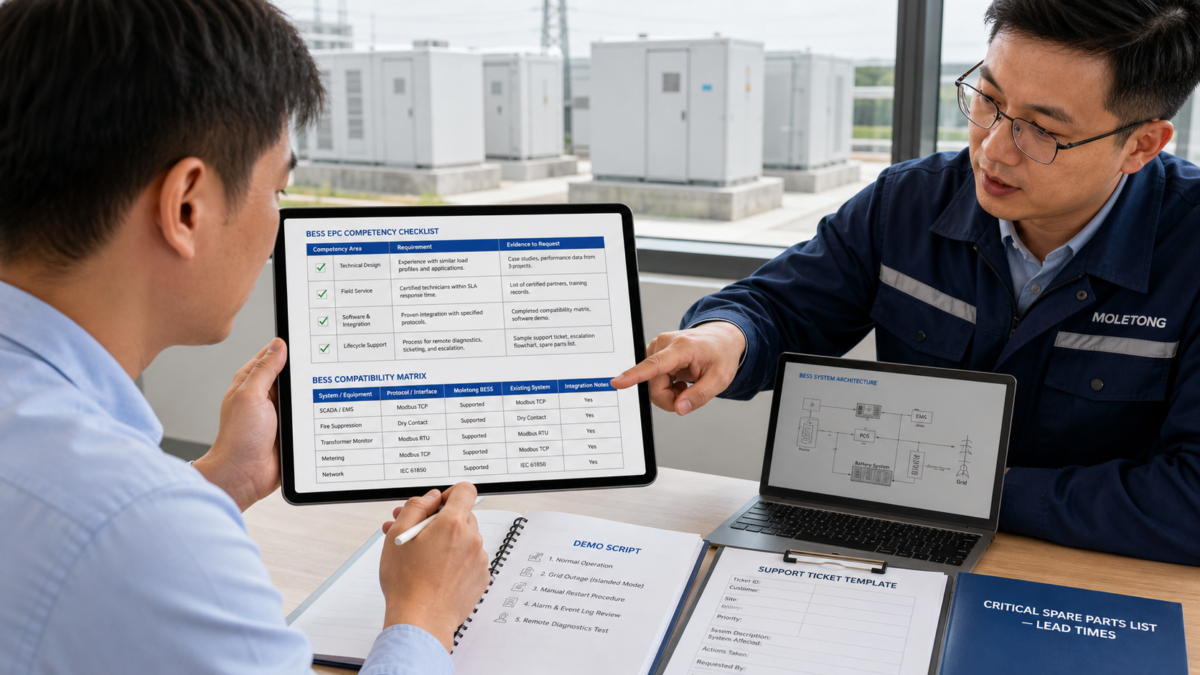
To make this useful, you need to move from ideas to documents. For my Moletong partners, I build materials around exact requirements. Let's make this real for you. Don't just ask an EPC if they are "competent." Give them a checklist and ask for evidence. Don't ask if their system is "compatible." Provide a matrix of your equipment and protocols and have them fill it out. I’ve included a sample competency checklist below. You should also demand a demo script that tests the most inconvenient operating condition—what happens during a grid blackout when the internet is also down? How do you manually restart the system? Ask for their standard support ticket template and a critical parts list with lead times. These simple documents transform a vague sales pitch into a set of clear, binding specifications that protect you.
Key Questions and a Competency Checklist
Before you approve any design, you need to ask the right questions. Here are the exact questions to ask, followed by a checklist to formalize the evaluation.
Final Questions for Your EPC:
- Can you provide a draft of the Service Level Agreement (SLA) defining uptime and response times?
- What is your escalation and ownership plan for a critical system failure at our specific location?
- Show me the training program and certification required for technicians who will service my system.
- Can you complete this compatibility matrix for our existing SCADA, fire suppression, and network systems?
- What is the lead time for critical replacement parts like an inverter or battery module?
| Competency Area | Requirement | Evidence to Request |
|---|---|---|
| Technical Design | Demonstrated experience with similar load profiles and applications. | Case studies, system performance data from 3 past projects. |
| Field Service | Certified technicians available within the SLA response time for our territory. | List of certified service partners, technician training records. |
| Software & Integration | Proven integration with our specified communication protocols (e.g., Modbus, DNP3). | Completed compatibility matrix, live or recorded software demo. |
| Lifecycle Support | Documented process for remote diagnostics, ticketing, and escalation. | Sample support ticket, escalation flowchart, spare parts list. |
Conclusion
Evaluate your BESS EPC partner on their commitment to lifecycle support. Use SLAs, competency checklists, and tough operational questions to build clear specifications and ensure your project succeeds long-term.


Leave a Reply