

How Should Indonesia Energy as a Service BESS Be Specified for Real Operating Conditions?
Energy as a Service BESS promises big savings with no upfront cost, but performance is never guaranteed. How do you ensure the system you get actually delivers on its promises?
Specify your Indonesia Energy as a Service BESS by focusing on real operating conditions. Prioritize a clear measurement plan, conservative savings estimates based on your actual PLN bills, robust on-site acceptance tests, and transparent termination terms. These factors matter more than nameplate capacity alone.
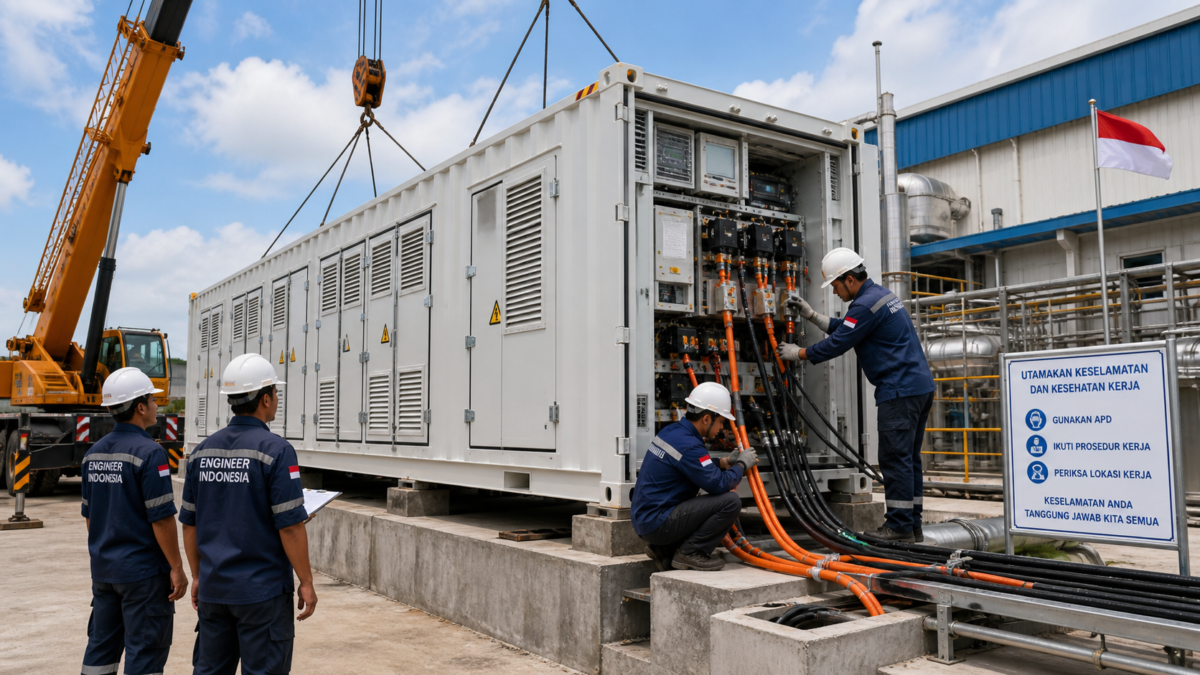
I often see buyers get excited about the "no upfront cost" part of an Energy as a Service (EaaS) offer. They think that because they aren't buying the battery, they have no risk. But that is not true. This model transfers the capital cost, but it does not automatically transfer the performance risk, regulatory risk, or the risk of your provider failing. The key to a successful project is to look past the attractive sales pitch and dig into the details that define performance in the real world. I will walk you through how I evaluate these deals to protect my clients and ensure the savings are real.
What Indonesia Energy as a Service BESS Reveals About the Real Constraint?
You signed an EaaS deal expecting big savings on your electricity bill. But after a few months, you see the actual savings are much lower than the proposal promised.
The real constraint for an Indonesian EaaS BESS is not just capital cost. It is the combination of your factory's specific electricity usage, PLN's complex tariff structure, and the system's actual, guaranteed performance under local conditions. If you misjudge any of these, your expected savings will not materialize.
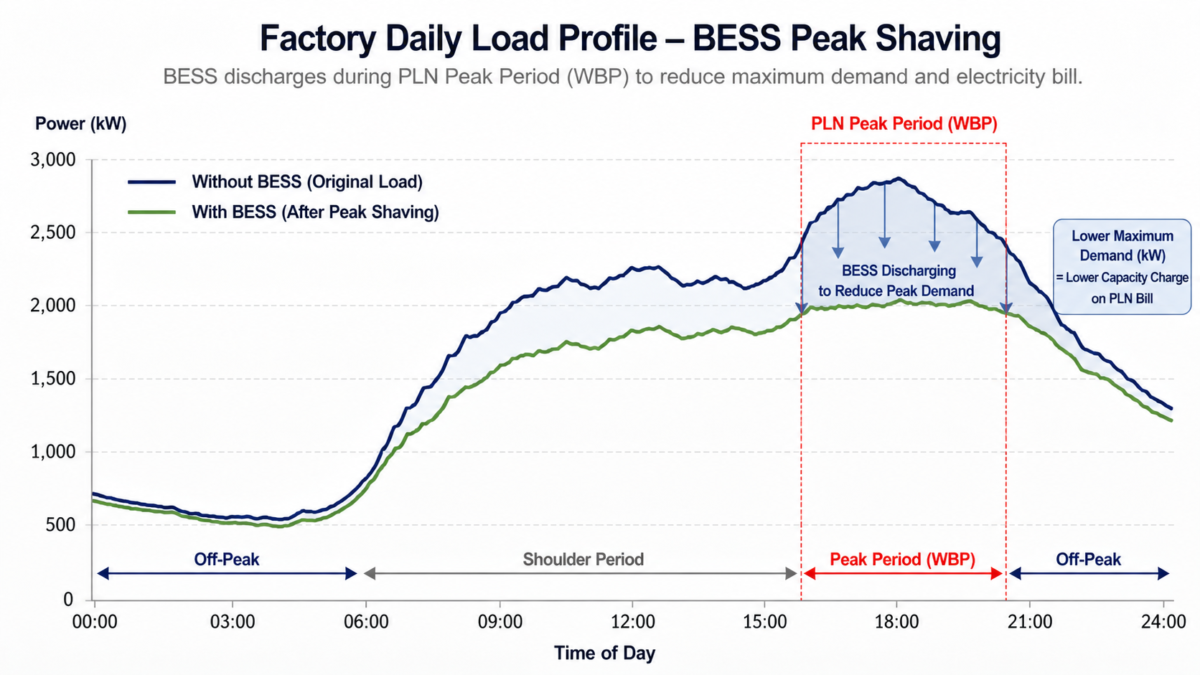
When I start a project, I don't begin by looking at battery brochures. I begin by analyzing at least one year of the client's PLN electricity bills. This data tells the true story. It shows me exactly when the factory uses the most power and how much that peak power costs. In Indonesia, this is the WBP (Waktu Beban Puncak) period. The real money is saved by reducing demand during these few, expensive hours each day. The provider's proposal might assume the battery is available 100% of the time to shave this peak. But I prefer to test a more conservative case. What if it's only available 98% of the time due to maintenance or unexpected grid issues? That small difference can have a huge impact on the final savings. The real constraint is ensuring guaranteed performance during the moments that matter most.
Comparing Key Project Assumptions
| Assumption Parameter | Attractive (Provider’s) Case | Conservative (My) Case | Why It Matters |
|---|---|---|---|
| System Availability | 99.5% | 98.0% | Missing even one peak demand window per year can significantly reduce savings. |
| Round-Trip Efficiency | 92% | 88% | Lower efficiency means more energy is lost, increasing the cost to charge the battery. |
| PLN Tariff Escalation | 3% per year | 1.5% per year | Overestimating tariff increases inflates the projected long-term savings. |
| Battery Degradation | 0.5% per year | 1.5% per year | Higher degradation means less available capacity to shave peaks in later years. |
Which Measurements Matter More Than Nameplate Data for Indonesia Energy as a Service BESS?
The provider's proposal shows impressive nameplate data like kWh capacity and kW power. But what if the system cannot deliver that power consistently when you actually need it?
For an Indonesian EaaS BESS, you must focus on practical measurements. These include round-trip efficiency under your actual load, system response time, and the guaranteed available capacity at high ambient temperatures. These real-world metrics determine your savings, not the numbers on a spec sheet.
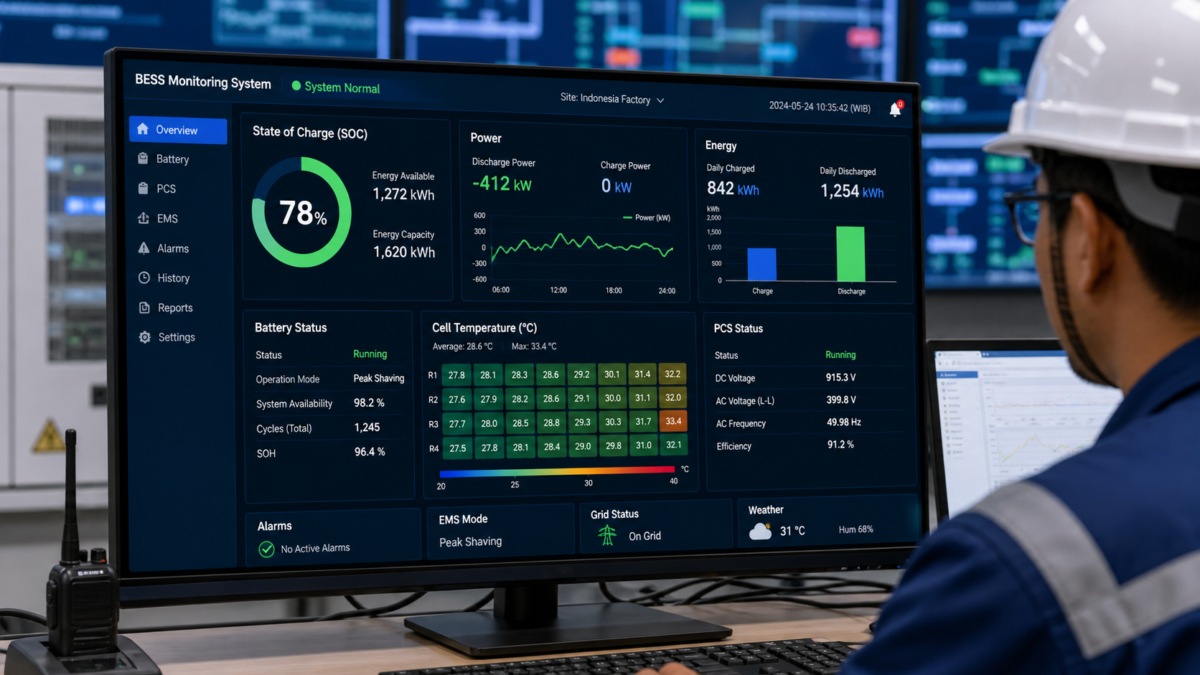
A nameplate rating is measured in a perfect laboratory environment. Your factory in Bekasi or Karawang is not a lab. The heat and humidity are real, and they affect performance. This is why I insist that the contract clearly defines the Measurement and Verification (M&V) protocol. We must agree on exactly what we will measure, how we will measure it, and what happens if the performance is not met. For example, a spec sheet might claim 92% round-trip efficiency. But when the battery is operating in 35-degree Celsius heat, the cooling system uses extra power, and that efficiency might drop to 88%. This 4% difference adds up to a lot of money over a 10-year contract. I also define service response time. If the system fails during a critical peak period, the contract must state that a technician will be on-site in hours, not days, with clear financial penalties for delays.
How Termination Terms Can Undermine the Expected Result?
Your EaaS contract looks great for the first few years. But when you try to exit the contract early, you discover huge fees that wipe out all of your savings.
Vague or punitive termination terms can completely destroy the value of an EaaS contract. You must demand a clear, predictable termination schedule with pre-agreed buyout costs for each year. This protects you if your business needs change or the provider fails to perform.
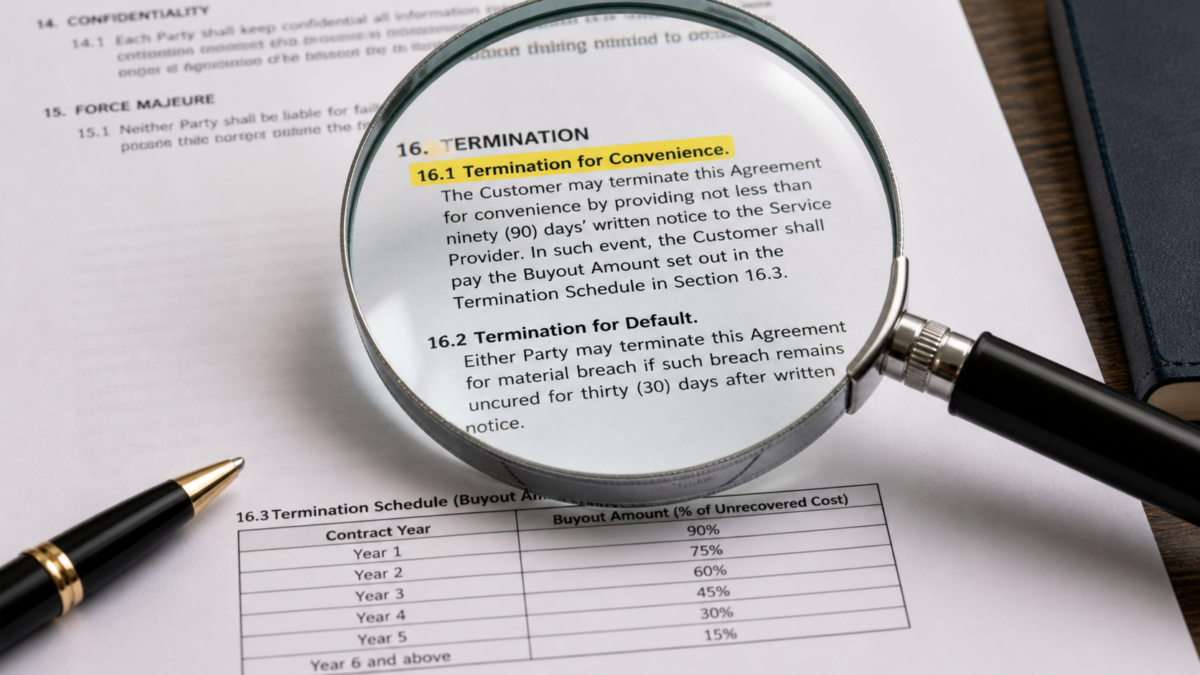
This is the part of the contract where many buyers get trapped. The provider makes it very easy and cheap to start the service, but they make it very difficult and expensive to leave. I always tell my clients that a good EaaS contract should have a clear exit plan. We work together to create a "termination for convenience" schedule. This is a simple table in the contract that shows the exact buyout price if the client wants to end the agreement at the end of any given year. The price should be fair. It should reflect the provider's remaining unrecovered cost, not be a massive penalty. Without this clear schedule, you have no flexibility. What happens if you need to move your factory in year four? What if a much better, cheaper battery technology is available in year six? A clear exit path gives you options and keeps the provider focused on delivering good service for the entire contract term.
Which Acceptance Tests Should Buyers Request for Indonesia Energy as a Service BESS?
The BESS is installed on your site, but you are not sure it actually works as promised. The provider says everything is ready, but how can you verify this before payments begin?
Buyers must request specific, on-site acceptance tests that copy real operating conditions. These tests must include a capacity test (to verify kWh), a power test (to verify kW), and a round-trip efficiency test. The system should only be accepted after passing these tests.
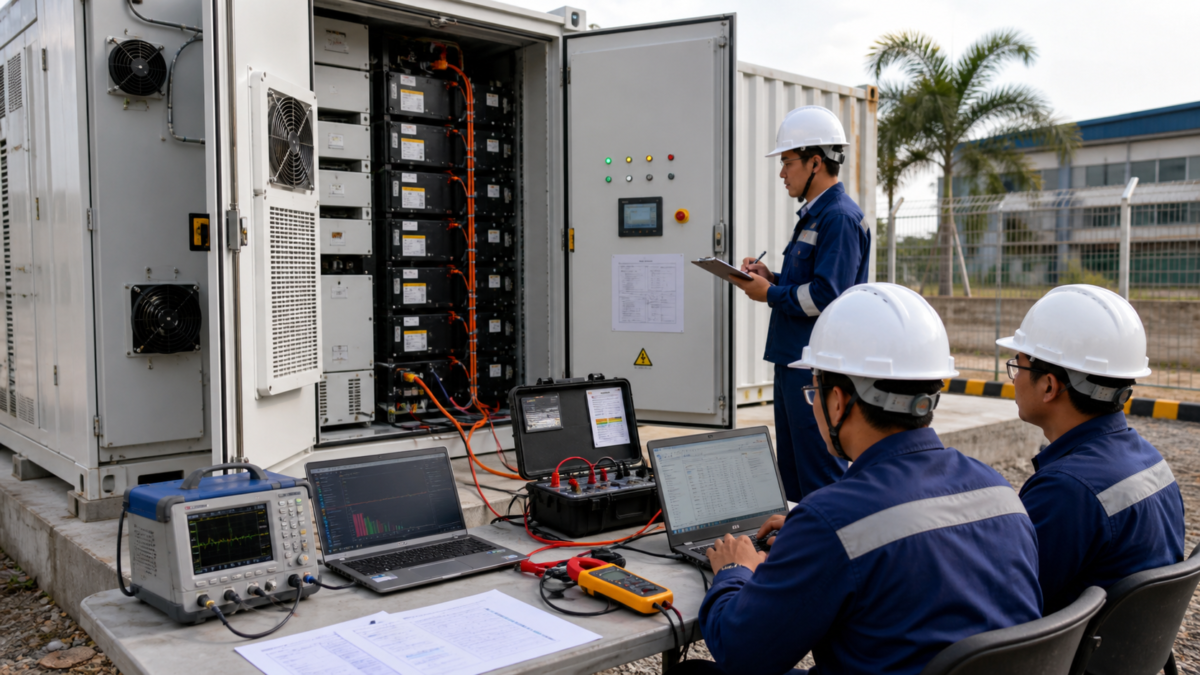
Commissioning a new system is more than just turning it on. It is about proving that the BESS can do the job you are paying for. Before my client accepts a project and starts making monthly payments, I require a formal Site Acceptance Test (SAT). This process is defined clearly in the contract. We run several key tests to confirm performance. First, we do a Capacity Test. We charge the battery to 100%, then discharge it completely at a specified rate to prove it delivers the contracted kWh. Second, we run a Power Test. We make the system discharge at its maximum rated power (kW) for a specific time to ensure it can handle the stress. Third, we perform a Round-Trip Efficiency Test on-site to verify the actual efficiency, not just the lab value. My team and the provider's team witness these tests together. The system is only formally accepted when it passes. This is the final quality check before you commit to a long-term service contract.
Conclusion
A successful Indonesia EaaS BESS project requires you to specify real-world performance metrics, a clear M&V plan, fair termination terms, and tough acceptance tests before you ever sign a contract.
My Role
About me
Brand Name: Moletong
Slogan: Carbon Neutrality, Tracking the Future
Website: www.moletong.com
Company Overview
Established in 2011 and headquartered in Dongguan, Guangdong, we are an integrated new-energy equipment enterprise specializing in energy storage systems, complete electrical equipment, photovoltaic solutions, charging infrastructure, and hydrogen-energy solution integration.
We integrate R&D, manufacturing, sales, system configuration, and technical service to support utility-scale, commercial and industrial, and residential energy applications. Our solutions are designed around practical customer needs such as peak shaving and valley filling, electricity-cost optimization, transformer-capacity support, emergency backup, renewable-energy integration, intelligent energy management, and photovoltaic-storage-charging coordination.
Our Core Business
1. Energy Storage Systems & Equipment
We develop lithium iron phosphate energy-storage products for utility-scale, commercial and industrial, residential, and integrated charging applications. Our documented portfolio includes liquid-cooled containerized energy-storage systems, commercial and industrial storage cabinets, residential battery systems, storage-and-charging systems, BMS, PCS, and EMS functions.
2. Complete Electrical Equipment
We provide complete high- and low-voltage electrical products, including gas-insulated ring-main units, high-voltage switchgear, low-voltage withdrawable and fixed switchgear, power-distribution cabinets, meter boxes, box-type substations, charging-station substations, and busbar-trunking systems.
3. Photovoltaic & Integrated Energy Solutions
We provide photovoltaic supporting equipment and system solutions, including 35 kV step-up substation equipment, photovoltaic combiner cabinets, adjustable mounting structures, photovoltaic-storage integration, and equipment support for grid connection, power transmission, and microgrid applications.
4. Charging & Hydrogen-Energy Solution Integration
We provide AC and DC charging solutions, storage-and-charging systems, and photovoltaic-storage-charging integration for industrial parks, commercial parking facilities, transport hubs, and locations with limited grid or transformer capacity. We also develop hydrogen-energy integration concepts involving renewable hydrogen production, hydrogen storage, refueling, and hydrogen-electric coupling. Specific hydrogen products, certifications, production capacity, and completed projects must be confirmed separately.
Product Applications & Technology Focus
Primary Service Industries:
Our principal customer sectors include Industrial and Commercial Energy Users, Renewable-Energy Developers, Power and Electrical Engineering, EV Charging Infrastructure, Commercial and Public Facilities, and Residential Energy Storage.
Product Categories We Serve:
- Utility-Scale Containerized Energy-Storage Systems
- Commercial and Industrial Energy-Storage Cabinets
- Residential Energy-Storage Batteries and Inverters
- Integrated Storage-and-Charging Systems
- High- and Low-Voltage Switchgear
- Box-Type Substations and Charging-Station Substations
- Busbar-Trunking and Power-Distribution Products
- Photovoltaic Step-Up and Combiner Equipment
Technology Expertise:
Our documented technical focus includes:
Lithium Iron Phosphate Cells, BMS, PCS, EMS, Liquid Cooling, Natural Cooling, Modular System Integration, Remote Monitoring, Load Tracking, Anti-Reverse-Flow Control, Transformer-Capacity Protection, and Intelligent Operation and Maintenance.
Production Capacity & Equipment
Energy Storage Production & R&D Platform
Our supplied corporate materials identify one production base in Dongguan and a Dongguan engineering R&D center. We support product development, equipment manufacturing, system configuration, and technical service for residential, commercial and industrial, and large-scale energy-storage applications.
- Product Platform Highlights: 5,015 kWh liquid-cooled containerized storage systems, 627 kWh and 261 kWh commercial and industrial storage cabinets, 16 kWh residential battery systems, and 261 kWh and 627 kWh integrated storage-and-charging systems.
Electrical Equipment Platform
We provide product design and manufacturing support for complete electrical assemblies used in industrial facilities, commercial buildings, substations, photovoltaic projects, charging stations, and public infrastructure.
- Equipment Highlights: High-Voltage Ring-Main Units, High-Voltage Metal-Clad Switchgear, Low-Voltage Withdrawable Switchgear, AC Low-Voltage Switchgear, Distribution Cabinets, Box-Type Substations, Prefabricated Charging-Station Substations, and Busbar-Trunking Systems.
Energy Storage & Electrical System Capabilities
General Capabilities:
- Application and electricity-use requirement analysis
- Energy-storage system selection and capacity configuration
- Equipment design and manufacturing
- BMS, PCS, and EMS system integration
- Peak shaving, valley filling, and time-of-use energy scheduling
- Load tracking and anti-reverse-flow control
- Transformer-capacity protection and demand management
- Photovoltaic-storage and storage-charging integration
- Remote installation, commissioning, and trial-operation support
- Operator training, warranty service, and technical after-sales support as contracted
Our Core Specialties:
- ✔️ Liquid-Cooled Large-Capacity energy-storage systems
- ✔️ Commercial & Industrial peak-valley and backup-power solutions
- ✔️ Integrated Photovoltaic-Storage-Charging applications
- ✔️ Complete Electrical Distribution equipment and system coordination
Quality Control & Certifications
We apply quality, environmental, and occupational health and safety management requirements to the design, manufacture, and sales of our documented product scope.
Quality Management Scope:
The supplied qualification materials show ISO management-system certificates and patent certificates held by Moletong. The product manuals separately define model-specific electrical parameters, monitoring functions, protection requirements, cooling methods, fire-protection configurations, operating environments, and technical-service conditions.
Testing & Protection Focus:
- Cell voltage, current, temperature, and operating-status monitoring
- Overcharge, over-discharge, overtemperature, and abnormal-condition protection
- Liquid-cooling or natural-cooling verification according to product model
- Fire-protection configuration according to product type
- Enclosure protection, corrosion resistance, and operating-environment requirements
- BMS, PCS, EMS, and communication-function verification where applicable
Certifications & Compliance:
- ISO 9001 Quality Management System
- ISO 14001 Environmental Management System
- ISO 45001 Occupational Health and Safety Management System
- Invention Patent and Utility Model Patent Certificates
- Selected product models list IEC 62619, UN 38.3, RoHS, EN 61000 series requirements, GB/T 36276, CCC, and relevant IEC/GB electrical standards
Certification scope varies by product model, configuration, destination market, and certificate validity period. Model-specific certificates must be confirmed before any formal compliance claim.
Target Markets & Partnership Models
Who We Serve:
- Industrial Facility Owners: Plant managers, energy managers, facility managers, and procurement teams at factories or industrial parks seeking peak-valley electricity-cost optimization, demand management, transformer-capacity support, or emergency backup power
- Renewable-Energy Developers: Project developers, engineering managers, and procurement teams for photovoltaic or wind projects requiring energy storage, step-up equipment, electrical distribution, or renewable-energy integration
- EPC & Electrical Contractors: Project managers, technical managers, and equipment-purchasing teams at qualified engineering companies requiring packaged energy-storage or electrical equipment with technical coordination
- Charging-Station Developers & Operators: Investment, construction, and operations teams working on sites with limited grid access, insufficient transformer capacity, high peak demand, or photovoltaic-storage-charging requirements
- Energy Service Companies & System Integrators: Solution designers and project-development teams building commercial and industrial energy-management, microgrid, or distributed-energy projects
- Residential Storage Distributors & Installers: Importers, distributors, wholesalers, and qualified installers requiring lithium iron phosphate batteries, off-grid or hybrid inverters, and residential storage configurations
- Commercial & Public-Facility Owners: Property, engineering, and facility-management teams for commercial buildings, schools, hospitals, hotels, parking facilities, and transport locations requiring reliable power distribution, charging, or backup-energy solutions
Target Geographies:
Our home market is China, supported by regional sales coverage for South, East, Central, and Southwest China. The supplied 2026 catalogue also identifies an overseas office in Indonesia, supporting practical market development in Southeast Asia. Other overseas markets are served only after confirming model-specific certification, grid requirements, shipping conditions, and local installation standards.
Types of Cooperation:
- Equipment Supply: Standard or configured energy-storage and electrical products
- System Configuration: Product selection and capacity configuration based on the customer's application
- System Integration: BMS, PCS, EMS, photovoltaic, charging, and electrical-system coordination
- Project Technical Cooperation: Technical coordination with renewable-energy developers, EPC contractors, and qualified local engineering companies
- Integrated Energy Solutions: Photovoltaic-storage, storage-charging, and photovoltaic-storage-charging applications
- Technical Service: Training, remote installation and commissioning support, warranty, and after-sales service as agreed in the commercial contract
Our Core Competitive Advantages
⭐ Integrated New-Energy Product Portfolio
By combining energy-storage systems, complete electrical equipment, photovoltaic supporting products, charging applications, and intelligent energy-management functions, we can configure solutions around the customer's complete power-use scenario.
⭐ Coverage from Residential to Utility Scale
Our documented energy-storage range extends from 16 kWh residential systems to 261 kWh and 627 kWh commercial and industrial systems and a 5,015 kWh containerized system.
⭐ Application-Oriented System Design
Our solutions address identifiable operating needs, including peak-valley arbitrage, demand management, transformer-capacity constraints, backup power, renewable-energy consumption, and charging-station power support.
⭐ Integrated Control & Safety Architecture
Our storage products combine lithium iron phosphate cells with BMS, PCS, EMS, model-specific thermal management, multi-level protection, intelligent monitoring, and remote operation and maintenance functions.
⭐ Regional Sales & Technical Service Support
With a Dongguan headquarters and engineering center, regional sales coverage in China, and an overseas office identified in Indonesia, we support equipment selection, technical coordination, training, remote commissioning assistance, and contracted after-sales service.
Leave a Reply