

How Batteries, Not Natural Gas, CAN Power the Data Center Boom?
Your data center needs more power, and it needs it to be reliable. But traditional natural gas solutions feel outdated and risky. Can batteries really handle this massive boom?
Yes, batteries can power the data center boom by providing a mix of resilience, capacity relief, and renewable energy integration. The key is to use a site-specific decision model, not a generic product label, and to never double-count the different value streams a battery provides.
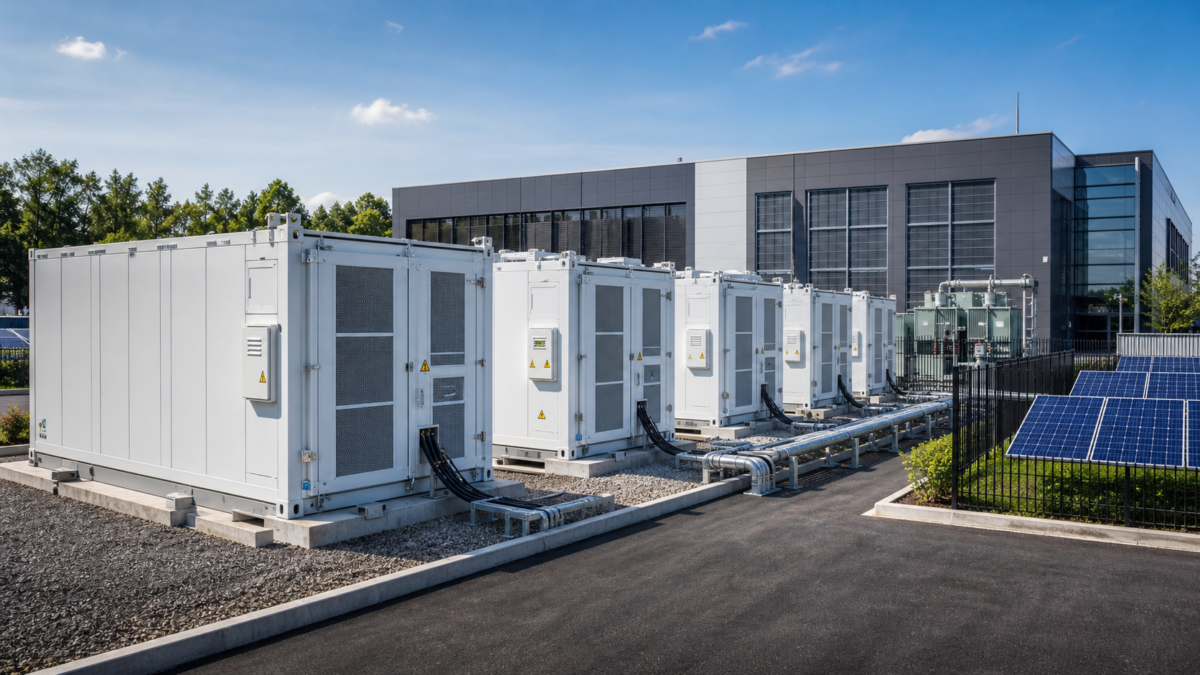
If I were advising you on data center battery storage, I would start with that one question. The promise of batteries is huge, but the path to a successful project is full of traps. I have seen many companies get distracted by an attractive proposal, only to find it doesn't work when things get tough. The difference between a success and a failure is not in the battery itself, but in the rigor of the questions you ask before you ever sign a contract. Let’s break down how to get this right.
What is The Buyer Pain Point Behind Powering Data Centers with Batteries Instead of Natural Gas?
You see attractive battery proposals promising big savings and perfect uptime. But you worry the numbers are too good to be true or that reliability will be compromised for profit.
The biggest pain point is double-counting value streams. A battery reserved for emergency backup (resilience) cannot be fully used for daily peak shaving (cost savings). This conflict creates a false economic picture and can leave you without power when you need it most.
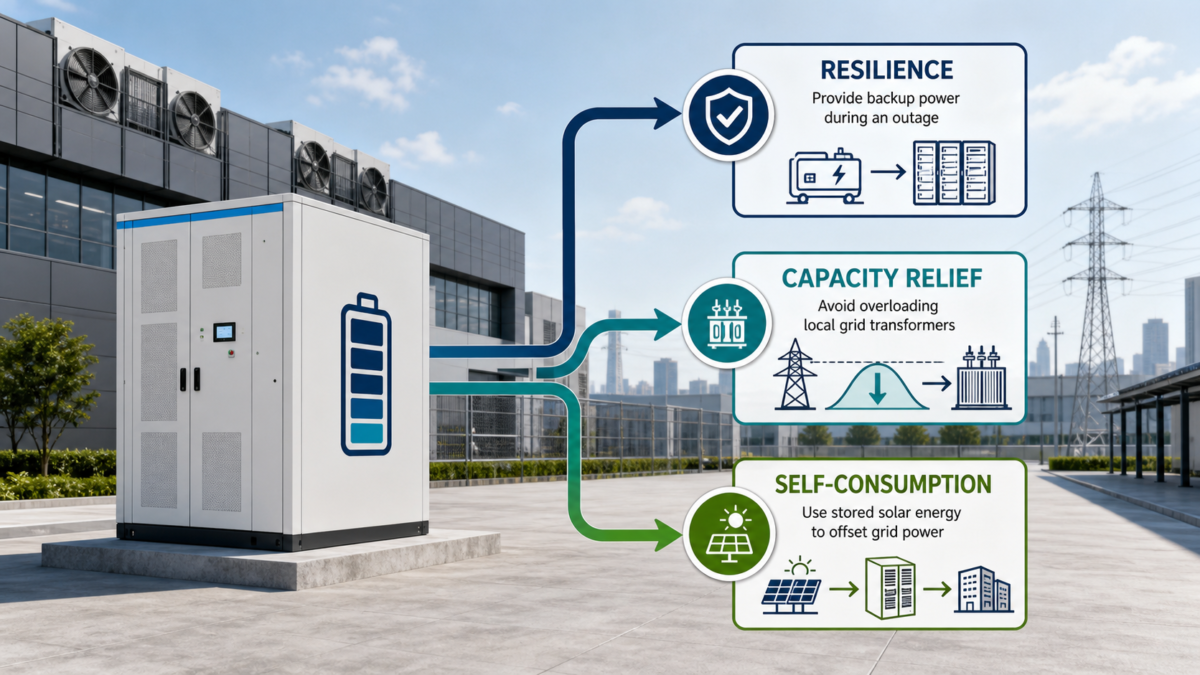
The practical issue is that self-consumption, grid capacity relief, and resilience are different jobs. They are separate value streams and must not be mixed up. I once reviewed a proposal where a company planned to use a battery to avoid demand charges, which meant discharging it every afternoon. They also listed "10-hour resilience" as a key benefit. But if the grid failed at 6 PM after the battery had already been used for peak shaving, they would have had less than an hour of backup, not ten. They were trying to count the same stored energy twice. To avoid this, you have to be very clear about the primary job of your battery. I always start by creating a simple table to force this conversation.
| Value Stream | Primary Goal | Typical State of Charge (SoC) Requirement | Conflict Potential |
|---|---|---|---|
| Resilience | Provide backup power during an outage | Must be kept high (e.g., >90%) | High. Conflicts directly with any strategy that discharges the battery daily. |
| Capacity Relief | Avoid overloading local grid transformers | Variable, must be ready to discharge during peak hours | Medium. Can reduce available energy for resilience if an outage occurs. |
| Self-Consumption | Use stored solar energy to offset grid power | Cycles daily (charges midday, discharges evening) | High. Leaves minimal stored energy for overnight outages. |
This simple exercise reveals the tradeoffs. You can't have it all from a single system at the same time. The first step is deciding which job is the most important.
How to Test the Key Data Center Battery Storage Assumptions?
A vendor's proposal looks perfect on paper, with impressive performance numbers. But you know your site has unique challenges. How can you be sure it will actually work for you?
You must test the most inconvenient operating condition. Don't just model a perfect, sunny day. Instead, simulate a black start of your critical systems after a 12-hour outage on a cloudy day. This stress test reveals the true limits of a system, not just its advertised potential.
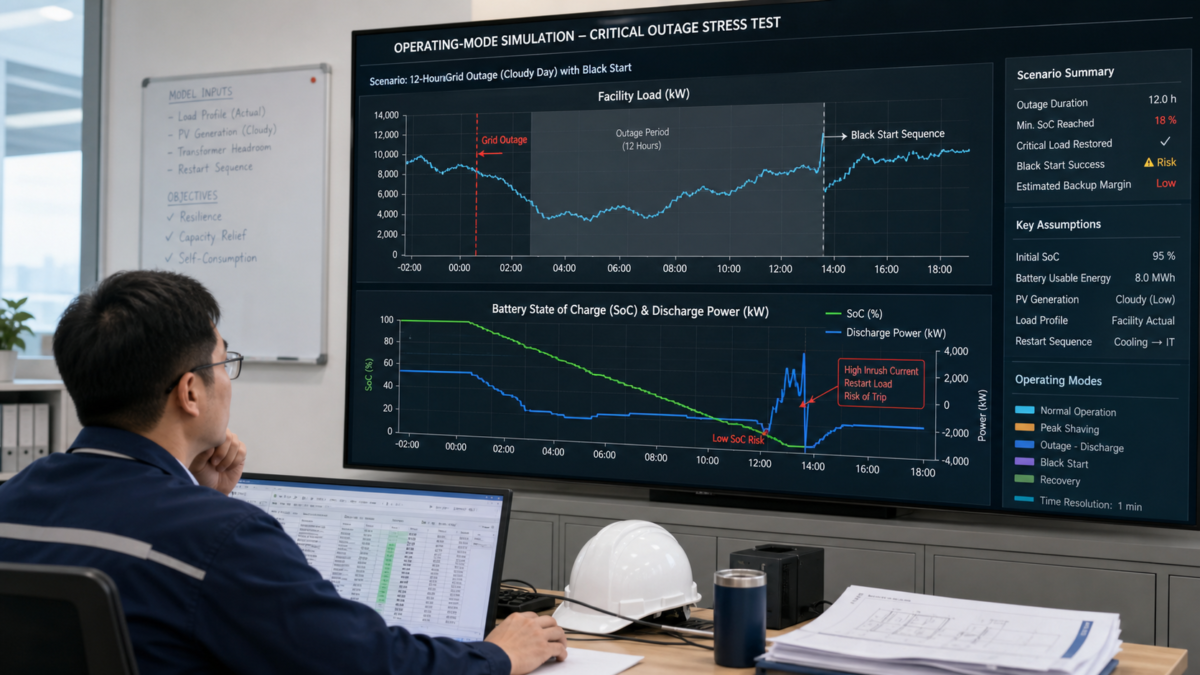
Attractive proposals often fall apart under pressure. That's why I insist on turning principles into a decision model before buying anything. I use the facility's specific data: the actual minute-by-minute load profile, the solar PV generation profile (if any), the real headroom on the utility transformer, and the exact sequence of critical processes that must restart after an outage. For one client, we simulated what would happen if the grid failed right after the battery finished a peak-shaving cycle. The proposal claimed 4 hours of backup, but our model showed that the inrush current from restarting the cooling systems would trip the battery's inverter instantly. The "restart-load record" proved the advertised system was undersized. This isn't about being negative; it's about being realistic. The system has to work when it's hardest, not just when it's easy. A good partner will welcome this kind of testing and help you build the simulation. If they resist, that's a major red flag.
How to Balance Cost, Reliability, and Compliance in Data Center Battery Storage?
You need a solution that is affordable, absolutely reliable, and meets every code. But cutting costs can hurt reliability, and strict compliance can drive up the price. How do you manage this?
The best way to balance these is with a "constraint register." This is a master document that lists every limitation—budget, minimum backup time, fire codes, grid rules—before you design anything. It forces you to prioritize, ensuring reliability and safety are never sacrificed for cost.
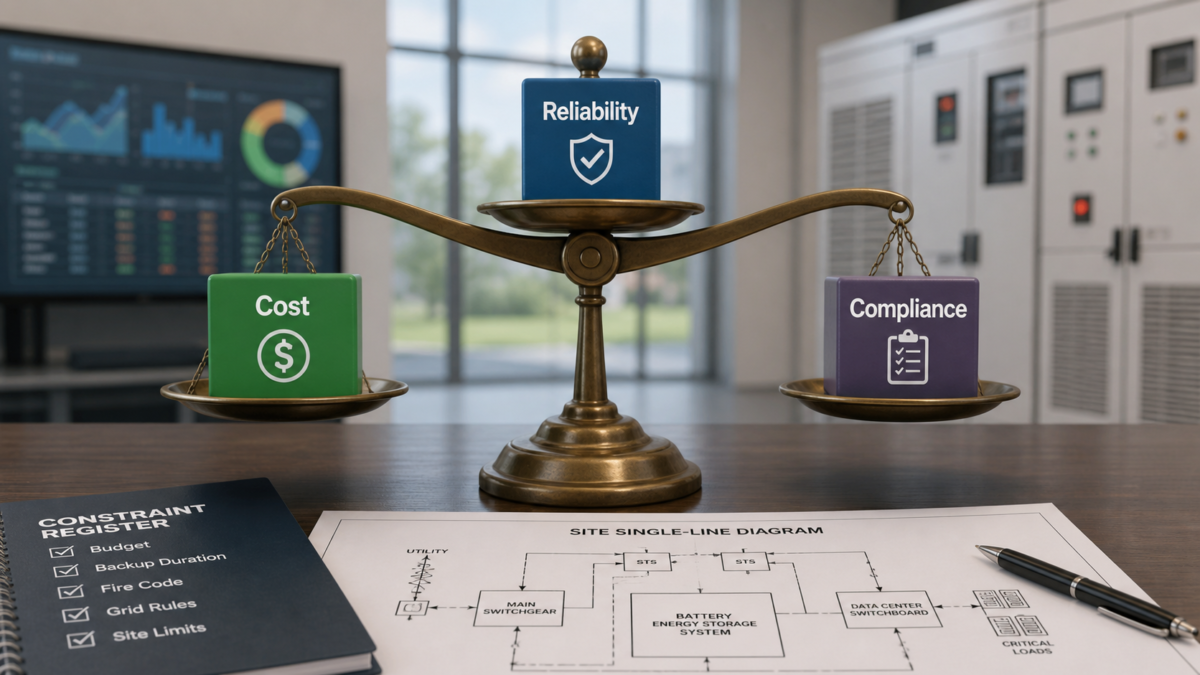
I treat this like a non-negotiable checklist. A constraint register is a simple document, but it's powerful. It forces everyone—your team, the vendor, the engineers—to agree on the rules of the game upfront. For example, a register might state: "The battery system must maintain a minimum 80% state of charge at all times for resilience," "The fire suppression system must comply with the latest NFPA 855 standard," and "The total project cost must not exceed $2 million." Once these constraints are written down, they guide every decision. You can immediately disqualify a proposal that uses the battery for daily cycling if it violates your 80% rule. It prevents "value engineering" that compromises core functions. At Moletong, we use this process because our scope includes not just the batteries but also the complete electrical equipment. This helps us ensure the entire system, from the switchgear to the Energy Management System (EMS), respects the constraints you define.
What a Bankable Data Center Battery Storage Proposal Should Show?
You're looking at multiple proposals, all claiming to be the best. They are filled with impressive brochures and data sheets, but how do you identify the one that is truly solid and bankable?
A bankable proposal provides engineering evidence, not just marketing claims. It must include a site-specific single-line diagram, a detailed operating-mode simulation based on your load data, a constraint register, and a restart-load record. This proves the solution is engineered for you.
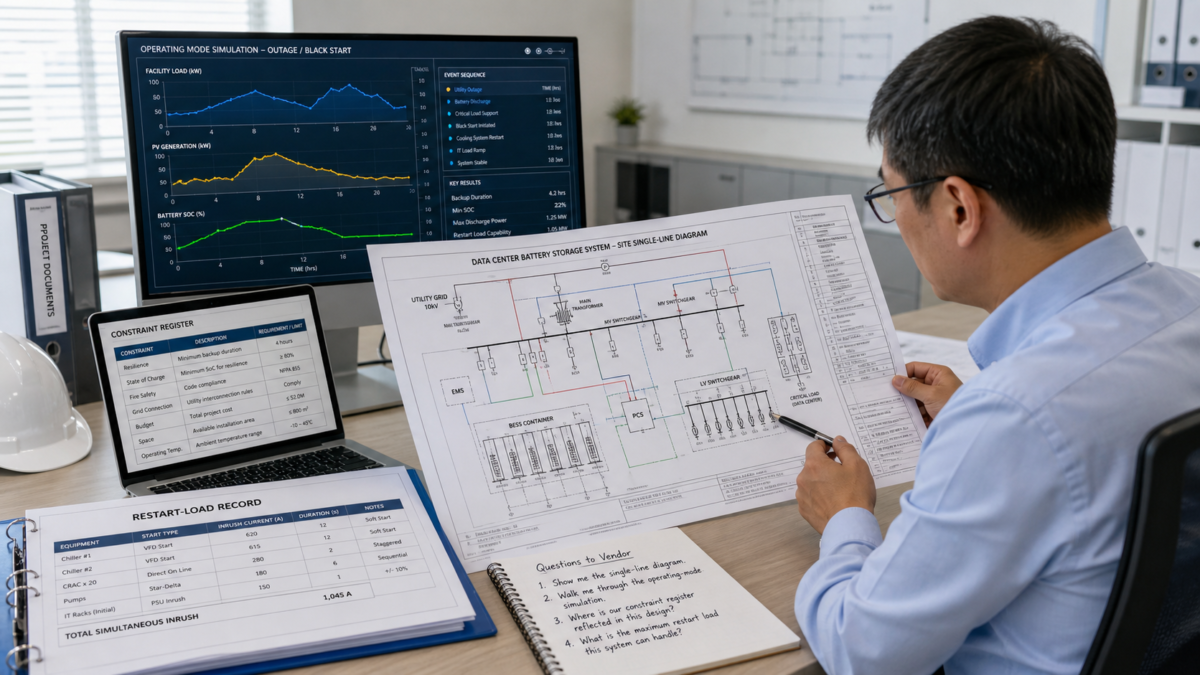
When I prepare a proposal for a client, I make sure it's more than just a product pitch. At Moletong, I present our storage, EMS, and electrical equipment as one integrated option that is subject to detailed site engineering. A truly bankable proposal is a technical plan. It should allow you to ask very precise questions and get clear answers. Before you approve any design, you should be able to ask your vendor the following:
- Show me the single-line diagram. Does it clearly show how the battery, your existing switchgear, and the utility grid connect?
- Walk me through the operating-mode simulation. How does the system behave during our peak load, during a grid outage, and during a black start?
- Where is our constraint register reflected in this design? How have you ensured our non-negotiable requirements for resilience and compliance are met?
- What is the maximum restart load this system can handle? Can you show me the calculation that proves it can restart our critical cooling and IT hardware simultaneously?
A vendor who can provide clear, data-backed answers to these questions is offering a real, engineered solution. One who can't is just selling a box.
Conclusion
A successful battery project for your data center depends on a rigorous, site-specific model. You must test the most inconvenient conditions and demand engineering proof, not just a product label.
Leave a Reply