

Rack Battery: A Practical Design and Procurement Guide?
Choosing a rack battery seems simple, but getting it wrong can cause major headaches. I've seen it happen too many times.
The best rack battery choice depends entirely on your specific goals. I always start by asking what the buyer wants to achieve—savings, resilience, or capacity relief. Then I compare site conditions like enclosure exposure and usable energy against realistic equipment limits to find the right fit.
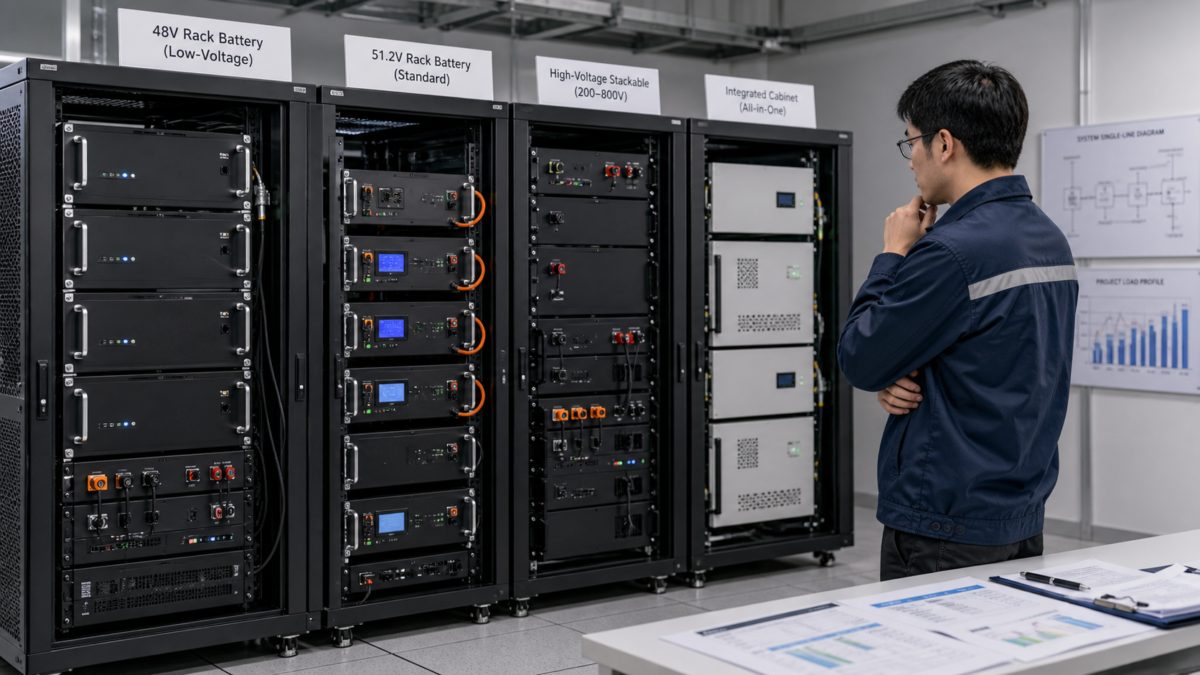
I’ve learned that a single positive review or a great datasheet doesn't guarantee success. The real world is messy, and a battery system that works perfectly in one location can be a total failure in another. The details of your site, your power needs, and your plans for the future are what truly matter. The most convincing recommendation I can make always comes after a deep dive into these practical factors. It's about looking beyond the shiny brochure and finding a solution that will actually work for you, day in and day out. Let me walk you through how I approach this.
Why the Obvious Rack Battery Answer May Be Wrong?
You picked a popular, well-reviewed rack battery. But now it won’t fit, you can't expand it, and technicians can't even service it properly. What went wrong?
The obvious answer is often wrong because it ignores how form factor and coupling architecture impact installation, service, and expansion. A wall-mounted, stackable, or high-voltage system might be a much better fit for your site than a standard server-rack battery.
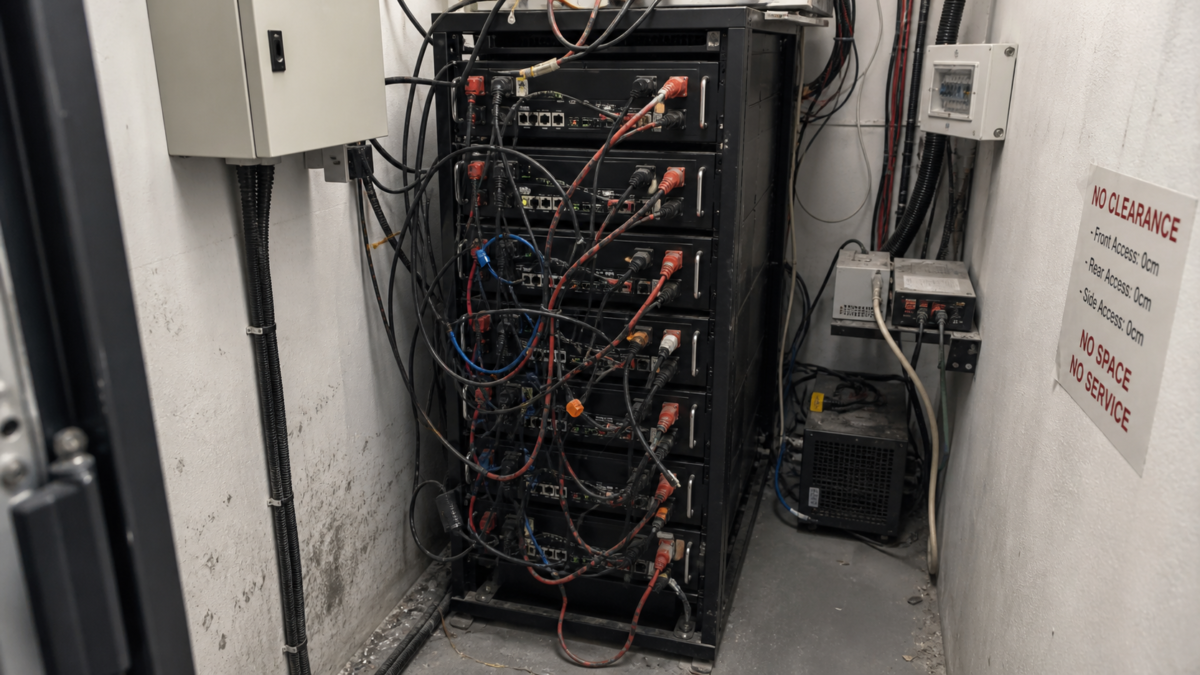
I once worked with a client who bought standard 19-inch rack batteries for a small equipment closet. On paper, it was a perfect fit. But when we got to the site, we realized the narrow doorway and tight corners made it impossible to bring the rack in. We had to unbox everything in the hallway. Worse, the rack needed rear access for maintenance, but the closet was only deep enough to push it against the back wall. They chose the "obvious" solution but ended up with a system that was a nightmare to service. This is why I always compare different form factors. Form factor isn't just about looks; it defines how you live with the system.
Moletong Form Factor Comparison
Here’s a quick comparison of how different Moletong product types address these risks. This helps explain why there is no single "best" answer.
| Form Factor | Typical Use Case | Installation Risk | Expansion Risk |
|---|---|---|---|
| Wall-Mount | Residential, small commercial backup. | Low. Requires a solid wall but saves floor space. | Moderate. Expansion is limited by wall space and inverter capacity. |
| Standard Rack | Data centers, C&I backup with existing racks. | High. Requires deep clearance for front/rear access and proper ventilation. | Low. Easy to add modules to an existing rack if space was planned. |
| Stackable (High-Voltage) | Residential, C&I off-grid, peak shaving. | Low. Modules are handled individually and don’t require a heavy rack. | Moderate. Can add stacks in parallel, but requires floor space. |
| Integrated Cabinet | C&I, PV integration, charging stations. | Moderate. A single, heavy unit but all components are pre-wired. | High. Expansion often means adding a second, identical cabinet. |
Separating Rack Battery Site Conditions from Equipment Limits?
Your new battery performs perfectly in the lab. But at your dusty, hot facility, it constantly overheats, underperforms, and gives you endless alerts. What’s the disconnect?
You must match the battery's documented operating limits to your actual site conditions. I always check things like enclosure exposure, site voltage stability, and required maintenance clearance. These practical factors often matter more than the nameplate specs on a datasheet.

I remember a project for a small factory. They installed a rack battery system in a shed out back to save indoor space. The datasheet said the battery was fine up to 45°C. The problem was that the uninsulated metal shed became an oven in the afternoon sun, with internal temperatures hitting 55°C. The Battery Management System (BMS) correctly de-rated the power to protect the cells, so the factory couldn't get the energy they paid for during peak hours. The equipment wasn't faulty; the design failed to separate the equipment's limits from the site's reality. We had to go back and install an expensive forced-air ventilation system. This is a classic example of a problem that could have been avoided with a simple site walk and a temperature logger before a single dollar was spent.
What Happens When Peak Power Is Overlooked?
Your battery has plenty of stored energy (kWh). But every time you start up your heavy machinery, the whole system trips offline. This is incredibly frustrating, isn't it?
Overlooking peak power (kW) is a critical and common mistake. Your battery and inverter's continuous and peak discharge ratings must exceed your site's maximum load. A system designed only for energy capacity will fail when you need power the most.
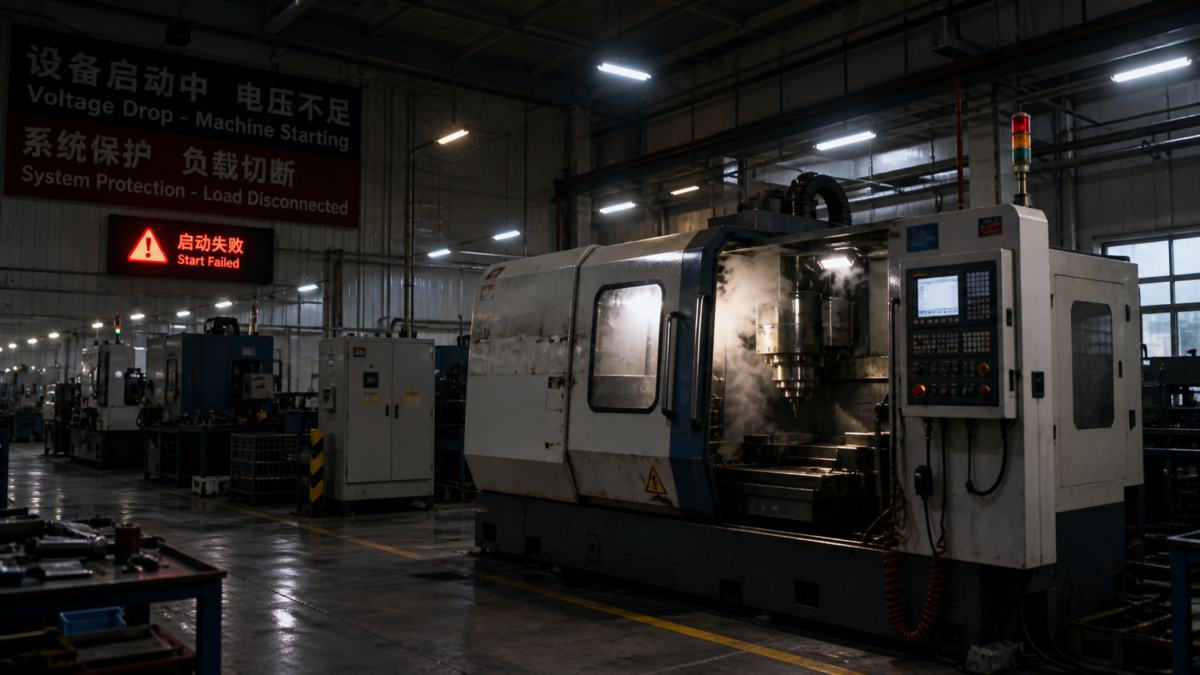
Think of energy (kWh) as the amount of water in a tank and power (kW) as the size of the pipe coming out of it. You can have a giant tank, but if the pipe is too small, you can't get the water out fast enough to put out a fire. I saw this happen at a workshop that installed a battery to lower their electricity bills. They had enough energy capacity to run the shop for hours. But they didn't account for the huge inrush current from their largest welding machine. The moment the welder struck an arc, the power demand spiked so high that the inverter's protection circuit would trip, shutting everything down. They had the right amount of energy, but not enough power. We had to upgrade to an inverter with a much higher peak power rating to solve the problem, an expensive change that could have been avoided by looking at a single-line diagram and the equipment list first.
A Better Decision Process for Rack Battery?
Are you feeling overwhelmed by all the battery choices? Worried you'll pick the wrong one and waste thousands of dollars on a system that doesn't deliver?
I use a simple, four-step process to avoid these problems. First, I clarify the primary goal. Second, I map the site's physical and electrical conditions. Third, I compare realistic options against a downside case. Finally, I choose the system that best manages the project's specific risks.
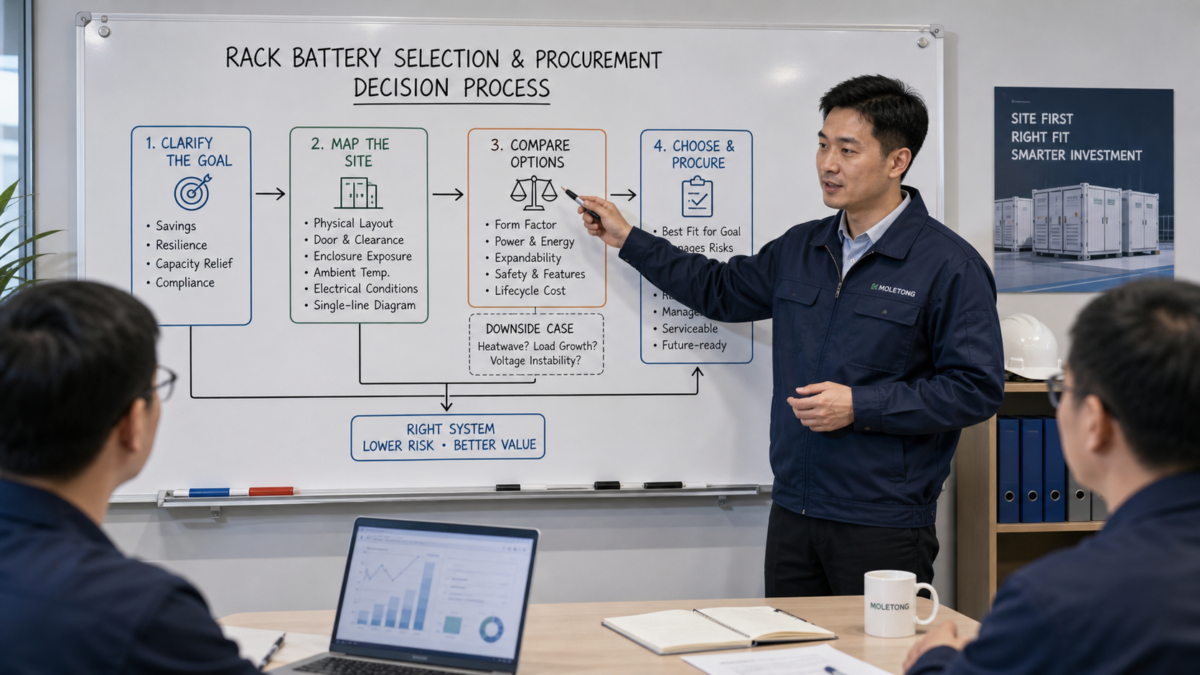
This process removes the guesswork. It forces a conversation about what really matters before anyone gets attached to a specific product. Here's how it works in practice.
Step 1: Clarify the Goal
I start by asking: "What is the number one thing you want this battery to do?" The answer changes the entire design.
- Savings: The goal is peak shaving or time-of-use arbitrage. The design prioritizes cycle life and efficiency.
- Resilience: The goal is backup power during outages. The design must prioritize peak power output and the ability to start heavy loads.
- Capacity Relief: The goal is avoiding a utility transformer upgrade. The design must focus on limiting peak demand from the grid.
- Compliance: The goal is meeting a local renewable energy mandate. The design prioritizes integration with solar and meeting grid codes.
These outcomes are not interchangeable. A system designed for savings may not be able to provide reliable backup power.
Step 2: Map the Site
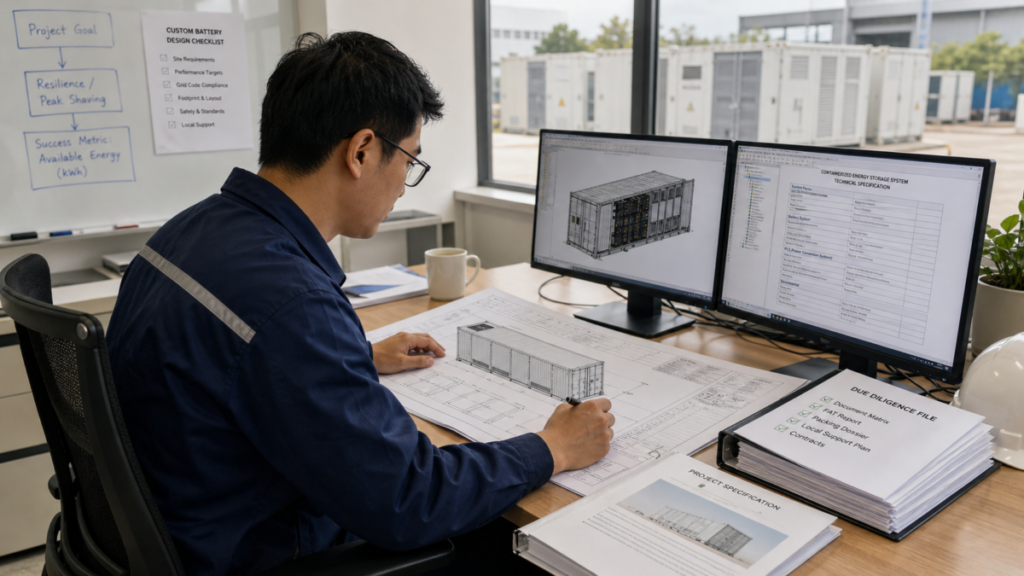
Next, I look at the physical space. I'll sketch a dimensioned layout showing the equipment, walls, and doors. I also get a photo showing the required maintenance clearance. This visual check quickly eliminates options that simply won't fit or can't be serviced. I also check the site voltage for stability and review the single-line diagram to understand the loads.
Step 3: Compare with a Downside Case
Finally, I ask, "What is a realistic worst-case scenario?" What if the utility power is less stable than we thought? What if you add another machine next year? What if there's a heatwave? We compare how different systems—like a Moletong high-voltage stackable system versus a standard 48V rack system—would perform under that stress. This simple thought experiment often reveals which system has a more robust design for the real world.
Conclusion
Success with a rack battery comes from matching the right equipment to your specific goals and site risks, not just picking the one with the best datasheet specifications.
Leave a Reply