

What Should Buyers Verify About Solar EPC Interconnection Zero Export?
Your solar EPC presents a design with great returns. But what if it's based on flawed assumptions about your grid connection? This can lead to costly surprises later.
Before comparing solar products, you should verify the core assumptions affecting your project. This includes the roof or land survey, irradiance data, DC/AC ratio, and grid protection settings. Specifically, test a conservative zero-export operating case to ensure the design is viable under real-world, not just ideal, conditions.
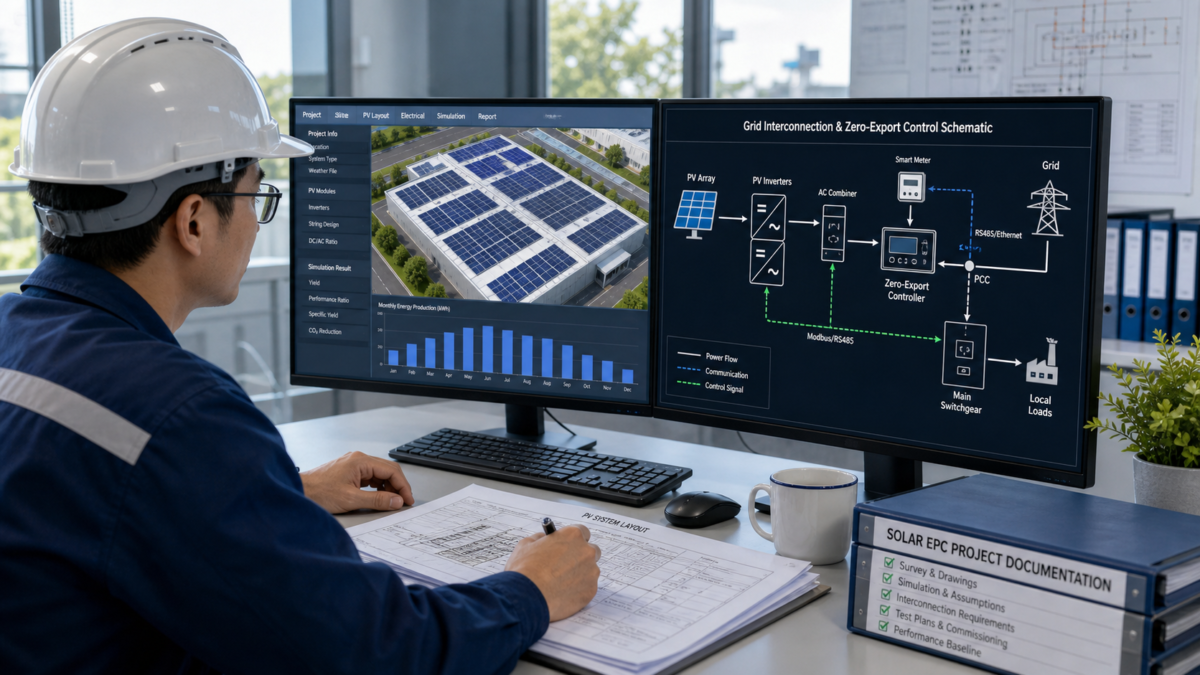
I believe that an optimized PV design is incomplete until you close the loop on grid and acceptance constraints. Many buyers jump straight to comparing panel or inverter brands. I think that’s a mistake. The most attractive performance simulation means nothing if it can't be approved by the utility or if it doesn't work with your site’s actual limitations. The real work is in verifying the inputs before you fall in love with the output. In this post, I will walk you through the practical steps I use to do just that.
From Solar EPC Interconnection Zero Export to an Engineering Requirement?
A "zero export" rule from your utility sounds simple. But it's a hard technical limit that can make or break your project's financial case. Let's make it a core requirement.
A zero-export rule is a strict engineering requirement that prevents your solar system from sending power to the utility grid. It needs hardware like anti-reverse-flow controllers and smart meters to monitor power and instantly reduce inverter output, protecting the local grid from back-feed.
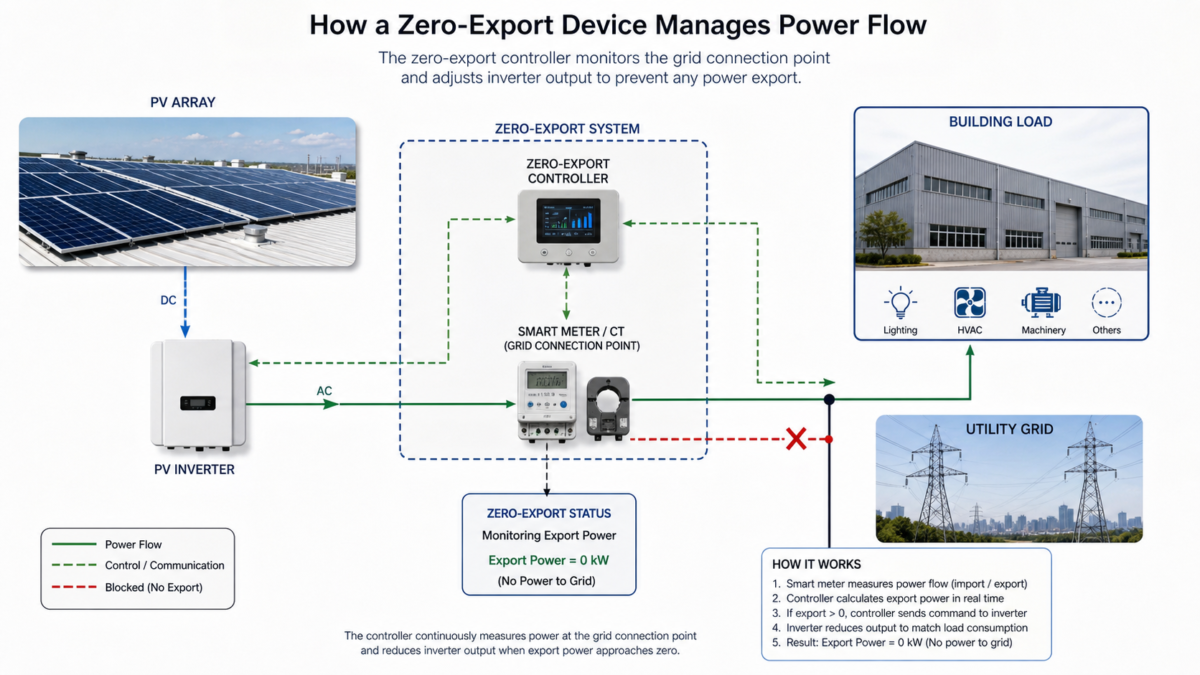
When a utility company tells you that you must operate under a "zero export" condition, they are placing a firm boundary on your system. It is no longer just a suggestion; it is a primary engineering constraint. This means your system must be smart enough to produce only as much power as your facility is consuming at any given moment. If your solar panels produce more power than you need, the system must immediately curtail, or reduce, its output. This requires specialized equipment. At Moletong, our experience with complete electrical equipment shows that integrating an anti-reverse-flow controller is critical. This device acts as a traffic cop, constantly measuring power at the grid connection point and telling the inverters to back off when necessary.
Key Zero-Export Constraints to Define
Getting these details right is the first step. You must ask your EPC and utility to clarify these points in writing before finalizing the design.
| Constraint | Description | Impact on Design |
|---|---|---|
| Grid Operator Rule | The official written policy from the utility defining zero export. | Determines the type of control hardware and software needed. |
| Transformer Capacity | The maximum power your local transformer can handle. | Can limit the total size of the PV system you’re allowed to install. |
| Local Load Profile | Your building’s minute-by-minute electricity consumption. | Defines how often and how much the PV system will need to curtail energy. |
| Control System Response Time | How quickly the system must react to stop exporting power. | Dictates the required performance of the controller and communication network. |
The Role of Roof/land Survey in the Final Design?
You have a large roof and assume it's perfect for solar. But hidden issues like shading or weak structures can shrink your usable space and ruin your project's economics.
A detailed roof or land survey is critical because it defines the real-world physical boundaries for your PV design. It confirms the actual usable area, identifies structural load limits, maps all sources of shading, and determines the best orientation for the panels for an accurate energy yield simulation.

I can't stress this enough: the physical survey is the foundation of a good design. A satellite image from the internet is not enough. I've personally reviewed projects where the initial design, based on a simple area measurement, had to be cut by 30% after a proper survey. The survey team needs to get on the roof or walk the land. They must check for things the satellite can't see, like vents, skylights, air conditioning units, and other obstacles that you cannot place panels on. More importantly, a structural engineer needs to confirm the roof can handle the added weight of the solar array, especially in areas with snow. Shading is another huge factor. A nearby tree or a taller adjacent building can cast a shadow that moves across the roof during the day, significantly reducing energy production. The survey creates a precise 3D model that feeds into the simulation software. Without this accurate input, the energy yield predictions are just a guess.
Why One Solar EPC Interconnection Zero Export Outcome Does Not Prove the Rule?
An EPC shows you an impressive energy simulation result. But this single, best-case scenario can hide the performance risks under typical or poor conditions. Don't accept just one outcome.
A single simulation does not prove performance because it often uses ideal assumptions. Buyers must insist on seeing multiple scenarios, including a conservative case with lower-than-average sunlight and high facility loads, to understand the system's true operational range and verify the zero-export function works reliably.
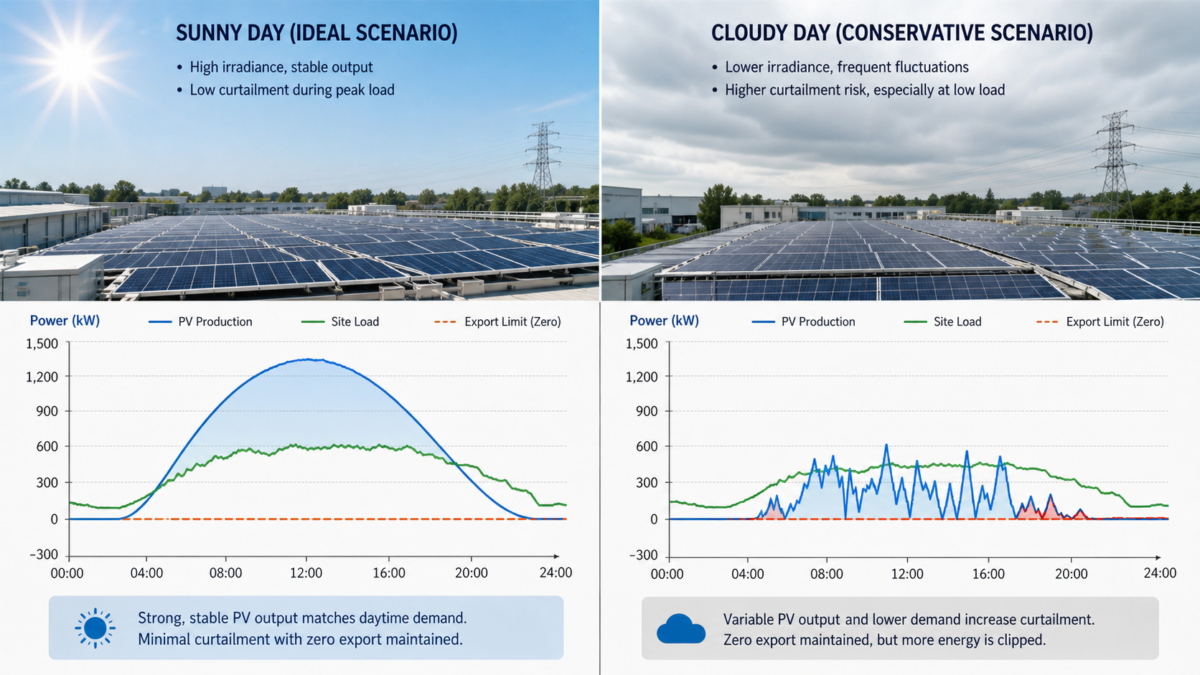
My position is clear: before you compare products, you must test the assumptions. The most attractive result is often based on a perfect, sunny day with your facility running at full capacity. But what happens on a cloudy day? What happens on a weekend when the factory is shut down, and your electricity load drops to nearly zero? In a zero-export scenario, any solar energy produced when there's no load to consume it is wasted. I once worked on a project where the EPC's simulation for a factory looked amazing. However, they assumed the factory ran 24/7. In reality, it shut down every weekend. The ROI collapsed once we re-ran the numbers with the real load profile, as massive amounts of potential generation were curtailed. You should ask to see a conservative case. This means using a less sunny weather file and your actual load data. It's also important to review the DC/AC ratio. A high ratio can boost production but also increases the amount of power that must be curtailed during low-load periods. Zhongwei’s company-published PV EPC cases are a good example of how transparent data can be presented, and our Moletong electrical products are built to handle these real-world variable conditions.
How to Document the Solar EPC Interconnection Zero Export Decision?
You agreed on the design in a meeting. But verbal agreements are easily forgotten, leading to conflicts later when the system doesn't perform as you expected. A paper trail is essential.
Properly document your zero-export decision with a complete project file. This package must include the final survey, all simulation inputs and results (especially the conservative case), a log of grid requirements, commissioning test sheets for the zero-export function, and the agreed-upon performance baseline.

To avoid future problems, I always create a comprehensive documentation pack. This isn't just for record-keeping; it is the single source of truth for what was agreed upon. It ensures everyone—you, the EPC, and the utility—is on the same page. This pack becomes the basis for the final contract and the standard against which you will measure the project's success. It should be a collection of clear, final documents that you can refer back to during commissioning and operation. Instead of just copying a conclusion from another project that may not fit your site, this process gives you a repeatable evaluation method. It puts you in control of the decision-making process by focusing on verifiable facts and clear expectations for everyone involved in the project.
Your Decision Checklist
- Survey Pack: Includes final site drawings, structural engineering reports, and a detailed shading analysis.
- Simulation Inputs: Clearly lists the weather data file used, the final DC/AC ratio, module and inverter specifications, and all loss assumptions (soiling, wiring, etc.).
- Interconnection Register: A log of all communications with the utility, their official written requirements, and the agreed-upon protection settings and response times.
- Test Sheets: The specific procedures for Factory Acceptance Tests (FAT) and Site Acceptance Tests (SAT) that will be used to prove the zero-export system works as designed.
- Performance Baseline: The final, agreed-upon energy yield model and production forecast that will define a successful installation.
Conclusion
A successful zero-export solar project comes from a verified and well-documented design, not from a hopeful simulation. Following these steps ensures your investment is based on reality.

Leave a Reply