

Why Does Areas of the World with a Tropical Climate According… Matter in Real Projects?
Deploying a battery energy storage system (BESS) in a tropical climate seems easy, until your copied design fails. You are left with underperforming assets and unexpected costs.
Areas of the world with a tropical climate matter because the constant high heat and humidity directly attack a BESS's performance, safety, and lifespan. A successful project requires a localized design based on a country delta register, not a copied bill of materials, to survive these conditions.
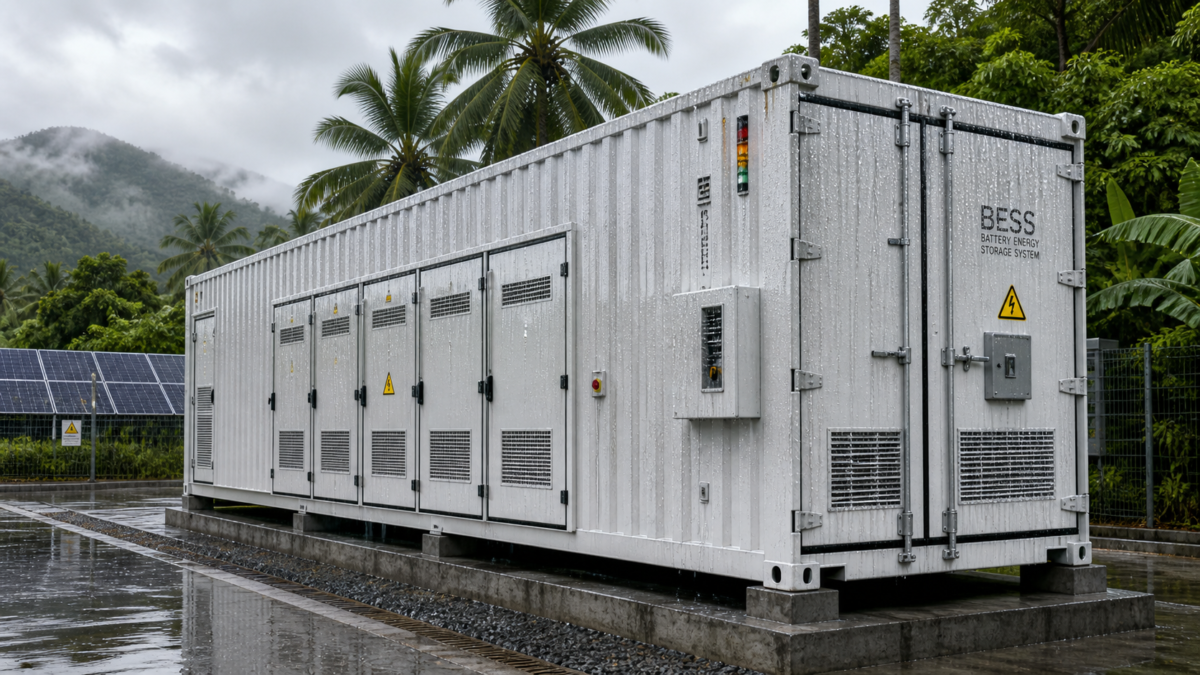
When I advise a buyer on a tropical climate BESS, I always start with that one question. The answer separates a successful, bankable project from a costly failure. It’s easy to pick a product from a catalog that worked well in Germany or California. It is much harder to make that same product work reliably for ten years in Indonesia or Brazil. The difference is not in the product label, but in the engineering details adapted for the local environment. Let’s break down why this matters and what you should look for.
The Buyer Pain Point Behind Tropical Climate BESS?
You have a proposal for a BESS that looks great, but it was designed for a temperate climate. You worry about premature failure and hidden costs in your tropical location.
The core buyer pain point is the risk of underperformance, early failure, and a ruined financial model. Standard BESS designs often cannot handle constant high heat and humidity. This leads to rapid battery degradation, overloaded cooling systems, and corrosion that a standard warranty might not even cover.
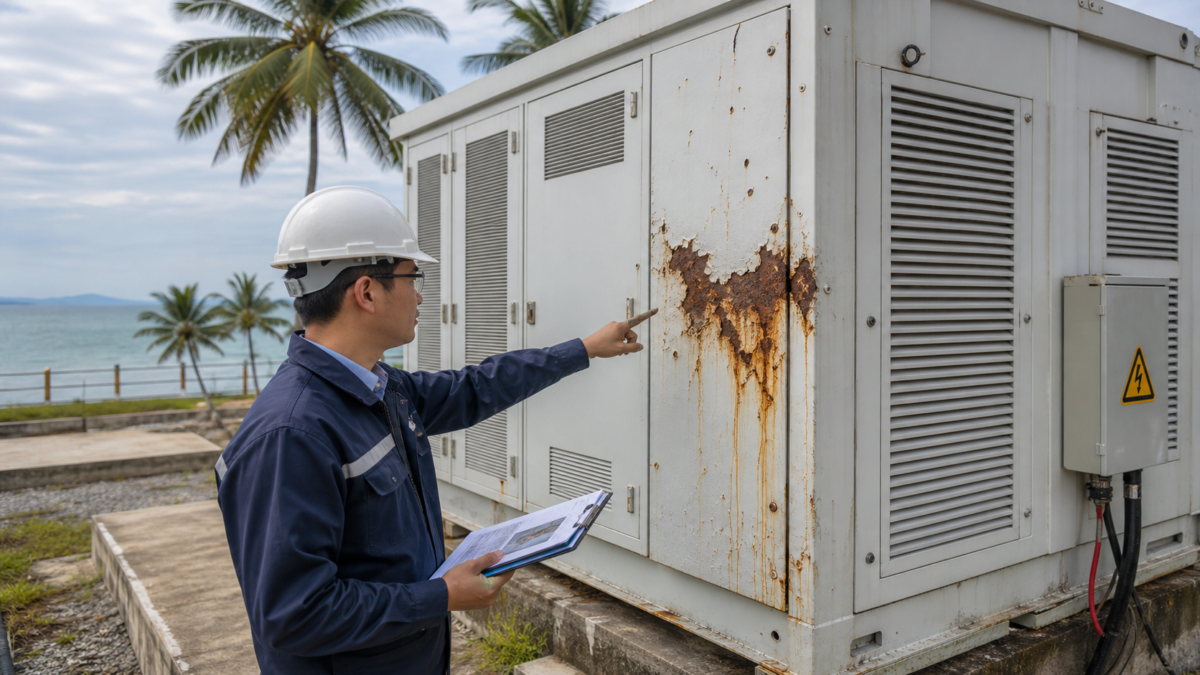
The biggest mistake I see is what I call "copy-paste engineering." A project developer takes a bill of materials (BoM) from a successful project in a mild climate and assumes it will work in a harsh one. This is a recipe for disaster. The practical issue is that regional replication requires a country delta register, which details every change made specifically for that new country. It is not just a copied parts list. An attractive proposal on paper becomes very difficult to deliver when the cooling system cannot keep up, or when humidity corrodes connectors.
From a Copied BoM to a Country Delta Register
Simply using a BoM that worked elsewhere ignores critical local factors. A Country Delta Register, on the other hand, forces the supplier to prove they have thought through the local challenges.
| Factor | Standard BoM Assumption | Tropical Climate Delta (What to Ask For) |
|---|---|---|
| Thermal Management | Air conditioning (AC) sized for moderate ambient temperatures and low humidity. | Is the AC system sized for 45°C and 95% humidity? What is its power consumption (parasitic load) under these conditions? |
| Enclosure Protection | Standard paint (e.g., C3 rating) and IP54 rating are sufficient. | Requires C4 or C5 anti-corrosion rating for coastal areas. Are gaskets and seals rated for high UV exposure and humidity? |
| Component Selection | Standard industrial-grade electronics are used. | Are all control electronics conformally coated to protect against moisture and condensation? |
| Logistics & Spares | Spare parts are available from a central warehouse with 48-hour delivery. | Where is the local spare parts depot? What is the real lead time for a replacement cooling fan or controller? |
How to Test the Key Tropical Climate BESS Assumptions?
A supplier's proposal looks good, but the performance data seems too optimistic for your site. How do you check if their claims will hold up in your hot, humid reality?
You test the key assumptions by focusing on the most inconvenient operating condition. Don't look at annual average performance. Instead, demand performance data and thermal models for the hottest hour of the hottest day of the year at your specific project location.
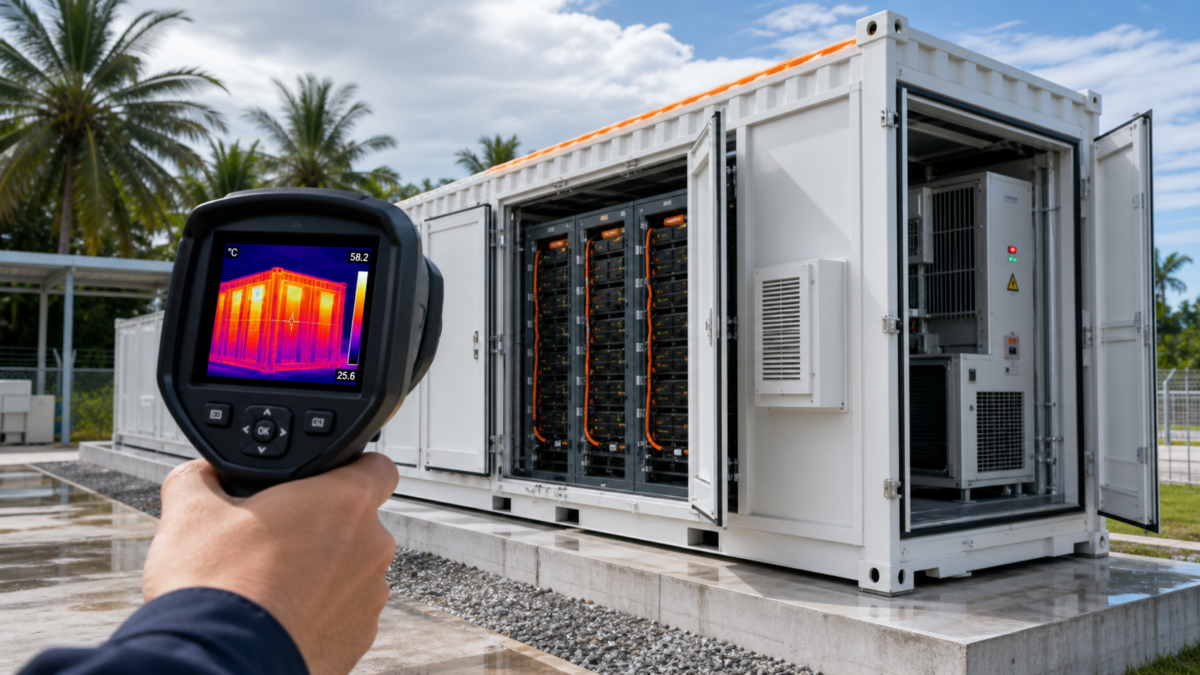
Attractive proposals often become difficult to deliver at the margins. I always tell clients to find that margin and push on it. The most inconvenient condition is usually where a system breaks. For a tropical BESS, this might be at 2 PM on a sunny afternoon when the grid is demanding full power, the sun is beating down on the container, and ambient humidity is near 100%. This is when the cooling system works its hardest and when batteries are most stressed. A system that performs well here is a system you can trust. Any analysis based on "average" temperatures is hiding the real risk. You need to see the proof that the system can handle the peak stress, because that is what determines its long-term reliability and degradation rate.
I would push the supplier with specific questions. Show me the thermal simulation for my site's specific solar radiation and ambient temperature profile. What is the expected internal temperature of the container and the battery modules during this worst-case hour? What is the calculated parasitic load from the HVAC system just to keep the system online? If a supplier can provide clear, data-backed answers to these questions, it shows they have done their homework. If they respond with generic datasheets, it is a major red flag.
Balancing Cost, Reliability, and Compliance in Tropical Climate BESS?
You need a BESS that is reliable in a tropical climate, but the most robust solutions seem too expensive. You fear cutting costs will lead to non-compliance or system failure.
You can balance these factors by using a decision model based on localized operational realities, not just a product label. Evaluate options based on tangible factors like service travel time, local grid code compliance, and logistics, rather than relying on a "tropical-ready" marketing claim.
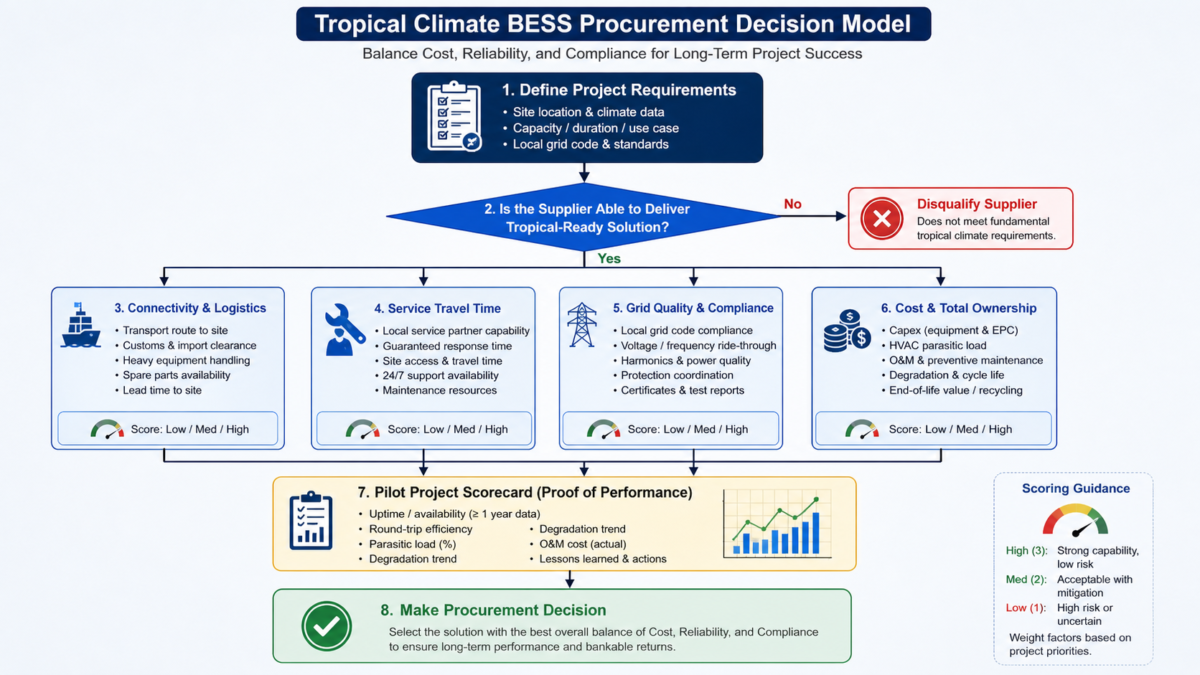
I would turn this principle into a practical decision model. A sticker on a BESS container that says "tropicalized" is meaningless without a plan to support it locally. The true cost of a BESS is not its purchase price, but its total cost of ownership over its entire life. A cheaper system that fails after three years is infinitely more expensive than a properly engineered one that lasts for ten.
My decision model would weigh four key areas:
- Connectivity and Logistics: How will you get a 2-ton replacement inverter to my remote island site? What is the customs clearance process? A low upfront cost means nothing if critical spares are stuck in port for six weeks.
- Service Travel Time: Who is your local service partner? I want to meet them. What is their guaranteed response time to my site, in writing? A four-hour response time from an office 2,000 kilometers away is not a real service plan.
- Grid Quality and Compliance: My local grid has frequent voltage and frequency fluctuations. Show me the simulation data proving your inverter can ride through these events without tripping. Show me the compliance certificates for our specific national grid code.
- Pilot Scorecard: I would prioritize a supplier who can provide a transparent scorecard from a pilot project in a similar climate. This shows real-world data on uptime, performance ratio, and actual maintenance costs, which is far more valuable than a factory acceptance test report.
What a Bankable Tropical Climate BESS Proposal Should Show?
You receive a BESS proposal, but it feels generic and lacks specific details for your project's tropical site. You feel you cannot get financial approval without concrete proof.
A bankable proposal for a tropical climate must show four key documents beyond the standard technical datasheet: a country delta register, a climatic design basis, a local partner plan, and a transparent pilot project scorecard. These items demonstrate the project has been de-risked.
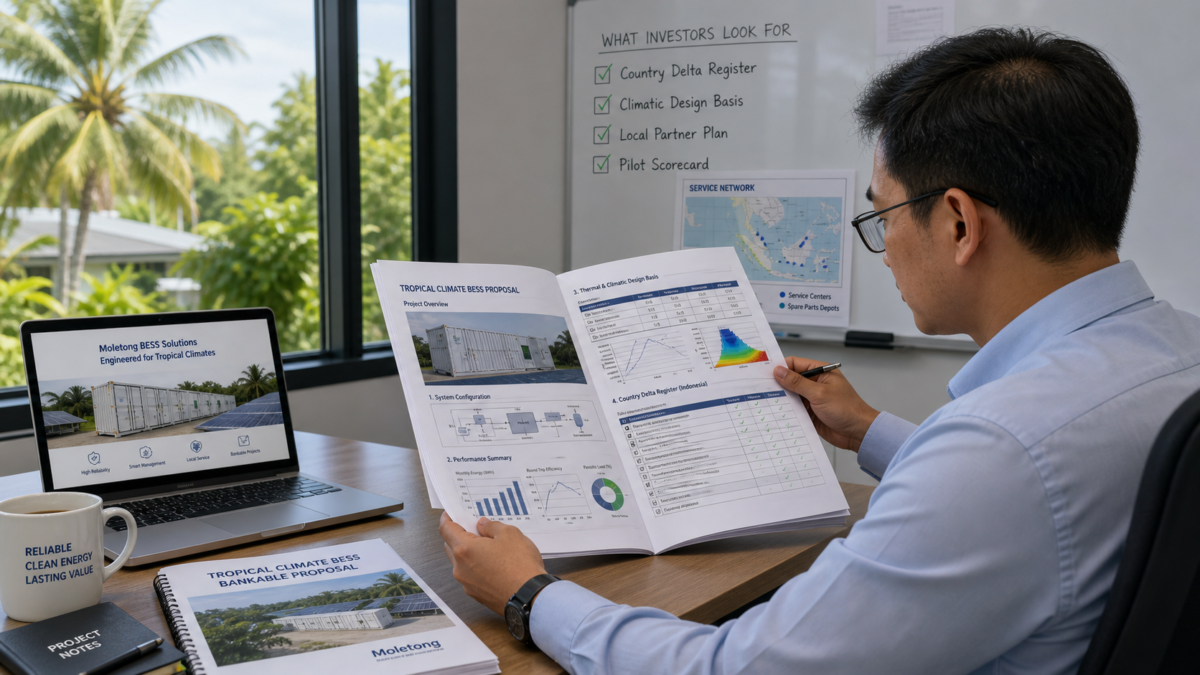
When I work with financiers, this is exactly what we look for. A bankable proposal is one that proves the supplier has moved from theory to practice. It is not about selling a product; it is about delivering a reliable, long-term infrastructure asset. At Moletong, when we approach a project in a new region like Southeast Asia, we build our proposal around our product range, but we localize the engineering for climate, approvals, logistics, and service. This is what any serious buyer should demand.
Here are the exact questions you should ask before approving a design:
- Regarding the Country Delta Register: Can you provide a list of every component and design change made from your standard model to adapt this system for our country's specific climate and regulations?
- Regarding the Climatic Design Basis: What specific maximum temperature, humidity, and solar irradiance values did you use to size the thermal management system, and where did this data come from?
- Regarding the Local Partner Plan: Who is your certified local installation and maintenance partner? Can I see their qualifications and a map of their service locations and spare parts depots?
- Regarding the Pilot Scorecard: Can you share anonymized operational data—specifically uptime, round-trip efficiency, and parasitic load percentage—from a comparable system operating in a similar climate for at least one year?
If a supplier can confidently answer these questions and provide the documents, you have found a partner, not just a vendor.
Conclusion
Success in tropical BESS projects comes from demanding a localized design and verifiable proof. Do not accept a generic product label. Ask the hard questions before you commit.
Leave a Reply