

Why Is Humidity So High?
You opened your battery enclosure and found water inside. Now you are worried about safety and reliability. This is a common problem that points to a bigger issue.
High humidity in a Battery Energy Storage System (BESS) enclosure is usually caused by the daily heating and cooling cycle. This "breathing" pulls moist air inside, where it condenses on cooler surfaces. It means the system's thermal management and sealing aren't matched to the site's environment.
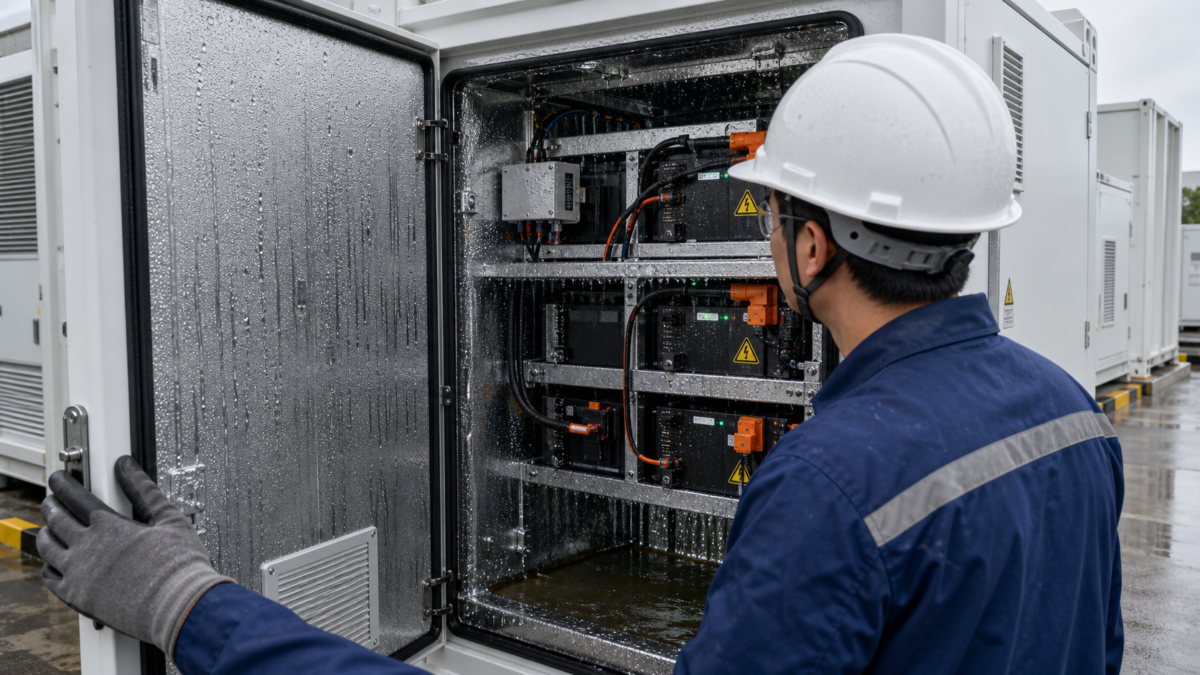
I’ve seen this happen many times. A buyer invests in a BESS with a high IP (Ingress Protection) rating, expecting it to be perfectly sealed. But a few months after installation, they find condensation, or even standing water, inside. They feel confused and let down. The spec sheet promised protection, but reality delivered a moisture problem. This is a frustrating situation, but it's also a valuable lesson. The humidity isn't just a nuisance; it's a signal. It tells you that a single number on a data sheet can't capture the full story of how a system will perform in the real world. Understanding why this happens is the first step to preventing it and protecting your investment for the long haul.
What Humidity So High Reveals About the Real Constraint?
Are you worried that moisture will corrode your BESS components and void your warranty? High humidity is a silent threat that can lead to expensive failures and safety hazards.
High humidity reveals that the true constraint is not the static IP rating, but the enclosure's dynamic response to environmental changes. It shows a mismatch between design assumptions, like stable temperatures, and the reality of a site with constant thermal cycling, which drives moisture ingress.
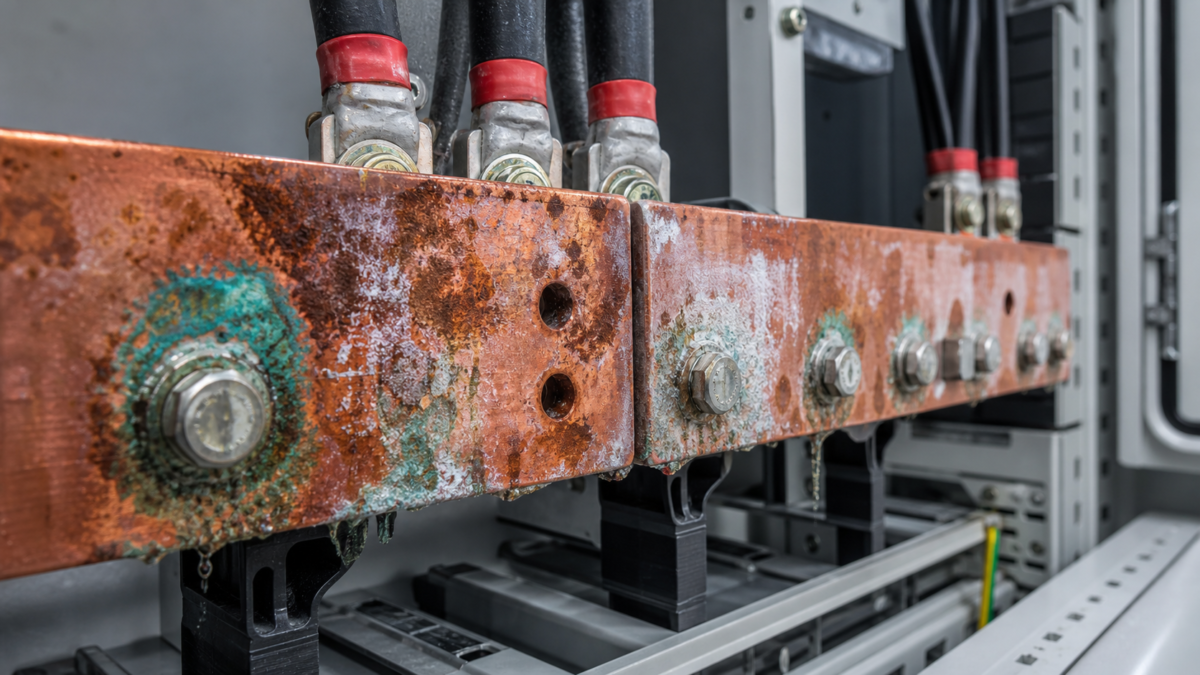
In my experience, people focus too much on the IP rating. An IP54 rating sounds great, but that test is done under specific, controlled conditions. It doesn't simulate a hot day followed by a cool, rainy night. The real constraint is what I call "diurnal breathing." As the sun heats the enclosure, the air inside expands and some escapes. At night, the enclosure cools, the internal air contracts, and a slight vacuum is created. This vacuum pulls in the surrounding air, and if that air is humid, you've just injected moisture into your "sealed" box. This cycle repeats every single day. The problem gets worse when you consider system layout. Poor spacing between units can create hot spots, and limited access can make it hard to spot early signs of corrosion. The real test is not in the lab, but on your site, over hundreds of these breathing cycles.
Design Assumptions vs. Site Reality
The gap between the spec sheet and performance often comes down to a few key assumptions. It's critical to compare the design basis with what actually happens at your location.
| Design Assumption | Site Reality | What It Means |
|---|---|---|
| Static pressure and seals | Dynamic pressure from thermal cycles | Seals are constantly stressed, allowing the enclosure to “breathe” in moist air. |
| Uniform ambient temperature | Direct solar radiation and rapid cooling from rain | Creates extreme temperature swings that accelerate the breathing cycle and condensation. |
| No internal moisture sources | Moisture trapped during assembly or from minor leaks | Even a small amount of trapped water can evaporate and condense repeatedly. |
Which Measurements Matter More Than Nameplate Data for Water Ingress and Humidity in BESS Enclosures?
Your BESS has a high IP rating but you still see condensation inside. You start to think the nameplate data is not telling you the whole story, and you are right.
Instead of a static IP rating, you should focus on dynamic performance data. Measurements like internal dew point tracking, air exchange rate under thermal cycling, and pressure differential tests give a true picture of how the enclosure will handle moisture on your site.
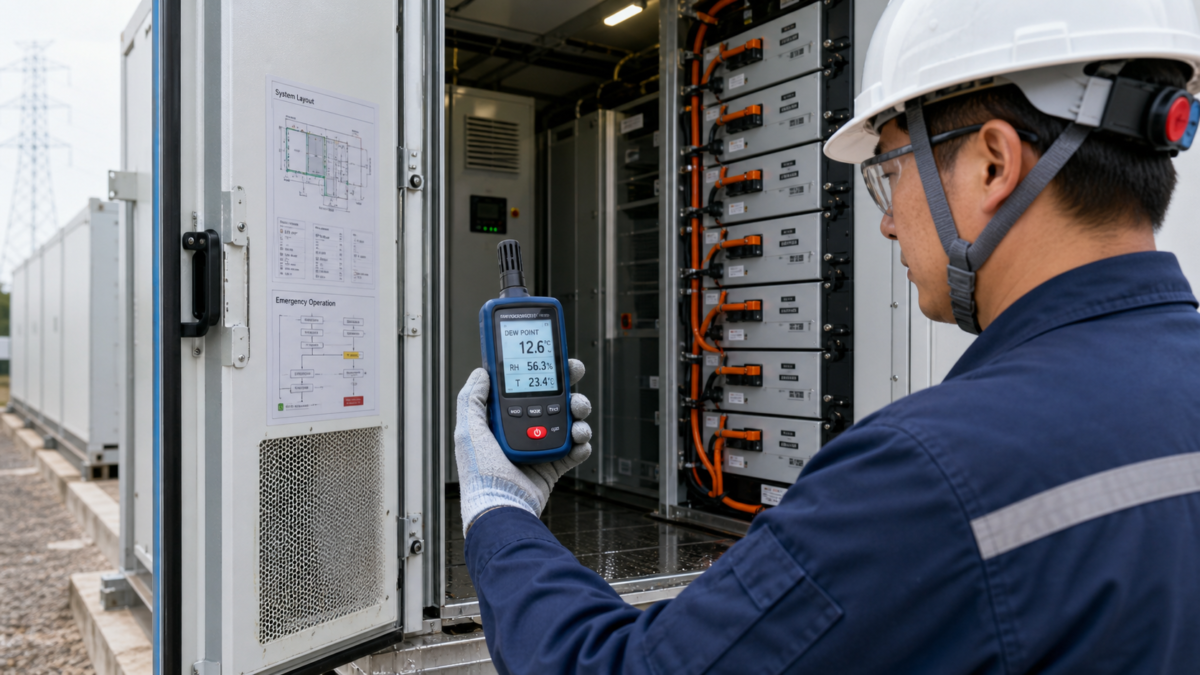
I always tell my clients to look past the marketing. A nameplate is a starting point, not the final word. The standard IP test involves spraying a stationary box with water for a few minutes. It does not replicate the real world, where a BESS bakes in the sun, gets cooled by its own HVAC system, and experiences pressure changes for years. The measurements that truly matter are the ones that show how the system behaves over time. For example, can the supplier show you data from a 24-hour thermal cycle test? In that test, did they monitor the internal dew point? A system that keeps the internal surface temperatures above the dew point of the internal air is a well-designed system. Another key measurement is the air exchange rate. A perfectly sealed box is a myth; what matters is how slowly it breathes and whether it has a way to manage the moisture that inevitably gets inside, such as through drain holes or a dehumidifier.
How Thermal Design Can Undermine the Expected Result?
You chose a BESS with a powerful air conditioner to protect the batteries. But now you have a humidity problem, and the cooling system seems to be making it worse.
An aggressive cooling system can be the main cause of condensation. It creates very cold internal surfaces. When the enclosure "breathes" in warm, humid outside air, that moisture instantly condenses on those cold spots, turning your thermal solution into a water generator.
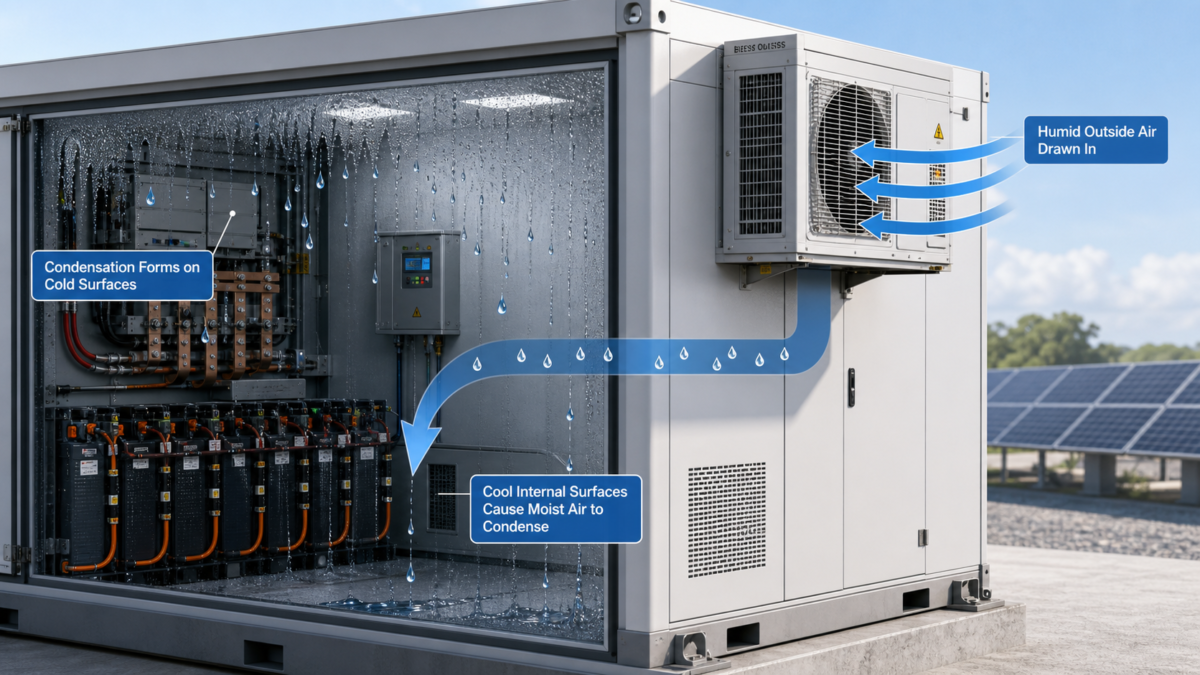
This is a classic case of an unintended consequence. The engineers are so focused on keeping the battery cells within their ideal temperature range that they overlook the impact on humidity. I once visited a site where the air conditioner was set to a very low temperature. The busbars inside were ice-cold. Every time the door was opened or the system breathed, you could practically see the water forming on them. This is where a different approach, like Moletong's liquid cooling systems, can offer an advantage. Liquid cooling often provides more stable and uniform temperatures inside the enclosure. It avoids creating those extremely cold surfaces that you get with high-powered air conditioning. By managing heat more gently and directly at the source (the cells), it can reduce the sharp temperature gradients that lead to condensation. The goal of a good thermal design shouldn't just be to cool the batteries, but to manage the entire internal environment, including the humidity.
Which Acceptance Tests Should Buyers Request for Water Ingress and Humidity in BESS Enclosures?
You are about to buy a BESS and want to make sure you avoid these moisture problems. You need to know what to ask for to verify the system's performance before it ships.
Buyers should request a witnessed "diurnal cycling test" as part of the Factory Acceptance Test (FAT). This test simulates day-night temperature swings in a climate chamber while tracking internal humidity and dew point, providing real evidence of performance beyond a simple water-spray test.
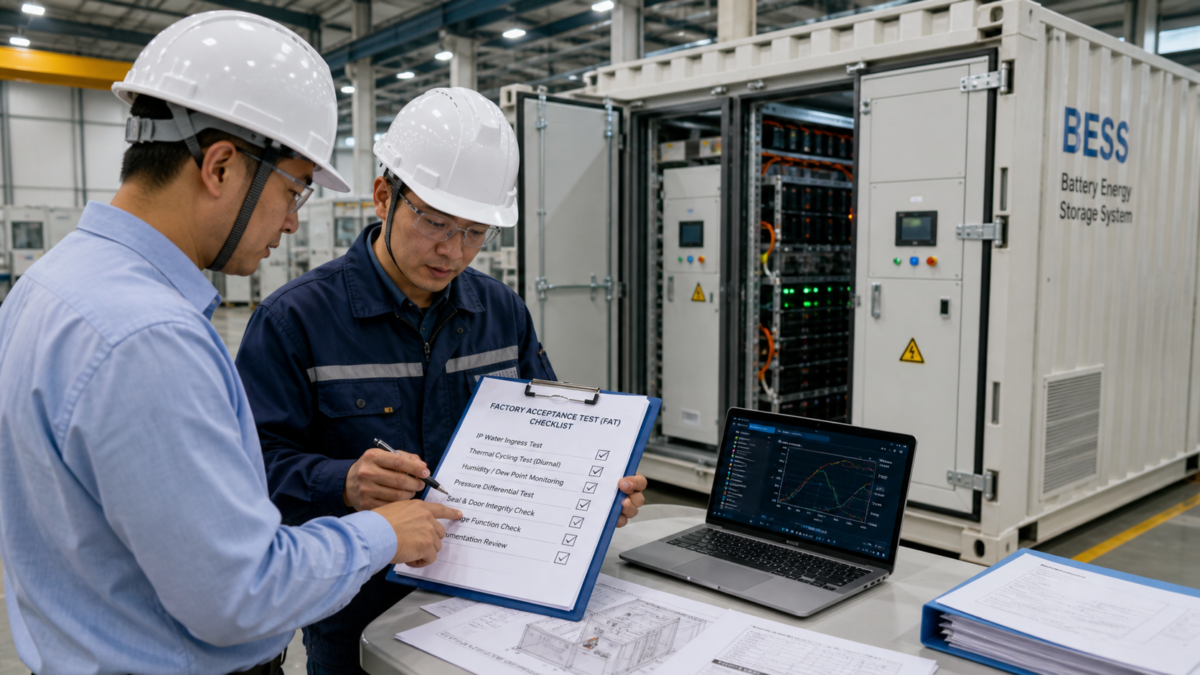
When I work with buyers, I insist on moving beyond the standard test plan. A simple IP test is not enough. You need to prove the system can handle your specific site conditions. This means providing the manufacturer with your site's typical daily high and low temperatures and humidity levels, and then asking them to replicate that cycle in their test chamber. During this test, you should be looking for specific outcomes. Is there any visible condensation? Does the internal dew point stay below the temperature of the internal surfaces? This is how you get real evidence. To make this process easier for others, I've developed a simple framework. It helps you connect the dots from potential causes to final acceptance, so you can make an informed decision instead of just hoping for the best.
From Cause to Acceptance: A Buyer's Checklist
This framework helps you systematically evaluate a BESS for humidity risks. It connects potential design issues to specific tests and planning steps.
| Evaluation Step | Key Question | Action for Buyer |
|---|---|---|
| Cause-and-Effect Analysis | What are the primary drivers of humidity on my site? (e.g., solar load, coastal air) | Provide the supplier with your site’s climate data and ask them to explain their design choices. |
| Test Report Crosswalk | Does the standard IP test report reflect my site’s reality? | Request a supplemental diurnal cycling test report and compare its results to the standard IP test. |
| Responder Walkthrough | What are the risks if water does get in? | Review the system’s electrical layout and drainage features with a focus on responder safety during an event. |
| Final Decision Checklist | Is there objective evidence the system will remain dry? | Confirm passing results from the diurnal test and verify that maintenance procedures for seals and drains are clear. |
Conclusion
High humidity in a BESS is a symptom of a system-level design challenge. Buyers must look beyond nameplate data and demand tests that prove performance under real-world, dynamic conditions.

Leave a Reply