

What Can Go Wrong with Home Battery Operation on Time-of-Use Tariffs?
Home battery ads promise big savings, but the reality can be disappointing. The numbers look great on paper, but your actual bill savings might not match the hype.
What goes wrong is that initial estimates often rely on outdated tariffs, ignore key financial assumptions, and apply one person's successful outcome to every situation. A correct analysis separates self-consumption, tariff arbitrage, and outage insurance, using your specific data to test a conservative operating case.
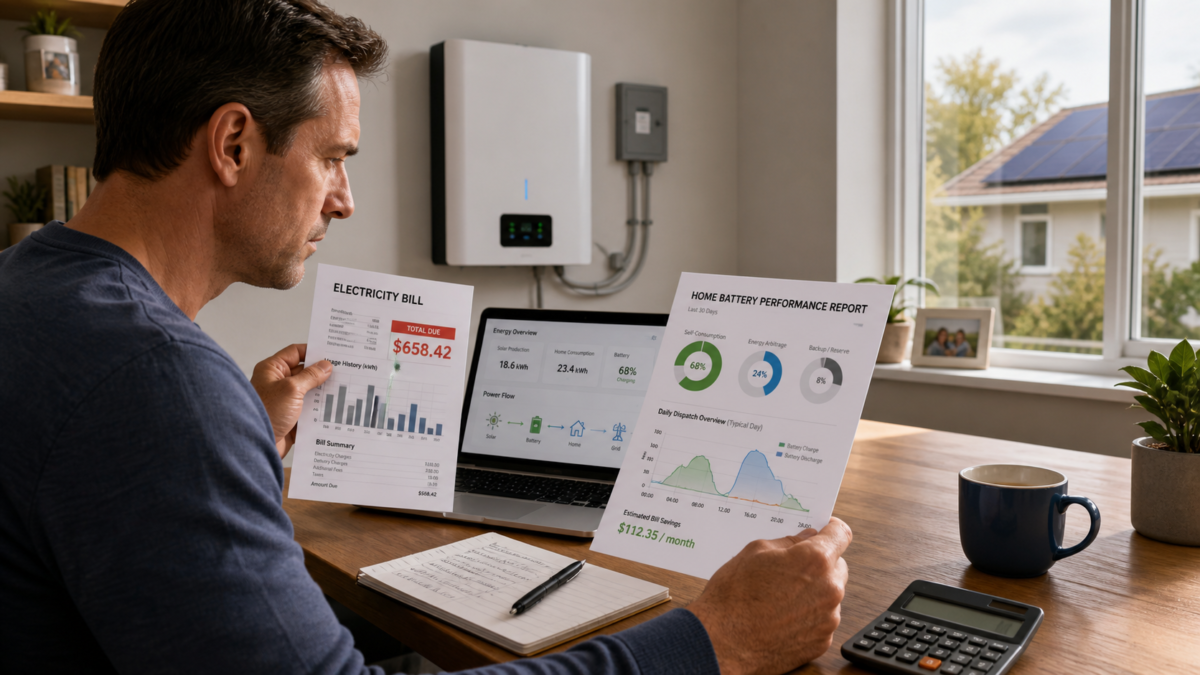
I see this problem often. A client comes to me excited about a home battery, holding a quote that promises a quick payback. But when we dig into the details, we find the numbers are based on best-case scenarios that don't fit their life. The key is to move past the sales pitch and into a real engineering review. This approach protects your investment and sets realistic expectations for how a battery will perform for you, on your tariff, with your energy habits. Let's break down how to do that.
From Home Battery Operation on Time-of-Use Tariffs to an Engineering Requirement?
You might think a home battery is just another appliance you plug in. But its performance is not guaranteed, and small details can change the financial outcome completely.
This shift happens when you properly separate the battery's value into three distinct jobs: self-consumption, tariff arbitrage, and outage insurance. Each job requires specific data, operating modes, and financial assumptions. This turns a simple product choice into a detailed engineering requirement for your specific home.
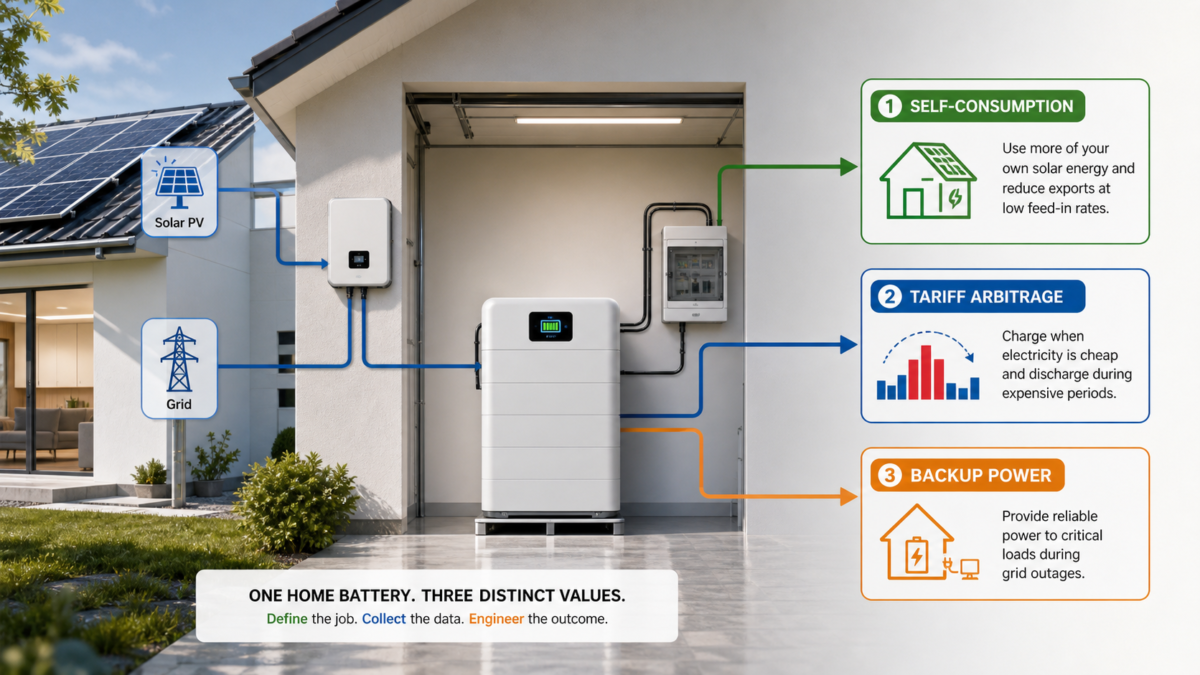
When I work with clients, the first thing I do is stop talking about products. Instead, we define the job we want the battery to do. Is the main goal to use more of your own solar power? That's self-consumption. Is it to charge on cheap nighttime electricity and use it during expensive peak hours? That's tariff arbitrage. Or is it just to keep the lights on during a blackout? That is outage insurance. Each goal changes the entire calculation. We have to treat this decision with the same seriousness as any other major home system upgrade. It is not about which battery is "best," but which operational strategy delivers real value for you.
Breaking Down the Value
To make this clear, I use a simple table to organize the thought process. This helps separate the marketing from the engineering.
| Value Stream | What It Means | Data You Need |
|---|---|---|
| Self-Consumption | Using your own solar energy instead of exporting it for a low credit. | 12 months of solar production and home energy usage data (interval data). |
| Tariff Arbitrage | Charging the battery when electricity is cheap and discharging when it is expensive. | A current, official copy of your time-of-use tariff, showing all rates and time slots. |
| Outage Insurance | Having backup power available during grid failures. | A list of critical loads you want to power and the typical duration of outages in your area. |
The Role of Dated Tariff in the Final Design?
Using last year's electricity bill to predict future savings is a common mistake. Tariffs change often, and those changes can completely erase your projected battery profits.
A dated tariff gives you a false picture of future savings. Utilities regularly update their rates, peak-hour windows, and solar export credits. Using the most current tariff document from your utility is the only way to build an accurate financial model for your battery investment.
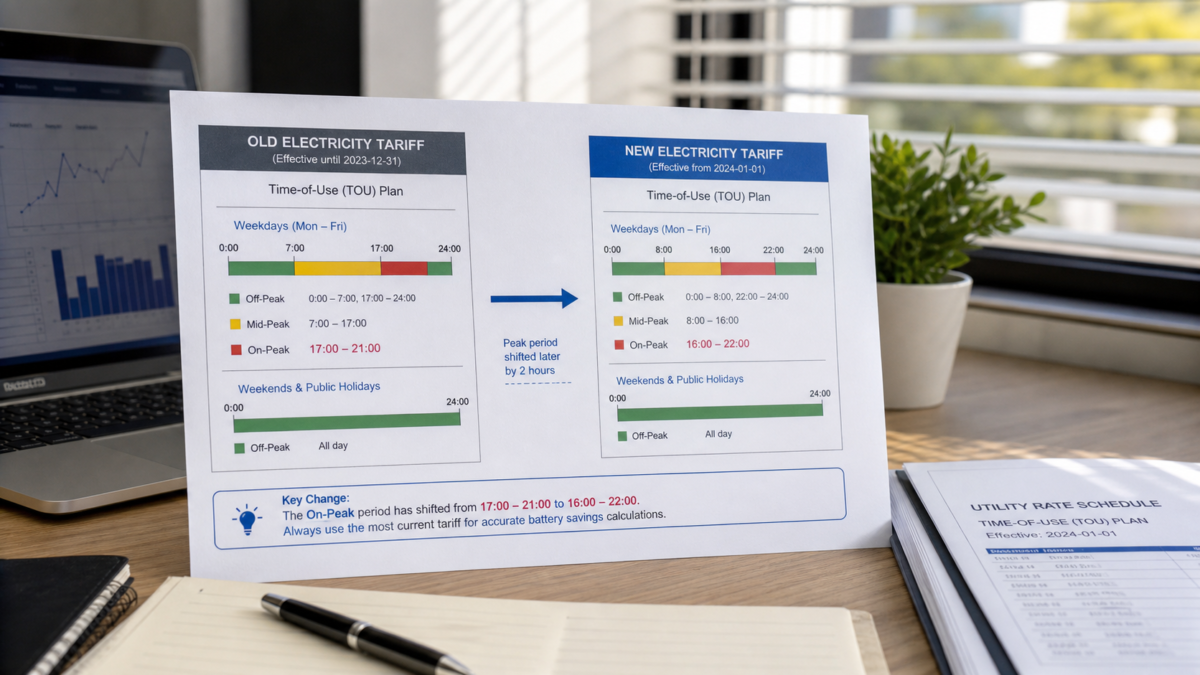
I remember a case where a potential client was very close to buying a system based on an analysis I was asked to review. The numbers looked fantastic. The problem was, the analysis used a tariff from 18 months prior. I pulled up the utility's current rate sheet. The evening peak period, which was the core of the savings plan, had shifted by two hours and the rate had dropped by 15%. Suddenly, the battery's arbitrage potential was cut in half. The final design had to be re-evaluated completely. This is why I never proceed without a screenshot or PDF of the customer's active tariff plan, directly from their utility account portal. Your 12-month bill history is great for understanding usage, but it is not a reliable source for the rates you will be paying next year.
Why One Home Battery Operation on Time-of-Use Tariffs Outcome Does Not Prove the Rule?
Your neighbor installed a battery and their bill disappeared. It is tempting to buy the exact same system, but this is a trap. Their success doesn't guarantee yours.
One positive outcome is tied to a specific household's energy profile, tariff, and battery settings. Every home is different. Copying a setup without analyzing your own data is a gamble that rarely pays off, often leading to a poor return on your investment.
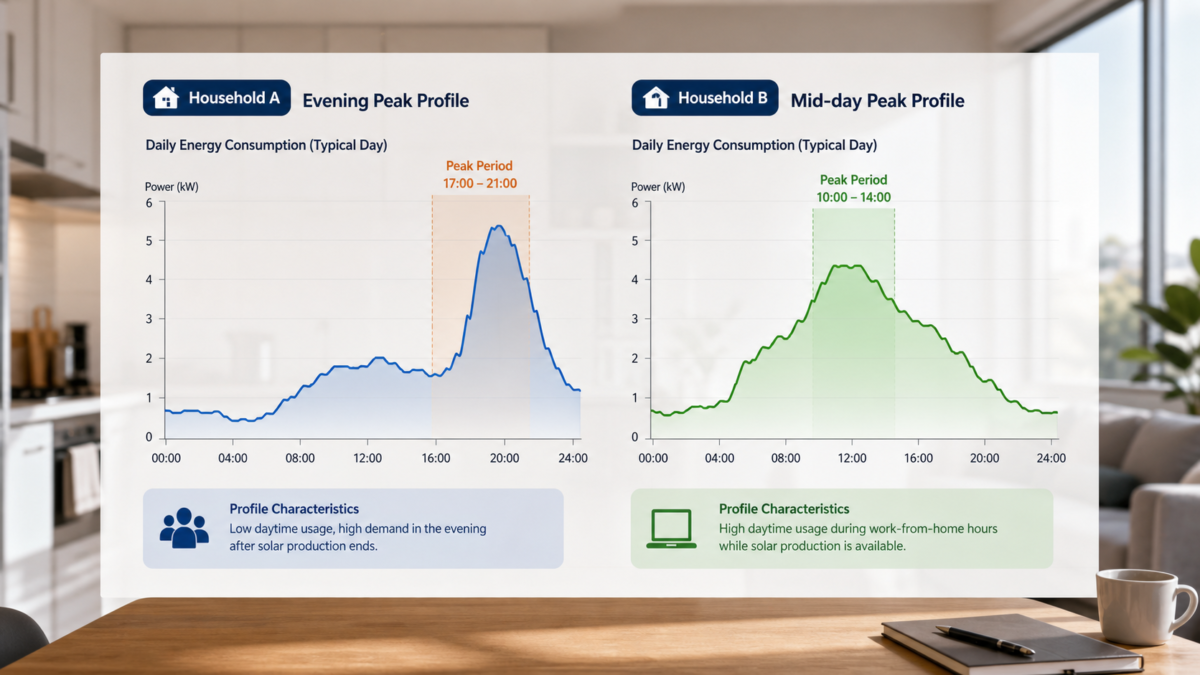
Every home has a unique energy "heartbeat," or what we call a load profile. I once worked with two families who lived on the same street and bought identical battery systems. One family worked from home, using computers and air conditioning all day. The other family was out of the house until the evening. The work-from-home family saw incredible savings from self-consuming their solar energy during the day. The other family saw almost no benefit because their peak usage happened after their solar panels stopped producing. Their battery was oversized for their actual needs. This shows why a generic proposal is so dangerous. I always insist on modeling a conservative operating case based on your 12 months of energy data, not just showing the most attractive or ideal scenario. We need to test the assumptions to see what really works.
How to Document the Home Battery Operation on Time-of-Use Tariffs Decision?
You have done the analysis and made a decision. But months later, how do you know if the system is actually performing as promised? You need a record.
You document the decision with a simple checklist that captures the core data and assumptions. This should include an anonymized bill, a tariff screenshot, the modeled dispatch trace, and a list of key assumptions, all reviewed by a named engineer.
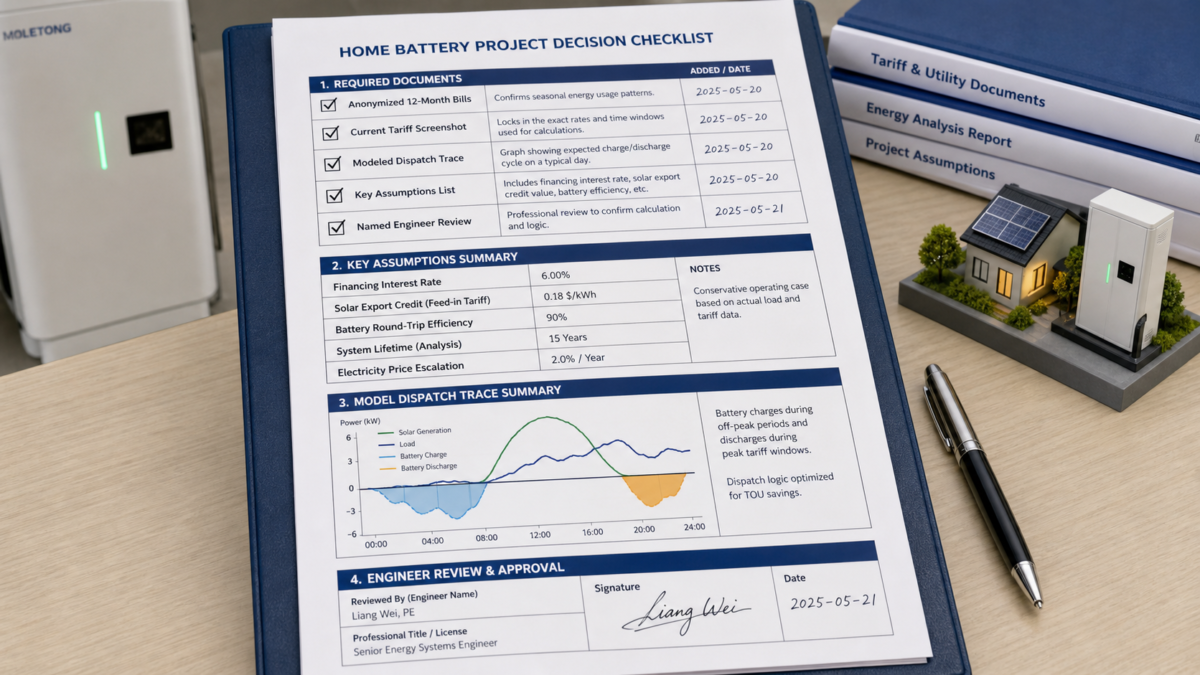
This isn't just about creating paperwork. It's about accountability and creating a baseline for success. When I finalize a system design for a client, I give them a simple one-page decision summary. This document is our shared source of truth. It allows us to go back six or twelve months later and compare the battery's actual performance to the original plan. For example, if we see that the savings are lower than expected, we can check the dispatch trace. Is the battery charging and discharging at the right times according to the tariff we documented? If not, we can adjust the settings. This process turns a purchase into a managed asset. When I work with a product like a Moletong residential battery, I use its specific operating parameters to create this dispatch model, ensuring our plan is based on real-world capabilities.
Here is a simple checklist you can use to document your own decision:
- Anonymized 12-Month Bills: Confirms your seasonal energy usage patterns.
- Current Tariff Screenshot: Locks in the exact rates and time windows used for calculations.
- Modeled Dispatch Trace: A graph showing the expected charge/discharge cycle on a typical day.
- Key Assumptions List: This must include the financing interest rate, the assumed solar export credit value, and the expected battery efficiency.
- Named Engineer Review: A signature from a professional who has checked the math and confirmed the logic.
Conclusion
To get the battery outcome you expect, you must verify your tariff, analyze your own energy data, test a conservative case, and document the key assumptions behind your decision.
My Role
About me
Brand Name: Moletong
Slogan: Carbon Neutrality, Tracking the Future
Website: www.moletong.com
Company Overview
Established in 2011 and headquartered in Dongguan, Guangdong, we are an integrated new-energy equipment enterprise specializing in energy storage systems, complete electrical equipment, photovoltaic solutions, charging infrastructure, and hydrogen-energy solution integration.
We integrate R&D, manufacturing, sales, system configuration, and technical service to support utility-scale, commercial and industrial, and residential energy applications. Our solutions are designed around practical customer needs such as peak shaving and valley filling, electricity-cost optimization, transformer-capacity support, emergency backup, renewable-energy integration, intelligent energy management, and photovoltaic-storage-charging coordination.
Our Core Business
1. Energy Storage Systems & Equipment
We develop lithium iron phosphate energy-storage products for utility-scale, commercial and industrial, residential, and integrated charging applications. Our documented portfolio includes liquid-cooled containerized energy-storage systems, commercial and industrial storage cabinets, residential battery systems, storage-and-charging systems, BMS, PCS, and EMS functions.
2. Complete Electrical Equipment
We provide complete high- and low-voltage electrical products, including gas-insulated ring-main units, high-voltage switchgear, low-voltage withdrawable and fixed switchgear, power-distribution cabinets, meter boxes, box-type substations, charging-station substations, and busbar-trunking systems.
3. Photovoltaic & Integrated Energy Solutions
We provide photovoltaic supporting equipment and system solutions, including 35 kV step-up substation equipment, photovoltaic combiner cabinets, adjustable mounting structures, photovoltaic-storage integration, and equipment support for grid connection, power transmission, and microgrid applications.
4. Charging & Hydrogen-Energy Solution Integration
We provide AC and DC charging solutions, storage-and-charging systems, and photovoltaic-storage-charging integration for industrial parks, commercial parking facilities, transport hubs, and locations with limited grid or transformer capacity. We also develop hydrogen-energy integration concepts involving renewable hydrogen production, hydrogen storage, refueling, and hydrogen-electric coupling. Specific hydrogen products, certifications, production capacity, and completed projects must be confirmed separately.
Product Applications & Technology Focus
Primary Service Industries:
Our principal customer sectors include Industrial and Commercial Energy Users, Renewable-Energy Developers, Power and Electrical Engineering, EV Charging Infrastructure, Commercial and Public Facilities, and Residential Energy Storage.
Product Categories We Serve:
- Utility-Scale Containerized Energy-Storage Systems
- Commercial and Industrial Energy-Storage Cabinets
- Residential Energy-Storage Batteries and Inverters
- Integrated Storage-and-Charging Systems
- High- and Low-Voltage Switchgear
- Box-Type Substations and Charging-Station Substations
- Busbar-Trunking and Power-Distribution Products
- Photovoltaic Step-Up and Combiner Equipment
Technology Expertise:
Our documented technical focus includes:
Lithium Iron Phosphate Cells, BMS, PCS, EMS, Liquid Cooling, Natural Cooling, Modular System Integration, Remote Monitoring, Load Tracking, Anti-Reverse-Flow Control, Transformer-Capacity Protection, and Intelligent Operation and Maintenance.
Production Capacity & Equipment
Energy Storage Production & R&D Platform
Our supplied corporate materials identify one production base in Dongguan and a Dongguan engineering R&D center. We support product development, equipment manufacturing, system configuration, and technical service for residential, commercial and industrial, and large-scale energy-storage applications.
- Product Platform Highlights: 5,015 kWh liquid-cooled containerized storage systems, 627 kWh and 261 kWh commercial and industrial storage cabinets, 16 kWh residential battery systems, and 261 kWh and 627 kWh integrated storage-and-charging systems.
Electrical Equipment Platform
We provide product design and manufacturing support for complete electrical assemblies used in industrial facilities, commercial buildings, substations, photovoltaic projects, charging stations, and public infrastructure.
- Equipment Highlights: High-Voltage Ring-Main Units, High-Voltage Metal-Clad Switchgear, Low-Voltage Withdrawable Switchgear, AC Low-Voltage Switchgear, Distribution Cabinets, Box-Type Substations, Prefabricated Charging-Station Substations, and Busbar-Trunking Systems.
Energy Storage & Electrical System Capabilities
General Capabilities:
- Application and electricity-use requirement analysis
- Energy-storage system selection and capacity configuration
- Equipment design and manufacturing
- BMS, PCS, and EMS system integration
- Peak shaving, valley filling, and time-of-use energy scheduling
- Load tracking and anti-reverse-flow control
- Transformer-capacity protection and demand management
- Photovoltaic-storage and storage-charging integration
- Remote installation, commissioning, and trial-operation support
- Operator training, warranty service, and technical after-sales support as contracted
Our Core Specialties:
- ✔️ Liquid-Cooled Large-Capacity energy-storage systems
- ✔️ Commercial & Industrial peak-valley and backup-power solutions
- ✔️ Integrated Photovoltaic-Storage-Charging applications
- ✔️ Complete Electrical Distribution equipment and system coordination
Quality Control & Certifications
We apply quality, environmental, and occupational health and safety management requirements to the design, manufacture, and sales of our documented product scope.
Quality Management Scope:
The supplied qualification materials show ISO management-system certificates and patent certificates held by Moletong. The product manuals separately define model-specific electrical parameters, monitoring functions, protection requirements, cooling methods, fire-protection configurations, operating environments, and technical-service conditions.
Testing & Protection Focus:
- Cell voltage, current, temperature, and operating-status monitoring
- Overcharge, over-discharge, overtemperature, and abnormal-condition protection
- Liquid-cooling or natural-cooling verification according to product model
- Fire-protection configuration according to product type
- Enclosure protection, corrosion resistance, and operating-environment requirements
- BMS, PCS, EMS, and communication-function verification where applicable
Certifications & Compliance:
- ISO 9001 Quality Management System
- ISO 14001 Environmental Management System
- ISO 45001 Occupational Health and Safety Management System
- Invention Patent and Utility Model Patent Certificates
- Selected product models list IEC 62619, UN 38.3, RoHS, EN 61000 series requirements, GB/T 36276, CCC, and relevant IEC/GB electrical standards
Certification scope varies by product model, configuration, destination market, and certificate validity period. Model-specific certificates must be confirmed before any formal compliance claim.
Target Markets & Partnership Models
Who We Serve:
- Industrial Facility Owners: Plant managers, energy managers, facility managers, and procurement teams at factories or industrial parks seeking peak-valley electricity-cost optimization, demand management, transformer-capacity support, or emergency backup power
- Renewable-Energy Developers: Project developers, engineering managers, and procurement teams for photovoltaic or wind projects requiring energy storage, step-up equipment, electrical distribution, or renewable-energy integration
- EPC & Electrical Contractors: Project managers, technical managers, and equipment-purchasing teams at qualified engineering companies requiring packaged energy-storage or electrical equipment with technical coordination
- Charging-Station Developers & Operators: Investment, construction, and operations teams working on sites with limited grid access, insufficient transformer capacity, high peak demand, or photovoltaic-storage-charging requirements
- Energy Service Companies & System Integrators: Solution designers and project-development teams building commercial and industrial energy-management, microgrid, or distributed-energy projects
- Residential Storage Distributors & Installers: Importers, distributors, wholesalers, and qualified installers requiring lithium iron phosphate batteries, off-grid or hybrid inverters, and residential storage configurations
- Commercial & Public-Facility Owners: Property, engineering, and facility-management teams for commercial buildings, schools, hospitals, hotels, parking facilities, and transport locations requiring reliable power distribution, charging, or backup-energy solutions
Target Geographies:
Our home market is China, supported by regional sales coverage for South, East, Central, and Southwest China. The supplied 2026 catalogue also identifies an overseas office in Indonesia, supporting practical market development in Southeast Asia. Other overseas markets are served only after confirming model-specific certification, grid requirements, shipping conditions, and local installation standards.
Types of Cooperation:
- Equipment Supply: Standard or configured energy-storage and electrical products
- System Configuration: Product selection and capacity configuration based on the customer's application
- System Integration: BMS, PCS, EMS, photovoltaic, charging, and electrical-system coordination
- Project Technical Cooperation: Technical coordination with renewable-energy developers, EPC contractors, and qualified local engineering companies
- Integrated Energy Solutions: Photovoltaic-storage, storage-charging, and photovoltaic-storage-charging applications
- Technical Service: Training, remote installation and commissioning support, warranty, and after-sales service as agreed in the commercial contract
Our Core Competitive Advantages
⭐ Integrated New-Energy Product Portfolio
By combining energy-storage systems, complete electrical equipment, photovoltaic supporting products, charging applications, and intelligent energy-management functions, we can configure solutions around the customer's complete power-use scenario.
⭐ Coverage from Residential to Utility Scale
Our documented energy-storage range extends from 16 kWh residential systems to 261 kWh and 627 kWh commercial and industrial systems and a 5,015 kWh containerized system.
⭐ Application-Oriented System Design
Our solutions address identifiable operating needs, including peak-valley arbitrage, demand management, transformer-capacity constraints, backup power, renewable-energy consumption, and charging-station power support.
⭐ Integrated Control & Safety Architecture
Our storage products combine lithium iron phosphate cells with BMS, PCS, EMS, model-specific thermal management, multi-level protection, intelligent monitoring, and remote operation and maintenance functions.
⭐ Regional Sales & Technical Service Support
With a Dongguan headquarters and engineering center, regional sales coverage in China, and an overseas office identified in Indonesia, we support equipment selection, technical coordination, training, remote commissioning assistance, and contracted after-sales service.
Leave a Reply