

C&i BESS Preventive Maintenance: A Practical Design and Procurement Guide?
Confused by BESS lifecycle guarantees? You are not alone. Vague promises can lead to costly surprises. I am here to help you cut through the noise with a clear plan.
A buyer should conclude that every C&I BESS preventive maintenance plan or lifecycle guarantee requires a clear measurement method, a designated data owner, and a formal dispute process. Before comparing products, test a conservative operating case based on your site's specific assumptions for augmentation and throughput.

I have seen too many projects get bogged down by poorly defined expectations. A performance guarantee that you cannot measure is not a guarantee at all. It is just a marketing claim. The goal of this guide is to give you a framework to turn those claims into contractual realities. Instead of just taking a supplier's conclusion, I will show you how to build your own evaluation, so you can make a decision that fits your project perfectly. Let’s get started.
From C&i BESS Preventive Maintenance to an Engineering Requirement?
A supplier promises "great lifecycle performance." This sounds good, but what does it actually mean? Without specifics, this promise is impossible to enforce and can lead to major disagreements later.
You must translate vague maintenance promises into concrete engineering requirements. This means defining the exact capacity-test method, assigning ownership of all performance data and event logs, and establishing a clear, step-by-step dispute resolution process before you sign any contract.
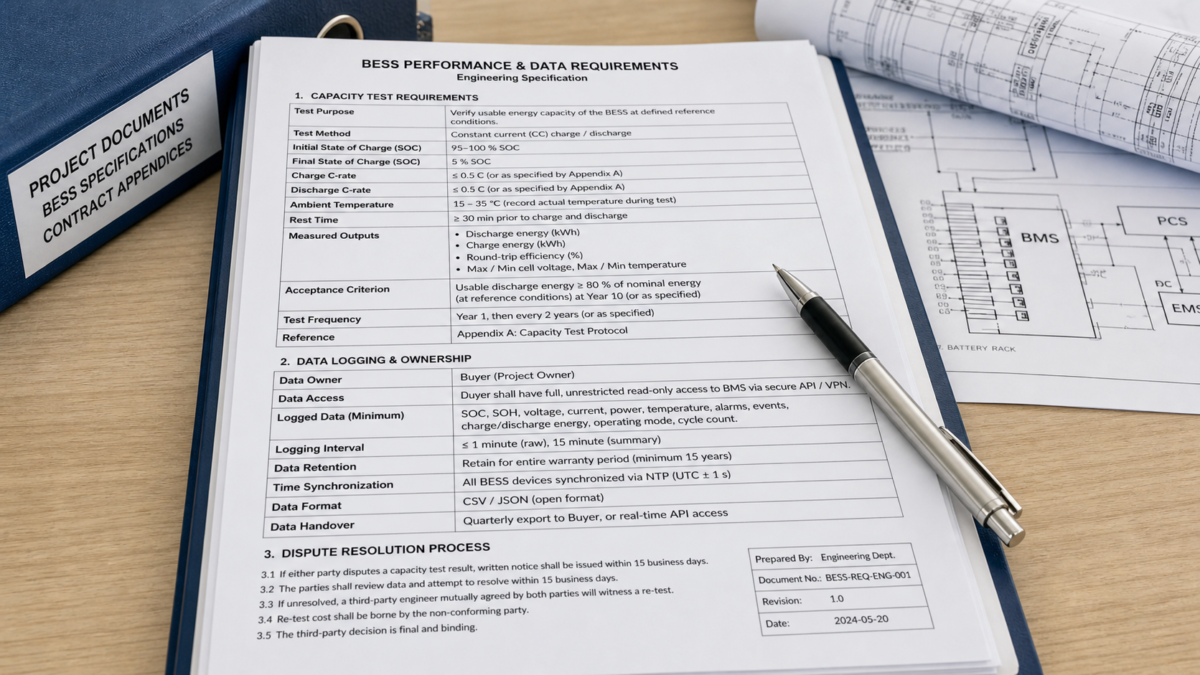
In my experience, the projects that succeed are the ones that treat preventive maintenance and performance guarantees as core engineering specifications from day one. It is not something to figure out after installation. It is a critical part of the system design. The key is to remove all ambiguity. For example, a supplier might guarantee 80% capacity after 10 years. But how will you prove it? You need a formal, agreed-upon test procedure. Who keeps the records that show how the system was operated? That needs to be defined. This transforms the conversation from a sales pitch into an engineering discussion, which is exactly where it needs to be.
Turning Promises into Specifications
The difference between a marketing promise and an engineering requirement is detail. You need to document every critical parameter so there is a single source of truth for both you and the supplier. A clear table can help illustrate this. I often use something like this to clarify terms with my clients.
| Vague Promise | Engineering Requirement |
|---|---|
| “The system will maintain high capacity.” | “The system shall demonstrate ≥80% of nominal energy capacity at year 10 when tested according to Appendix A: Capacity Test Protocol.” |
| “We monitor the system for you.” | “The Buyer shall have full, unrestricted read-only access to the BMS event log via a secure API. The data shall be retained for the full warranty period.” |
| “We’ll take care of any issues.” | “If a capacity test result is disputed, a third-party engineer agreed upon by both parties will oversee a re-test at the supplier’s expense.” |
The Role of Augmentation in the Final Design?
All batteries degrade over time. If your project needs to deliver a specific capacity for 10 or 15 years, you will eventually face a shortfall. Ignoring this reality is a recipe for failure.
Augmentation is the planned addition of new battery capacity during the project's lifecycle to counteract degradation. It is not just a maintenance task; it is a critical design and financial variable that directly impacts your long-term project revenue and must be defined upfront.

I remember a project where the client focused only on the day-one cost. They chose a system without a clear augmentation plan. A few years later, their system could no longer meet its contractual obligations, and they faced significant financial penalties. Augmentation is how you solve this. It means your initial design includes the physical space and electrical infrastructure to add more batteries later. More importantly, your financial model must include the cost of these future battery modules. When you compare two BESS proposals, you are not just comparing the initial hardware. You are comparing two different lifecycle strategies, and the cost and timing of augmentation is one of the most important assumptions in that comparison.
Why One C&i BESS Preventive Maintenance Outcome Does Not Prove the Rule?
A supplier shows you a case study where their BESS performed perfectly for five years. This is great for that specific customer, but it tells you very little about how it will perform for you.
A single case study is not proof because your project's operating conditions—throughput, temperature, and application—are unique. You should insist on evaluating a conservative operating case tailored to your site, rather than accepting a supplier’s most attractive, and possibly irrelevant, result.
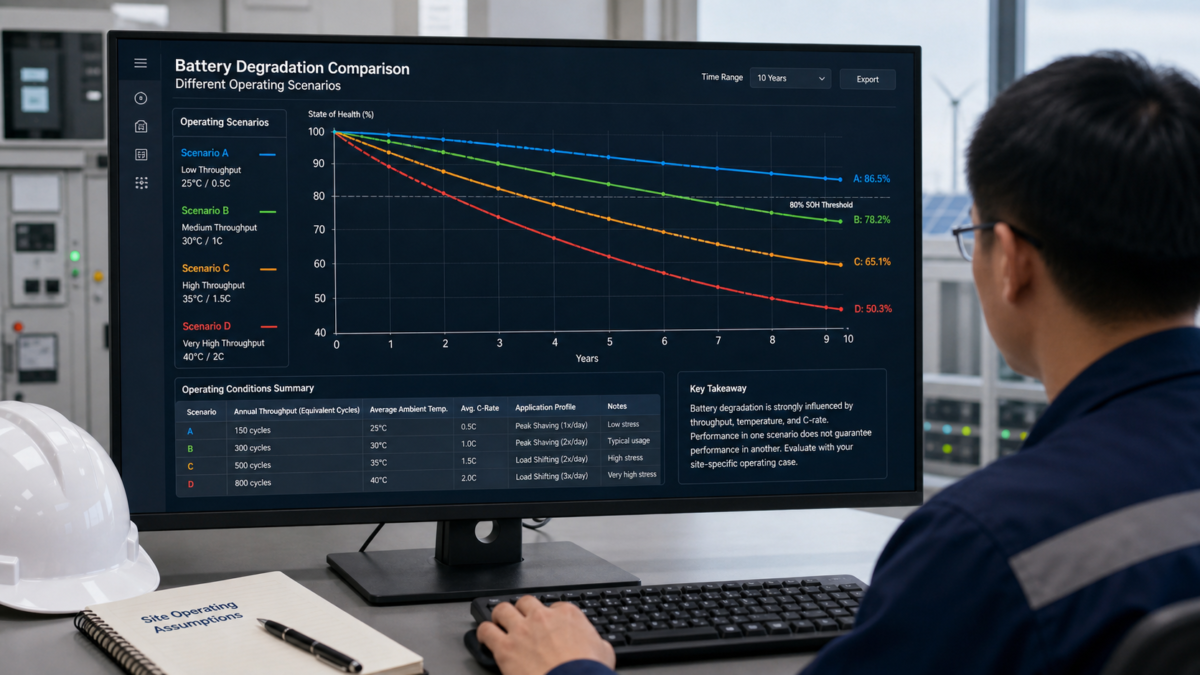
Your BESS might cycle twice a day while the one in the case study cycled once every other day. Your site might be in a hot climate, while theirs was in a cool one. These differences have a massive impact on battery degradation. This is why, at Moletong, we believe in transparency. We use approved service records to build performance models, or we provide clearly labeled worked examples. A "worked example" is honest; it takes real degradation data and applies it to a specific, stated set of operating assumptions. This allows you to ask the right questions. Instead of asking "Will I get this result?" you can ask, "What happens to the result if my annual throughput is 20% higher than your assumption?" This gives you the power to test the assumptions that have the greatest effect on your business case.
How to Document the C&i BESS Preventive Maintenance Decision?
You have done the analysis and chosen a supplier. The hard work is over, right? Not yet. If the details of your agreement are not clearly documented, they can be forgotten or disputed.
Document your decision with a comprehensive checklist that becomes part of your contract. This document must include a KPI dictionary, event log requirements, a defined capacity-test method, a parts forecast for augmentation, and a chain-of-custody plan for recycling.

This final document is your project's single source of truth for lifecycle performance. It protects both you and the supplier by making sure everyone is working from the same set of rules. I always push my clients to create this before signing the final purchase order. It forces everyone to have the difficult conversations upfront, which is much better than having them five years into the project when a problem arises. It is your ultimate tool for accountability. Here are the key components I insist on including:
- KPI Dictionary: Do not assume everyone defines "State of Health" the same way. Write down the exact mathematical formula for every key metric.
- Event Log: Specify what data the BMS must log, how often it must be logged, and who can access it.
- Capacity-Test Method: A step-by-step procedure, including state of charge at the start and end, the C-rate for charging and discharging, and the ambient temperature conditions.
- Parts Forecast: A schedule showing when augmentation modules are expected to be needed, based on your agreed-upon operating case.
- Chain-of-Custody Record: A plan for who is responsible for decommissioning, transport, and recycling of the batteries at the end of their life, including all necessary documentation.
Conclusion
Turn vague promises into concrete engineering requirements. Use a clear, documented checklist to evaluate lifecycle guarantees for your specific project, ensuring long-term value and holding your partners accountable.

Leave a Reply