

How Should Buyers Evaluate Load Management?
Evaluating EV charging load management feels complex. You face conflicting claims and worry about choosing a system that either underperforms or is needlessly expensive, stalling your project entirely.
My approach is simple: define your required outcome, identify the site constraint that can defeat it, and then test any proposed design with your real-world inputs. Focus on charger power, session data, transformer headroom, and any on-site PV profile.
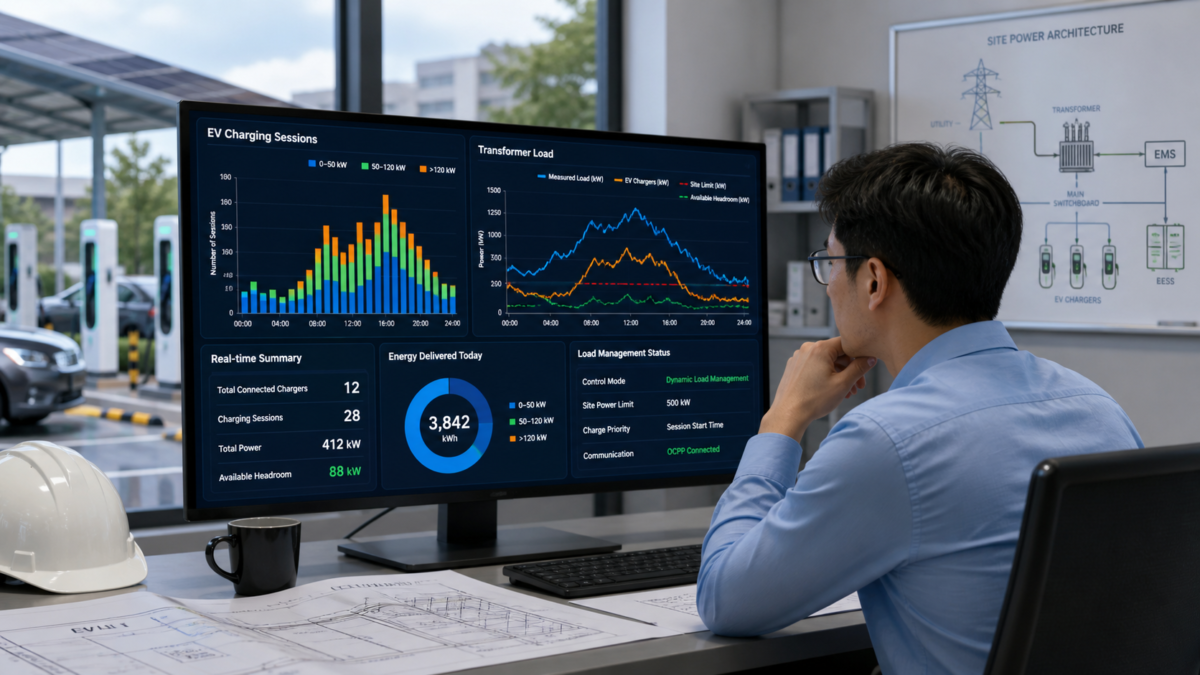
This seems straightforward, but I see buyers get distracted by fancy features instead of focusing on what really matters. A solution that looks great on paper can easily fail when it meets the messy reality of your site's specific power limitations and driver behaviors. The key is to demand proof that a system can handle your reality, not just a theoretical one. Let’s break down how I do this, step by step, to ensure a load management solution is practical, credible, and truly useful.
The Buyer Pain Point Behind Buyers Evaluate Load Management?
Your site has a fixed power limit, but your EV charging demand is growing. You fear high demand charges, tripping breakers, or facing a massive, expensive grid upgrade.
The core pain point is the conflict between the need for reliable, fast EV charging and the very real, expensive limits of your site's electrical infrastructure. You need to maximize charging capacity and revenue without triggering crippling costs or grid instability.
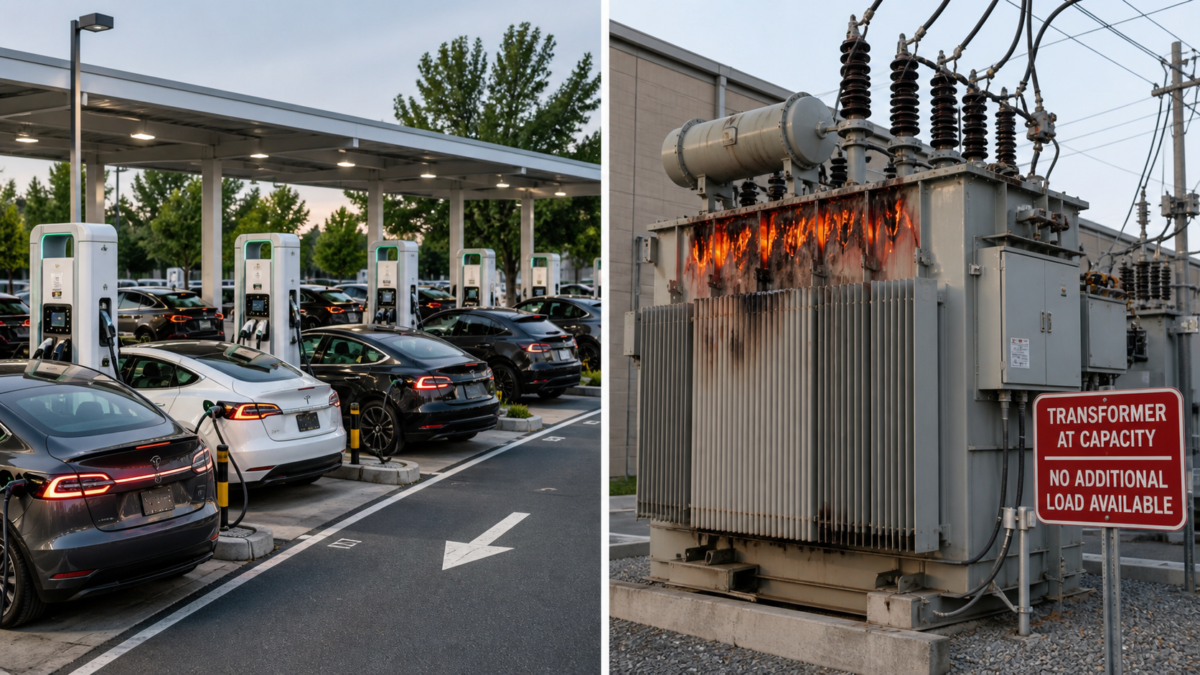
I’ve seen this play out many times. A client wants to install ten 120 kW DC fast chargers, but their transformer only has 500 kW of available capacity. A simple calculation shows that just five cars charging at once could push them over the limit, let alone ten. The knee-jerk reaction is often to call the utility, who quotes a six-figure sum and an 18-month wait for a transformer upgrade. This is where the project usually dies. The real problem isn't just about adding chargers; it's about intelligently managing the power you already have. Without a load management strategy, you are forced to either drastically limit your charging business or pay a fortune for more power.
Comparing Scenarios
To make this clear, I often show clients a simple table that contrasts the financial reality of going with or without load management.
| Metric | Scenario 1: No Load Management | Scenario 2: Active Load Management |
|---|---|---|
| Peak Demand (kW) | Uncontrolled, potentially > 1,200 kW | Capped at site limit, e.g., 500 kW |
| Monthly Demand Charges | Extremely high and unpredictable | Controlled and minimized |
| Grid Upgrade Cost | Often required, $100,000+ | Avoided or deferred |
| Charger Uptime | At risk from tripped breakers | High, power is shared intelligently |
This simple breakdown shows that the upfront cost of a good load management system is an investment to avoid much larger, ongoing operational costs and capital expenditures.
How to Test the Key Load Management Assumptions?
You're reviewing a proposal, and the supplier promises their system works perfectly. But how can you be sure it will work for your site, with your drivers?
You must test their assumptions using your site's data. I would demand a simulation using a real session dataset and a 24-hour transformer power trace. I’d also insist on seeing a proposed control sequence and proof of a successful OCPP/EMS test.
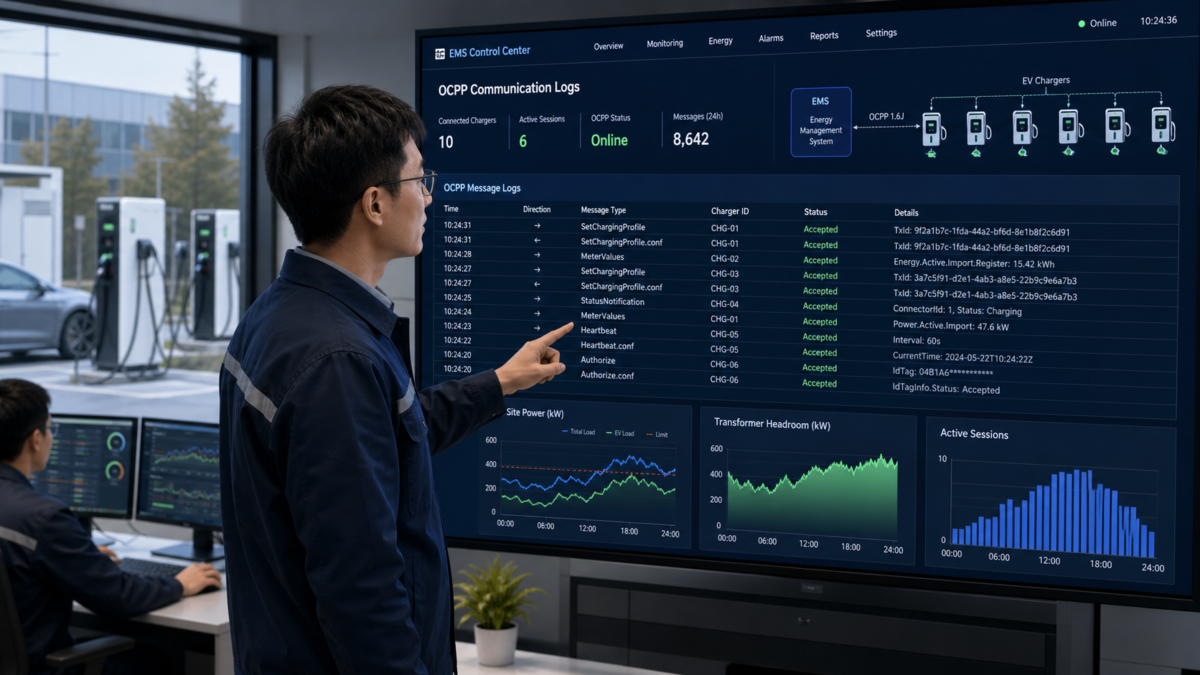
An assumption is just a guess until it's tested with data. My process here is non-negotiable because it separates an attractive sales pitch from a bankable engineering solution. First, I provide the vendor with a real or representative dataset of charging sessions. This includes arrival times, requested energy, and vehicle types. This tests if their algorithm can handle the random, overlapping nature of real-world demand. Second, I give them a 24-hour power trace from the site's main transformer. This shows the non-EV building loads and reveals the true, fluctuating headroom available for charging. Their simulation must show me that the chargers will stay within this limit at all times. Third, I want to see the control logic. If three cars arrive at once and there's only enough power for two, who gets priority? Is it first-come, first-served? Does power get shared equally? This must be defined. Finally, I ask for proof that their Energy Management System (EMS) can actually talk to the chargers using standard protocols like OCPP. A simple bench test log is often enough to prove this critical communication link works.
Balancing Cost, Reliability, and Compliance in Load Management?
You're caught between a basic system that feels risky and a complex one with a scary price tag. You need to meet your operational needs without overspending.
The key is to match the solution's complexity to the problem's severity. Start with software-based load sharing first. Only add battery buffering if session demand and control priorities, like guaranteeing a certain charge speed, absolutely justify the extra cost.

I always think of this as a ladder. The first rung is the cheapest and simplest: dynamic load management (DLM) that just shares power among the EV chargers. This is a software feature. The next rung up is integrating the DLM with the site's main power meter to make sure the chargers don't overload the building's transformer. This is still mostly software, with one extra piece of hardware. The top rung is adding a battery energy storage system (BESS). This is the most expensive and complex step.
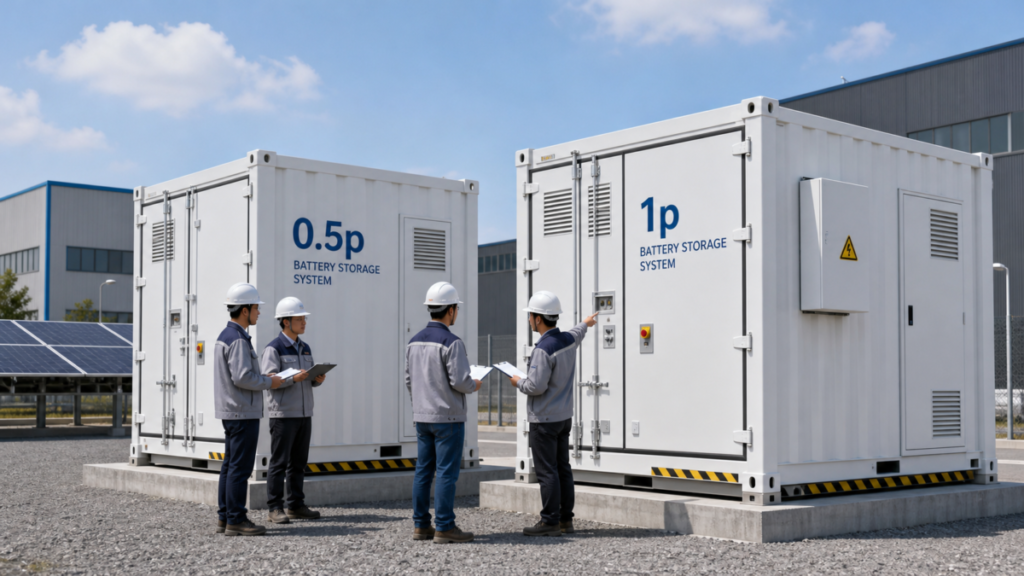
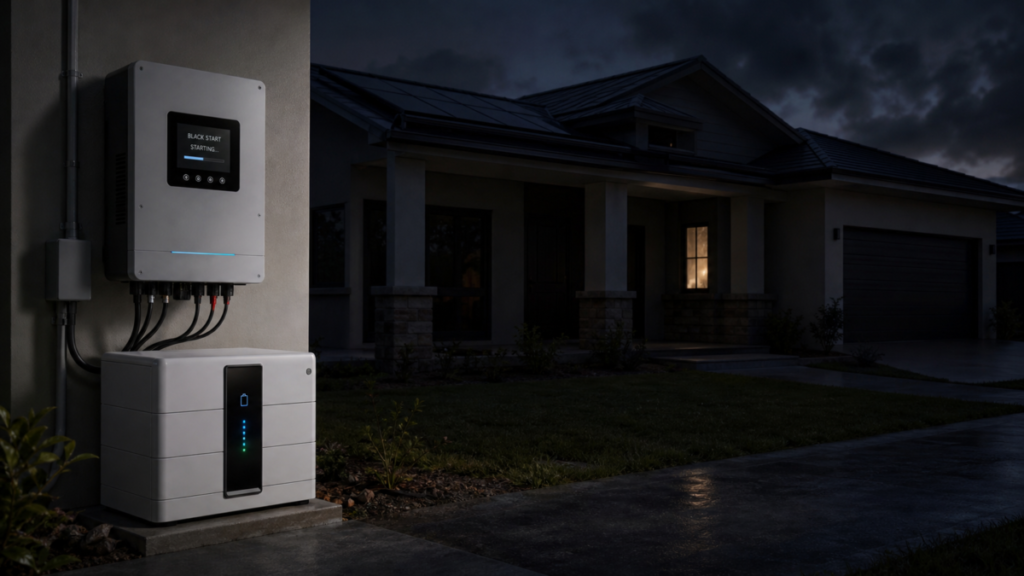
I only recommend adding a battery when it’s truly necessary. For example, if a site frequently has more high-power DC fast charging demand than the grid can support, a battery can buffer that demand. Using our Moletong products as an example, a 261 kWh / 60 kW storage-charging system could absorb solar energy during the day and discharge to support one extra fast-charging session during the evening peak. But if the site needs to support three or four simultaneous sessions, a larger 627 kWh / 120 kW system would be required. The decision comes down to the value of reliability. If losing a charging session costs you a key customer, the battery is justified. If not, stick to the simpler software solution.
What a Bankable Load Management Proposal Should Show?
You’ve received a proposal, but it’s full of vague promises and marketing material. You can’t tell if the solution is properly engineered or how it compares to others.
A credible, bankable proposal must be a practical engineering document. It should show a simulation using your data, specify the control sequence, and include a sensitivity analysis. Crucially, it must state the conditions under which the recommendation would change.
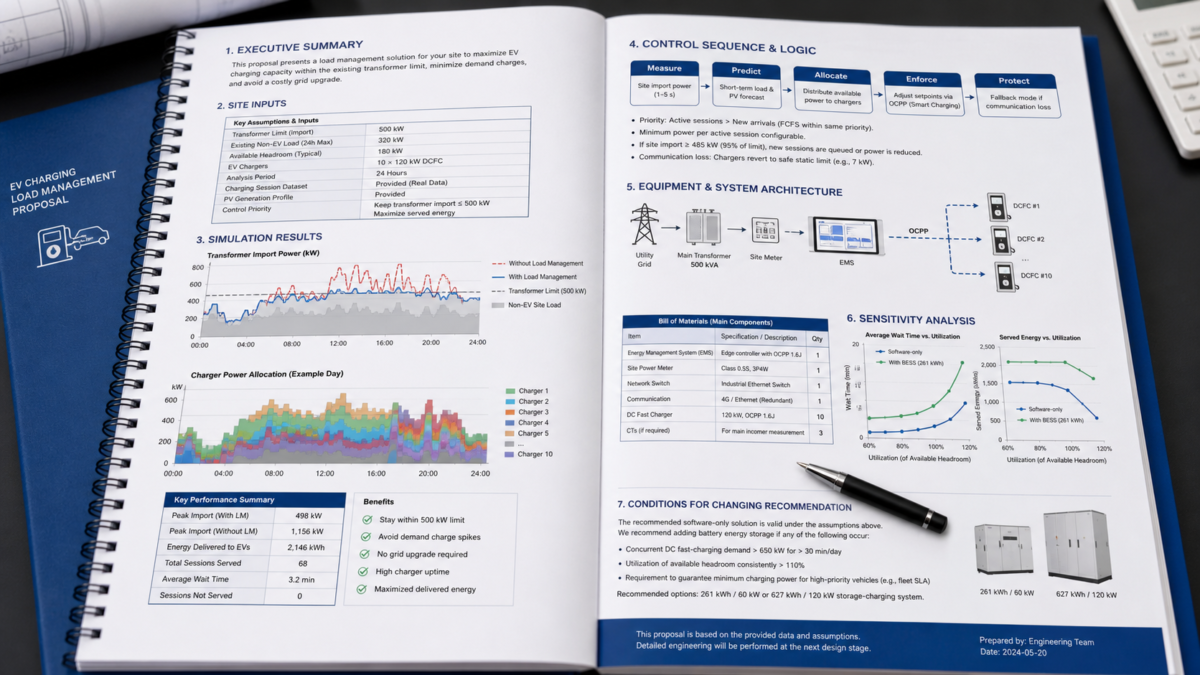
When I review a proposal, I look for evidence, not just claims. A supplier who has done their homework will gladly provide it. First on my checklist is the simulation output I mentioned earlier—graphs showing how their system manages my session data and transformer limits over a 24-hour period. Second, I need to see the bill of materials and the exact control logic. What happens if the internet connection to the EMS goes down? The chargers must have a safe, default behavior. Third, I look for a utilization sensitivity analysis. This shows me how the system's performance (like average wait times or delivered power) changes if my site gets 20% busier or 20% slower than expected. This proves the solution is robust. Finally, the most important part for me is the list of conditions for changing the recommendation. A good engineer will say, "Our software-only solution works for your current projections, but if your concurrent session demand exceeds 'X', we would recommend adding a 261 kWh battery system." This shows they understand the limits of their own design and gives me a clear roadmap for the future.
Conclusion
To evaluate load management, you must define the outcome, identify the constraint that can defeat it, and test any proposed design with real site data. This practical, data-first approach works.

Leave a Reply