

How Should Buyers Respond to Indonesia-belanda Jajaki Proyek Pltb Untuk Produksi Hidrogen Hijau?
That no-upfront battery storage offer looks great on paper. But what if the deal shifts performance and regulatory risk directly onto your project, threatening your green hydrogen production goals?
You should respond by treating any no-upfront storage offer as a complex design and operating decision, not a simple catalogue comparison. I would demand detailed proof of performance, clear service terms, and a transparent risk-sharing plan before committing to a partner for this critical infrastructure.
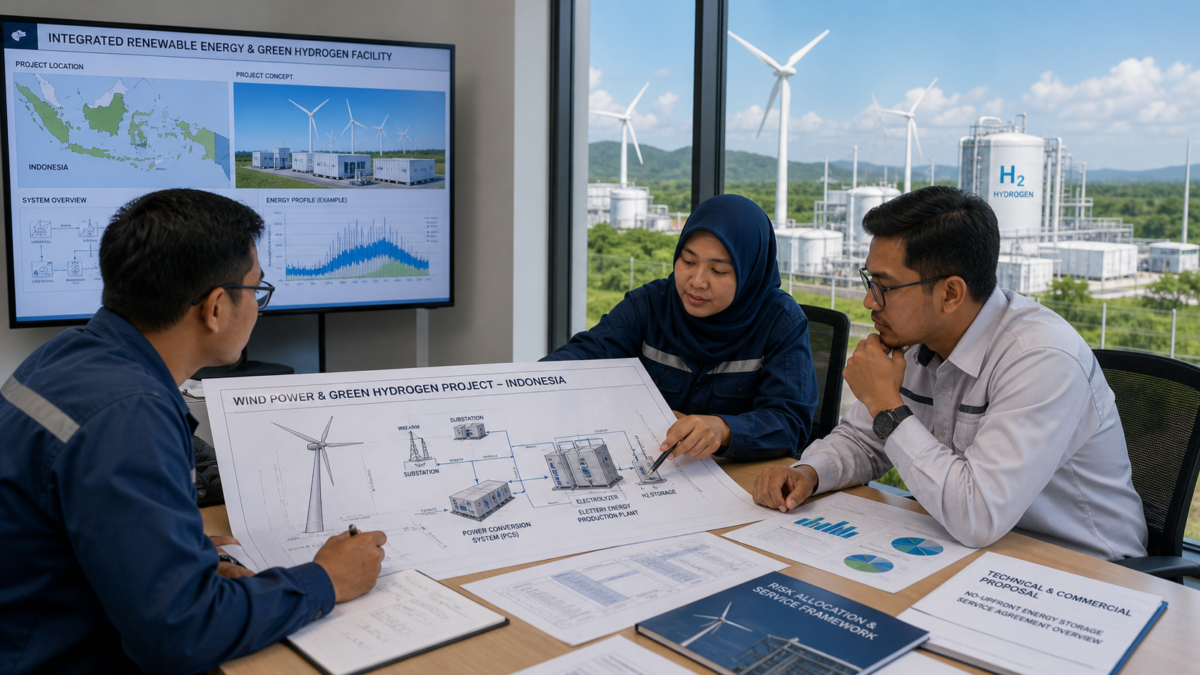
News of Indonesia and the Netherlands exploring a wind power project for green hydrogen production is exciting. It points to a future where large-scale renewable energy drives new industries. Many of these projects will likely involve battery energy storage systems (BESS) to ensure a stable power supply for electrolysis. A popular financing model I see is "no-upfront storage," where you pay a service fee instead of buying the hardware. I've been involved in these kinds of evaluations for years, and they are never as simple as they seem. This model transfers the initial capital cost, but it does not automatically transfer the performance, regulatory, or counterparty risks. Before you can trust the conclusion of any proposal or use it in an RFQ, you need to dig much deeper. This is the level of detail I would insist on.
Why Indonesia No Upfront Battery Storage Is Harder Than It Looks?
You’re trying to de-risk a major project by avoiding a huge capital expense. But the service agreement you sign might have clauses that lock you into poor performance with no easy way out.
This model is harder because the supplier's long-term goals may not match yours. You need constant, reliable power for hydrogen production. They might be focused on meeting minimum contract terms to secure their revenue stream. True partnership requires aligning these goals through a detailed, enforceable service contract.
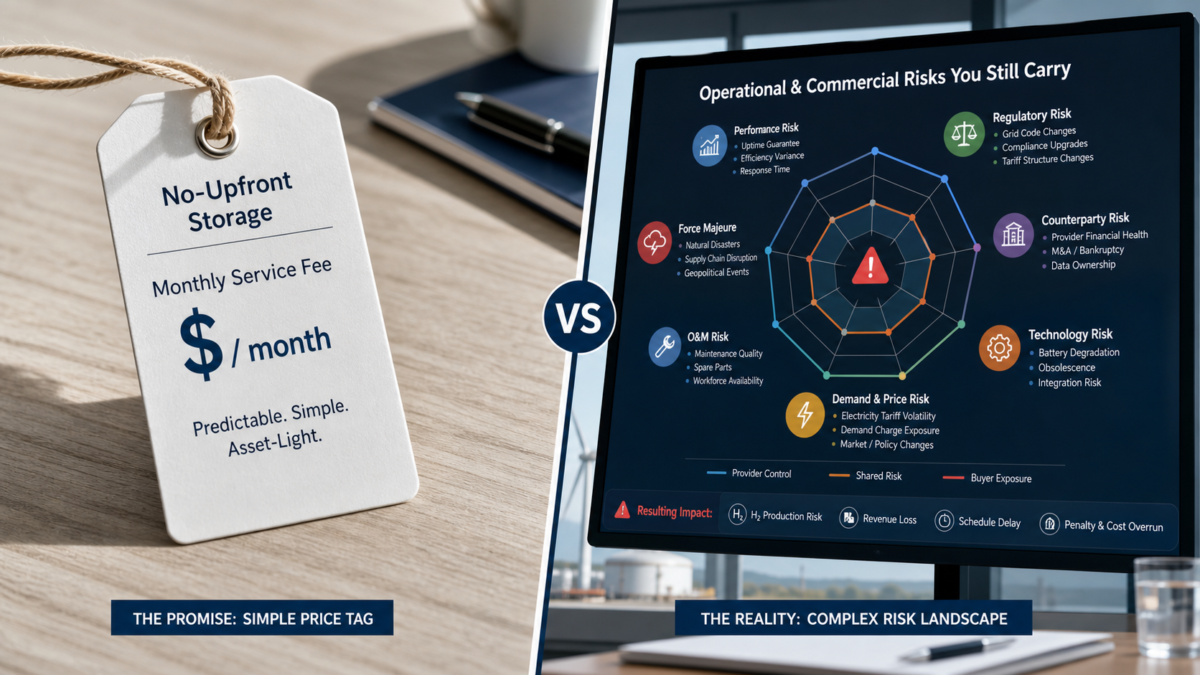
The central issue I always come back to is risk transfer. A "no-upfront" or "energy-as-a-service" model looks attractive because it moves a large capital expenditure (CapEx) item off your balance sheet and turns it into a predictable operating expense (OpEx). But what risks are you actually transferring, and which ones are you keeping? In my experience, the sales pitch focuses on the hardware cost you avoid, but the contract often keeps the most significant operational risks with you, the buyer. You are still exposed to fluctuating energy tariffs, changes in grid regulations, and the financial stability of the provider. If the BESS doesn't perform as promised, your hydrogen plant's output suffers. If the provider goes out of business, your "asset-light" model suddenly leaves you with no asset and a major operational crisis.
Key Risk Categories
I always map out the risks in a simple table to make them visible. This isn't about being negative; it's about being prepared.
| Risk Category | How It Looks in a “No-Upfront” Model | The Hidden Reality I Would Test For |
|---|---|---|
| Performance Risk | The provider guarantees uptime and efficiency. | What are the penalties if they miss targets? Is the M&V system transparent? How quickly must they respond to a failure? |
| Regulatory Risk | The provider handles grid compliance. | Who pays if regulations change and the system needs an expensive upgrade? Is your tariff structure protected? |
| Counterparty Risk | A stable partner manages the asset. | What is the provider’s financial health? What happens if they are acquired or go bankrupt? Who owns the data? |
Treating this as a simple equipment choice is a mistake. It is a long-term operational partnership. You must vet the partner and the contract with the same rigor you would apply to your core production equipment.
The Site Data Needed to Evaluate Indonesia No Upfront Battery Storage?
You want to confirm if a BESS proposal is viable. But using generic data or supplier estimates can lead to an undersized system that fails when you need it most.
To properly evaluate a proposal, you need at least 12 months of your own site-specific, high-resolution data. This includes interval electricity usage, grid voltage and frequency logs, and a clear breakdown of existing electricity tariff components. This data forms the non-negotiable baseline for any serious simulation.
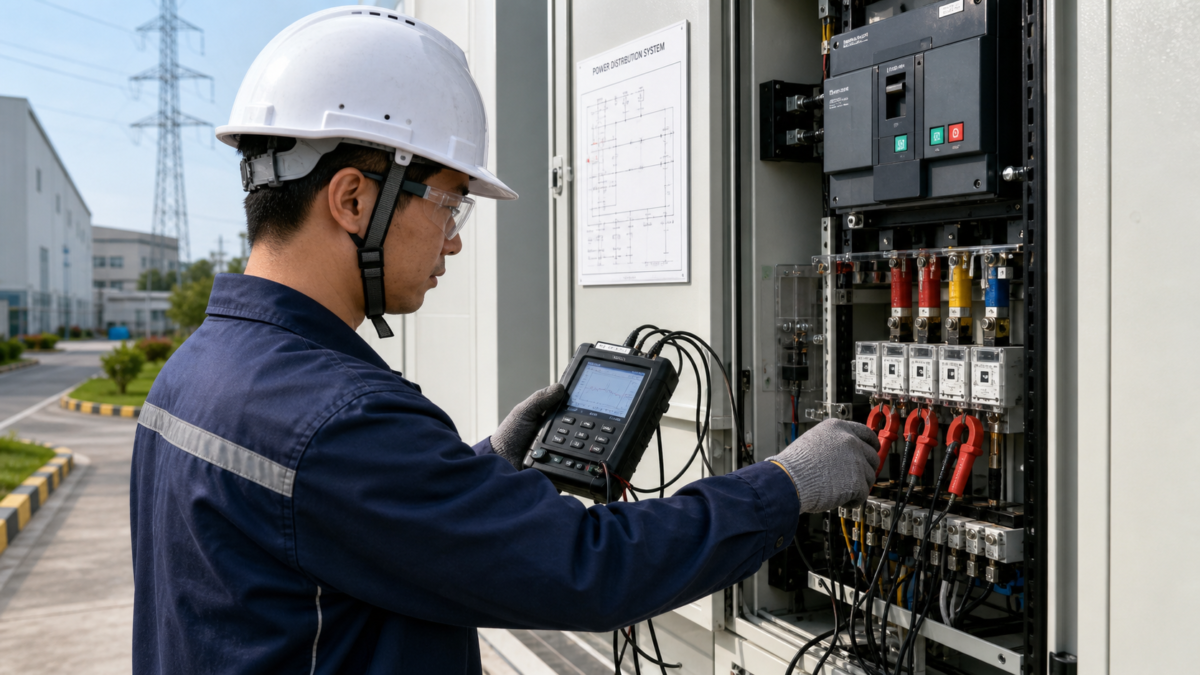
I once saw a project where the proposal was based on average monthly electricity bills. The real-world load profile had huge spikes that the proposed BESS couldn't handle, causing critical failures. The problem wasn't the battery technology; it was the poor data used for the initial design. Before I even look at a supplier's equipment list, I demand a detailed data-sharing agreement. The first step is to establish a shared, undisputed baseline of reality. This isn't just about kilowatts and volts. It's about understanding the commercial environment the system will operate in. For a green hydrogen project in Indonesia, I would focus on the specific PLN tariff structure. Where does the power come from? How are demand charges calculated? What are the penalties for grid instability? You need this information to model the "downside condition" and see what happens financially if the BESS underperforms by 5% or 10%. Without your own verified data, you are relying entirely on the seller's model, and their model is designed to sell you a service.
Which Indonesia No Upfront Battery Storage Assumptions Distort the Result?
The financial model shows fantastic savings over ten years. But these numbers are built on assumptions that might be unrealistic, making the entire projection dangerously optimistic and misleading.
The most distorting assumptions are often related to future electricity prices, battery degradation rates, and service response times. An overly optimistic tariff forecast or an understated degradation curve can make a marginal project look like a huge success. You must stress-test these assumptions.
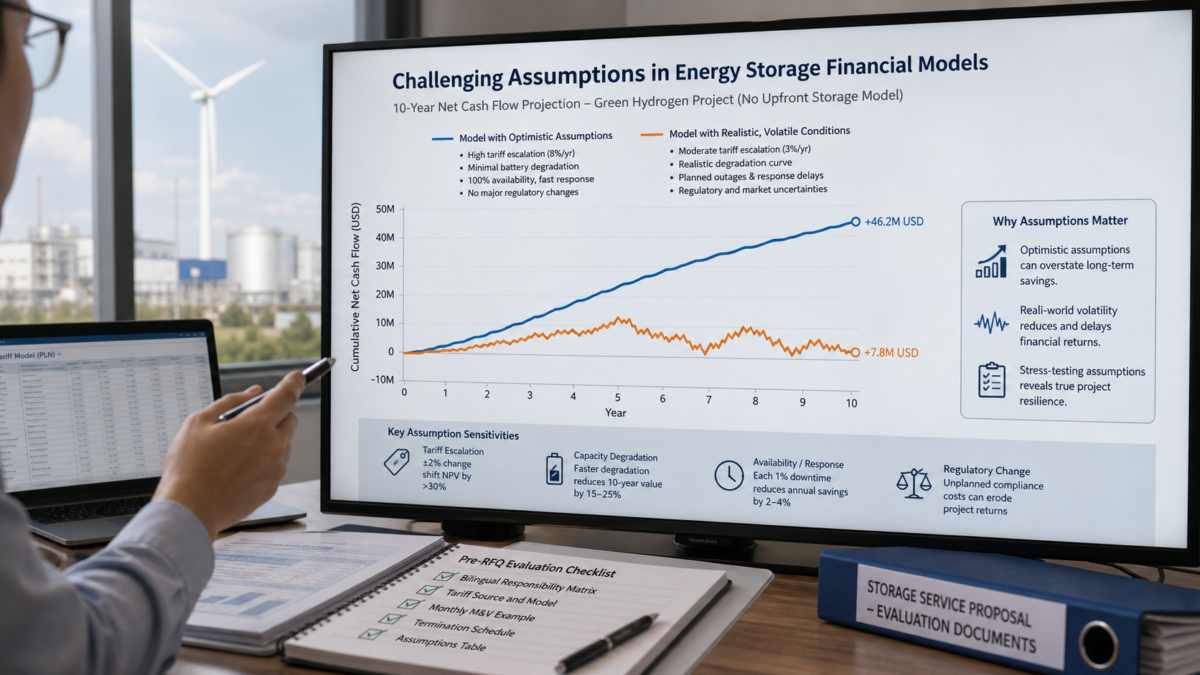
Every financial projection is built on a set of assumptions. The key is to make them visible and test them. In a "no-upfront" storage proposal, the provider makes assumptions to calculate their service fee and your projected savings. Your job is to find them and question them. I always ask for a simple table listing every key assumption. I've found this is the fastest way to understand the quality of a proposal. For instance, what is the assumed annual increase in the grid tariff? A provider might assume a high increase of 8% per year, which makes the savings from their BESS look larger. A more conservative 3% assumption could completely change the business case. Another critical area is battery performance. What is the warranted round-trip efficiency, and how is it measured? What is the guaranteed capacity at year 5 and year 10? These are not just technical details; they are the financial engine of the entire deal. Making these assumptions transparent allows you to see how sensitive the project's success is to each variable.
A Practical Indonesia No Upfront Battery Storage Selection Checklist?
You're ready to move forward but need to compare different offers. How do you cut through the marketing and ensure you're making a safe, reliable, and commercially sound decision?
Use a detailed checklist focused on operational and contractual clarity. This list should force providers to move beyond generic claims and commit to specific deliverables, responsibilities, and performance metrics. This is the only way to compare offers on a true like-for-like basis.
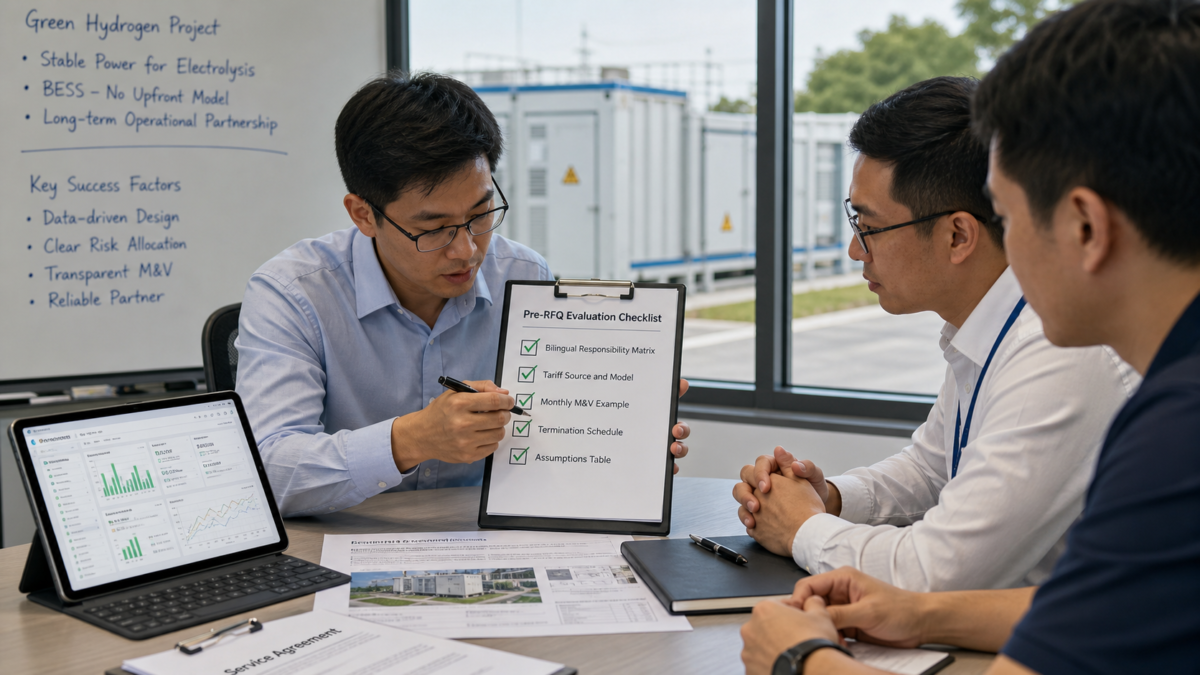
This is the level of detail I would demand before signing any agreement or even putting a provider on a shortlist for an RFQ. This isn't just a list of questions; it's a request for auditable documents that will form the basis of the final contract. For a project in Indonesia, some of these documents, like the responsibility matrix, must be bilingual to ensure total clarity for both local and international teams. When I specify equipment from my company, Moletong, I insist that our offerings are described in the context of a service plan just like this. The hardware is only one part of the solution; the contractual framework that guarantees its performance is what creates the real value. You should ask every potential partner, including us, to provide these items. A provider who is unwilling or unable to provide this level of detail is not a partner you want for a critical, long-term project. This checklist makes the downside visible and shows you which provider is truly prepared to stand behind their promises.
My Pre-RFQ Evaluation Checklist
- Bilingual Responsibility Matrix: Who is responsible for what? Detail every task from installation and commissioning to daily operation, maintenance, and emergency response.
- Tariff Source and Model: Show me the exact PLN tariff schedule you used for your financial model and provide the calculation spreadsheet.
- Monthly M&V Example: Provide a sample of the monthly performance report. It must clearly show how you measure uptime, efficiency, and savings against the agreed baseline.
- Termination Schedule: What are the conditions for ending the contract? Detail the costs, asset transfer process, and data hand-over plan for both early termination and end-of-term.
- Assumptions Table: Provide a simple, one-page summary of all key financial and technical assumptions used in your proposal.
Conclusion
Treat no-upfront storage as an operational partnership. Scrutinize the service contract, M&V plan, and risk allocation with more rigor than the hardware itself to ensure long-term project success.
Leave a Reply