

When Does 4 Hour Solar Battery Storage Make Business Sense?
You hear "4-hour solar battery storage" and think it's the perfect solution. But is it right for your actual business needs? Let's figure out when it truly makes sense.
A 4-hour solar battery system makes business sense when its duration matches your specific goals, like capturing peak energy arbitrage revenue or providing backup for defined periods. It's not a one-size-fits-all solution; its value depends on how well it’s designed for your operational needs.

I've seen too many projects start with a product, like a "4-hour battery," instead of starting with a problem. The conversation immediately goes to product specs, pricing, and availability. But the most important discussion hasn't happened yet. What job does this battery actually need to do? It's like buying a truck because it has a certain size engine without first knowing if you need to haul feathers or lead bricks. The practical lesson I've learned is that we need to flip the conversation. We must begin with the real-world constraints and the outcomes the buyer needs. This approach helps us separate a genuine technical requirement from a poor assumption. Let's dig into how to do that.
What Buyers Often Misunderstand About 4 Hour Solar Battery Storage?
People see "4-hour" on a data sheet and assume it's a guarantee. This misunderstanding leads to systems that fail to perform when it matters most. Let's clarify this.
Buyers often misunderstand that "4-hour" is a nominal rating under ideal conditions. The actual usable duration depends on your load, ambient temperature, and most importantly, how many different jobs the battery is doing at once. Your 4-hour battery might only give you 1 hour of backup if it's already busy.
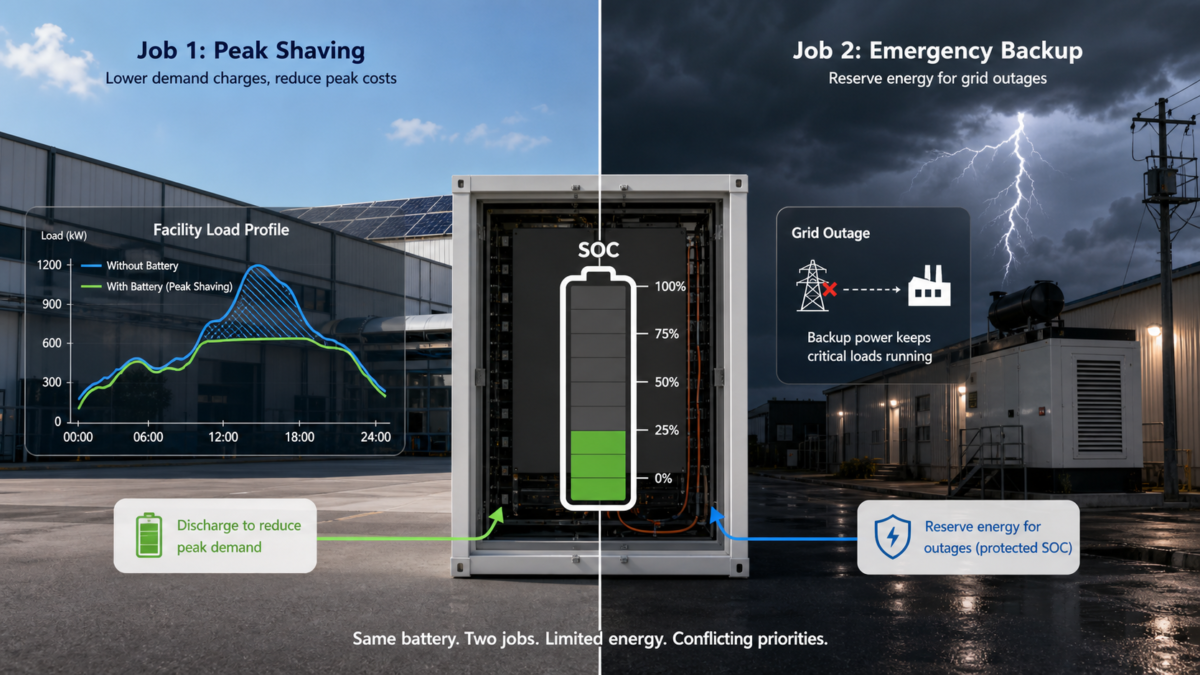
The term "4-hour battery" simply describes the ratio of energy capacity (in kWh) to power capacity (in kW). If a battery has 400 kWh of energy and can discharge at 100 kW, it’s a 4-hour system (400 kWh / 100 kW = 4 h). But this is a lab number. In reality, the system is rarely just sitting there, fully charged, waiting for one single task. It's usually juggling multiple services to maximize its value, and that's where the conflict happens. I've seen customers expect a battery to perform daily peak shaving and also have a full 4 hours of backup ready for an emergency. This is a classic case of what I call State of Charge (SOC) conflict. If the battery uses 70% of its energy to lower your daily electricity bill, you don't have 4 hours of backup left. You have 30% of 4 hours, which is just over an hour.
Understanding Service Stacking and Its Conflicts
To make a battery financially viable, we often "stack" services—using it for more than one purpose. However, these services can compete for the same limited pool of energy. A clear understanding of these potential conflicts is essential.
| Primary Service | Secondary Service | Potential Conflict | Impact on “4-Hour” Promise |
|---|---|---|---|
| Peak Shaving | Emergency Backup | State of Charge (SOC) | The battery may be depleted from peak shaving when an outage occurs, drastically reducing backup duration. |
| Frequency Regulation | Energy Arbitrage | Cycling & SOC | Constant charging and discharging for grid services can leave the battery at a suboptimal SOC for buying or selling energy. |
| Renewable Integration | Demand Charge Management | Dispatch Priority | The system might prioritize absorbing excess solar over discharging to prevent a new demand peak, failing one of its jobs. |
The key takeaway is that multi-service value is only credible when these SOC conflicts and the system's restoration behavior are properly modeled before you buy.
Sizing Around Diesel Constraints and Black Start?
You need your backup system to be completely reliable. But if your battery isn't sized for your existing equipment, it can create a bigger problem than it solves.
Sizing must begin with your toughest technical challenges, like a diesel generator’s minimum load or the power surge needed for a black start. The battery must have enough power (kW) and energy (kWh) specifically reserved for these critical moments, separate from its daily economic tasks.
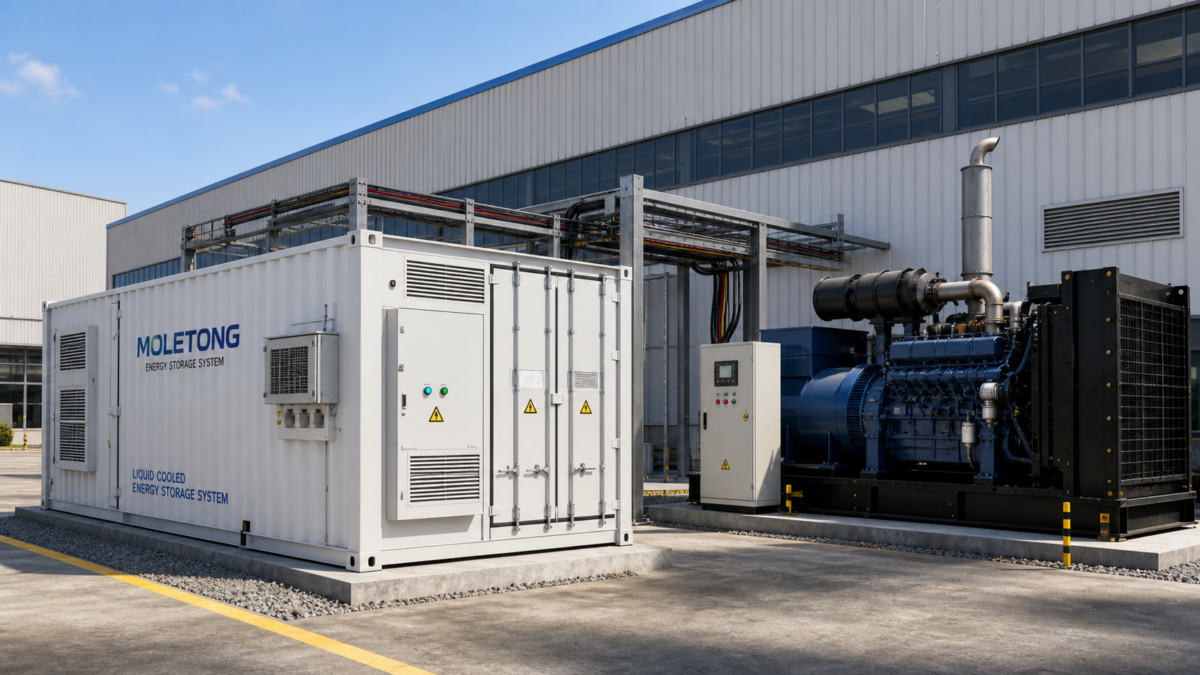
I once worked with a facility that had a large diesel generator for backup. They wanted to add a battery to save on fuel and run more efficiently. The problem was that large diesel generators hate running at low loads. It's inefficient and causes long-term engine damage. The plan was for the battery to handle the low loads, allowing the generator to run only at its optimal output or turn off completely. The mistake they almost made was sizing the battery based on their average load, not the generator's minimum load threshold. We had to resize the battery to ensure it could always absorb the difference between the facility's load and the generator's minimum output. Another critical factor is black start capability. This is the ability to restart your facility from a complete shutdown without any help from the grid. It requires a massive, short-term surge of power to energize transformers and start large motors. A battery sold for "energy" (kWh) may not have enough "power" (kW) to provide that jolt. We must start the design process by asking about these physical constraints, not by picking a product off a shelf.
The Failure Mode Hidden in Service Definition?
You're promised a battery that does everything: it saves money, provides backup, and supports the grid. But without a clear rulebook, these jobs will clash, and the system will fail.
The most common failure mode is not a hardware defect; it's a conflict between services without a defined priority. If peak shaving and backup power are treated as equal, the battery will inevitably fail at one when you need it most. You need a clear dispatch hierarchy.
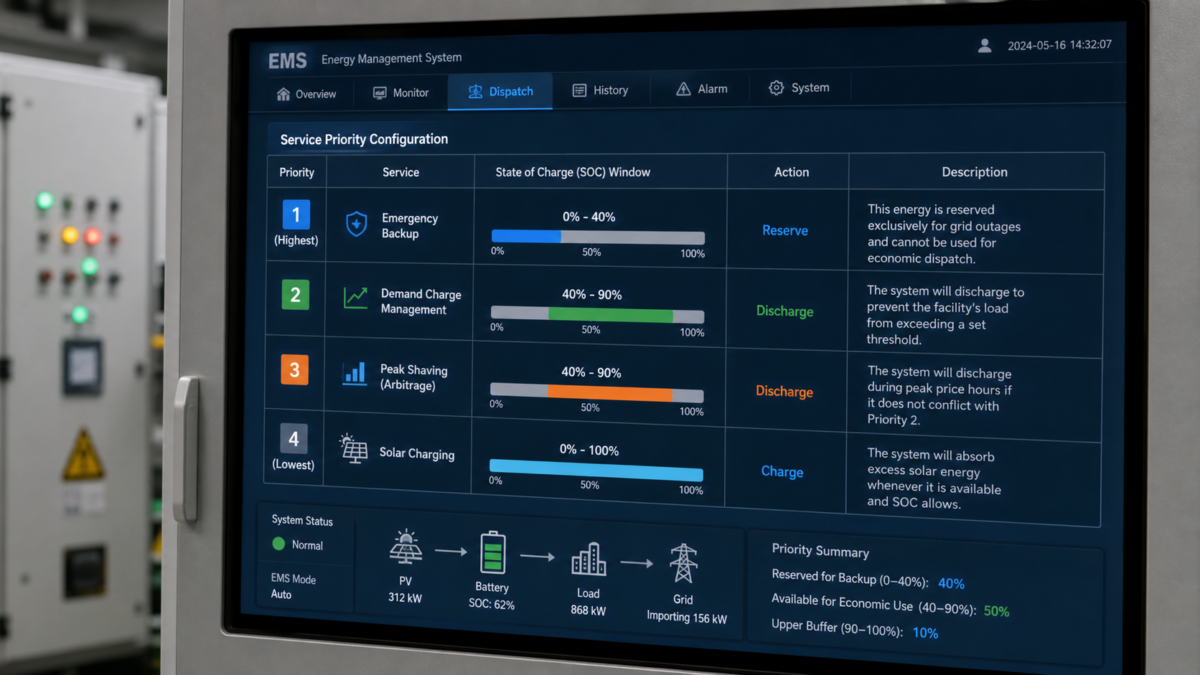
The practical lesson I take from every complex project is that value from multiple services is only real when the rules are clear. Imagine telling an employee to complete two urgent tasks at once. They'll probably do one poorly or freeze. A battery's Energy Management System (EMS) is the same. It needs a strict hierarchy. What is the number one priority? Is it keeping the lights on during an outage? Or is it saving money on demand charges? The two are not always compatible. For my projects with Moletong equipment, I insist on mapping their containerized BESS and EMS to a project-specific controls hierarchy. We build a simple service-priority table that becomes the brain of the system. For example, emergency backup is Priority 1, and we reserve 40% of the battery's State of Charge for it at all times. That energy cannot be touched for any other purpose. Peak shaving is Priority 2, and it can only use the energy between 40% and 90% SOC. This simple logic, defined upfront, prevents the most common failures.
Example Service Priority Table
A clear hierarchy, programmed into the EMS, ensures the battery performs its most critical function without compromise.
| Priority | Service | State of Charge (SOC) Window | Description |
|---|---|---|---|
| 1 (Highest) | Emergency Backup | 0% – 40% | This energy is reserved exclusively for grid outages and cannot be used for economic dispatch. |
| 2 | Demand Charge Management | 40% – 90% | The system will discharge to prevent the facility’s load from exceeding a set threshold. |
| 3 | Peak Shaving (Arbitrage) | 40% – 90% | The system will discharge during peak price hours if it does not conflict with Priority 2. |
| 4 (Lowest) | Solar Charging | 0% – 100% | The system will absorb excess solar energy whenever it is available and SOC allows. |
Key 4 Hour Solar Battery Storage Questions Before Signing the Contract?
You are about to make a major investment. Asking the right technical questions now can save you from a costly system that doesn't meet your real-world needs.
Before you sign anything, ask for proof. Request a dispatch trace showing how the system handles conflicting services. Ask for the specific black start sequence and restoration test procedures. Vague answers to these questions are a major red flag that the system has not been properly engineered for your needs.

A glossy brochure and a data sheet are not enough. The real value is in the control strategy and the proof that it works. I always tell my clients to push past the marketing claims and ask for the engineering evidence. Don't just ask, "Does it provide backup?" Instead, ask, "Can you provide a dispatch trace from your simulation software showing the battery's state of charge during a full 24-hour cycle that includes both peak shaving and a simulated 3-hour grid outage?" This forces the vendor to show you the data. It makes them prove that their control logic works and that SOC reservations are respected. Another critical question is about restoration. Ask, "What is the detailed, step-by-step procedure for a restoration test, and what are the pass/fail criteria?" This turns a vague promise of "backup power" into a concrete, testable deliverable. Asking these tough questions gives you a clear decision path and separates qualified suppliers from those just selling a box. It protects your investment and ensures the system you buy is the system you actually need.
Conclusion
A 4-hour battery is a powerful business tool, but only when applied to the right job. Success comes from defining that job first, based on your technical needs, not just a product label.

Leave a Reply