

What Should Buyers Verify About 25 Year BESS O&M?
A 25-year BESS O&M promise seems to solve your long-term risk. But what if that guarantee is based on conditions that don't match your project, leaving you exposed?
Buyers should treat a 25-year BESS O&M claim as a design decision, not a catalogue item. You must verify its applicability to your exact system, duty cycle, and site conditions using tested models, and make sure the contract has clear remedies for failure.

I see this question a lot. It’s tempting to just look for a supplier who ticks the "25-year" box in an RFQ and move on. But in my experience, that's the fastest way to lock in long-term problems. The real value isn't in the number on the certificate; it's in the proof that the number applies to you. I believe the entire decision-making process needs to change. Instead of asking "Do you offer it?", we should be asking "How do you prove it for my specific case?". The details that follow are how I approach that question for any project I'm involved with.
Why the Obvious 25 Year BESS O&M Answer May Be Wrong?
You found a supplier offering a 25-year warranty, a clear winner. But the fine print invalidates it for your project's high cycle rate, exposing you to massive future costs.
The obvious answer is often wrong because a generic certificate or warranty is based on ideal lab conditions, not your project's real-world duty cycle, climate, or grid events. Critical exclusions and unstated assumptions can make the 25-year claim practically useless, creating major financial risk.
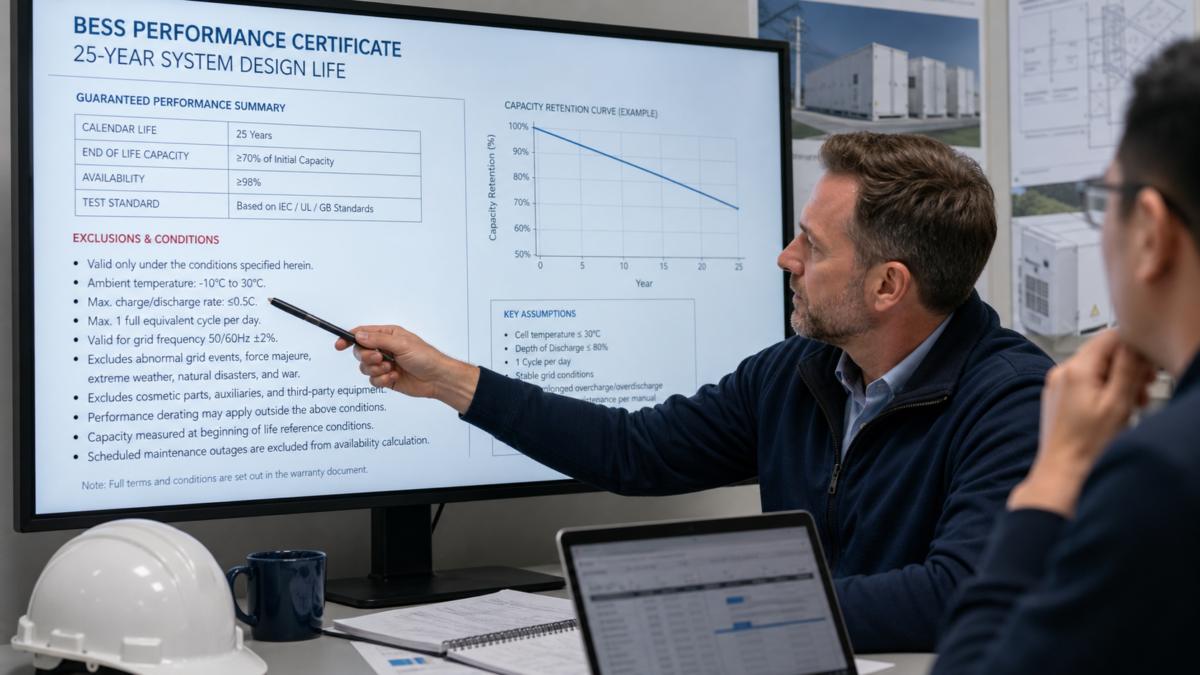
When I first started in this industry, I also thought a certificate was a golden ticket. I was working on a proposal and we were comparing two suppliers. One had a very clear "25-year design life" certificate. The other didn't, but they provided pages of degradation data based on different operating scenarios. The procurement team pushed for the first supplier; it was an easier box to check. I pushed back. I insisted we model both, using our project's expected operating profile.
The results were eye-opening. The "certified" system's guarantee had so many exclusions—around temperature, C-rate, and daily cycles—that it wouldn't have been valid for even a single year of our planned operation. The second supplier's data showed their system would perform reliably for the full term under our exact conditions. We chose the second supplier. That experience taught me to treat a 25-year claim as a hypothesis to be tested, not a fact to be accepted. It's a design and operating decision, not a simple catalogue comparison.
Certificate Claims vs. Project Reality
A certificate proves a component or system can last 25 years under a specific, controlled set of test conditions. It does not prove it will last 25 years under your unique conditions. The gap between these two is where risk lives. I always build a simple table to make this gap visible.
| Factor | Typical Certificate Assumption | What a Buyer Must Verify |
|---|---|---|
| Duty Cycle | Assumes a limited number of cycles per day (e.g., 1 full cycle) at a moderate C-rate. | Provide your actual expected dispatch profile (e.g., 1.7 cycles/day, high C-rate for grid services) and demand a simulation using that data. |
| Operating Environment | Based on a standard temperature like 25°C with minimal fluctuation. | What are the average, minimum, and maximum temperatures at your site? How will performance be derated or guaranteed at these real-world temperatures? |
| Availability | Often states a high percentage (e.g., 98%) but excludes many outage causes. | What exactly is excluded? Are grid outages, scheduled maintenance, or extreme weather events counted against the availability guarantee? |
Separating 25 Year BESS O&M Site Conditions from Equipment Limits?
Your BESS is underperforming after five years. Is it because the equipment is failing, or because the desert heat was never properly accounted for in the original O&M agreement?
You must separate them by contractually defining the equipment's absolute operating limits (e.g., cell temperature, C-rate) and then modeling performance against your site's specific, variable conditions (e.g., ambient temperature, grid instability). The agreement must clarify who bears the risk when site conditions push equipment past its limits.

I once reviewed a project in West Texas where this became a major point of contention. The supplier’s warranty guaranteed performance as long as the internal module temperature didn't exceed a certain limit. The buyer assumed this was the supplier's problem to manage. However, the site’s ambient temperatures were so high that the HVAC system had to run constantly, consuming a huge amount of parasitic power and still struggling to keep the modules within the warrantied range.
The supplier argued the equipment was fine; it was the site's "extreme" conditions that were the issue. The buyer argued the supplier should have designed a thermal management system capable of handling the known climate. The contract was vague, and it led to a long, costly dispute. From that day on, I have always insisted on a clear "Site & Equipment Responsibility Matrix" in any O&M contract. This document explicitly states the expected range for site conditions (like ambient temperature and humidity) and defines the performance guarantee within that range. It also specifies exactly what happens if site conditions go outside that range—is performance derated, is the warranty paused, or is it the O&M provider's job to mitigate it? This simple step avoids so much future trouble.
What Happens When Remedies Is Overlooked?
Your BESS has clearly failed its capacity test at year 10. But your contract is vague on what the provider must do, how quickly, and who pays.
When remedies are overlooked, a performance guarantee becomes an empty promise. You are left with an underperforming, devalued asset and no clear contractual power to force a fix, replacement, or financial compensation. This can destroy your project's economic viability and lead to endless disputes.
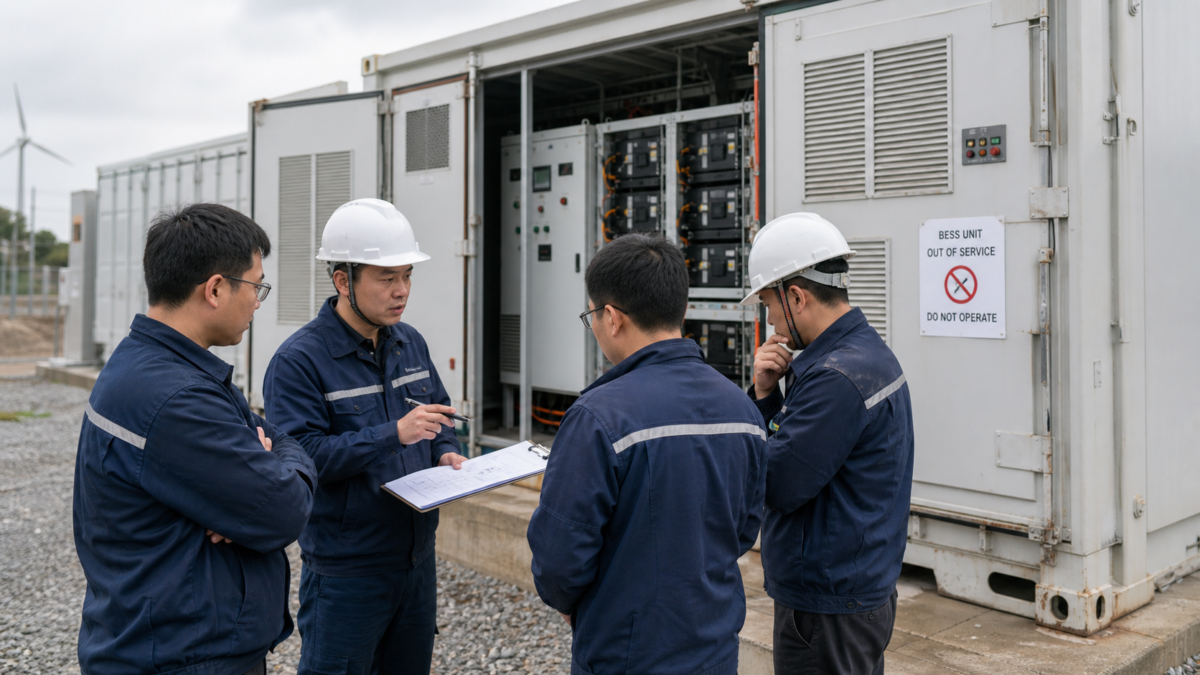
This is the part of the contract I spend the most time on. A guarantee without a remedy is just marketing. I remember a case where an owner had a solid capacity warranty with annual testing requirements. At year seven, the system failed the test. The warranty said the manufacturer would "provide a remedy." That was it. No definition of what the remedy was, no timeline, and no penalties for delay.
The manufacturer dragged its feet for 18 months, arguing about the test data and proposing minor software tweaks. All the while, the project was losing revenue every single day because it couldn't meet its contractual obligations to the grid. The owner finally had to pursue expensive litigation to force the manufacturer to augment the system with new batteries. The lesson is simple: if the consequence for failure is not clearly defined, you can't rely on the promise. The remedy clause must be painfully specific. It should detail the exact steps for re-testing, the timeframe for proposing a cure plan (e.g., 30 days), the options for the cure (augmentation, replacement), and the financial compensation (liquidated damages) you are owed for every day the system remains non-compliant.
A Better Decision Process for 25 Year BESS O&M?
You're facing a stack of proposals, all claiming 25-year lifespans. How do you cut through the noise and find the one that is actually engineered for your project's success?
A better process is to stop treating 25-year O&M as a marketing claim and start treating it as a technical conclusion that needs to be proven. You should build an evidence-based framework using a crosswalk, a warranty model, a deviation register, and an assumptions table.
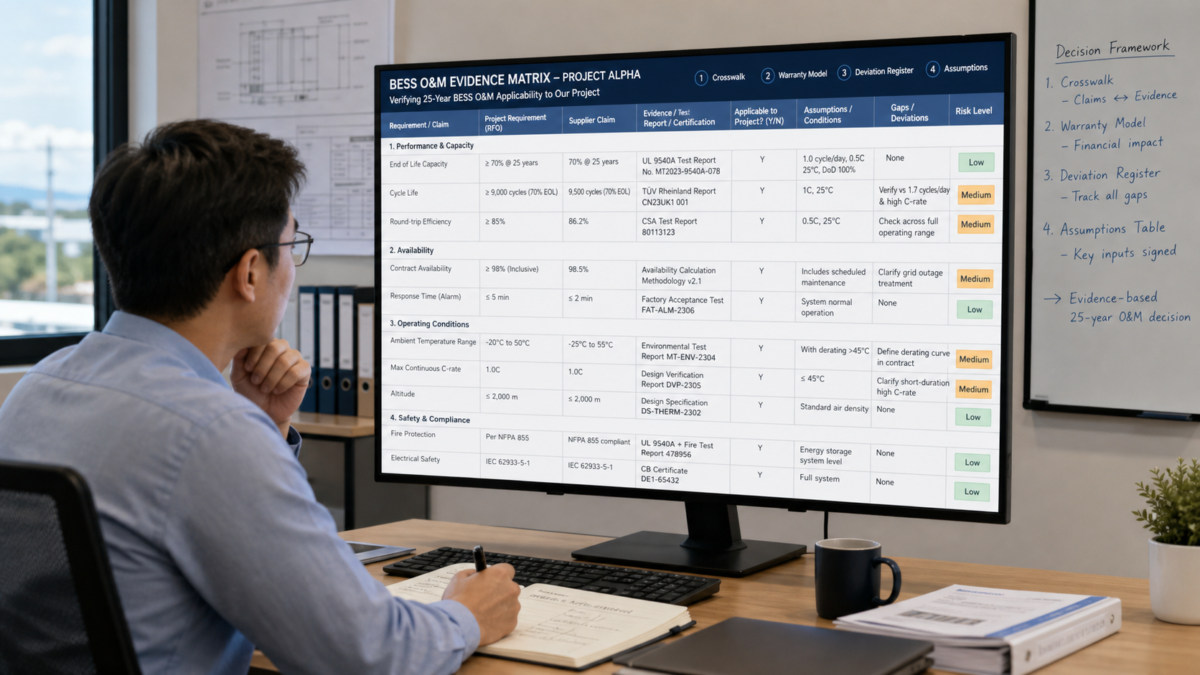
This is the process I use now. Instead of just asking for a certificate, I ask suppliers to populate an evidence file for my specific project. It’s more work upfront, but it completely changes the conversation from sales to engineering. It makes the downside condition visible and forces a discussion about reliability and commercial value, not just catalogue specs.
First, I create a certificate/test-report crosswalk. I list every single performance claim from their proposal in one column, and in the next column, I require them to list the specific, dated test report or certification that proves it. This immediately flags any unsupported claims. Second, I build a warranty model. I take their warranty document and model it financially against our dispatch profile, calculating the potential cost of exclusions, derating, and uncovered failures. Third, I maintain a deviation register. This lists every point where their proposal differs from our RFQ requirements, no matter how small. Finally, I create a short assumptions table that both parties must sign, listing the key inputs like average site temperature and cycles per year. This is the level of detail I need before I can trust a 25-year conclusion or recommend using it as the basis for a multi-million dollar investment.
Conclusion
Treat 25-year BESS O&M not as a promise to be trusted, but as a hypothesis to be tested. Demand project-specific proof before you commit, and define the consequences of failure.


Leave a Reply