

When Does Second Life Battery Energy Storage Make Business Sense?
Second-life batteries promise lower costs but often hide serious risks. This uncertainty can turn a smart investment into a costly mistake. Don't let a low price tag lead you to a high-risk asset.
Second-life battery energy storage makes business sense only when its lifecycle guarantee is backed by a clear measurement method, data owner, and dispute process. This framework allows you to accurately assess cost, performance, and risk based on verifiable data, not just an attractive upfront price.
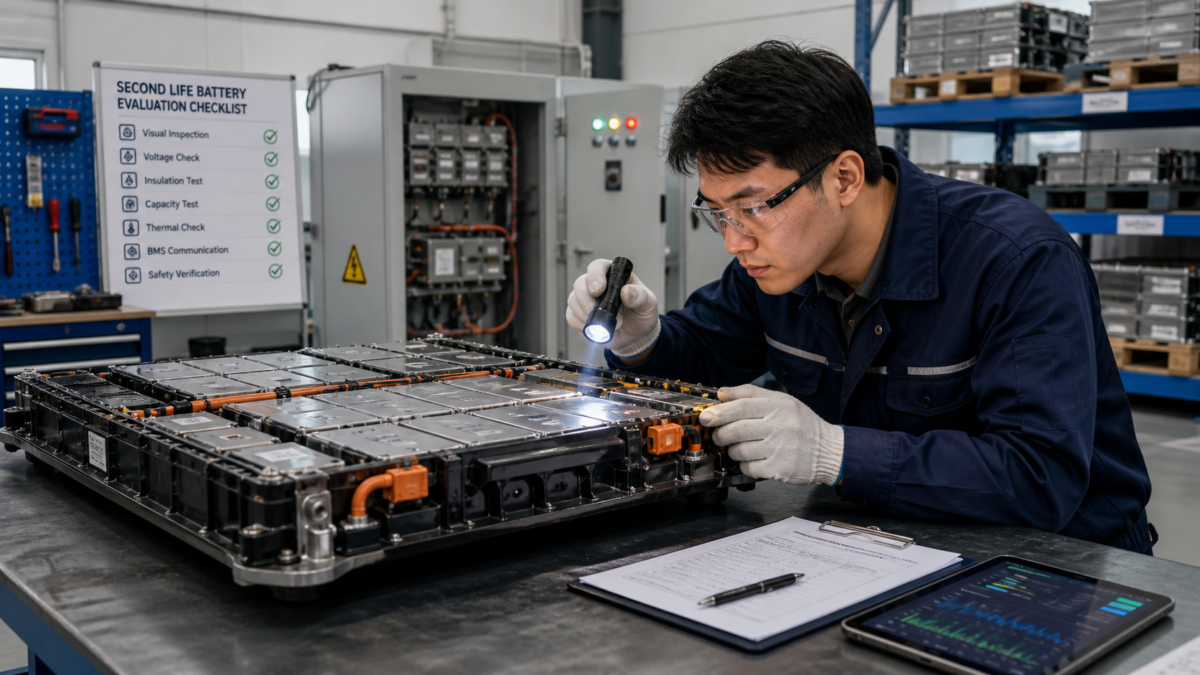
This rule sounds simple, but I’ve seen how easy it is to get this wrong. The details are what protect your investment and separate a successful project from a failure. The only way to judge a second-life system is to stop guessing and start measuring. Throughout my career, I've learned that you can't manage what you don't measure, and this is especially true for an asset that already has a history. Let's break down how to turn this idea into a practical decision-making tool that you can apply to your own projects. This is not about finding a universally "good" or "bad" answer; it's about building a business case with numbers you can actually trust.
How Can You Reframe Second Life Storage as a Measurable Decision?
Guarantees for second-life batteries often feel like vague promises. Without clear, measurable terms, you are exposed to unexpected costs, poor performance, and long downtime. You need a way to turn promises into contractual obligations.
Reframe the decision by treating every performance claim as a contract term. For every guarantee, like cycle life or capacity, you must define the measurement method, who owns the data, and what the dispute resolution process is. This removes guesswork and establishes a clear baseline.
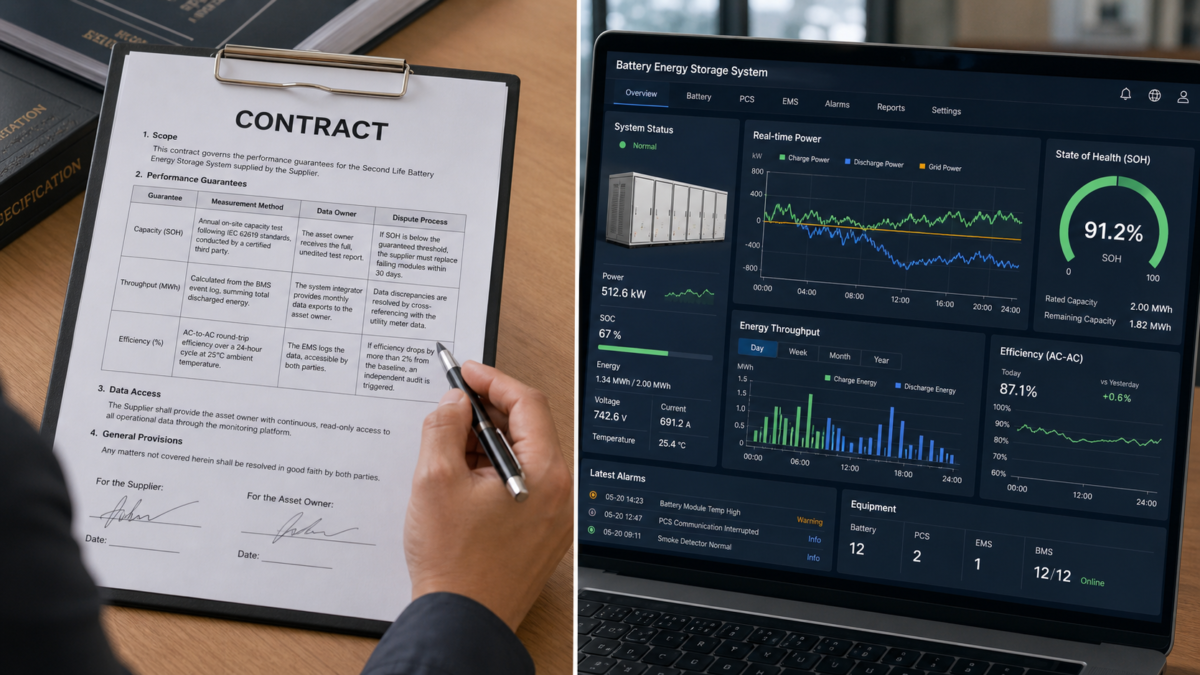
What stands out to me is how often I see a project judged from the wrong number. The focus is always on the low initial price. But the real question is about the lifetime value, and you can't calculate that without clear rules. I insist on one principle: every single guarantee must have a measurement method, a designated data owner, and a pre-agreed dispute process. A supplier might promise "80% State of Health (SOH) after 5,000 cycles," but what does that actually mean? How will SOH be measured? Who performs the test? What data is used? And if the test shows 79%, what happens next? Without answers to these questions, the guarantee is just a marketing slogan. I've seen projects get stuck when performance drops and both parties argue over how to even measure the problem. By defining these things upfront, you turn a vague promise into a number you can track, verify, and hold your supplier accountable for.
| Guarantee | Measurement Method | Data Owner | Dispute Process |
|---|---|---|---|
| Capacity (SOH) | Annual on-site capacity test following IEC 62619 standards, conducted by a certified third party. | The asset owner receives the full, unedited test report. | If SOH is below the guaranteed threshold, the supplier must replace failing modules within 30 days. |
| Throughput (MWh) | Calculated from the Battery Management System (BMS) event log, summing total discharged energy. | The system integrator provides monthly data exports to the asset owner. | Data discrepancies are resolved by cross-referencing with the utility meter data. |
| Efficiency (%) | Measured as AC-to-AC round-trip efficiency over a 24-hour cycle at 25°C ambient temperature. | The Energy Management System (EMS) logs the data, accessible by both parties. | If efficiency drops by more than 2% from the baseline, an independent audit is triggered. |
What Data Is Needed to Evaluate Second Life Storage Without Guesswork?
You're offered a second-life battery system at a steep discount. But the attractive price comes with a hidden problem: you have no idea about its true condition or operating history. Making a decision without this data is a pure gamble.
To evaluate a second-life system, you need a KPI dictionary to define terms, a full event log from its first life, a recent capacity-test result, a parts forecast for replacements, and a chain-of-custody record to prove its origin and handling history.
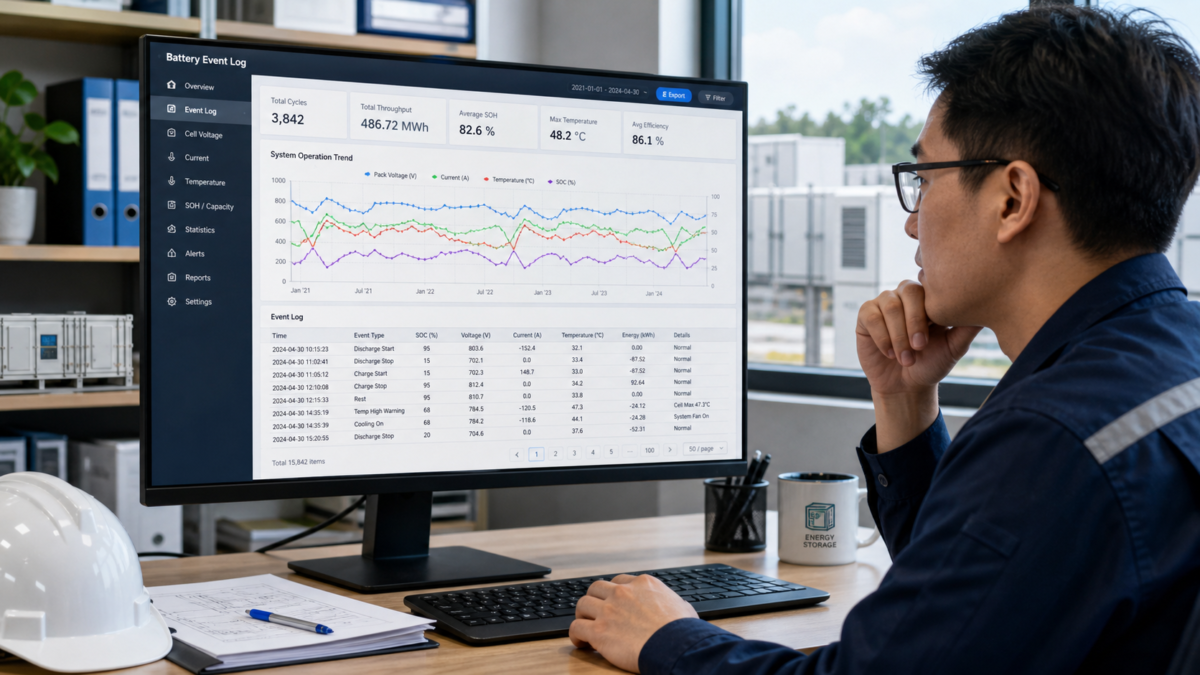
When I evaluate a second-life proposal, I treat it like a detective case. The first thing I ask for is the data, and if the supplier can't provide it, the conversation is over. The "first life" history is everything. For example, I need the complete event log from the vehicle or original application. This log tells me the story of the battery. Did it operate in a hot climate like Dubai or a mild one like San Francisco? Was it constantly fast-charged? These factors dramatically change its remaining useful life. At Moletong, when we look at service records, we can clearly see which assets are better candidates. A battery pack that consistently operated within a 20–40°C range is a much safer bet than one that frequently saw temperatures above 50°C. I also need a recent, verifiable capacity test—not a simple voltage reading, but a full discharge test under controlled conditions. Finally, I ask for the chain-of-custody record. This proves the battery wasn't left sitting in a warehouse for two years, which can be just as damaging as overuse. Without this complete data package, you are simply buying someone else's problem.
How Does Efficiency Change the Risk Profile of Second Life Batteries?
A lower-cost second-life battery looks like a simple way to save money. The problem is that its lower efficiency means you are constantly buying more energy than you can sell, which slowly eats away at your profits over time.
Lower round-trip efficiency directly increases operating costs. For every megawatt-hour you cycle, you lose more energy and money compared to a new system. This hidden cost can easily erase the initial savings, making the second-life option much riskier over its lifetime.
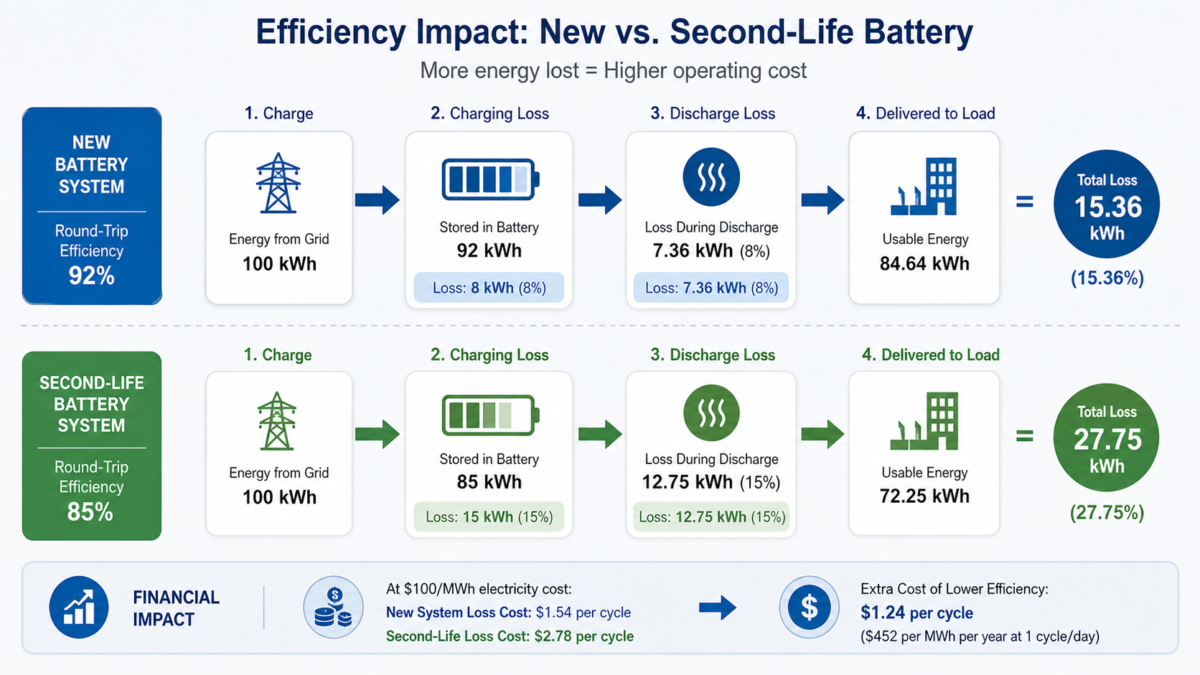
Efficiency is one of the most overlooked variables, but it has a huge impact on the business case. Round-trip efficiency is simply the amount of energy you get out divided by the amount you put in. A brand-new, high-quality lithium iron phosphate system might have a round-trip efficiency of 92% or more. A second-life system might be closer to 85%. That 7% difference sounds small, but let’s do the math. If you buy electricity for $100 per MWh, the new system loses $8 in energy for every cycle. The second-life system loses $15. If you cycle the battery daily, that's an extra $2,555 lost per MWh of capacity each year. I once reviewed a project where the team was excited about saving $100,000 on a 2 MWh second-life system. But they hadn't modeled the lower efficiency. Their operating costs were so much higher that the initial savings were gone in under four years, and the project was unprofitable for the rest of its life. Older cells also have higher internal resistance, which means they generate more heat. This forces the cooling system to work harder, consuming even more energy and further reducing your net efficiency.
What Are the Final Checks Before Approving a Second Life Storage Project?
You have analyzed the data and the financial model looks promising. But what happens when something inevitably goes wrong, like a single module failing two years from now? Without a practical support plan, your asset could become useless overnight.
Before approving, confirm the availability and cost of spare parts, especially for unique modules and the BMS. Clarify the warranty terms for a system with parts from multiple sources, and verify the supplier has documented experience integrating and servicing second-life batteries.
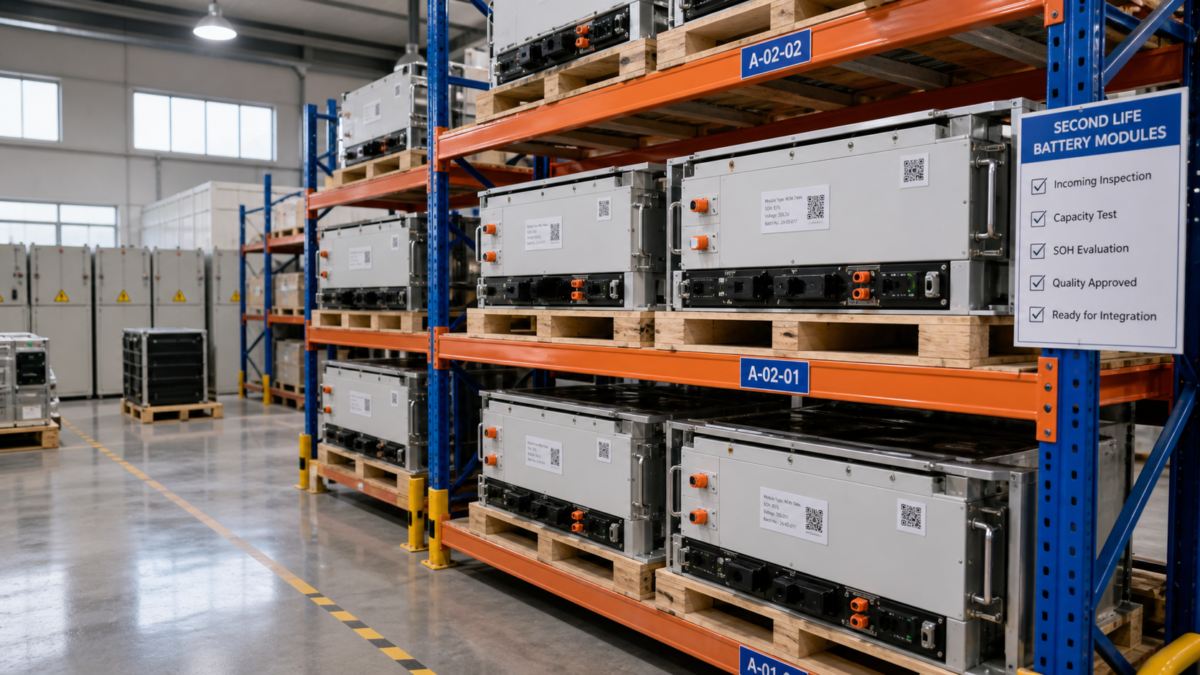
The final checks are all about practicality. The first question I ask is about spares. In a second-life system built from old EV packs, modules are not always interchangeable. If one module fails, can you get a replacement? And more importantly, can you get one with a similar state of health and degradation level? Mixing a new module with old ones can unbalance the entire string and cause even more problems. You need a clear parts forecast and a supplier who can guarantee the availability of compatible replacements. Next is the warranty. A second-life system is often a mix of components: batteries from one company, an inverter from another, and a BMS from a third. Who is responsible when something fails? I’ve seen customers get caught in a finger-pointing battle between suppliers. You need a single point of responsibility for the entire system's performance. Finally, I look at the supplier’s track record. Have they actually built and operated second-life systems before? I ask to see performance data from their existing projects, not just marketing materials. At Moletong, our experience with complete electrical equipment gives us an edge because we understand that integrating a battery is about more than just the cells; it's about making the entire system work together reliably.
Conclusion
Second-life batteries can work, but only when you shift from a price-based guess to a data-driven decision. Demand the data, define the terms, and measure everything to succeed.
My Role
About me
Brand Name: Moletong
Slogan: Carbon Neutrality, Tracking the Future
Website: www.moletong.com
Company Overview
Established in 2011 and headquartered in Dongguan, Guangdong, we are an integrated new-energy equipment enterprise specializing in energy storage systems, complete electrical equipment, photovoltaic solutions, charging infrastructure, and hydrogen-energy solution integration.
We integrate R&D, manufacturing, sales, system configuration, and technical service to support utility-scale, commercial and industrial, and residential energy applications. Our solutions are designed around practical customer needs such as peak shaving and valley filling, electricity-cost optimization, transformer-capacity support, emergency backup, renewable-energy integration, intelligent energy management, and photovoltaic-storage-charging coordination.
Our Core Business
1. Energy Storage Systems & Equipment
We develop lithium iron phosphate energy-storage products for utility-scale, commercial and industrial, residential, and integrated charging applications. Our documented portfolio includes liquid-cooled containerized energy-storage systems, commercial and industrial storage cabinets, residential battery systems, storage-and-charging systems, BMS, PCS, and EMS functions.
2. Complete Electrical Equipment
We provide complete high- and low-voltage electrical products, including gas-insulated ring-main units, high-voltage switchgear, low-voltage withdrawable and fixed switchgear, power-distribution cabinets, meter boxes, box-type substations, charging-station substations, and busbar-trunking systems.
3. Photovoltaic & Integrated Energy Solutions
We provide photovoltaic supporting equipment and system solutions, including 35 kV step-up substation equipment, photovoltaic combiner cabinets, adjustable mounting structures, photovoltaic-storage integration, and equipment support for grid connection, power transmission, and microgrid applications.
4. Charging & Hydrogen-Energy Solution Integration
We provide AC and DC charging solutions, storage-and-charging systems, and photovoltaic-storage-charging integration for industrial parks, commercial parking facilities, transport hubs, and locations with limited grid or transformer capacity. We also develop hydrogen-energy integration concepts involving renewable hydrogen production, hydrogen storage, refueling, and hydrogen-electric coupling. Specific hydrogen products, certifications, production capacity, and completed projects must be confirmed separately.
Product Applications & Technology Focus
Primary Service Industries:
Our principal customer sectors include Industrial and Commercial Energy Users, Renewable-Energy Developers, Power and Electrical Engineering, EV Charging Infrastructure, Commercial and Public Facilities, and Residential Energy Storage.
Product Categories We Serve:
- Utility-Scale Containerized Energy-Storage Systems
- Commercial and Industrial Energy-Storage Cabinets
- Residential Energy-Storage Batteries and Inverters
- Integrated Storage-and-Charging Systems
- High- and Low-Voltage Switchgear
- Box-Type Substations and Charging-Station Substations
- Busbar-Trunking and Power-Distribution Products
- Photovoltaic Step-Up and Combiner Equipment
Technology Expertise:
Our documented technical focus includes:
Lithium Iron Phosphate Cells, BMS, PCS, EMS, Liquid Cooling, Natural Cooling, Modular System Integration, Remote Monitoring, Load Tracking, Anti-Reverse-Flow Control, Transformer-Capacity Protection, and Intelligent Operation and Maintenance.
Production Capacity & Equipment
Energy Storage Production & R&D Platform
Our supplied corporate materials identify one production base in Dongguan and a Dongguan engineering R&D center. We support product development, equipment manufacturing, system configuration, and technical service for residential, commercial and industrial, and large-scale energy-storage applications.
- Product Platform Highlights: 5,015 kWh liquid-cooled containerized storage systems, 627 kWh and 261 kWh commercial and industrial storage cabinets, 16 kWh residential battery systems, and 261 kWh and 627 kWh integrated storage-and-charging systems.
Electrical Equipment Platform
We provide product design and manufacturing support for complete electrical assemblies used in industrial facilities, commercial buildings, substations, photovoltaic projects, charging stations, and public infrastructure.
- Equipment Highlights: High-Voltage Ring-Main Units, High-Voltage Metal-Clad Switchgear, Low-Voltage Withdrawable Switchgear, AC Low-Voltage Switchgear, Distribution Cabinets, Box-Type Substations, Prefabricated Charging-Station Substations, and Busbar-Trunking Systems.
Energy Storage & Electrical System Capabilities
General Capabilities:
- Application and electricity-use requirement analysis
- Energy-storage system selection and capacity configuration
- Equipment design and manufacturing
- BMS, PCS, and EMS system integration
- Peak shaving, valley filling, and time-of-use energy scheduling
- Load tracking and anti-reverse-flow control
- Transformer-capacity protection and demand management
- Photovoltaic-storage and storage-charging integration
- Remote installation, commissioning, and trial-operation support
- Operator training, warranty service, and technical after-sales support as contracted
Our Core Specialties:
- ✔️ Liquid-Cooled Large-Capacity energy-storage systems
- ✔️ Commercial & Industrial peak-valley and backup-power solutions
- ✔️ Integrated Photovoltaic-Storage-Charging applications
- ✔️ Complete Electrical Distribution equipment and system coordination
Quality Control & Certifications
We apply quality, environmental, and occupational health and safety management requirements to the design, manufacture, and sales of our documented product scope.
Quality Management Scope:
The supplied qualification materials show ISO management-system certificates and patent certificates held by Moletong. The product manuals separately define model-specific electrical parameters, monitoring functions, protection requirements, cooling methods, fire-protection configurations, operating environments, and technical-service conditions.
Testing & Protection Focus:
- Cell voltage, current, temperature, and operating-status monitoring
- Overcharge, over-discharge, overtemperature, and abnormal-condition protection
- Liquid-cooling or natural-cooling verification according to product model
- Fire-protection configuration according to product type
- Enclosure protection, corrosion resistance, and operating-environment requirements
- BMS, PCS, EMS, and communication-function verification where applicable
Certifications & Compliance:
- ISO 9001 Quality Management System
- ISO 14001 Environmental Management System
- ISO 45001 Occupational Health and Safety Management System
- Invention Patent and Utility Model Patent Certificates
- Selected product models list IEC 62619, UN 38.3, RoHS, EN 61000 series requirements, GB/T 36276, CCC, and relevant IEC/GB electrical standards
Certification scope varies by product model, configuration, destination market, and certificate validity period. Model-specific certificates must be confirmed before any formal compliance claim.
Target Markets & Partnership Models
Who We Serve:
- Industrial Facility Owners: Plant managers, energy managers, facility managers, and procurement teams at factories or industrial parks seeking peak-valley electricity-cost optimization, demand management, transformer-capacity support, or emergency backup power
- Renewable-Energy Developers: Project developers, engineering managers, and procurement teams for photovoltaic or wind projects requiring energy storage, step-up equipment, electrical distribution, or renewable-energy integration
- EPC & Electrical Contractors: Project managers, technical managers, and equipment-purchasing teams at qualified engineering companies requiring packaged energy-storage or electrical equipment with technical coordination
- Charging-Station Developers & Operators: Investment, construction, and operations teams working on sites with limited grid access, insufficient transformer capacity, high peak demand, or photovoltaic-storage-charging requirements
- Energy Service Companies & System Integrators: Solution designers and project-development teams building commercial and industrial energy-management, microgrid, or distributed-energy projects
- Residential Storage Distributors & Installers: Importers, distributors, wholesalers, and qualified installers requiring lithium iron phosphate batteries, off-grid or hybrid inverters, and residential storage configurations
- Commercial & Public-Facility Owners: Property, engineering, and facility-management teams for commercial buildings, schools, hospitals, hotels, parking facilities, and transport locations requiring reliable power distribution, charging, or backup-energy solutions
Target Geographies:
Our home market is China, supported by regional sales coverage for South, East, Central, and Southwest China. The supplied 2026 catalogue also identifies an overseas office in Indonesia, supporting practical market development in Southeast Asia. Other overseas markets are served only after confirming model-specific certification, grid requirements, shipping conditions, and local installation standards.
Types of Cooperation:
- Equipment Supply: Standard or configured energy-storage and electrical products
- System Configuration: Product selection and capacity configuration based on the customer's application
- System Integration: BMS, PCS, EMS, photovoltaic, charging, and electrical-system coordination
- Project Technical Cooperation: Technical coordination with renewable-energy developers, EPC contractors, and qualified local engineering companies
- Integrated Energy Solutions: Photovoltaic-storage, storage-charging, and photovoltaic-storage-charging applications
- Technical Service: Training, remote installation and commissioning support, warranty, and after-sales service as agreed in the commercial contract
Our Core Competitive Advantages
⭐ Integrated New-Energy Product Portfolio
By combining energy-storage systems, complete electrical equipment, photovoltaic supporting products, charging applications, and intelligent energy-management functions, we can configure solutions around the customer's complete power-use scenario.
⭐ Coverage from Residential to Utility Scale
Our documented energy-storage range extends from 16 kWh residential systems to 261 kWh and 627 kWh commercial and industrial systems and a 5,015 kWh containerized system.
⭐ Application-Oriented System Design
Our solutions address identifiable operating needs, including peak-valley arbitrage, demand management, transformer-capacity constraints, backup power, renewable-energy consumption, and charging-station power support.
⭐ Integrated Control & Safety Architecture
Our storage products combine lithium iron phosphate cells with BMS, PCS, EMS, model-specific thermal management, multi-level protection, intelligent monitoring, and remote operation and maintenance functions.
⭐ Regional Sales & Technical Service Support
With a Dongguan headquarters and engineering center, regional sales coverage in China, and an overseas office identified in Indonesia, we support equipment selection, technical coordination, training, remote commissioning assistance, and contracted after-sales service.
Leave a Reply