

Where Does 20ft vs 40ft BESS Container Create the Greatest Risk?
Choosing between a 20ft and 40ft BESS container seems like a simple density calculation. But this decision can introduce risks that silently undermine your project’s financial model and operational reliability.
The greatest risk comes from ignoring the operational reality behind the datasheet. A container's rated MWh is meaningless without confirming its net deliverable energy, which is heavily impacted by site-specific auxiliary loads (like HVAC), serviceability, and real-world round-trip efficiency. These factors can easily reverse an apparently obvious choice.
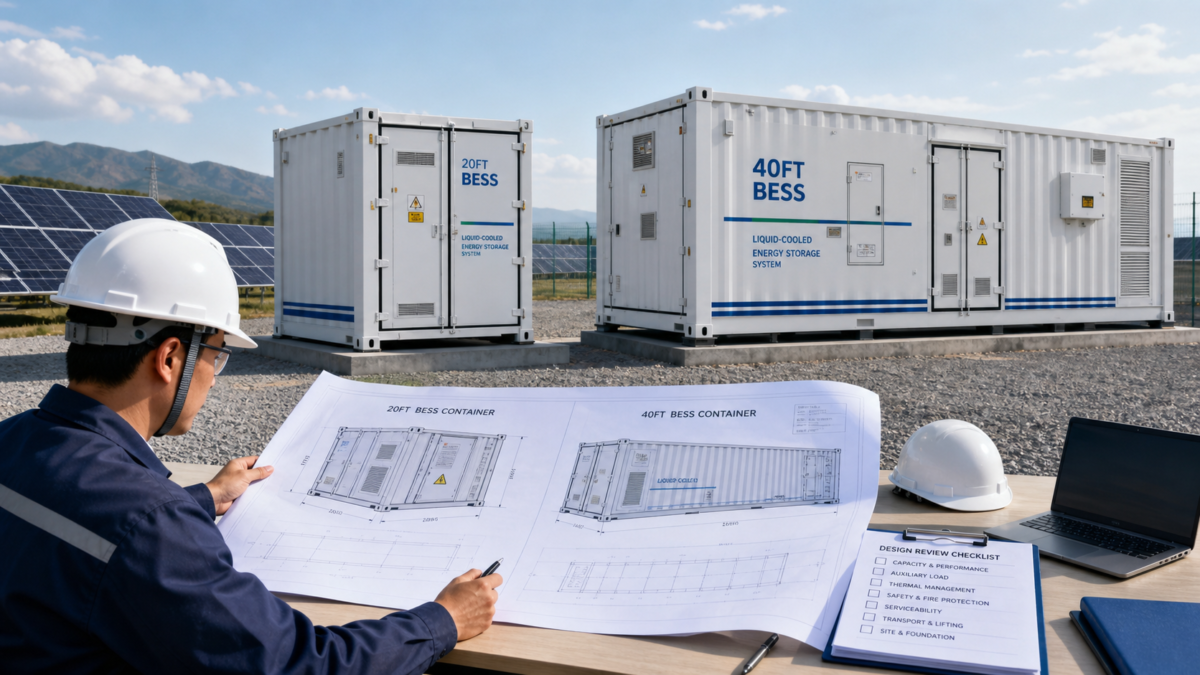
My approach to this question is simple. I define the required outcome, identify the constraints that can defeat it, and test the design with real site inputs. When I look at a 20ft vs. a 40ft container, I see more than just a steel box with batteries inside. I see a complex system where seemingly small details can have a huge impact on profitability. Focusing only on the initial capital cost or the MWh per square foot is a common mistake.
The real challenge is to understand how the container will perform over 20 years in your specific location, under your specific operating conditions. That's where we need to dig deeper than the marketing materials and look at the engineering trade-offs that were made. Let's break down where the real risks are hiding.
The Operational Reality Behind 20ft vs 40ft BESS Container?
You’ve calculated your project’s required capacity and found a container that fits. But what if the energy it delivers is consistently less than what you paid for, day after day?
The operational reality is that the physical footprint directly influences long-term performance and costs. A 40ft container often allows for a more efficient, centralized thermal management system and better service access, while two 20ft containers might offer layout flexibility but with potentially higher cumulative auxiliary loads.
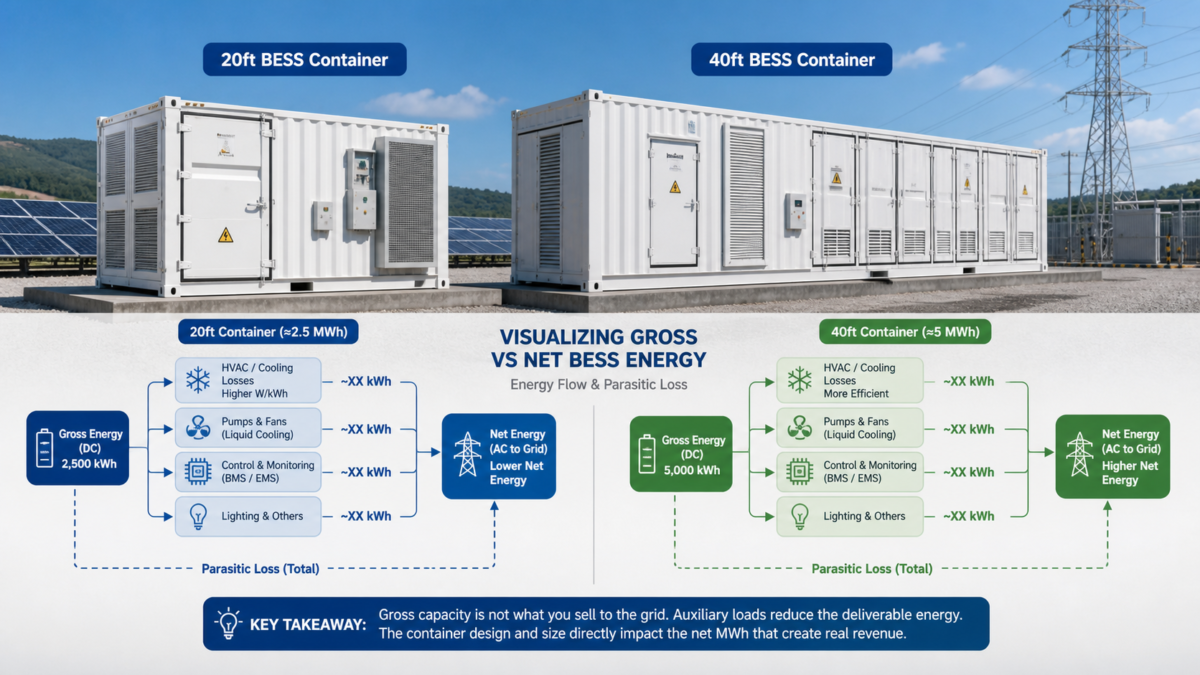
When I evaluate a container, my first step is to build a gross-to-net energy bridge. The number on the datasheet is the gross MWh. The number that makes you money is the net MWh delivered to the grid. The difference between these two is eaten by losses, primarily the auxiliary systems needed to keep the container operating safely. I've seen projects where the difference was much larger than the developer modeled, which directly hurt their revenue. For example, a 5 MWh container that consumes 50 kWh per cycle on its own systems is only delivering 4.95 MWh. This might seem small, but over thousands of cycles, it adds up to a significant financial impact. The physical size of the container plays a huge role here.
Gross-to-Net Energy Bridge Comparison
| Factor | 20ft Container (e.g., 2.5 MWh) | 40ft Container (e.g., 5 MWh) | My Key Question |
|---|---|---|---|
| Gross Capacity | 2,500 kWh | 5,000 kWh | Is this number based on ideal lab conditions? |
| HVAC & Cooling Load | Higher W/kWh due to less efficient, smaller units. | Often more efficient with a single, larger system. | What is the consumption at my site’s peak temperature? |
| Control & Monitoring | Standard load for controllers, BMS. | Similar load, but spread over more batteries. | What is the idle load when not cycling? |
| Net Deliverable Energy | Gross – Losses = Lower net energy. | Gross – Losses = Potentially higher net energy. | What is the guaranteed net MWh at handover? |
A 40ft container isn't always better, but it forces a different design conversation. It allows for more integrated systems, which can be more efficient. Two 20ft containers, on the other hand, double up on certain components, which can increase the parasitic load. You have to model this based on your site's climate and operating profile to see which one truly delivers a better return.
Why Auxiliary Load Changes the Design?
You’ve chosen a container with high energy density to save space. But what if the power needed to cool that dense system consumes a huge chunk of your stored energy?
Auxiliary load, especially the HVAC system, is a critical design driver that can reverse the benefits of higher density. A densely packed 20ft container may require a disproportionately powerful and energy-intensive HVAC system compared to a less dense 40ft design, directly reducing your project’s round-trip efficiency.
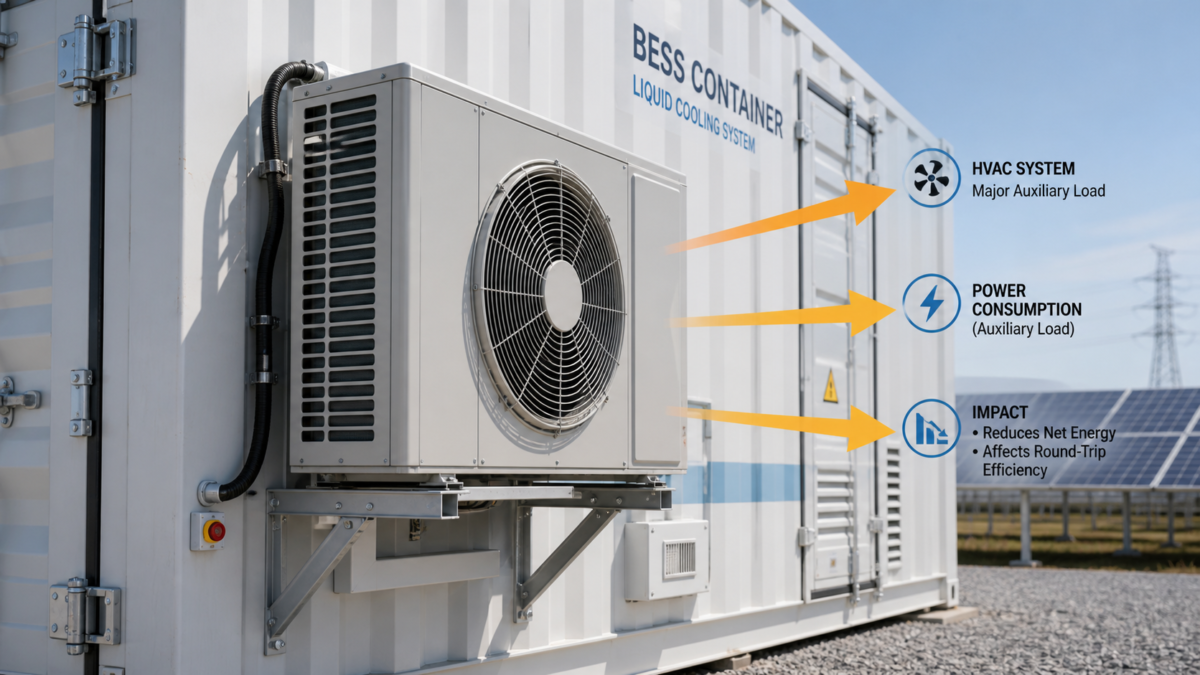
I always focus on the auxiliary load because it’s a constant operational cost. It's the "tax" you pay on every kWh you cycle. This is especially true for liquid-cooled systems, like the Moletong 5 MWh container. While liquid cooling is extremely effective at managing heat from dense battery racks, it comes with its own auxiliary load: the pumps and chillers. The design question then becomes, how efficient is that cooling system? In a 40ft container, designers have more room to install a larger, more efficient chiller and optimize the pipe runs. In a cramped 20ft container, they might be forced to use less efficient components or make compromises that increase the power draw. I insist on seeing a full list of auxiliary loads and their power ratings during the design review. This isn't just about the HVAC; it includes the BMS, EMS controllers, lighting, and any other powered device.
Auxiliary Load Breakdown
Here’s a simplified list of what I would check for a 5 MWh system, whether it’s in one 40ft container or two 20ft containers.
- HVAC/Chiller Unit: The biggest consumer. I need to see the power rating and the thermal model for my site.
- Coolant Pumps: For liquid-cooled systems, these run continuously. What is their consumption?
- BMS/EMS Controllers: Always on. It's a small but constant drain.
- Sensors and Monitoring: Fire suppression, leak detection, etc.
- Internal Lighting: Only used during maintenance, but it’s part of the system.
- Transformer Losses: If the auxiliary power transformer is part of the container package, its efficiency matters.
The total of these loads is your parasitic loss. If a manufacturer can't give you a clear, guaranteed number for this based on your site's temperature profile, it's a major red flag. This data is more important than the headline MWh figure.
Balancing Performance, Safety, and Serviceability in 20ft vs 40ft BESS Container?
A container packed with the maximum possible MWh looks impressive. But what happens when a technician needs to replace a faulty module in the middle of the night?
The critical balance is between energy density and human factors. A 40ft container often provides wider, safer service aisles. This improves serviceability, reduces maintenance time, and lowers the risk of accidents. A hyper-dense 20ft design can turn a simple repair into a complex, time-consuming task.
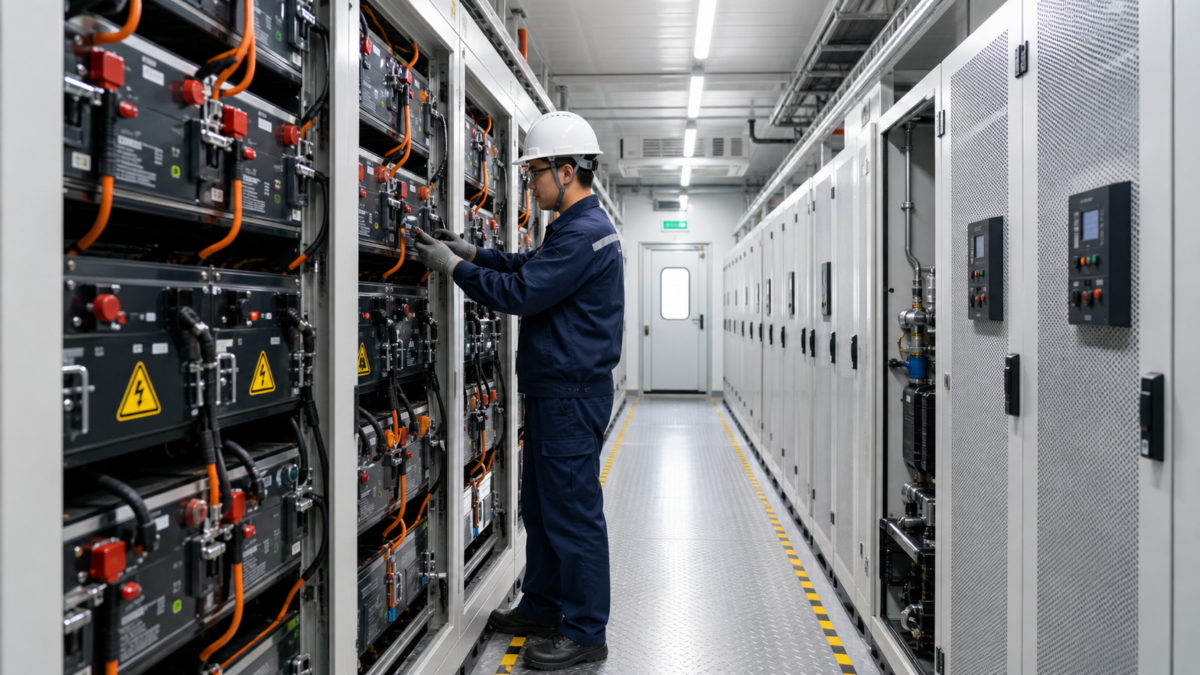
I’ve walked through enough BESS containers to know that service access is not a luxury; it’s a core component of performance and safety. When a system is down, every minute costs money. If a technician has to spend an extra hour just to get access to a component, your operational costs go up. Worse, cramped conditions increase the risk of mistakes or injury. A 40ft container naturally provides more layout flexibility. Designers can include a central corridor, ensure adequate clearance around electrical panels, and make high-maintenance components like HVAC filters easy to reach. In a 20ft container, the pressure to maximize MWh often leads to compromises. I’ve seen designs where you can’t even fully open a cabinet door without hitting something else. This is unacceptable. My maintainability review is a non-negotiable part of any design approval.
Maintainability & Safety Checklist
I use a simple checklist to evaluate the practicality of a container's internal layout.
| Check Item | Why It Matters | Typical 20ft Risk | Typical 40ft Advantage |
|---|---|---|---|
| Service Aisle Width | Allows for safe movement of people and tools. | Often very narrow to maximize rack space. | Can accommodate a central corridor design. |
| Access to Rear of Racks | Needed for cable connections and module replacement. | Sometimes racks are placed against the wall. | “Walk-in” designs allow 360-degree access. |
| HVAC & Pump Access | These are high-maintenance mechanical parts. | Units may be crammed in a corner. | Dedicated space for service clearance. |
| Emergency Egress | Clear, unobstructed exit paths are required. | Can be blocked by temporary equipment. | Multiple, clear exit points are easier to design. |
Ultimately, a system that is difficult to service is a system that will have lower availability. The potential revenue lost from extra downtime can quickly outweigh any initial savings from a slightly more compact footprint.
What to Confirm for 20ft vs 40ft BESS Container at Design Review and Handover?
The contract is signed and the containers are on their way. Are you sure you’re getting what you think you paid for, or are you in for a surprise at commissioning?
You must confirm the net deliverable energy, not just the gross capacity. At design review, demand a performance guarantee based on your site's climate data. At handover, conduct a witnessed test to measure the actual auxiliary load and verify the round-trip efficiency.
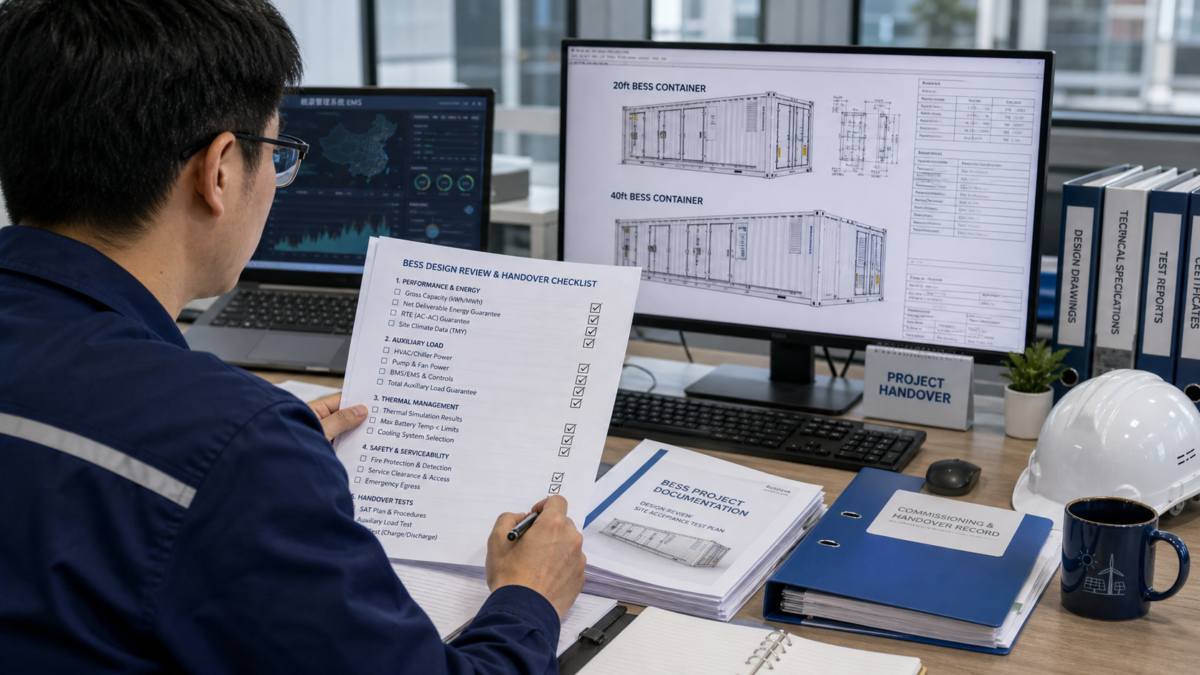
The transition from paper design to physical asset is where a project's success is locked in. I treat the design review and handover as the most critical gates. This is where I test the manufacturer's claims against my project's reality. I don’t just ask for a datasheet; I ask for the models behind it. For example, I would ask for the thermal simulation of the container using TMY3 (Typical Meteorological Year) weather data for my specific project location. This tells me exactly how the HVAC will perform on the hottest days, and what its energy consumption will be. Then, during the site acceptance test (SAT), I would insist on measuring the real-world auxiliary load with the system in both idle and full-power states. If the measured numbers don't match the guaranteed numbers from the design review, then we have a problem that needs to be solved before I sign off on the handover.
Key Verification Questions
Here are the questions I ask to protect the project's long-term value:
- Performance: What is the guaranteed net AC-to-AC round-trip efficiency, including all auxiliary loads, at our site's average and peak annual temperatures?
- Auxiliary Load: Please provide a full breakdown of all auxiliary loads and their power consumption. What is the guaranteed maximum power draw of the auxiliary systems?
- Thermal Management: Provide the thermal model showing battery temperatures will remain within warranty limits during the most extreme 24-hour period at our site.
- Serviceability: Provide drawings that demonstrate compliance with all required service clearances for major components, including batteries, PCS, and HVAC units.
- Handover Test: What specific tests will be performed during commissioning to verify the net energy capacity and auxiliary load?
These questions shift the responsibility to the supplier to prove their system will meet the required outcome. Answering them clearly is the sign of a credible and competent partner.
Conclusion
The choice between a 20ft and 40ft BESS container is not about size. It's about net performance, long-term operational cost, and risk management. Look beyond the datasheet MWh.
My Role
About me
Brand Name: Moletong
Slogan: Carbon Neutrality, Tracking the Future
Website: www.moletong.com
Company Overview
Established in 2011 and headquartered in Dongguan, Guangdong, we are an integrated new-energy equipment enterprise specializing in energy storage systems, complete electrical equipment, photovoltaic solutions, charging infrastructure, and hydrogen-energy solution integration.
We integrate R&D, manufacturing, sales, system configuration, and technical service to support utility-scale, commercial and industrial, and residential energy applications. Our solutions are designed around practical customer needs such as peak shaving and valley filling, electricity-cost optimization, transformer-capacity support, emergency backup, renewable-energy integration, intelligent energy management, and photovoltaic-storage-charging coordination.
Our Core Business
1. Energy Storage Systems & Equipment
We develop lithium iron phosphate energy-storage products for utility-scale, commercial and industrial, residential, and integrated charging applications. Our documented portfolio includes liquid-cooled containerized energy-storage systems, commercial and industrial storage cabinets, residential battery systems, storage-and-charging systems, BMS, PCS, and EMS functions.
2. Complete Electrical Equipment
We provide complete high- and low-voltage electrical products, including gas-insulated ring-main units, high-voltage switchgear, low-voltage withdrawable and fixed switchgear, power-distribution cabinets, meter boxes, box-type substations, charging-station substations, and busbar-trunking systems.
3. Photovoltaic & Integrated Energy Solutions
We provide photovoltaic supporting equipment and system solutions, including 35 kV step-up substation equipment, photovoltaic combiner cabinets, adjustable mounting structures, photovoltaic-storage integration, and equipment support for grid connection, power transmission, and microgrid applications.
4. Charging & Hydrogen-Energy Solution Integration
We provide AC and DC charging solutions, storage-and-charging systems, and photovoltaic-storage-charging integration for industrial parks, commercial parking facilities, transport hubs, and locations with limited grid or transformer capacity. We also develop hydrogen-energy integration concepts involving renewable hydrogen production, hydrogen storage, refueling, and hydrogen-electric coupling. Specific hydrogen products, certifications, production capacity, and completed projects must be confirmed separately.
Product Applications & Technology Focus
Primary Service Industries:
Our principal customer sectors include Industrial and Commercial Energy Users, Renewable-Energy Developers, Power and Electrical Engineering, EV Charging Infrastructure, Commercial and Public Facilities, and Residential Energy Storage.
Product Categories We Serve:
- Utility-Scale Containerized Energy-Storage Systems
- Commercial and Industrial Energy-Storage Cabinets
- Residential Energy-Storage Batteries and Inverters
- Integrated Storage-and-Charging Systems
- High- and Low-Voltage Switchgear
- Box-Type Substations and Charging-Station Substations
- Busbar-Trunking and Power-Distribution Products
- Photovoltaic Step-Up and Combiner Equipment
Technology Expertise:
Our documented technical focus includes:
Lithium Iron Phosphate Cells, BMS, PCS, EMS, Liquid Cooling, Natural Cooling, Modular System Integration, Remote Monitoring, Load Tracking, Anti-Reverse-Flow Control, Transformer-Capacity Protection, and Intelligent Operation and Maintenance.
Production Capacity & Equipment
Energy Storage Production & R&D Platform
Our supplied corporate materials identify one production base in Dongguan and a Dongguan engineering R&D center. We support product development, equipment manufacturing, system configuration, and technical service for residential, commercial and industrial, and large-scale energy-storage applications.
- Product Platform Highlights: 5,015 kWh liquid-cooled containerized storage systems, 627 kWh and 261 kWh commercial and industrial storage cabinets, 16 kWh residential battery systems, and 261 kWh and 627 kWh integrated storage-and-charging systems.
Electrical Equipment Platform
We provide product design and manufacturing support for complete electrical assemblies used in industrial facilities, commercial buildings, substations, photovoltaic projects, charging stations, and public infrastructure.
- Equipment Highlights: High-Voltage Ring-Main Units, High-Voltage Metal-Clad Switchgear, Low-Voltage Withdrawable Switchgear, AC Low-Voltage Switchgear, Distribution Cabinets, Box-Type Substations, Prefabricated Charging-Station Substations, and Busbar-Trunking Systems.
Energy Storage & Electrical System Capabilities
General Capabilities:
- Application and electricity-use requirement analysis
- Energy-storage system selection and capacity configuration
- Equipment design and manufacturing
- BMS, PCS, and EMS system integration
- Peak shaving, valley filling, and time-of-use energy scheduling
- Load tracking and anti-reverse-flow control
- Transformer-capacity protection and demand management
- Photovoltaic-storage and storage-charging integration
- Remote installation, commissioning, and trial-operation support
- Operator training, warranty service, and technical after-sales support as contracted
Our Core Specialties:
- ✔️ Liquid-Cooled Large-Capacity energy-storage systems
- ✔️ Commercial & Industrial peak-valley and backup-power solutions
- ✔️ Integrated Photovoltaic-Storage-Charging applications
- ✔️ Complete Electrical Distribution equipment and system coordination
Quality Control & Certifications
We apply quality, environmental, and occupational health and safety management requirements to the design, manufacture, and sales of our documented product scope.
Quality Management Scope:
The supplied qualification materials show ISO management-system certificates and patent certificates held by Moletong. The product manuals separately define model-specific electrical parameters, monitoring functions, protection requirements, cooling methods, fire-protection configurations, operating environments, and technical-service conditions.
Testing & Protection Focus:
- Cell voltage, current, temperature, and operating-status monitoring
- Overcharge, over-discharge, overtemperature, and abnormal-condition protection
- Liquid-cooling or natural-cooling verification according to product model
- Fire-protection configuration according to product type
- Enclosure protection, corrosion resistance, and operating-environment requirements
- BMS, PCS, EMS, and communication-function verification where applicable
Certifications & Compliance:
- ISO 9001 Quality Management System
- ISO 14001 Environmental Management System
- ISO 45001 Occupational Health and Safety Management System
- Invention Patent and Utility Model Patent Certificates
- Selected product models list IEC 62619, UN 38.3, RoHS, EN 61000 series requirements, GB/T 36276, CCC, and relevant IEC/GB electrical standards
Certification scope varies by product model, configuration, destination market, and certificate validity period. Model-specific certificates must be confirmed before any formal compliance claim.
Target Markets & Partnership Models
Who We Serve:
- Industrial Facility Owners: Plant managers, energy managers, facility managers, and procurement teams at factories or industrial parks seeking peak-valley electricity-cost optimization, demand management, transformer-capacity support, or emergency backup power
- Renewable-Energy Developers: Project developers, engineering managers, and procurement teams for photovoltaic or wind projects requiring energy storage, step-up equipment, electrical distribution, or renewable-energy integration
- EPC & Electrical Contractors: Project managers, technical managers, and equipment-purchasing teams at qualified engineering companies requiring packaged energy-storage or electrical equipment with technical coordination
- Charging-Station Developers & Operators: Investment, construction, and operations teams working on sites with limited grid access, insufficient transformer capacity, high peak demand, or photovoltaic-storage-charging requirements
- Energy Service Companies & System Integrators: Solution designers and project-development teams building commercial and industrial energy-management, microgrid, or distributed-energy projects
- Residential Storage Distributors & Installers: Importers, distributors, wholesalers, and qualified installers requiring lithium iron phosphate batteries, off-grid or hybrid inverters, and residential storage configurations
- Commercial & Public-Facility Owners: Property, engineering, and facility-management teams for commercial buildings, schools, hospitals, hotels, parking facilities, and transport locations requiring reliable power distribution, charging, or backup-energy solutions
Target Geographies:
Our home market is China, supported by regional sales coverage for South, East, Central, and Southwest China. The supplied 2026 catalogue also identifies an overseas office in Indonesia, supporting practical market development in Southeast Asia. Other overseas markets are served only after confirming model-specific certification, grid requirements, shipping conditions, and local installation standards.
Types of Cooperation:
- Equipment Supply: Standard or configured energy-storage and electrical products
- System Configuration: Product selection and capacity configuration based on the customer's application
- System Integration: BMS, PCS, EMS, photovoltaic, charging, and electrical-system coordination
- Project Technical Cooperation: Technical coordination with renewable-energy developers, EPC contractors, and qualified local engineering companies
- Integrated Energy Solutions: Photovoltaic-storage, storage-charging, and photovoltaic-storage-charging applications
- Technical Service: Training, remote installation and commissioning support, warranty, and after-sales service as agreed in the commercial contract
Our Core Competitive Advantages
⭐ Integrated New-Energy Product Portfolio
By combining energy-storage systems, complete electrical equipment, photovoltaic supporting products, charging applications, and intelligent energy-management functions, we can configure solutions around the customer's complete power-use scenario.
⭐ Coverage from Residential to Utility Scale
Our documented energy-storage range extends from 16 kWh residential systems to 261 kWh and 627 kWh commercial and industrial systems and a 5,015 kWh containerized system.
⭐ Application-Oriented System Design
Our solutions address identifiable operating needs, including peak-valley arbitrage, demand management, transformer-capacity constraints, backup power, renewable-energy consumption, and charging-station power support.
⭐ Integrated Control & Safety Architecture
Our storage products combine lithium iron phosphate cells with BMS, PCS, EMS, model-specific thermal management, multi-level protection, intelligent monitoring, and remote operation and maintenance functions.
⭐ Regional Sales & Technical Service Support
With a Dongguan headquarters and engineering center, regional sales coverage in China, and an overseas office identified in Indonesia, we support equipment selection, technical coordination, training, remote commissioning assistance, and contracted after-sales service.
Leave a Reply