

Comparing Fox Peak Shaving vs. Standard on Octopus Flux – Am I Losing Out?
Are you using a standard battery schedule on Octopus Flux and wondering if a predictive system could save you more? It’s confusing to know if you’re missing out on bigger savings.
Standard scheduling is often more reliable. Predictive peak shaving promises higher savings, but its success depends heavily on forecast accuracy. A single forecasting error can erase weeks of gains, making a simple, consistent strategy surprisingly effective for many users.
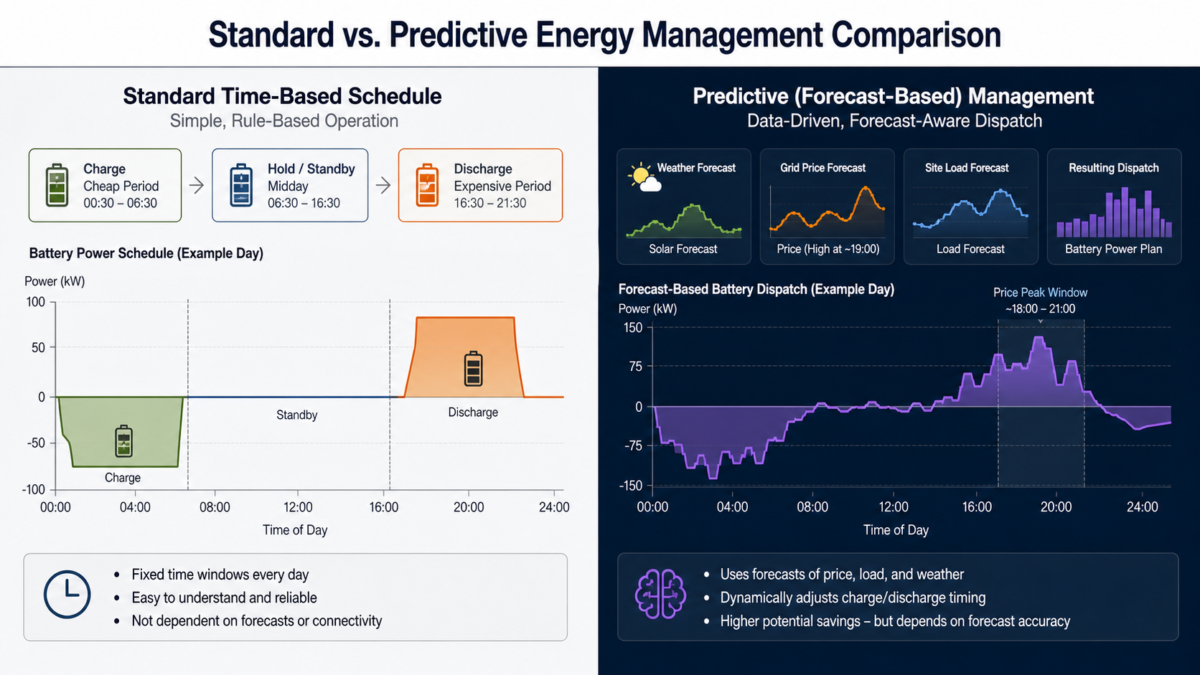
This is a story I see a lot. Someone gets a battery, sets it to charge cheap and discharge expensive, and it works. Then they hear about "AI" and "predictive" systems and start to doubt their simple setup. I decided to dig into the numbers myself. The results were not what I expected. Let's look at why this is so tricky.
Why is Predictive Peak Shaving EMS Harder Than It Looks?
Predictive systems promise to perfectly time your battery use for maximum profit. But what happens when the forecast is wrong? You could end up buying high and selling low.
It’s harder than it looks because it combines multiple uncertain forecasts: weather, grid demand, and your site's load. A small error in one prediction can cause a costly dispatch mistake, turning potential savings into an actual loss compared to a simple, fixed schedule.
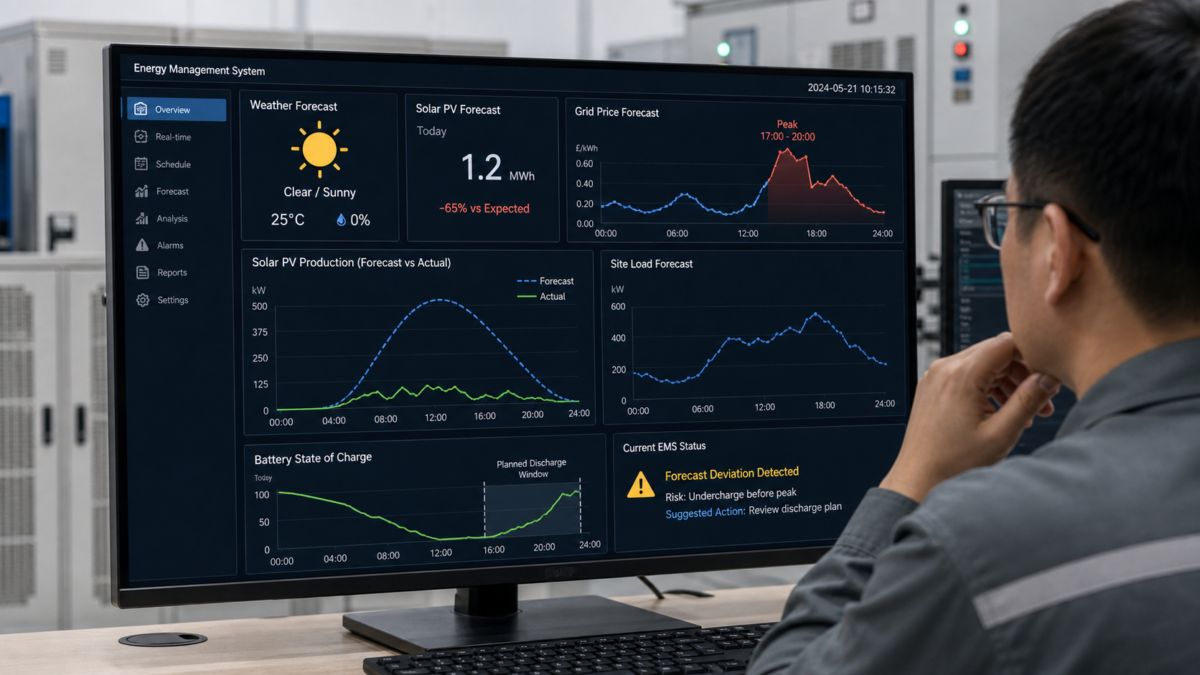
When I started looking at predictive systems, I assumed they were always better. But the data told a different story. My conclusion is that one missed billing peak can matter more than many successful dispatches. The main problem is that these systems juggle several forecasts at once. A mistake in any one of them can cause a chain reaction.
The Forecasting Chain
A predictive Energy Management System (EMS) has to get three things right:
- Weather Forecast: This predicts your solar generation. If it predicts sun and you get clouds, your battery won't charge as expected.
- Grid Price Forecast: This predicts when energy will be most expensive (the peak). Octopus Flux prices can change rapidly, making this a moving target.
- Site Load Forecast: This predicts how much energy your facility will use. An unexpected large load can drain your battery before the peak arrives.
A failure in any one of these can lead to a costly mistake. I saw one case where a bad weather forecast left the battery half-empty before the evening peak. The system bought expensive grid power to cover the load, wiping out all the savings from the previous week.
Here’s a simple table showing how it can go wrong:
| Scenario | Prediction | Reality | Battery Action | Financial Outcome |
|---|---|---|---|---|
| Successful Dispatch | High price at 5 PM | High price at 5 PM | Discharge fully at 5 PM | Maximized Savings |
| Missed Peak | High price at 5 PM | High price at 7 PM | Discharge at 5 PM (low price) | Loss of Savings/Potential Loss |
This is why I say one missed peak can matter more than many small wins.
What Site Data Is Needed to Evaluate a Predictive Peak Shaving EMS?
Vendors show you impressive case studies, but how do you know if a predictive EMS will work for your site? You need your own data to make a real comparison.
To properly evaluate a predictive EMS, you need a minimum of 12 months of your site's 15-minute interval electricity data. You also need your exact utility tariff details, especially demand charge ratchets, and historical grid price data for a realistic simulation.

A sales pitch is not data. To make an informed decision, I insist on seeing a simulation run with a site's actual data. Without it, any savings promise is just a guess. If I were advising a client, I would refuse to proceed without a few key pieces of information.
First, I need at least a full year of 15-minute interval load data. This is non-negotiable. It shows me the real consumption patterns, including daily, weekly, and seasonal peaks. A single month of data is useless because it won't show how usage changes in summer versus winter.
Second, I need to understand the site's coincident loads. This means I check if the building's highest usage happens at the same time as the utility's grid-wide peak. If they don't align, a simple time-based strategy might be more effective than a complex predictive one.
Third, I need the full utility tariff sheet. I pay special attention to demand charge ratchets. A ratchet clause means your highest peak demand in one month can set your demand charges for the next 11 months. A predictive EMS that misses even one peak on a tariff with a ratchet can be a financial catastrophe. The most convincing analysis shows a redacted interval dataset, a dispatch trace, and a utility-bill reconciliation.
Which Predictive Peak Shaving EMS Assumptions Distort the Result?
Predictive EMS proposals often show amazing savings, but they are based on perfect-world assumptions. These optimistic guesses can hide the real financial risks you might be taking on.
Results get distorted by assuming perfect forecasts, which never happen in reality. Other flawed assumptions include ignoring battery degradation from frequent cycling and overlooking grid rules or tariff limits that can restrict how often you can charge or discharge your battery.
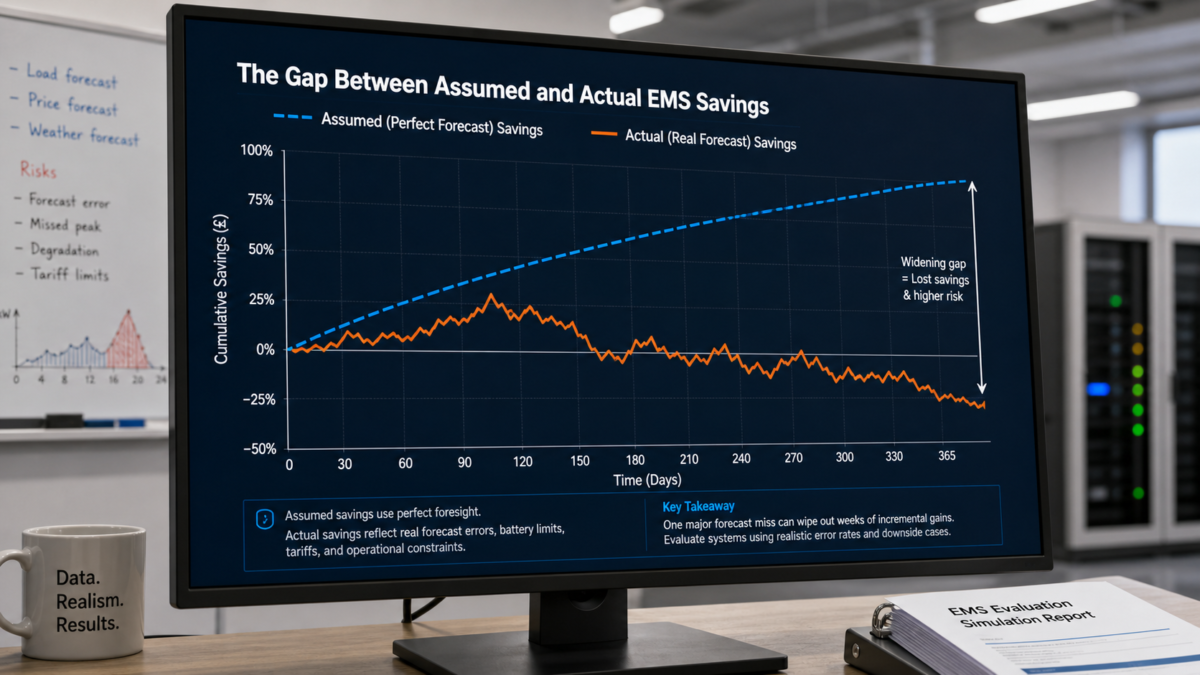
When I review a proposal for a predictive EMS, I immediately look for the assumptions. The numbers often look great, but they are built on a shaky foundation. The most common and dangerous assumption is "perfect foresight." This means the simulation assumes the EMS knew the future with 100% accuracy. This is impossible. A real system uses forecasts, which always have some error. I always ask for a sensitivity analysis that shows how savings change with a 10%, 20%, or even 30% forecast error.
Another common distortion is ignoring battery health. Some predictive algorithms might cycle the battery multiple times a day to chase small price differences. This increases battery degradation, shortening its life and adding a hidden cost that isn't in the savings report. A simple charge-once, discharge-once cycle is much healthier for the battery long-term.
Finally, I check if the simulation respects all utility rules. For example, some tariffs limit how many times you can export to the grid per month. An aggressive predictive EMS might violate these rules, leading to penalties. This is why I always start by asking what the main goal is: savings, resilience, capacity relief, or compliance. They are not the same.
What Is a Practical Predictive Peak Shaving EMS Selection Checklist?
Choosing an EMS is a big decision, and it’s easy to get lost in technical jargon. You need a simple way to compare different options and cut through the sales hype.
Use a checklist. First, demand a simulation using your site’s 15-minute interval data. Second, ask for their historical forecast accuracy metrics and an exception log showing dispatch errors. Finally, clarify how their logic handles demand ratchets and communication failures.

Over the years, I've developed a simple checklist to cut through the noise when evaluating an Energy Management System. It forces the conversation to be about real performance, not just promises.
- Clarify the Primary Goal. Before anything else, I state what I want the system to do. Is the number one priority bill savings, backup power for resilience, or relieving a constrained transformer? These are not the same thing.
- Provide Your Data, Demand a Simulation. I never accept a generic proposal. I provide at least one year of 15-minute interval data and demand they run a simulation with it. When I model this, I'll use a specific system like a Moletong 261 kWh or 627 kWh C&I cabinet to make the results concrete.
- Ask for the Forecast Error Rate. I ask them to quantify their forecast accuracy. I want to see the numbers. How often are they wrong, and by how much? A vendor who can't answer this is a red flag.
- Request the Exception Log. I ask to see a redacted exception log from a real customer. This log shows every dispatch error and missed peak. It tells me more about real-world performance than any marketing brochure.
- What’s the Fail-Safe Protocol? I always ask what the system does if it loses its connection to the cloud. Does it switch to a simple, reliable schedule, or does it stop working? For critical facilities, the answer is everything.
Conclusion
My analysis shows one missed billing peak can erase months of small savings. Define your goal first, then evaluate systems using your site data, and always consider a realistic downside case.



Leave a Reply