

How Should Buyers Evaluate 20ft vs 40ft BESS Container?
Choosing a BESS container feels like a simple size decision. But focusing only on MWh can lead to costly operational surprises and a system that doesn't deliver on its promise.
Buyers should evaluate 20ft vs 40ft BESS containers by comparing net usable energy, not just nameplate MWh. This includes accounting for auxiliary power consumption, transport mass constraints, DC voltage topology, and practical maintainability, which together reveal the true, lifetime cost and performance of the system.
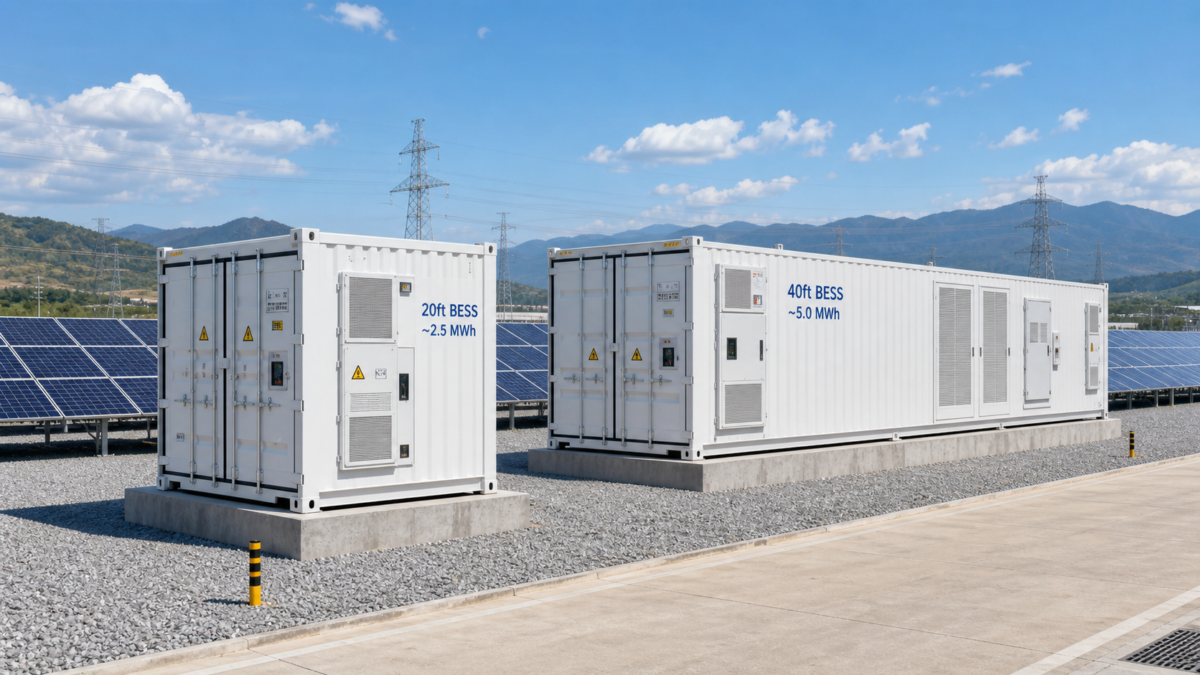
I've seen many project developers get fixated on the headline MWh number on a datasheet. It's a natural starting point, but it's far from the complete picture. The problem is that the datasheet value represents a perfect-world scenario that doesn't exist on a real project site. The real value of a system is determined by how much energy you can actually sell to the grid after accounting for all the practical constraints and losses. To make a smart choice that pays dividends over the 20-year life of your asset, we have to peel back the layers and look at the factors that suppliers don't always put front and center. Let's start by questioning the most basic assumption: that a bigger container is always better.
What Buyers Evaluate 20ft vs 40ft BESS Container Reveals About the Real Constraint?
You are comparing two spec sheets. The 40ft container boasts a higher MWh capacity and better energy density per square foot. But what if your project's real bottleneck isn't land area?
The evaluation between a 20ft and 40ft BESS container often reveals that transportable mass is a more significant constraint than land footprint. A fully loaded 40ft container can easily exceed standard road weight limits, requiring special permits or costly on-site assembly of batteries.
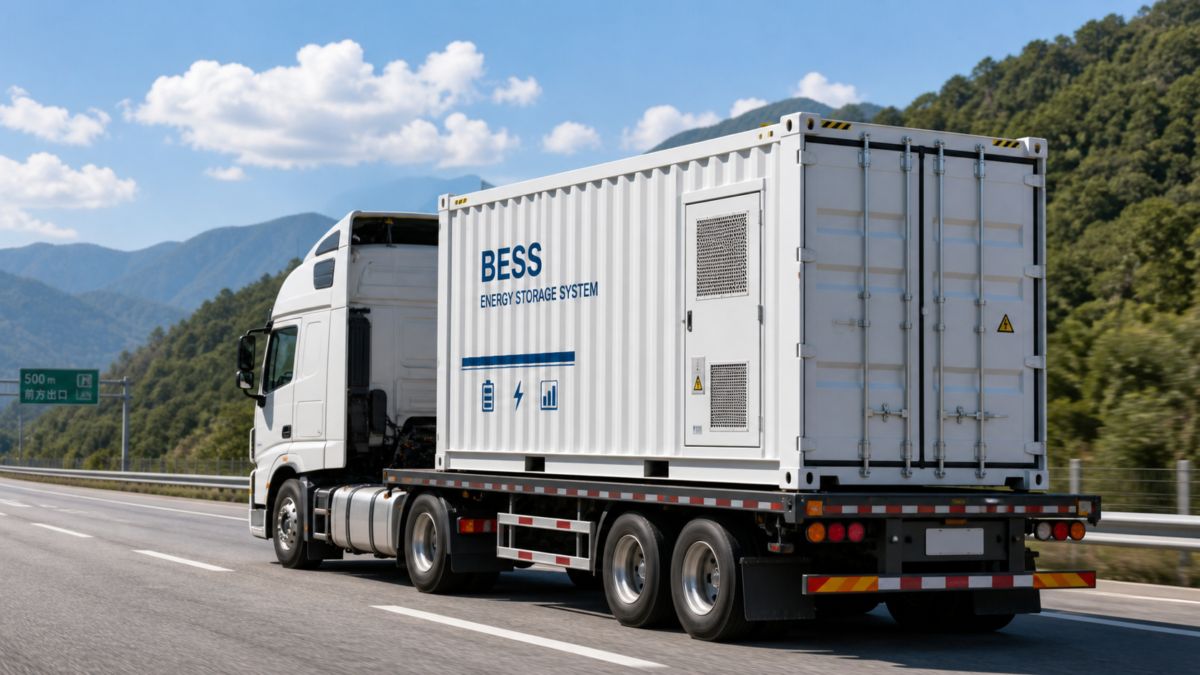
When I first started in this industry, I also focused on MWh per square meter. It seemed like the most logical way to measure efficiency. But a painful experience on an early project taught me otherwise. We had selected a large, high-density 40ft container, thinking we were saving on land costs. The problem came when we tried to ship it to the site. The fully assembled container was so heavy that it exceeded local bridge weight limits. We had to unload all the battery modules at a staging area, ship the empty container, and then ship the modules separately. The cost of the extra cranes, labor, and project delays for on-site re-assembly completely wiped out any savings we thought we had made. This is where we need to look past the simple datasheet comparison.
Comparing Key Constraints
The real challenge is often getting the equipment to the site in one piece, ready to go. A 20ft container is almost always within standard road transport weight limits, even when fully populated with batteries. This means it can arrive as a "plug-and-play" unit, drastically reducing on-site work.
| Evaluation Metric | Typical 20ft BESS Container | Typical 40ft BESS Container |
|---|---|---|
| Nameplate Energy | ~2.5 MWh | ~5.0 MWh |
| Footprint (approx.) | 14.6 m² | 29.2 m² |
| Energy Density (MWh/m²) | ~0.17 | ~0.17 |
| Transport Mass (approx.) | 30 – 35 tons | 65 – 75 tons |
| Transport Constraint | Generally compliant with standard road limits. | Often exceeds standard road limits, requiring special permits or on-site assembly. |
Before you even compare MWh, you should check the total shipping weight of each option and compare it to the transport regulations for your specific route. The real constraint is often not MWh/m², but MWh per ton.
Which Measurements Matter More Than Nameplate Data for 20ft vs 40ft BESS Container?
The datasheet promises 5 MWh, so you build your financial model assuming you can sell 5 MWh. But internal systems like cooling and controls are constantly consuming energy, chipping away at your revenue.
Gross-to-net energy is the most critical measurement beyond nameplate data. This is the actual, sellable energy available at the terminals after subtracting all auxiliary power consumption and accounting for round-trip efficiency losses. A system with high parasitic loads delivers significantly less net energy.
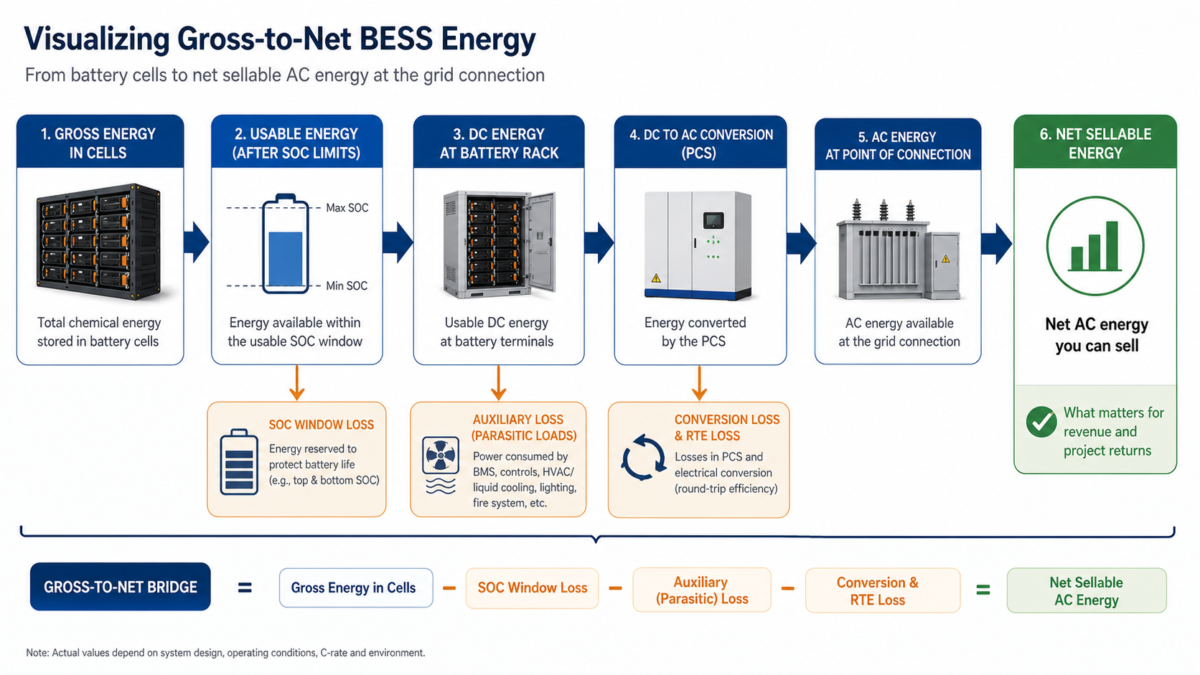
The nameplate capacity is the "gross" energy stored in the battery cells. But you can't sell gross energy. You sell "net" energy—what's left over after the system runs itself. The difference can be surprisingly large, and it's a continuous drain on your project's profitability, 24/7. I always press suppliers for a guaranteed figure on auxiliary loads. For example, a reference architecture like the Moletong 5 MWh liquid-cooled DC container uses a liquid cooling system. This technology is excellent for managing battery health and allowing for higher charge/discharge rates, but the pumps and heat exchangers consume power. This is a trade-off. You might get better performance, but you have to account for the energy cost of that performance. A simple air-cooled system might have lower auxiliary loads but may not perform as well in hot climates or under heavy use. You must get these numbers and build them into your model.
Building a Gross-to-Net Bridge
To understand the real output, I create a simple "bridge" from the gross nameplate value to the net sellable value.
- Gross Nameplate Energy: The starting point from the datasheet (e.g., 5,015 kWh).
- Minus State of Charge (SOC) Limits: You can't use 100% of the battery. Usable SOC is often 90% or less to preserve battery life.
- Minus Auxiliary Loads: This includes the constant power draw from the thermal management system (HVAC or liquid cooling), BMS, control systems, and lighting. This should be provided as a 24-hour kWh value.
- Minus Round-Trip Efficiency (RTE) Losses: If the DC RTE is 95%, you lose 5% of the energy in every cycle.
- Equals Net Deliverable Energy: This is the number you should use in your financial model.
How DC Voltage Can Undermine the Expected Result?
You assume that one 5 MWh system is just like another. But a system built with a low DC voltage can limit your power output and drive up your balance-of-system costs unexpectedly.
A lower DC system voltage can undermine performance by increasing electrical current for the same power output. This requires larger, more expensive DC cables and leads to higher resistive energy losses (I²R losses), reducing the net power and energy you can deliver to the grid.
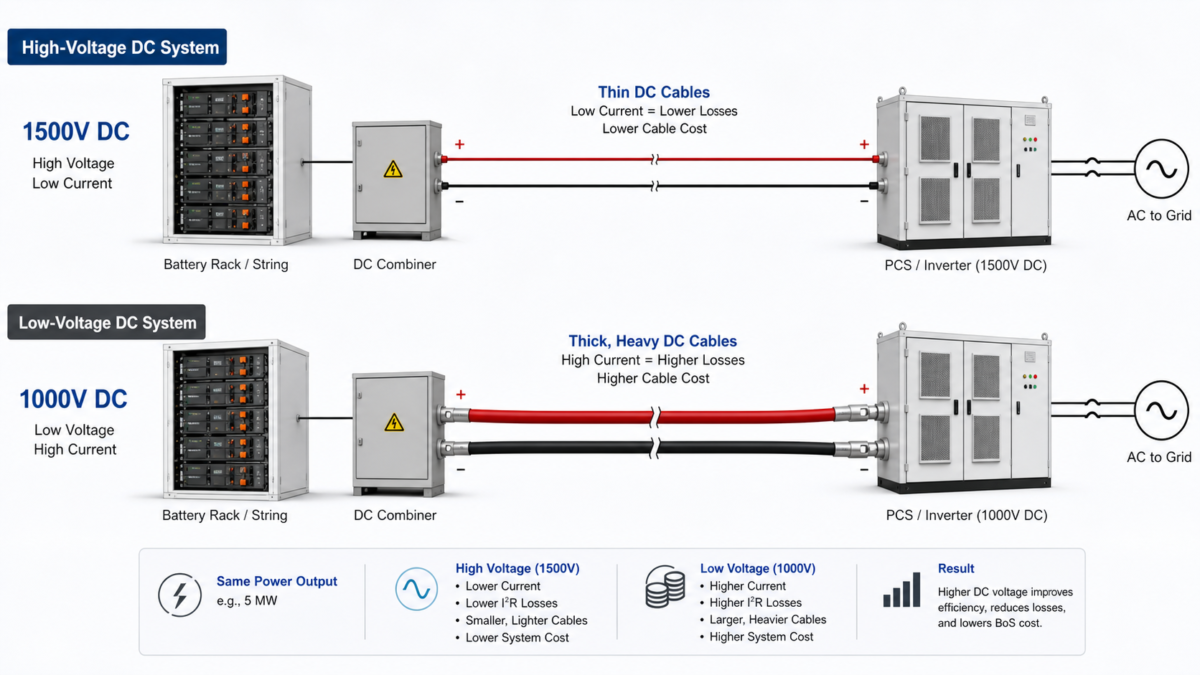
This is a technical detail that has huge financial consequences. Think of it like water in a pipe. To move the same amount of water (power), you can either use high pressure (voltage) in a small pipe or low pressure in a huge, expensive pipe. In electrical systems, that "huge pipe" means thick, costly copper cables. The fundamental relationship is Power = Voltage × Current. If you choose a BESS with a lower nominal DC voltage, you will have a much higher current to deliver the same amount of power. This high current creates more heat, which is wasted energy, directly hurting your round-trip efficiency. I’ve seen projects where the cost of the oversized DC cabling between the BESS and the power conversion system (PCS) became a major unbudgeted expense.
Why String Topology Matters
The choice between a 20ft and 40ft container doesn't inherently determine the DC voltage, but the internal design of the battery racks and strings does. A modern, utility-scale system, whether 20ft or 40ft, should be designed to connect to a 1500V DC PCS. This has become the industry standard for a reason: it's more efficient and cost-effective. A system with a lower voltage, say 1000V or 1200V, may limit your choice of PCS inverters and will certainly increase your cabling costs and electrical losses. When you evaluate a BESS container, one of your first technical questions should be: "What is the nominal DC voltage range, and which 1500V inverters is it compatible with?" This simple question can save you from significant headaches and hidden costs down the line.
Which Acceptance Tests Should Buyers Request for 20ft vs 40ft BESS Container?
The container is delivered to your site, and you assume it performs as advertised. But without proper, contractually-obligated testing, you might not discover a performance gap until you are already losing revenue.
Buyers must request a Capacity Test to verify net usable MWh and a Round-Trip Efficiency (RTE) Test performed at a contractually agreed C-rate. These site acceptance tests (SAT) provide objective proof that the BESS delivers the net energy you paid for after all system losses.
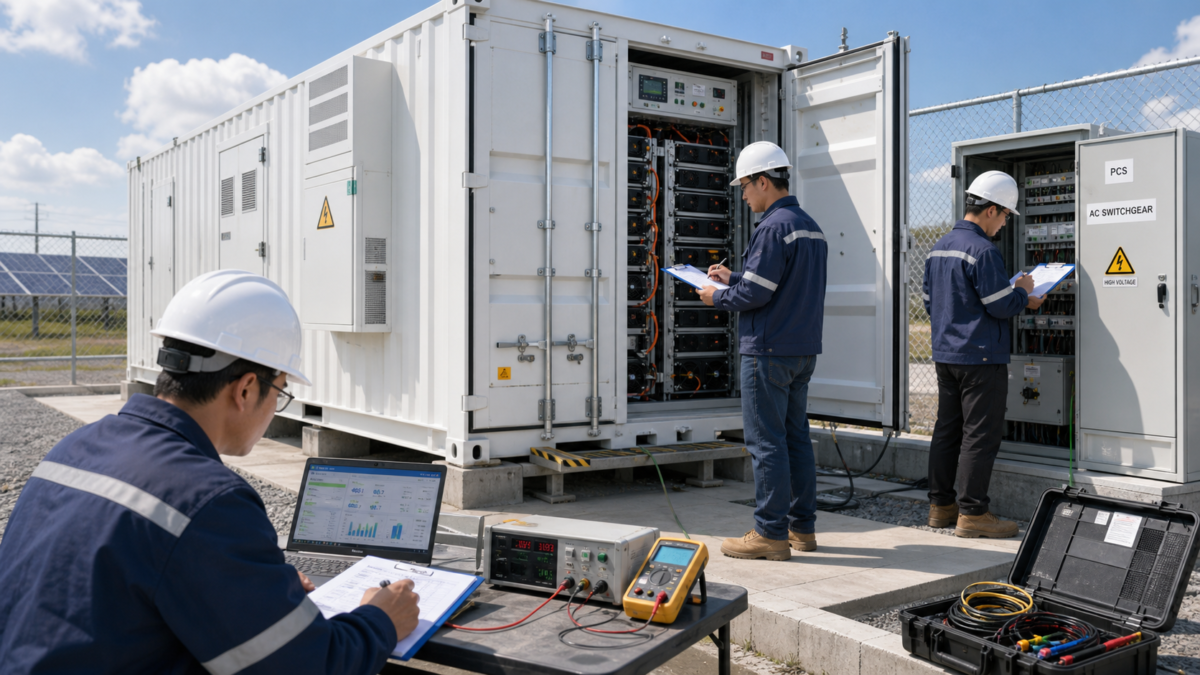
A datasheet is a promise, but an acceptance test is proof. I never sign off on a project without a rigorous Site Acceptance Test (SAT). While a Factory Acceptance Test (FAT) is good for checking basic functions before shipment, the SAT is where the supplier proves the system performs in its real operating environment, connected to your grid. I once had a supplier try to argue that their capacity test should be based on the DC energy measured at the battery rack terminals. I refused. The test must measure the AC energy delivered at the point of connection, after the PCS, because that is the only energy I can actually sell. You must be specific about these test procedures in your supply contract, because "the devil is in the details." The contract should clearly define the pass/fail criteria for each test.
Essential Tests to Include in Your Contract
- Capacity Verification Test: This involves a full charge and a full discharge at a specified C-rate (e.g., 0.5C or 0.25C). The test measures the total net AC kWh delivered to the grid. This confirms you got the MWh you paid for.
- Round-Trip Efficiency (RTE) Test: This measures the energy into the system versus the energy out over a complete cycle. It's the ultimate test of the gross-to-net calculation, as it includes all auxiliary loads and conversion losses. A guaranteed RTE of 88% is very different from one that is 85%.
- Auxiliary Load Measurement: While the system is idle (not charging or discharging), you should measure the power consumption of the container's internal systems for a set period. This verifies the parasitic load numbers the supplier gave you.
Without these tests defined in the contract, you are buying a product based on trust alone. With them, you are buying a guaranteed and verifiable performance outcome.
Conclusion
Choosing between 20ft and 40ft BESS is not about size. It’s about verifying transportable mass, net energy, DC voltage, and demanding proof through rigorous acceptance tests.

Leave a Reply