

How to Actually Read a Factory Audit Report?
You get a factory audit report. It's thick with certificates and checklists. But does it actually tell you if the BESS will work for your project, or just that the factory has good paperwork?
My approach is simple. A certificate's existence is less important than its applicability. I focus on duty limits, exclusions, and service capacity. These variables can reverse an apparently obvious answer and protect your investment from a critical failure that paper audits often miss.

I’ve seen too many people treat a factory audit report like a trophy. They check the boxes, see the ISO 9001 stamp, and think the job is done. But the real work is just beginning. A report is not the answer; it's a map. You still have to do the navigating. The key is to connect the generic findings of the report to the specific reality of your project site and your operational needs. I'm going to show you how I do it.
The Operational Reality Behind Reading a Factory Audit Report?
Your report says the factory is certified. But is the specific BESS model you're buying certified for your country and application? A generic certificate can create a dangerous false sense of security.
To find the operational reality, I build a model-specific evidence matrix. I cross-reference every certificate and test report against the exact BESS model, its configuration, and the project's jurisdiction. This turns a generic report into a practical, project-specific decision tool.
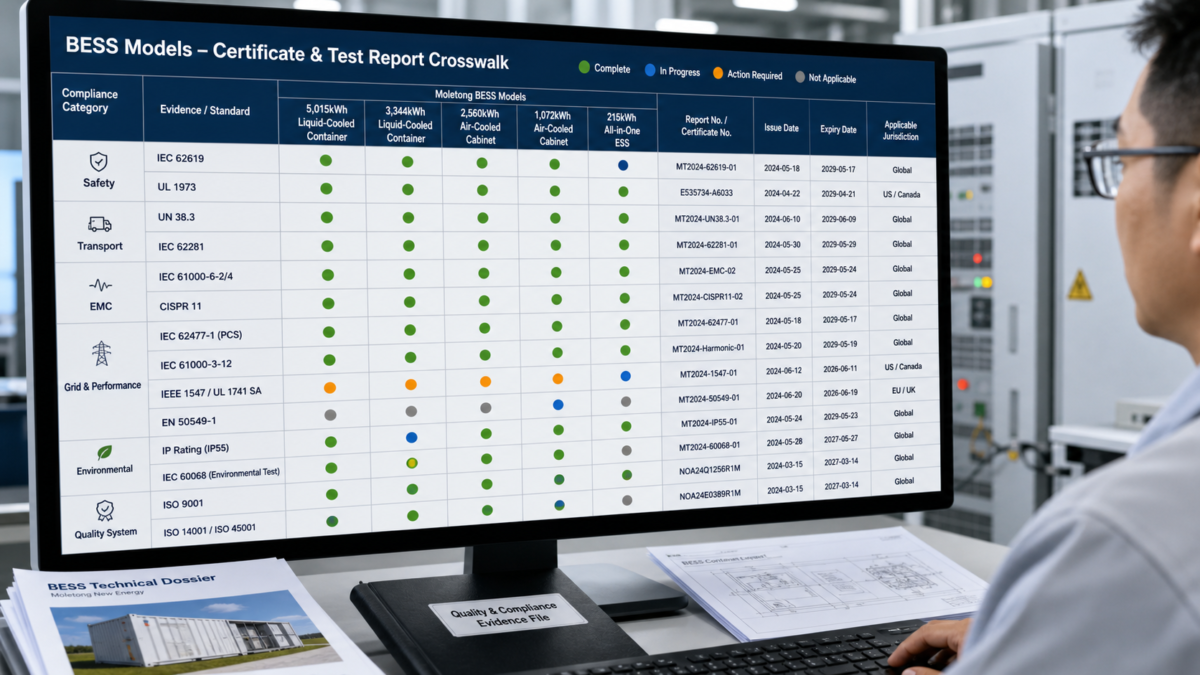
When I audit a supplier like Moletong, I don't just look at their ISO certificates. I look at their product-specific documents. For their 5,015 kWh liquid-cooled container, I want to see the test report for IEC 62619, not just a declaration of conformity. I also need to confirm that the UN 38.3 test was done on a comparable cell and module configuration. The details are what matter. A generic factory certification is a starting point, but it tells you nothing about the specific product you are buying. I use a simple table to organize this information and see the gaps immediately.
Evidence Crosswalk Example
This simple tool helps me organize the facts. It connects the paper claims to the physical product.
| Evidence Item | Required For My Project? | Model Specificity | Jurisdiction Validity | Status |
|---|---|---|---|---|
| IEC 62619 (Safety) | Yes | Confirmed for Model X | Valid in EU | Complete |
| UN 38.3 (Transport) | Yes | Confirmed for Model X | Global | Complete |
| Grid Code XYZ | Yes | Not Tested for Model X | Specific to USA | Action Required |
This approach keeps the audit practical, credible, and useful. It moves the conversation from "Are you certified?" to "Is this exact product certified for my specific need?"
Why Do Duty Limits Change the Design?
The report shows a BESS passed all performance tests. But those tests were done in a lab at 25°C. Your project site is in a desert, with ambient temperatures hitting 45°C.
Duty limits define the operational boundaries of the BESS. Exceeding them, even slightly, can invalidate warranties, accelerate degradation, and compromise safety. Changing the duty limit for temperature or C-rate isn't just a setting; it fundamentally changes the required design of the entire system.

I remember a project where the client wanted to increase the C-rate to capture more revenue during peak hours. The factory report said the system was capable of 1C operation. However, the fine print in the test report showed this was only for one hour at a moderate temperature. The client's duty cycle required 1C for two hours at a much higher ambient temperature. This small change had huge consequences. The original natural cooling design was no longer adequate. We had to switch to a more robust liquid-cooling system, similar to what Moletong uses in their large-scale BESS. This change impacted the container layout, the auxiliary power consumption, and the overall cost. It was a completely different design, all because the operational duty limit changed. This is why I always test the design with real site inputs, not just the numbers on a certificate.
How to Balance Performance, Safety, and Serviceability in a BESS Factory Audit Checklist?
A supplier might showcase a system with incredible energy density. But what they don't show you is that the modules are packed so tightly that a technician can't access them for service.
A good BESS must balance all three. High performance is useless if the system is unsafe or impossible to service. My audit checklist forces a review of how these three elements interact. I check for service access, emergency procedures, and component replacement feasibility under real-world conditions.

During one factory visit, I was reviewing a new commercial and industrial storage cabinet. The performance specs were impressive. But then I asked a simple question: "Show me how you would replace the middle module in this rack." The engineers looked at each other. They had to disassemble half the rack just to get to it. The estimated downtime was eight hours. This is a classic example of prioritizing performance over serviceability. In my checklist, I look at the physical layout. Is there enough space for a person to work? Are the connection points accessible? I also review the safety systems. Moletong's products list features like BMS, PCS, and thermal management. My job is to ask how a technician interacts with them. Can they test the fire suppression system? Can they easily isolate a faulty string for maintenance? A truly well-designed system considers the entire lifecycle, not just the datasheet performance.
What to Confirm for a BESS Factory Audit Checklist at Design Review and Handover?
The design looks good, and the factory is impressive. You feel ready to approve the project. But what happens if the supplier swaps a key component at the last minute due to supply chain issues?
At design review and handover, you must confirm the contractual and procedural documents. I always require a deviation register, a detailed warranty model, and a contract evidence schedule. These documents transform the technical audit into a commercially enforceable agreement and protect you from future problems.

The final handover is where many projects fail. The technical details are sorted, but the commercial protections are weak. That’s why I insist on a few key documents. The deviation register is critical. It formally tracks any changes from the agreed-upon design, no matter how small. This prevents surprise component swaps. Next, I scrutinize the warranty model. I want to know the exact process for making a claim, the expected response time, and who covers the cost of labor and shipping. Finally, I create a contract evidence schedule. This document lists all the key reports, certificates, and drawings from the audit process and attaches them to the final contract. It makes all the technical promises legally binding. It also includes the conditions under which I would change my recommendation, ensuring everyone knows the triggers for a project review. This rigor at the final stage is what makes a BESS factory audit truly useful.
Conclusion
An audit report is not a pass/fail certificate. It's a tool to verify that a specific BESS design is fit for your specific purpose, duty, and location.



Leave a Reply