

What Does Home Backup Batteries Without Solar Mean for Project Design?
Power outages are frustrating, and a home battery seems like the perfect fix. But choosing one based on marketing claims alone can lead to an expensive system that fails you.
A battery-only system design shifts your focus from energy generation to smart energy management. It demands a close look at your utility bills, financing, and exact backup needs to ensure the investment truly pays off as both outage insurance and a potential cost-saving tool.
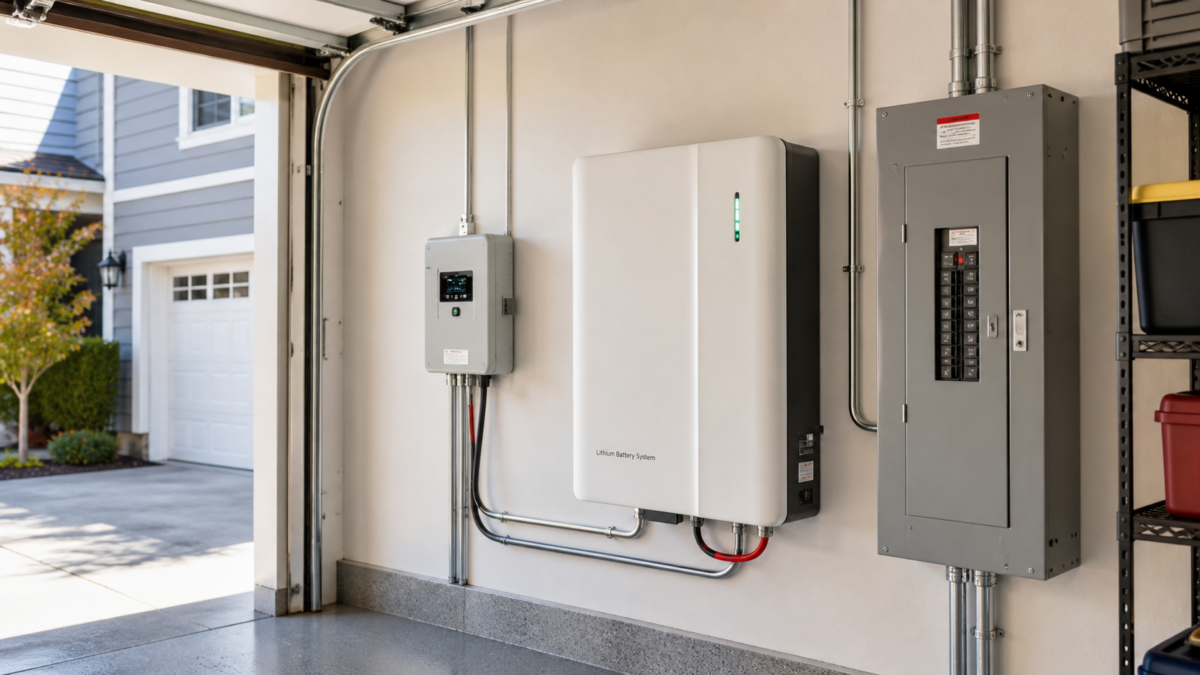
I have seen countless projects get started on the wrong foot because the conversation began with a product brochure. The real starting point is not a specific battery model; it's a deep dive into your unique situation. This approach makes it much easier to separate a genuine technical solution from a poor assumption or an unrealistic expectation. Let’s walk through how to do this correctly, so you get a system that actually works for you.
The Real Decision Behind Home Backup Batteries Without Solar Mean for Project Design?
You know you want a battery for backup power. But are you also hoping it will save you money every day? Trying to achieve both goals without a clear strategy causes confusion.
The real decision is to separate the battery's value into three distinct jobs: self-consumption, tariff arbitrage, and outage insurance. Without solar, self-consumption is off the table. This means you must clearly decide if you're paying for outage insurance, daily cost savings via arbitrage, or both.
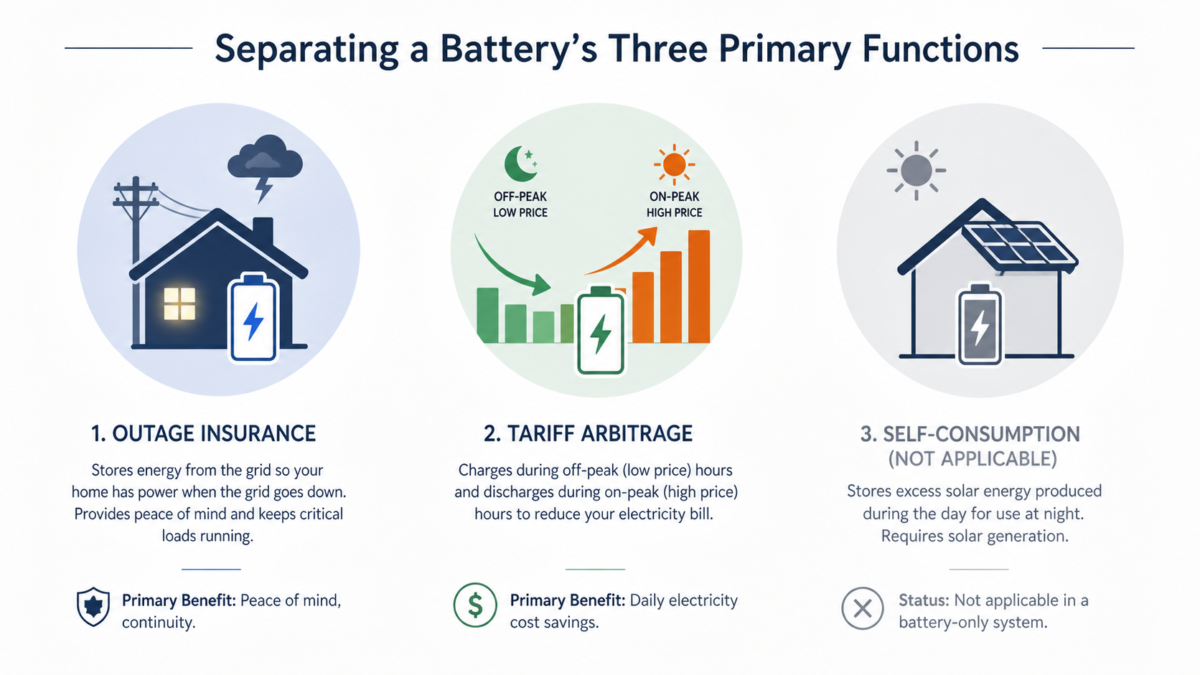
When I talk with homeowners, the first thing I do is break down what a battery can and cannot do in a solar-free setup. The economics must be crystal clear. You are essentially buying a very sophisticated insurance policy that you might also be able to use to play the energy market.
Value Stream 1: Outage Insurance
This is the most straightforward value. You pay for the battery, and in return, you have power when the grid goes down. The "return on investment" here is not financial; it's peace of mind and the ability to run critical loads like refrigerators, medical equipment, or home office gear. The key questions are about duration and which specific appliances you need to power.
Value Stream 2: Tariff Arbitrage
This is the financial-savings component. If your utility has a Time-of-Use (TOU) tariff, there's a price difference between off-peak and on-peak hours. The battery can charge with cheap grid power overnight and discharge to power your home during expensive peak hours in the afternoon. This is the only way a battery-only system generates daily savings.
Value Stream 3: Self-Consumption (Not Applicable)
With solar panels, a battery stores excess solar energy produced during the day for use at night. This is called self-consumption. Without solar, there is no self-generated energy to store, so this value stream does not exist. It's critical not to confuse this with arbitrage.
Here is how I would break it down for a client.
| Value Stream | How It Works (Battery-Only) | Primary Benefit | Key Requirement |
|---|---|---|---|
| Outage Insurance | Discharges stored grid power during an outage. | Peace of mind, continuity. | Sufficient capacity (kWh) and power (kW) for critical loads. |
| Tariff Arbitrage | Charges during cheap off-peak hours, discharges during expensive peak hours. | Daily electricity cost savings. | A utility tariff with a significant peak/off-peak price difference. |
How Financing and Dated Tariff Change the Answer?
A home battery is a significant financial commitment. The wrong utility rate plan or confusing financing terms can completely undermine the project's value, making a good idea seem terrible on paper.
Financing determines your actual monthly cost, while your utility tariff determines your potential daily savings. A modern Time-of-Use tariff with a wide price spread can make arbitrage profitable, but a flat-rate or "dated" tariff offers zero opportunity for daily savings, making financing much harder to justify.

I once worked with a family who was set on getting a battery. They had frequent, short outages and wanted that security. However, they were on an old, flat-rate electricity plan where power costs the same 24/7. Financially, their only value was backup. We ran the numbers, and the loan payment was far more than they were comfortable paying for just "insurance." We then checked with their utility and found they were eligible for a new TOU plan. The potential daily savings from arbitrage on that new plan completely changed the math. It made the monthly loan payment feel much more manageable because the battery was now helping to pay for itself.
This is why I insist on seeing 12 months of utility bills and the exact tariff details before I even think about specific products. A tariff with a small difference between peak and off-peak rates, say only a few cents, might not generate enough savings to be worthwhile. But a tariff with a 20-cent or 30-cent difference can create a compelling financial case. Understanding this relationship between your utility's rules and your financing options is the most critical step in the entire design process.
Where Interval Load Creates Cost or Performance Risk?
Your monthly bill shows total energy use, but a battery operates in real-time. A sudden, massive power draw from an appliance can drain your stored energy or exceed the system's power limit, leaving you without power anyway.
Interval load data, which tracks your home's power consumption every few minutes, reveals hidden risks. Brief but powerful surges from equipment like air conditioners or well pumps can overwhelm a battery's power rating (kW) or rapidly deplete its stored energy (kWh), creating serious performance and cost risks.
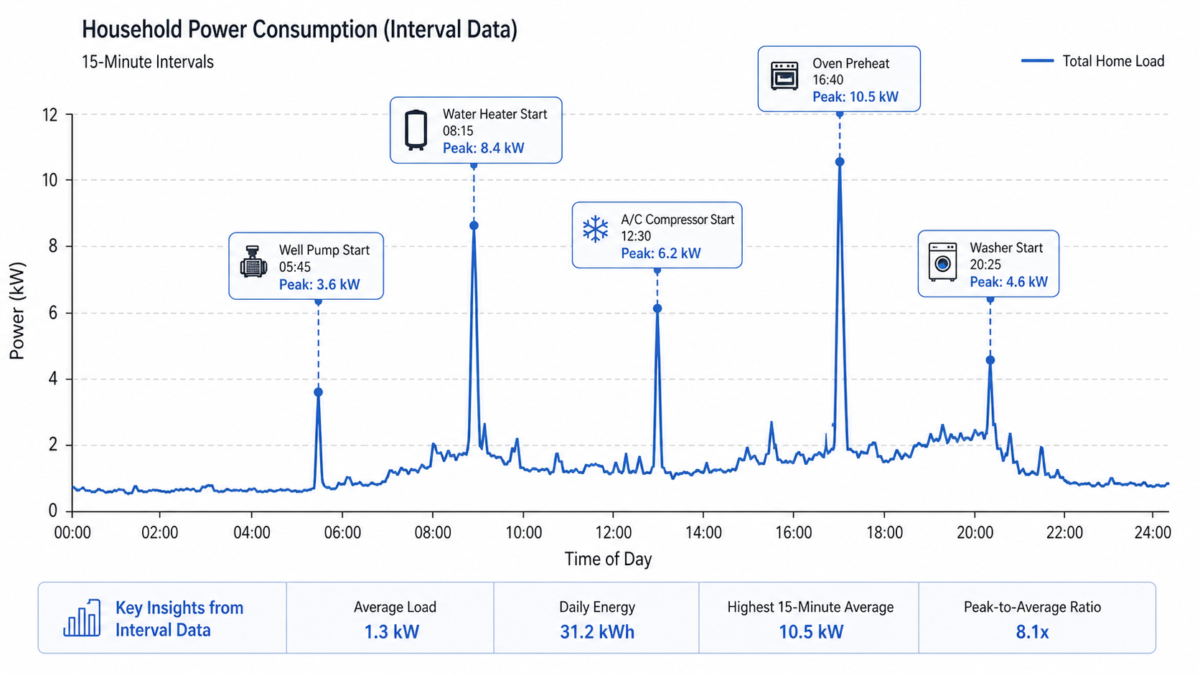
I remember a project for a rural home where the owner wanted to back up his well pump. On paper, the pump's average energy use was low. But we looked at the interval data and saw a massive inrush current every time the pump kicked on. This surge was more than double the power rating of the battery inverter he was considering. Had he installed that system, the inverter would have tripped every time the pump started, making the entire backup system useless for its main purpose.
This illustrates the critical difference between energy capacity and power output. Energy, measured in kilowatt-hours (kWh), is how much fuel you have in the tank. Power, measured in kilowatts (kW), is how fast you can use that fuel. A large battery (high kWh) with a small inverter (low kW) can't run power-hungry appliances. Conversely, a high-power inverter paired with a small battery will be able to start those appliances but may not be able to run them for very long. Analyzing your interval load data is the only way to correctly size both the battery and the inverter to avoid a system that fails when you need it most.
What to Verify Before Purchase or Installation: Battery-only System Design?
You're ready to move forward, but vendors are quoting different specs and making big promises. How do you cut through the marketing noise and verify that a proposed system will actually work?
Before signing anything, you must verify four key items. Demand to see the battery's true usable reserve capacity, provide your last 12 months of utility bills for analysis, confirm your exact utility tariff details, and clearly define the outcome you need, such as "run these specific appliances for ten hours."
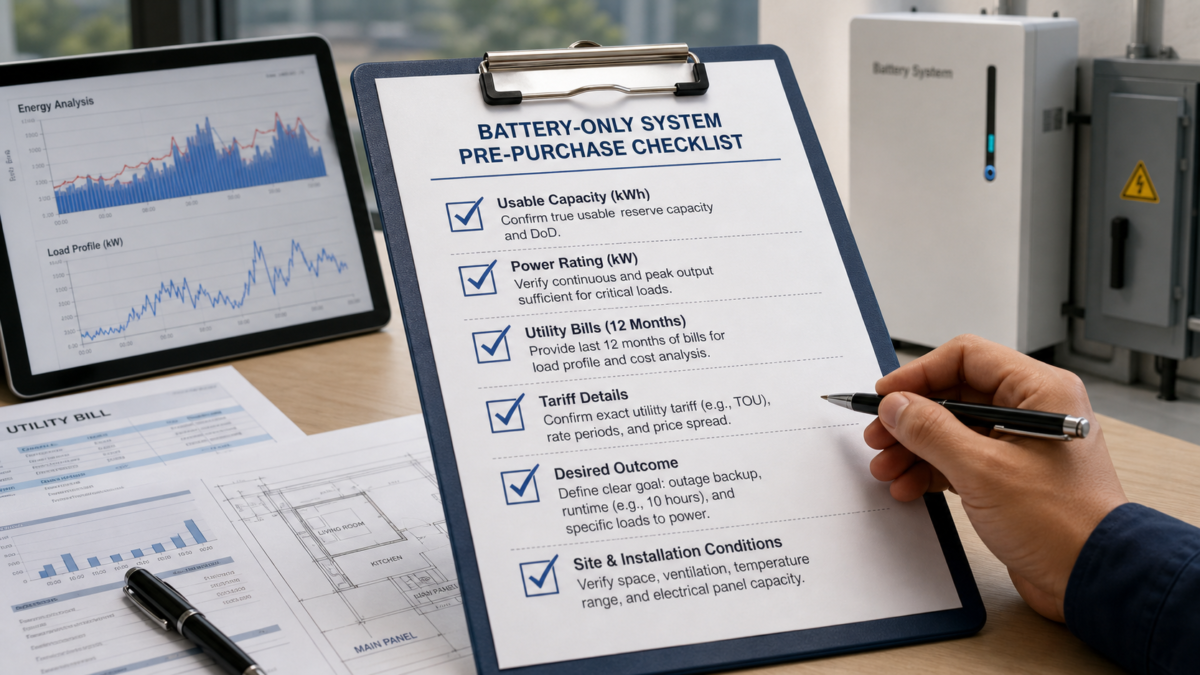
This verification process is how I separate a genuine technical constraint from a poor assumption. If I were designing a system using a Moletong residential battery and hybrid inverter, I would never start with a product recommendation. I would begin by collecting the data. First, I’d ask for 12 months of bills and a screenshot of the current utility tariff. Then, I’d discuss the exact outcome the buyer needs—is it whole-home backup or just essential loads? For how long?
With that information, I would model the system’s performance. I would show an anonymized bill with the analysis laid on top, a screenshot of the tariff with the arbitrage potential calculated, and a simulated dispatch trace showing how the battery would charge and discharge on a typical day. I would have a qualified engineer review this analysis. Finally, I would clearly state the limits of the comparison and explain what new information—like a change in the tariff or adding a major new appliance—could change my recommendation. This gives you, the buyer, a clear decision path without turning one person's public experience into a misleading marketing claim for everyone.
Conclusion
A successful battery-only project starts with your needs, bills, and tariff, not a product sheet. This disciplined, data-first approach ensures you get a system that delivers real value.

Leave a Reply