

Where Does BESS EMS SCADA Modbus Cybersecurity Create the Greatest Risk?
Your BESS cybersecurity feels like a chain with one weak link. A single vulnerability in your Modbus communication can bring down the entire system, but where do you look first?
The greatest risk in BESS EMS SCADA Modbus cybersecurity isn't in a specific device, but in the undefined gaps between them. It’s in the assumptions about how the BMS, EMS, and SCADA systems will behave during a communication failure, an attack, or a simple misconfiguration.
I see people focus on headline figures like capacity or payback. I don't. I believe the real risk is hidden in the integration details. Simply connecting devices over Modbus means nothing if you haven't defined who owns each data point and exactly how the system should fail. The only way to find these risks is to dig deeper than the sales brochure and look at the real evidence of how the system operates under pressure. Let's break down where the real risks are and what proof you need to see.
Defining Success for BESS EMS SCADA Modbus Cybersecurity?
Many projects define success as "the Modbus connection is working." This narrow view is dangerous because it ignores how the system behaves when things go wrong, creating hidden risks.
Success isn't a working connection; it's a predictable system. It's when ownership of every data point, alarm, and failure mode is explicitly defined, documented, and tested. You know exactly what happens, and who is responsible, when a connection drops or an invalid value appears.

When I evaluate an integration, I don't start with the hardware. I start with the documents. I ask for the point list, the protocol and register map, the alarm philosophy, and the network diagrams. My goal is to understand the boundaries. True success is about making the implicit, explicit. For example, a simple connection might let the EMS read battery state of charge. A successful integration defines what the EMS should do if that value suddenly reads zero or becomes unavailable. Does it shut down? Does it hold the last known state? Who gets an alarm? This thinking must be applied to every single point.
I use a simple table to clarify this. It forces a conversation about details that are often overlooked until it's too late.
Defining Integration Success
| System Aspect | “Mere Connection” (High Risk) | “Successful Integration” (Low Risk) |
|---|---|---|
| Ownership | Assumed. “The EMS will handle it.” | Explicit. “The SCADA operator is responsible for acknowledging this alarm.” |
| Failure Behavior | Undefined. System behavior is a surprise. | Documented in a cause-and-effect matrix and tested. |
| Alarms | A flood of nuisance alerts. | Rationalized. Every alarm is actionable and has a clear response. |
| Data Quality | Values are read but not validated. | Values are checked against operating boundaries before use. |
What Evidence Is Needed to Evaluate BESS EMS SCADA Modbus Cybersecurity?
You get two proposals that both promise secure and reliable integration. They look similar on the surface, but one could be robust while the other is fragile. How do you tell them apart?
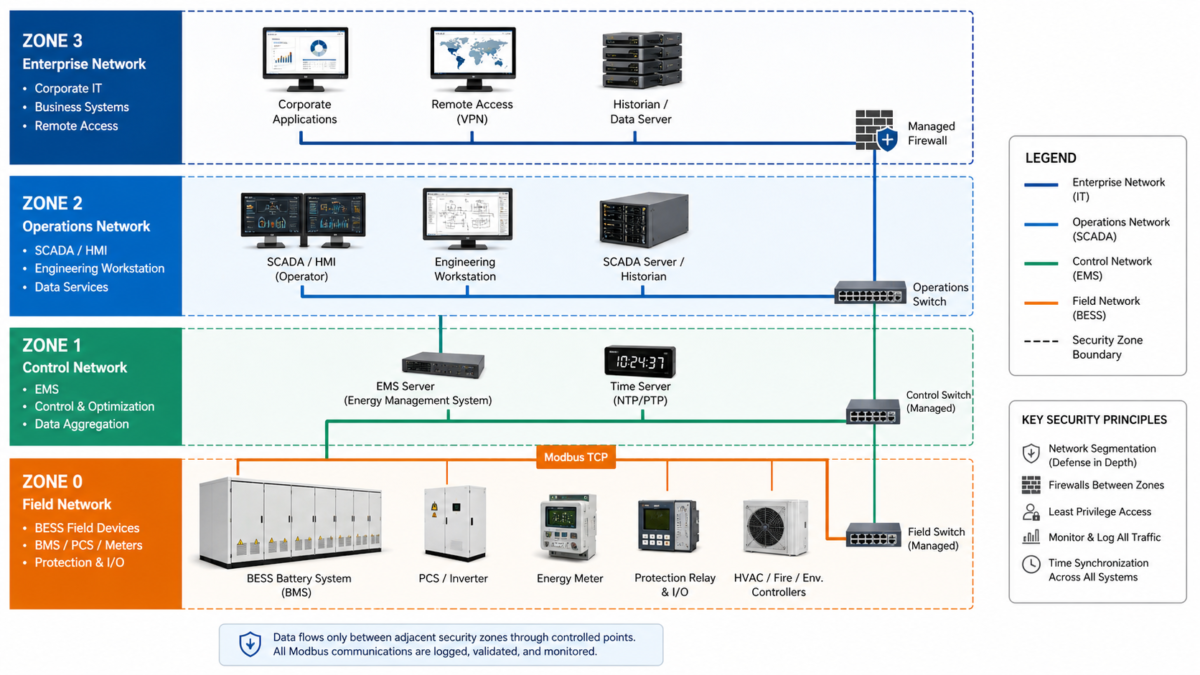
To properly evaluate cybersecurity, you must ignore marketing claims and demand verifiable evidence. The necessary evidence includes a detailed point list, a model-and-firmware specific register map, a network diagram with security zones, packet captures, and cause-and-effect test results.
I would never accept a vendor's word that their system is secure. I need to see the proof for myself. One successful installation doesn't prove the design will work everywhere. I once worked on a project where the integrator promised seamless communication. When we saw the packet captures, we discovered the EMS was constantly polling for registers that didn't exist on that specific PCS firmware version. This created thousands of exception errors every minute, flooding the network and hiding real alerts. The system "worked," but it was fragile and noisy. Without the packet capture, we never would have known. If I were evaluating a Moletong solution, I would demand the exact register map for the specific firmware on the BMS, EMS, and PCS. Then I would verify it against a live packet capture to ensure what is documented is what is actually happening on the wire. This is the level of detail required to expose the real risks.
The Trade-Off Between Point List and Time Sync?
Teams often want to monitor every single data point from the BESS. This feels safe, but collecting a flood of data can actually create more risk if you can't manage it properly.
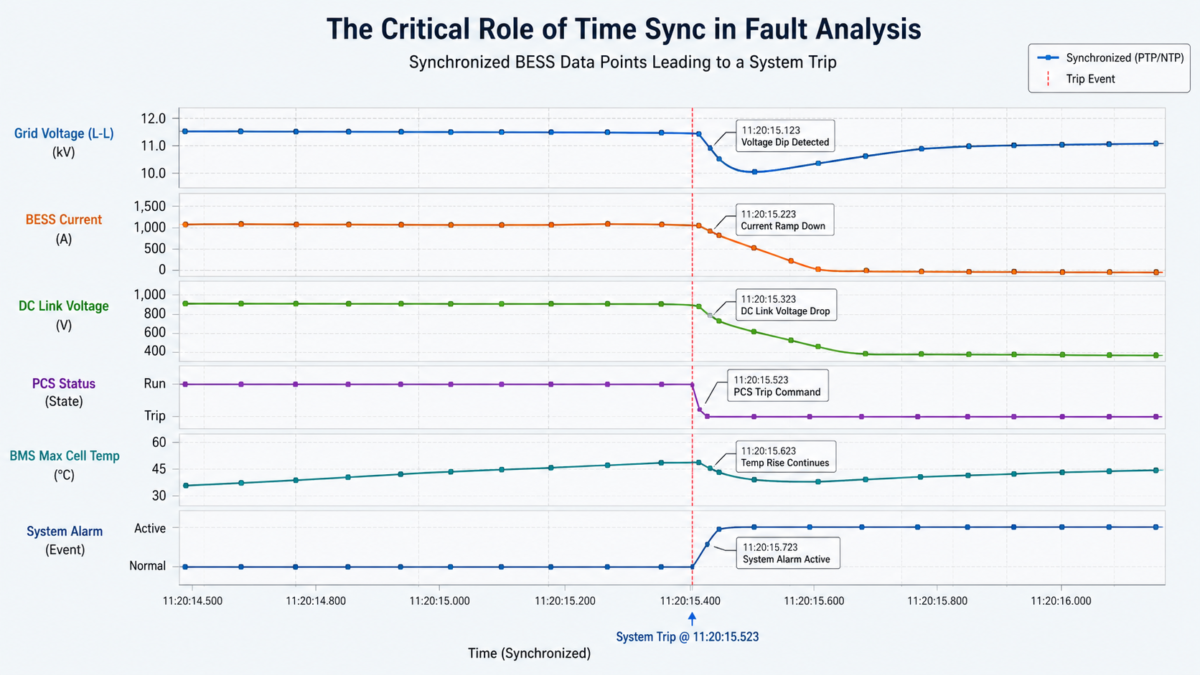
The trade-off is between data quantity and data quality. A massive point list without precise, synchronized timestamps is almost useless for diagnosing a fault. It's far better to have a smaller set of critical points with accurate time sync than a flood of data you can't properly sequence.
Imagine your BESS trips offline. You have a thousand data points from the second it happened. But which event came first? Did the grid voltage dip cause the PCS to trip, or did the PCS trip cause a voltage problem? Without accurate, system-wide time synchronization (like NTP or PTP), you are just guessing. The log on the BMS, the EMS, and the SCADA system might all have slightly different timestamps. You can't build a reliable sequence of events. The real problem is that polling a huge Modbus point list can slow down the network. This makes it impossible to guarantee that a value timestamped by the SCADA system reflects the exact moment the event happened at the BESS. My approach is to split the list. We define a small, critical list of points for high-speed polling to catch faults. We then use a larger, secondary list for slower polling for general monitoring. This ensures we capture the critical sequence of events without overwhelming the network.
How to Compare BESS EMS SCADA Modbus Cybersecurity Proposals on Equal Terms?
You have multiple proposals in front of you. Every vendor claims their solution is the best and the most secure. Without a consistent framework, you're just comparing marketing slogans, not technical reality.
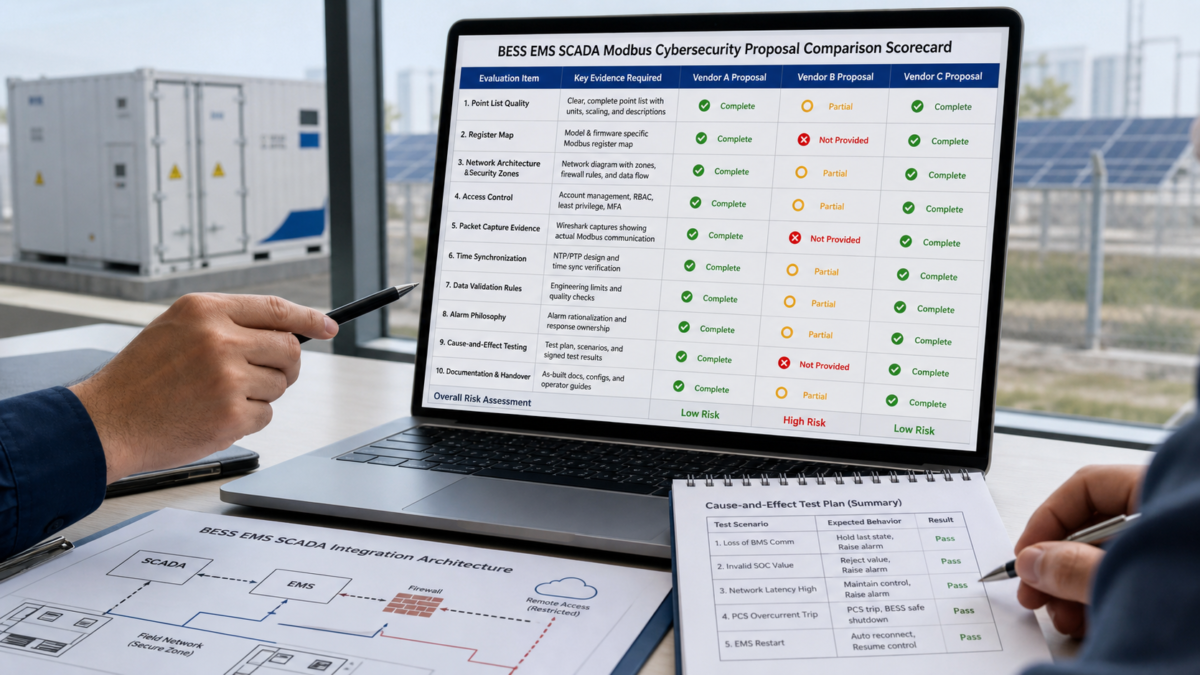
To compare proposals fairly, force every vendor to provide the same set of evidence. Create a scorecard and grade them on the quality of their point list, register map, network diagram, and their documented process for cause-and-effect testing. The proposal with the most specific, verifiable proof is the least risky.

When I help clients with this, we build a simple scorecard. It moves the conversation away from promises and toward proof. We ask questions like, "Show me your network diagram and explain the data flow between security zones." Or, "Provide the register map for the exact firmware version you are proposing." We also ask how their design handles less favorable operating conditions. For example, "What happens to system control if network latency increases by 200 milliseconds?" A good partner has already thought about these scenarios and has answers. A weak partner will give you vague assurances. The goal is to see who has truly engineered a robust solution versus who has just connected components together. The vendor who can provide a point list, packet capture, cause-and-effect test plan, alarm rationalization document, and a network diagram is the one who understands what real integration requires.
Conclusion
The biggest cybersecurity risk isn't a hacker; it's ambiguity. The greatest danger lies in undefined failure modes and unverified assumptions between your BESS, EMS, and SCADA. Demand evidence.


Leave a Reply